

Easy, Beginner DIY Liquid Castile Soap Recipe
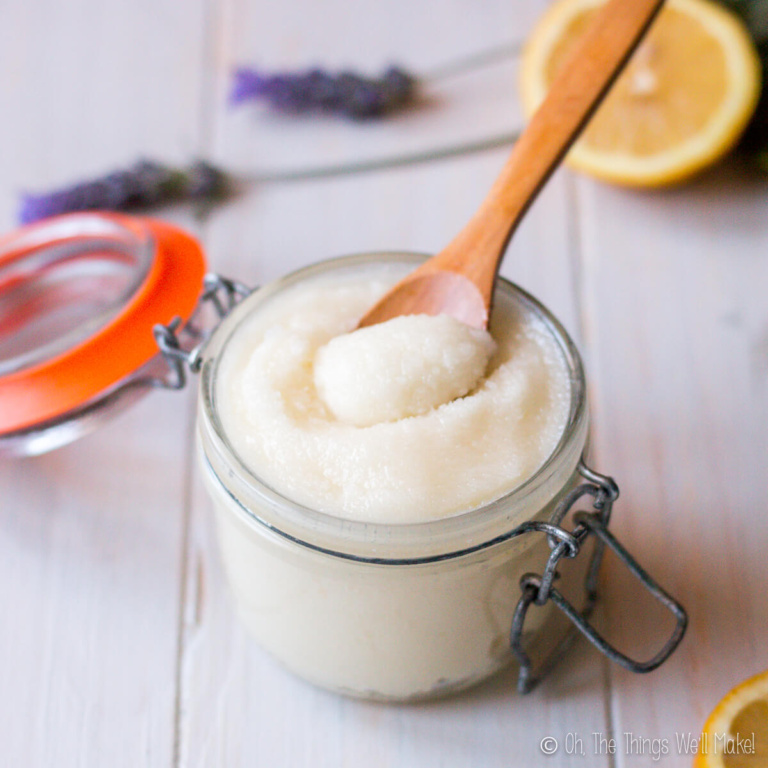
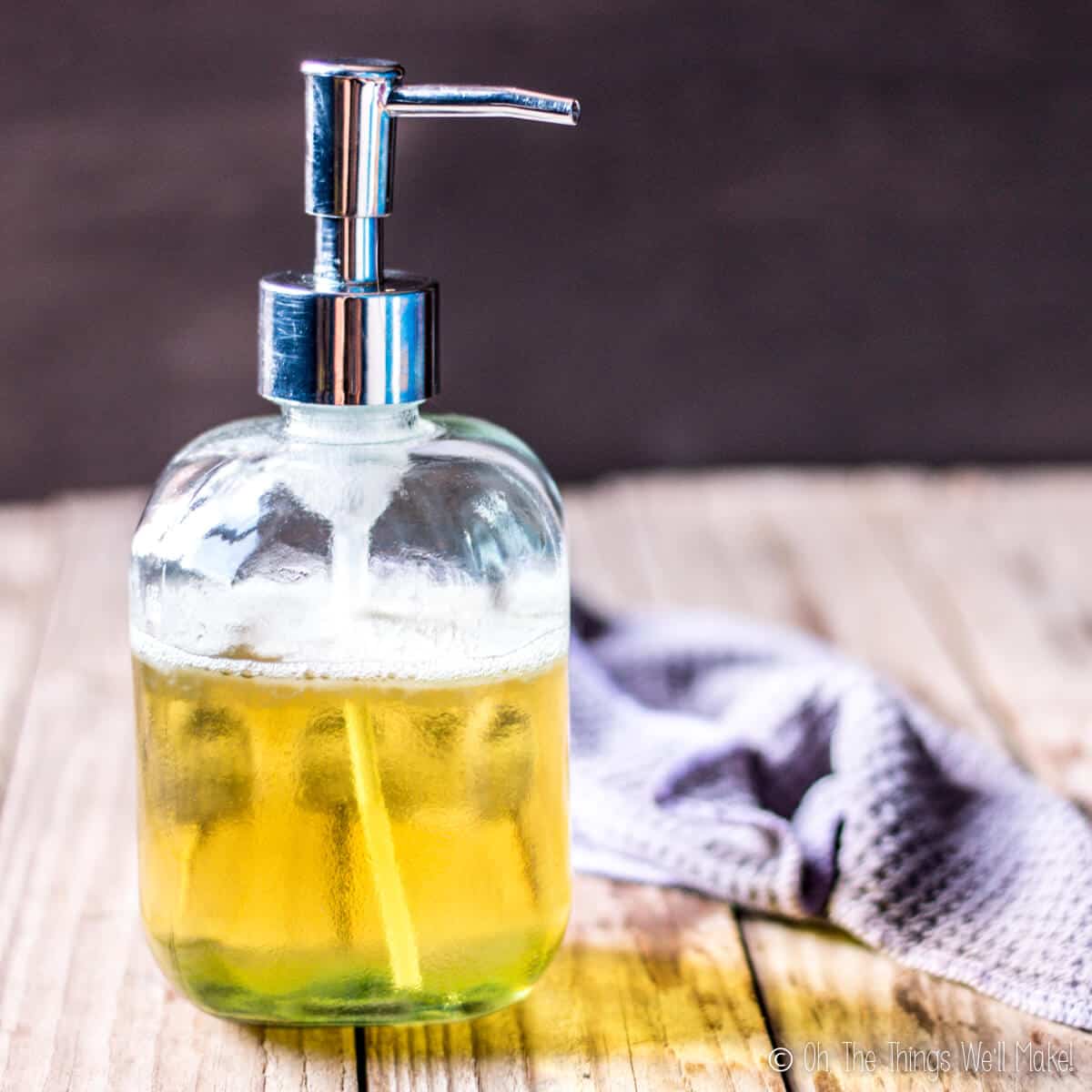
Made with only olive oil, this pure liquid Castile soap is easy to make and mild. It’s perfect for face and body, and for cleaning around the house.
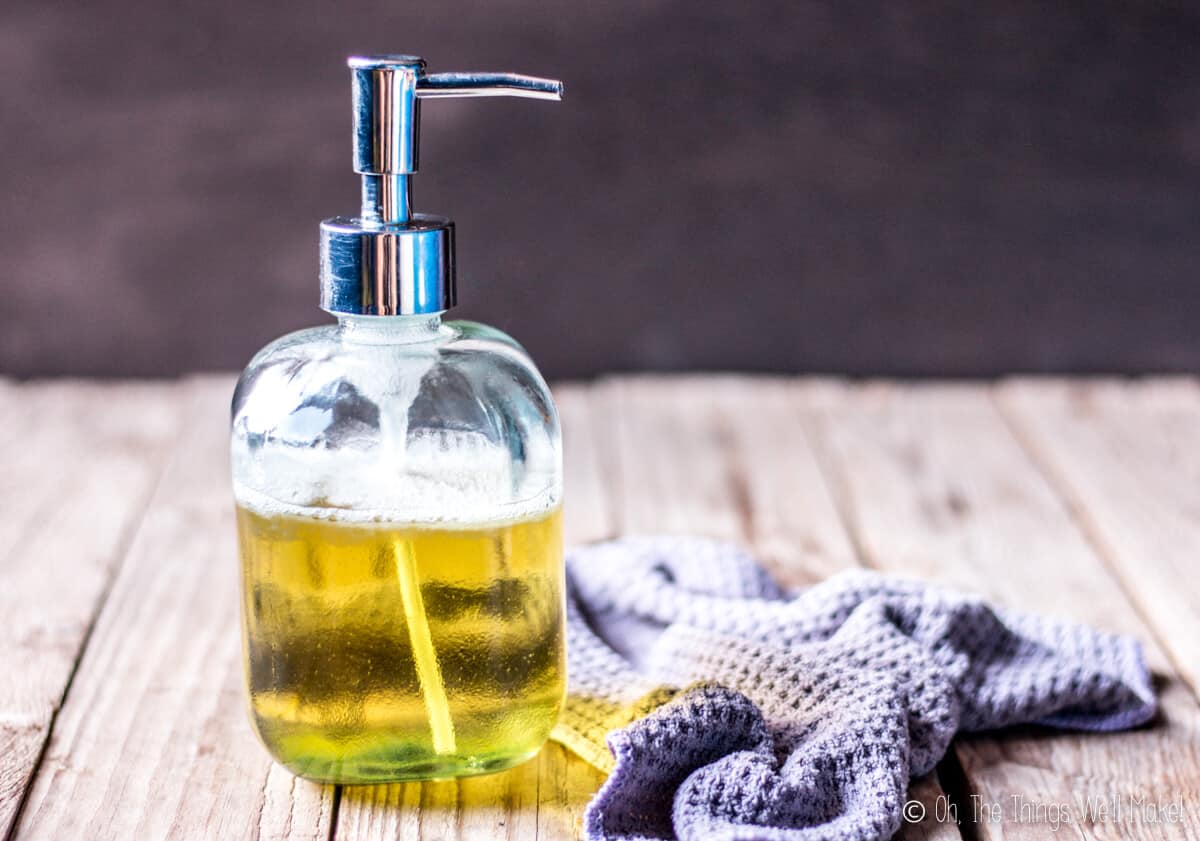
A couple of years ago, I showed you how easy it was to make a basic beginner soap, even if you’ve never done it before.
Making solid soaps can be a lot of fun, but not everybody likes using bar soap. Many people prefer using something in a dispenser like a shower gel or a liquid soap.
I made many different types of bar soaps before attempting to make a true liquid soap. There aren’t as many resources about making liquid soaps, so I had to do a lot of trial and error before posting this first liquid Castile soap recipe.
Once you find a good recipe, it’s pretty simple to make. While it does take a little more time and effort than whipping up some bars of cold process soap, I think you’ll find that it’s well worth it, especially when you take a look at the price of a store-bought liquid castile soap.
How does liquid soap differ from bar soap?
The main difference between bar soaps and liquid soaps is the type of lye used to make them. Liquid soaps are made with KOH, or potassium hydroxide, rather than NaOH, or sodium hydroxide.
You can read more about the different types of lye in my post about lye and why it is needed in soap.
While some people like to make a “liquid soap” of sorts by diluting bar soaps in water, you can’t really get a true, transparent liquid soap that way. Some people are happy with the result, but every time I’ve tried it, I’ve ended up with a gloopy mess. It doesn’t have the same cleaning power as either a bar soap or a true liquid soap, and the texture and appearance aren’t the same either.
What is pure Castile soap?
Technically, by definition, Castile soap is a type of soap made with only olive oil. The name “Castile” soap originates here in Spain. (You can read more about the origin of Castile soap and other soaps in my post with a recipe for pure Castile bar soap.)
Over the years, the definition of Castile soap has broadened to include other types of vegetable oils such as coconut oil. Dr. Bronner’s liquid Soap, which may be the most famous commercial liquid Castile soap, actually has a greater percentage of coconut oil than olive oil. (I made a Dr. Bronners liquid Castile soap copycat recipe for those who are interested!)
When it came to making a homemade liquid Castile soap, though, I was a bit of a purist and made the real deal: a soap made with only olive oil.
Olive oil in soap
Soaps made with different oils have different properties.
Soaps made with olive oil are more conditioning for your skin than soaps made with coconut oil. On the other hand, they don’t lather up as much as a coconut oil soap, nor do they leave you feeling squeaky clean in the same way (partly because they are more conditioning).
Some people find pure Castile bar soap to be “slimy” and not cleansing enough. On the other hand, pure coconut oil bar soap can be drying.
- Pure coconut oil soaps are great for general cleaning and for laundry. That’s why I made my homemade laundry soap only with coconut oil.
- Pure olive oil soaps tend to be gentle on the skin and great for gentle body cleansing.
Read my post about the properties of different oils in soaps.
Ideally, you’d combine different oils to get the qualities you want for your soap. That’s exactly what they did when they formulated Dr. Bronner’s soap, and what I did when I showed you how to make a basic beginner soap which uses a combination of olive oil and coconut oil.
Combining liquid soaps
When you make a bar of soap, you have to decide what combination of oils you want to use from the very beginning and your entire batch will have that very same combination.
With liquid soaps, though, you have the advantage of being able to combine your various soaps after the fact, making it easier to experiment with smaller combinations until you find the perfect soap for your need.
That’s why I made a pure liquid castile soap, using only olive oil, and then later made a pure liquid coconut oil soap. Once you’ve made both of them, you can combine them, as needed to get the type of soap you want.
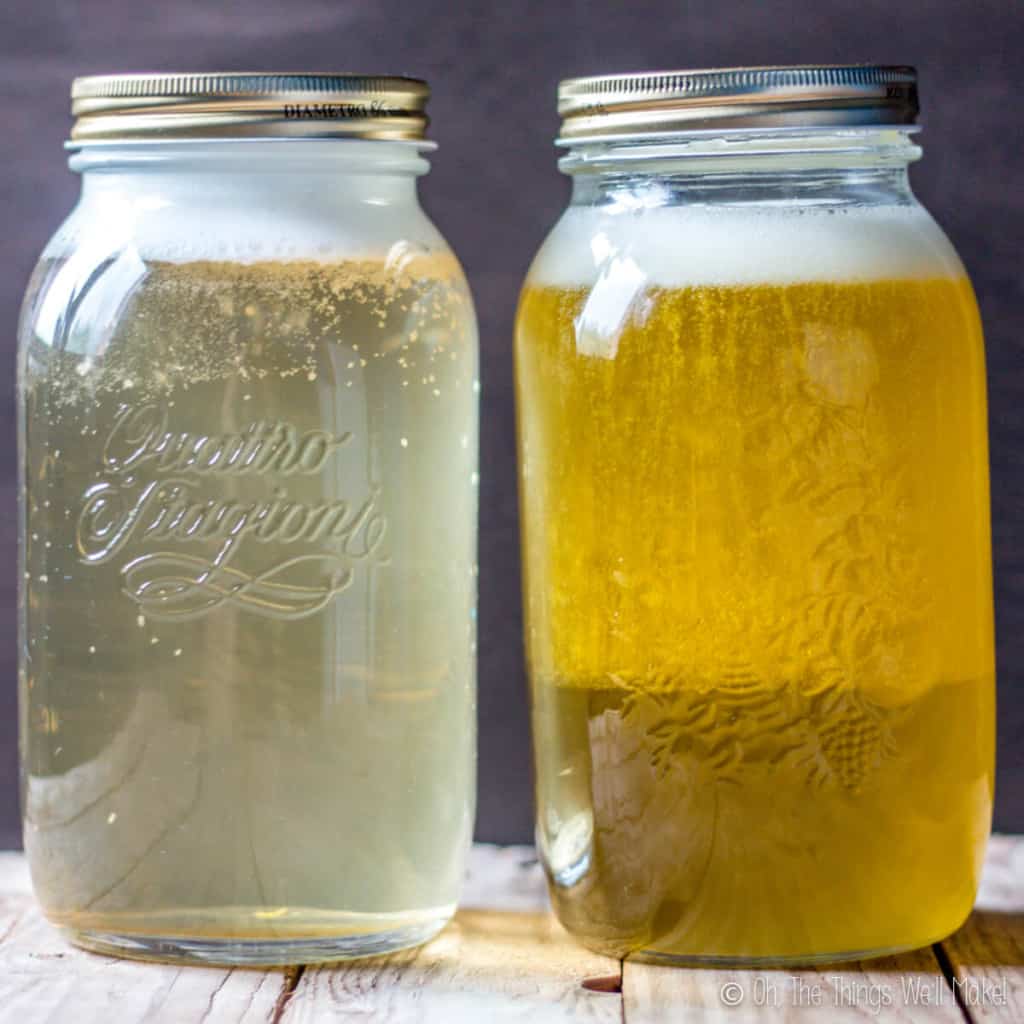
Coconut oil liquid soap vs. liquid Castile soap
When I first started making liquid soap, I assumed that liquid soaps would be just like bar soaps. The difference between a pure Castile bar soap and a coconut oil-based bar soap is HUGE!
I was very surprised to find, though, that liquid soap made with coconut oil was actually quite similar to that made with olive oil. Sure, the olive oil-based liquid soap was darker in color than the coconut oil-based liquid soap. For me, that was probably the most notable difference.
Yes, the coconut oil soap does make a bubblier lather than this one and may be slightly more drying. It does give more of a “squeaky clean” feeling.
In the end, though, the difference isn’t as pronounced as I expected. In fact, I normally just make the coconut oil liquid soap recipe these days. I can buy refined coconut oil cheaper than olive oil, but also love the look of a lighter-colored soap. I also love the fresh, subtle scent of the coconut oil soap when left unscented.
Both soaps give a decent lather. They are also both relatively mild for skin. If you have sensitive skin, though, this soap is probably the better choice.
Those who have very sensitive skin may find that they have issues with the higher pH of any soap. In those cases, it may be best to use something like my DIY Baby Wash and Shampoo. (I made it pH balanced for a baby’s delicate skin.)
Ingredients
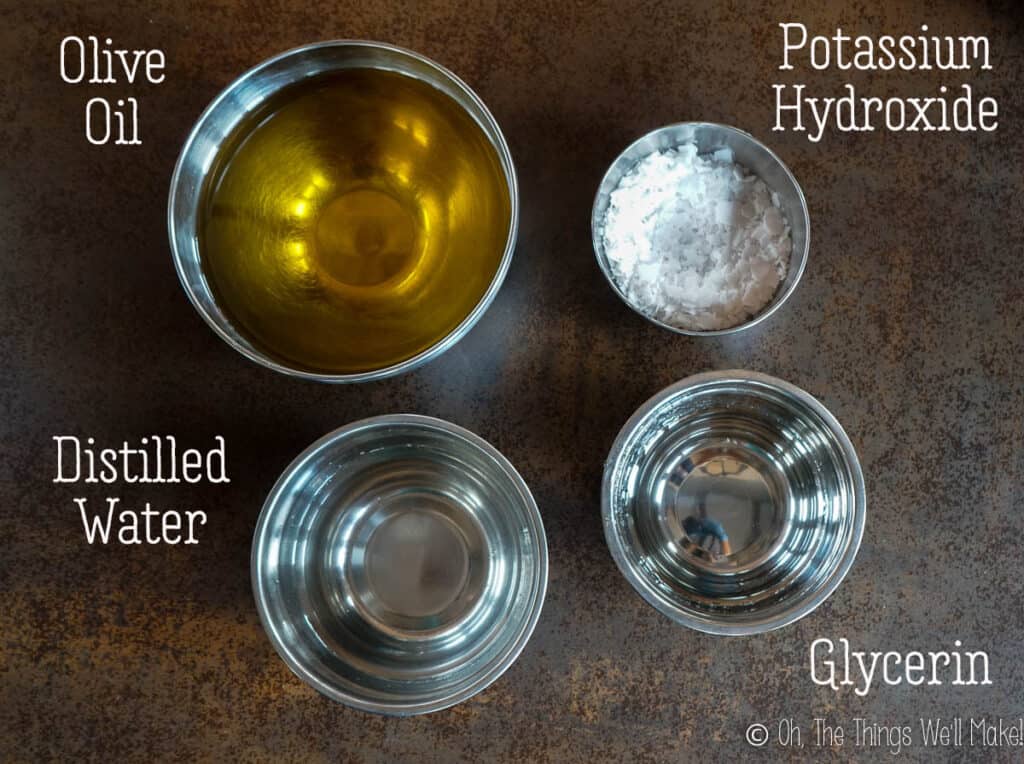
This soap uses 4 main ingredients: olive oil, potassium hydroxide, water, and glycerin.
You can use extra virgin olive oil or a lighter olive oil. What is important, though, is that you are using pure olive oil. (If it’s not pure olive oil, it may need a different amount of lye.)
For the water, it’s best to use distilled water. Tap water has minerals and may have other impurities that can affect the clarity of your soap.
Why use glycerin when making liquid soap?
One of the methods of making liquid soaps is called the glycerin method. It replaces part of the water with glycerin.
Adding glycerin moves the soap-making process along more quickly. Because I wanted to share a beginner liquid soap recipe, I chose the glycerin method to have this soap be as quick and fool-proof as possible.
Using glycerin may have some other benefits:
- The resulting soap paste dissolves very easily in water. I don’t need to heat the water nor do I need to leave it for days at a time. I can cover my soap paste with distilled water and usually, in a couple of hours, I have a beautiful, clear liquid soap effortlessly.
- Glycerin is a humectant, meaning it draws moisture into the skin. I find that even my liquid coconut oil soap doesn’t feel drying, despite the fact that it hasn’t been superfatted at all. I think the extra glycerin helps to make a really great, hydrating soap that is clear and doesn’t need extra oils. (I think my homemade glycerin bar soap has the same benefits.)
Materials
To make liquid Castile soap, you only need a few basic tools. An immersion blender helps mix the oils and lye solution quickly so the soap reaches trace faster. A slow cooker works beautifully for keeping the soap at a steady, gentle heat while it cooks. A kitchen scale is also important here, since soap making relies on accuracy. Measuring by weight instead of volume helps ensure that your recipe turns out perfectly every time.
Procedure
Making a liquid Castile soap isn’t difficult and it can save you a lot of money.
To get the clearest soap we can, we’ll use a hot-process method. That means that we will be cooking the soap. During the cooking process, the saponification process will complete and our soap will be ready to use immediately afterwards. (Liquid soap doesn’t need a curing time in the same way as bar soap does.)
The easiest way to make this and have it come out perfectly is to use a slow cooker. If you don’t have access to a slow cooker, though, you can also try baking it in the oven. (I showed how I used this method in the post and video for the coconut oil liquid soap.)
Making the lye solution
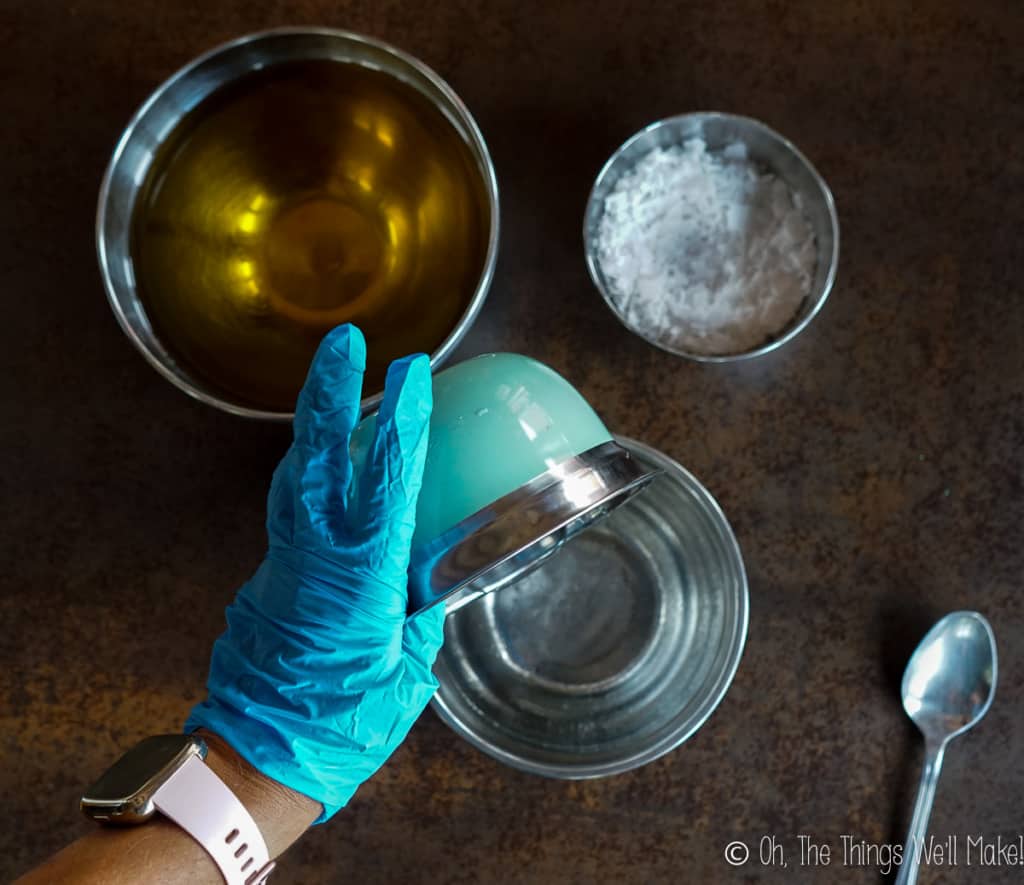
Weigh out the glycerine, water, and potassium hydroxide (KOH).
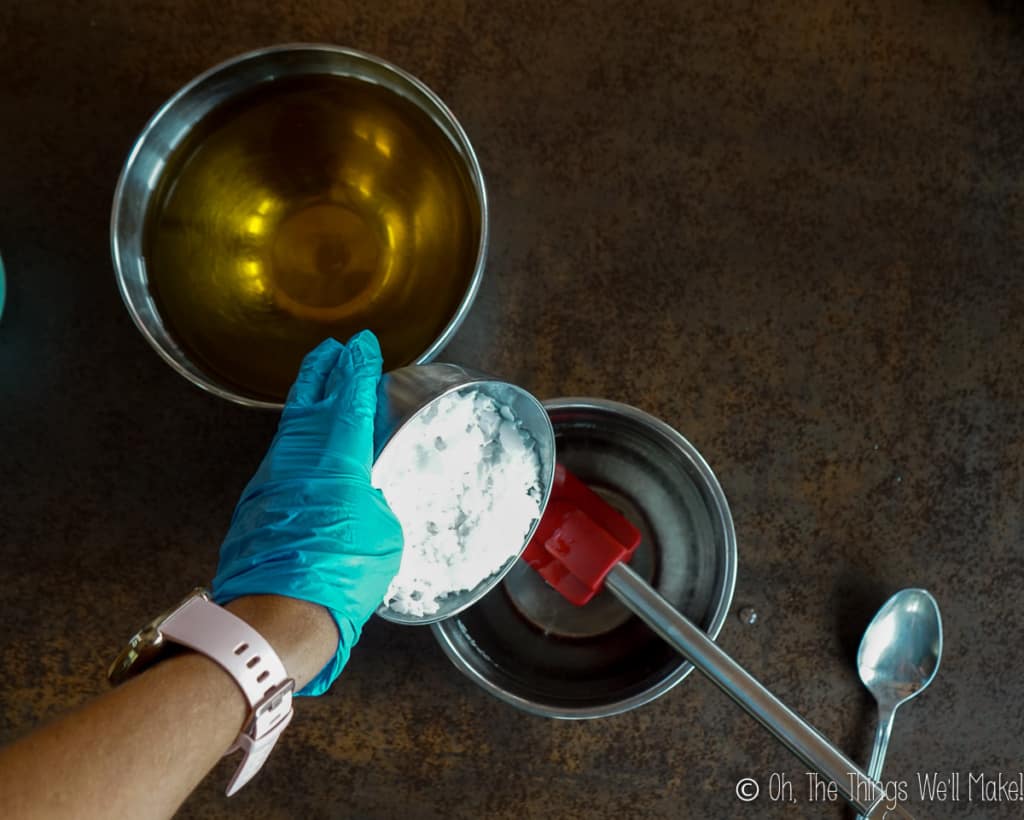
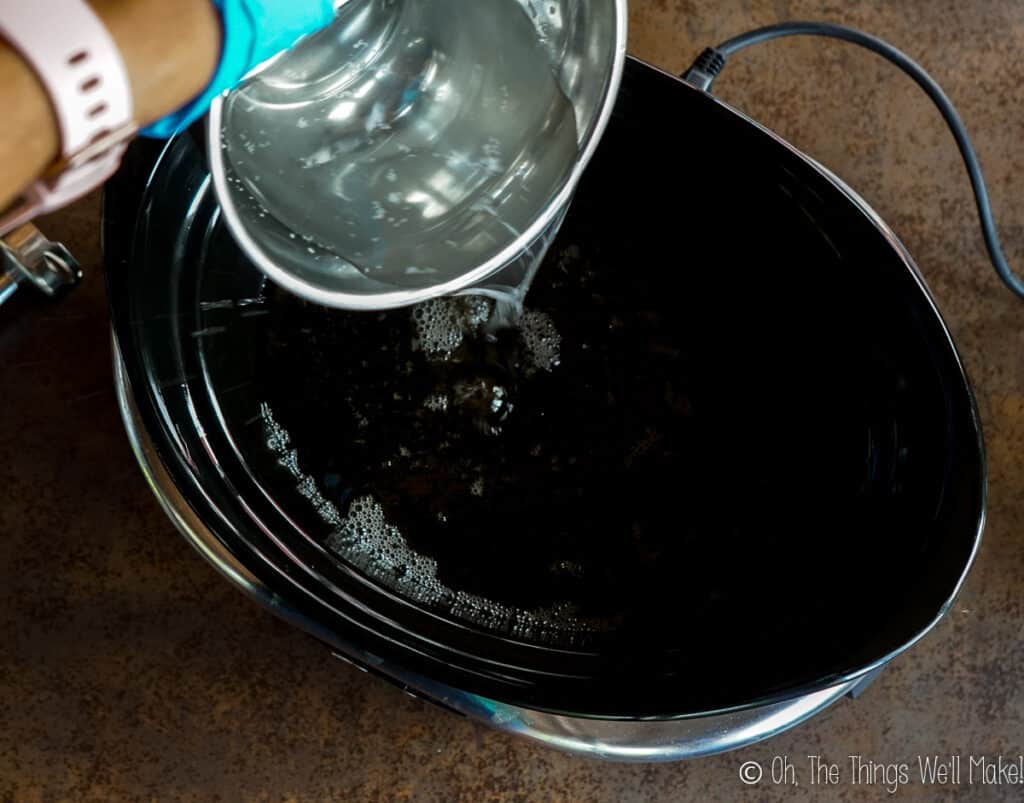
Add the glycerin to the water and then carefully add the KOH to the water and glycerin mixture. (Not the other way around!) Make the lye solution in a well-ventilated area.
Stir the KOH into the water until it dissolves. It will be cloudy at first, but then it will clear up.
Making the soap paste
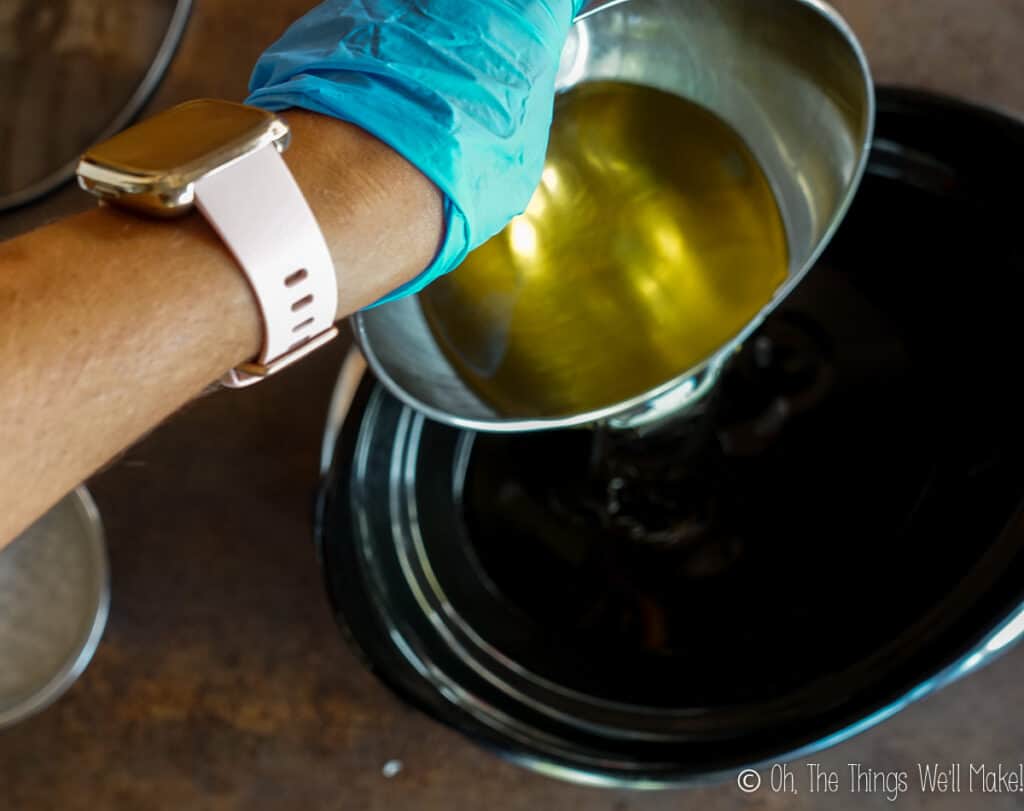
Measure out the olive oil and heat it over low heat directly in the slow cooker.
Slowly add in the the KOH mixture to the warm olive oil, and gently stir them together over low heat.
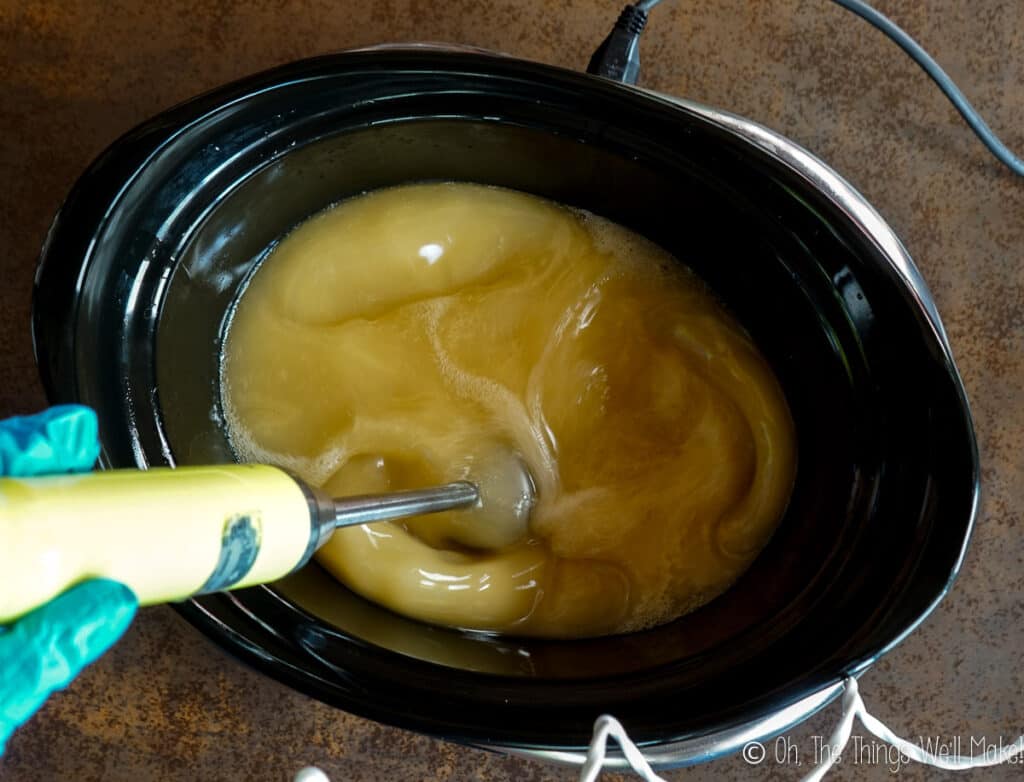
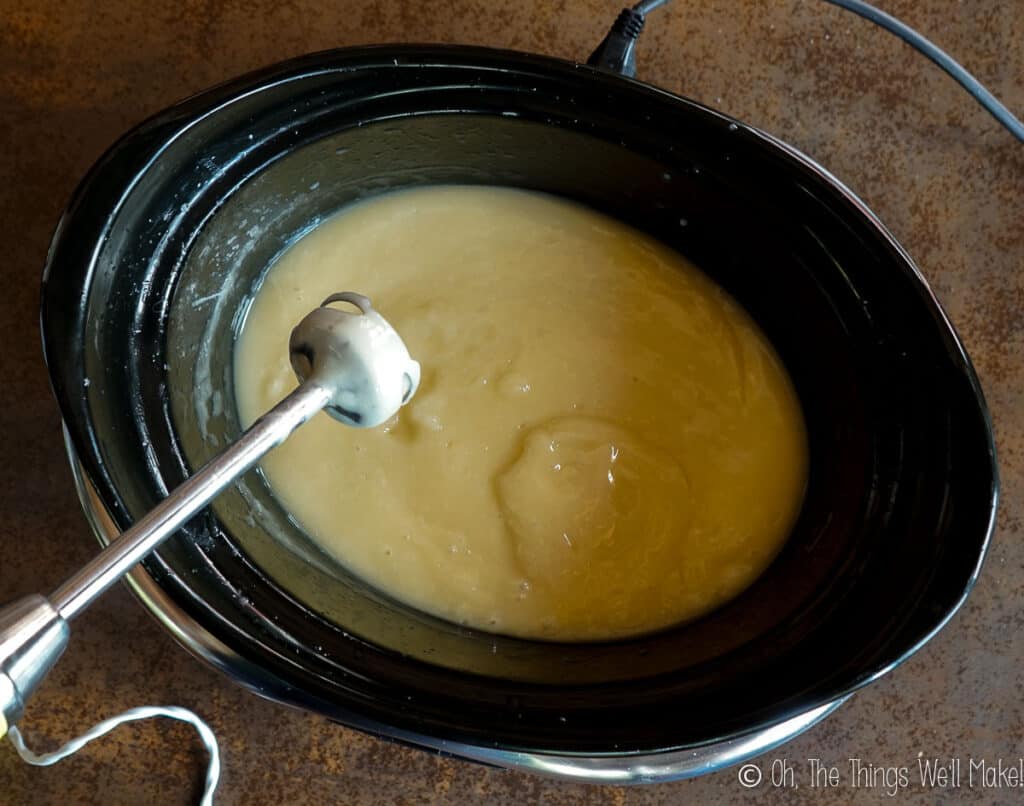
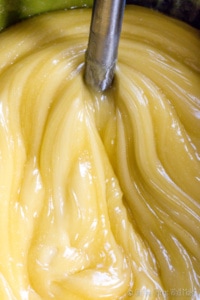
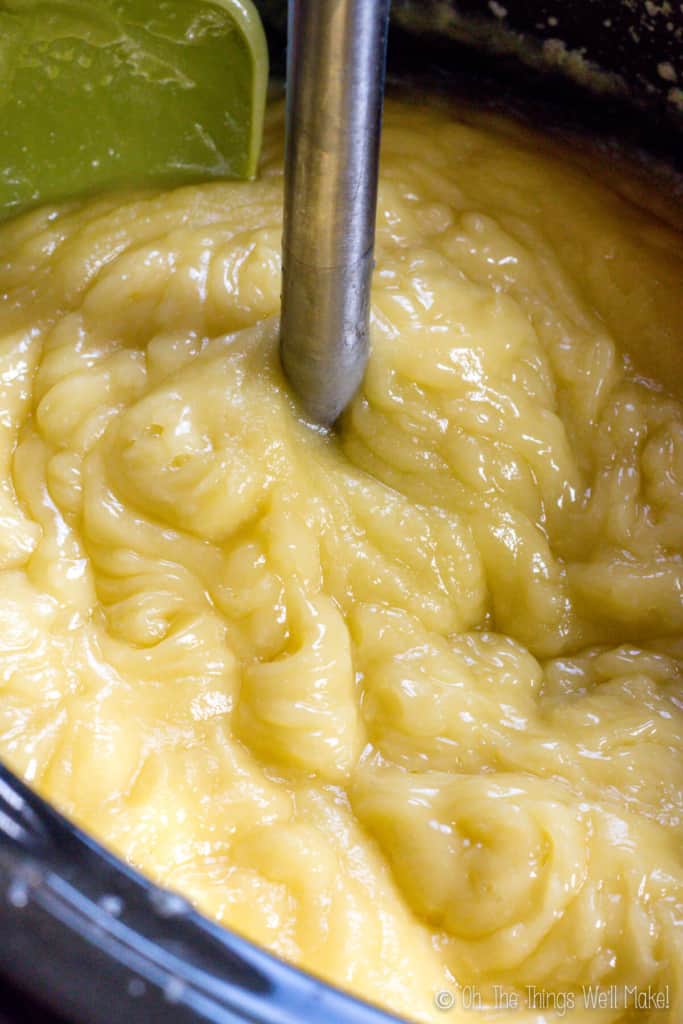
Once combined, use an immersion blender to blend the ingredients together in the slow cooker. In a few minutes the mixture will begin to thicken and look like mayonnaise. Soon after, it will look like a creamy pudding. (If you aren’t doing this over heat, it will take a bit longer.)
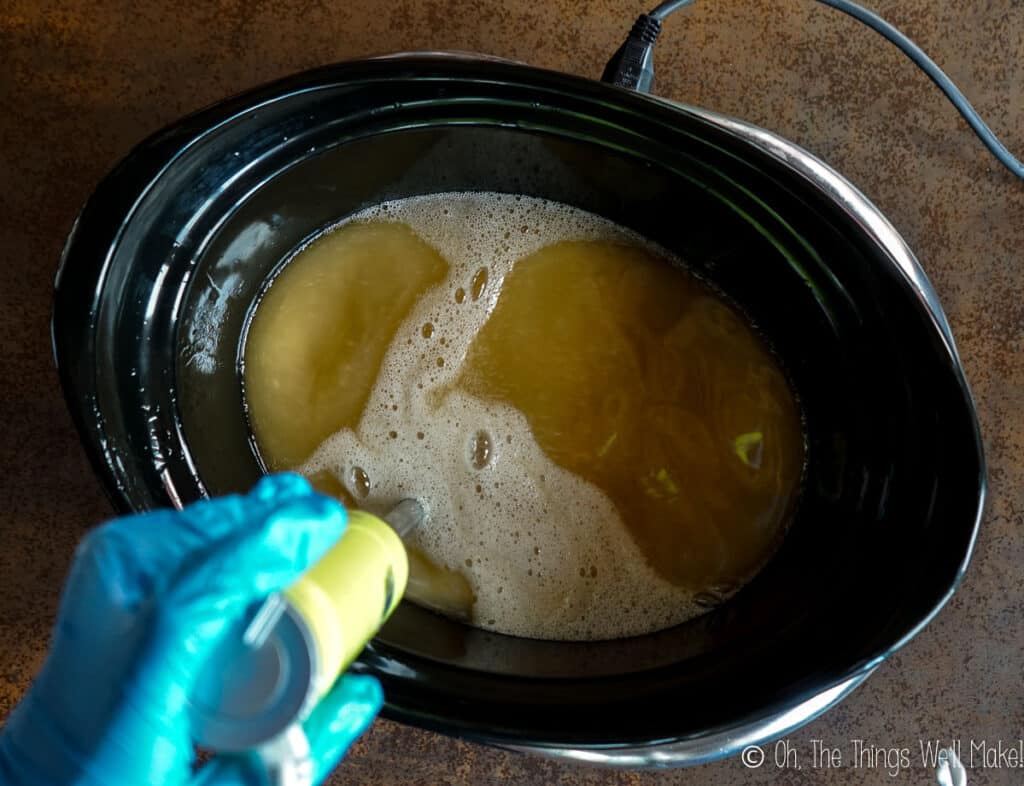
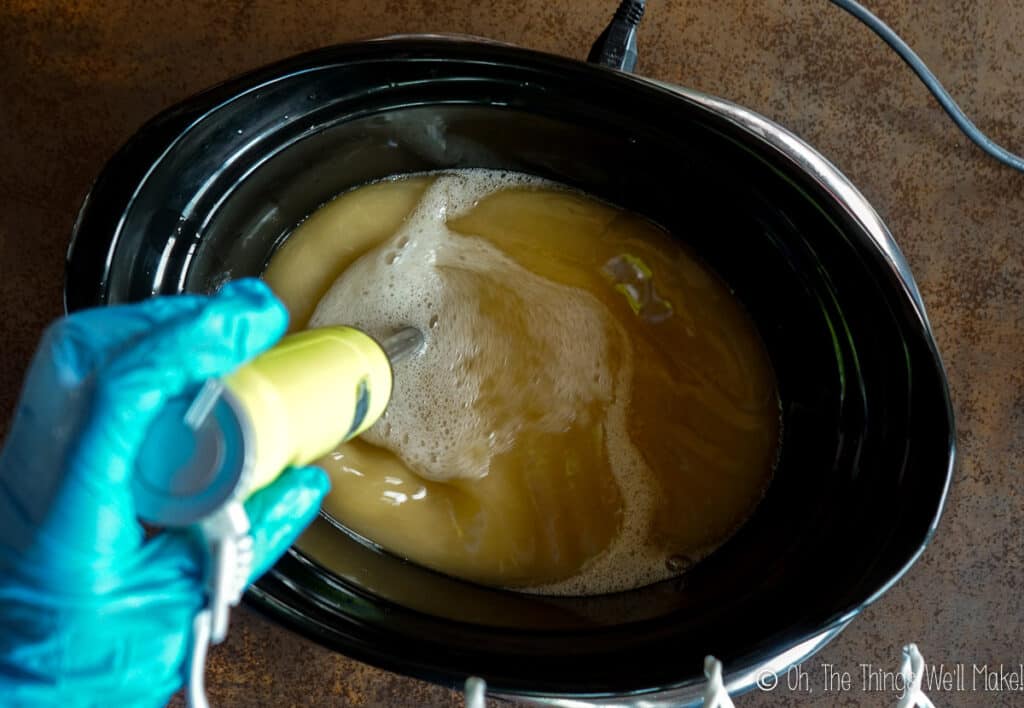
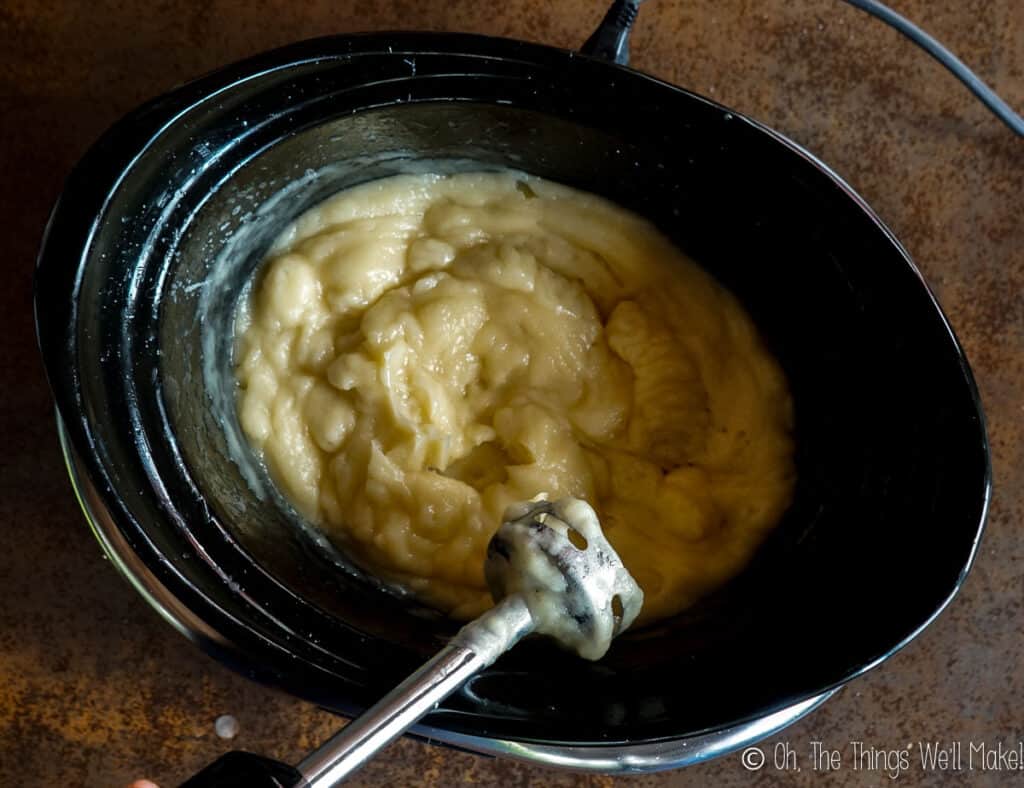
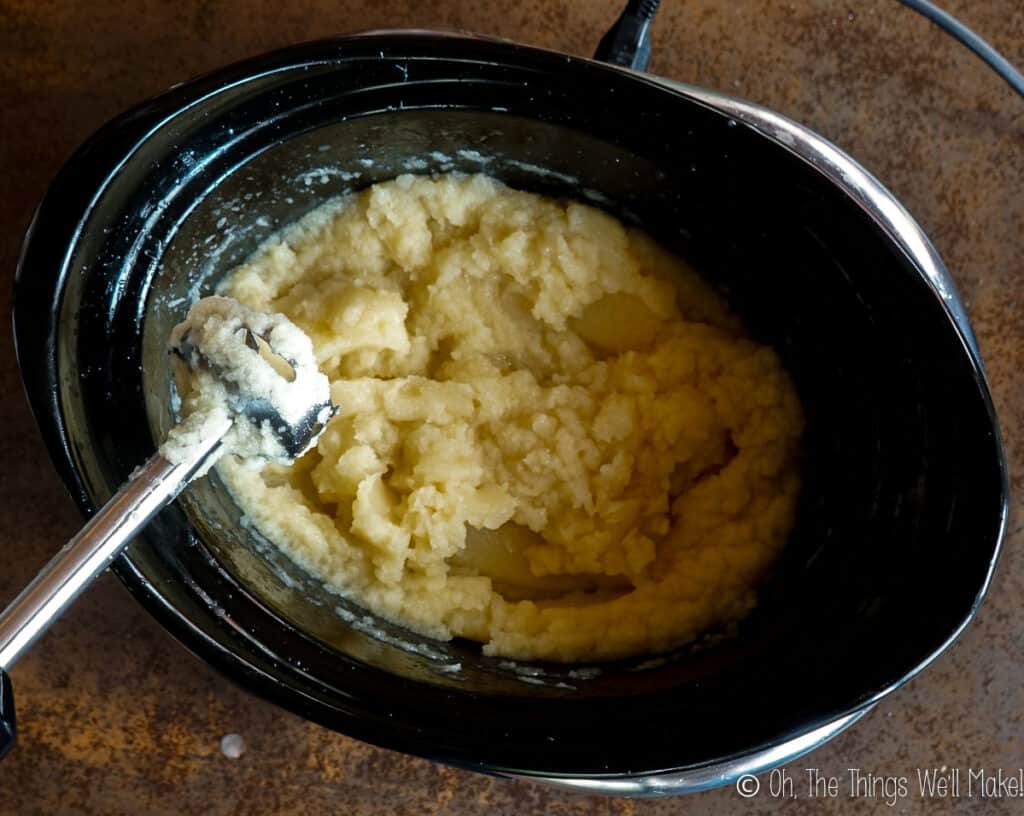
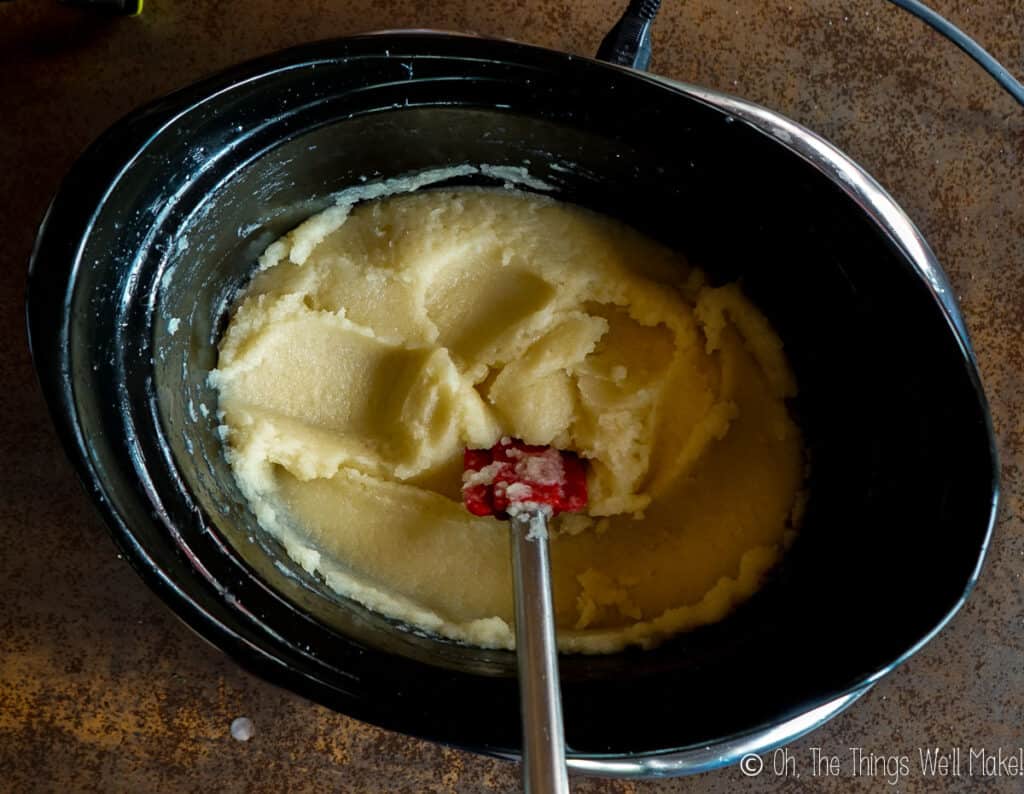
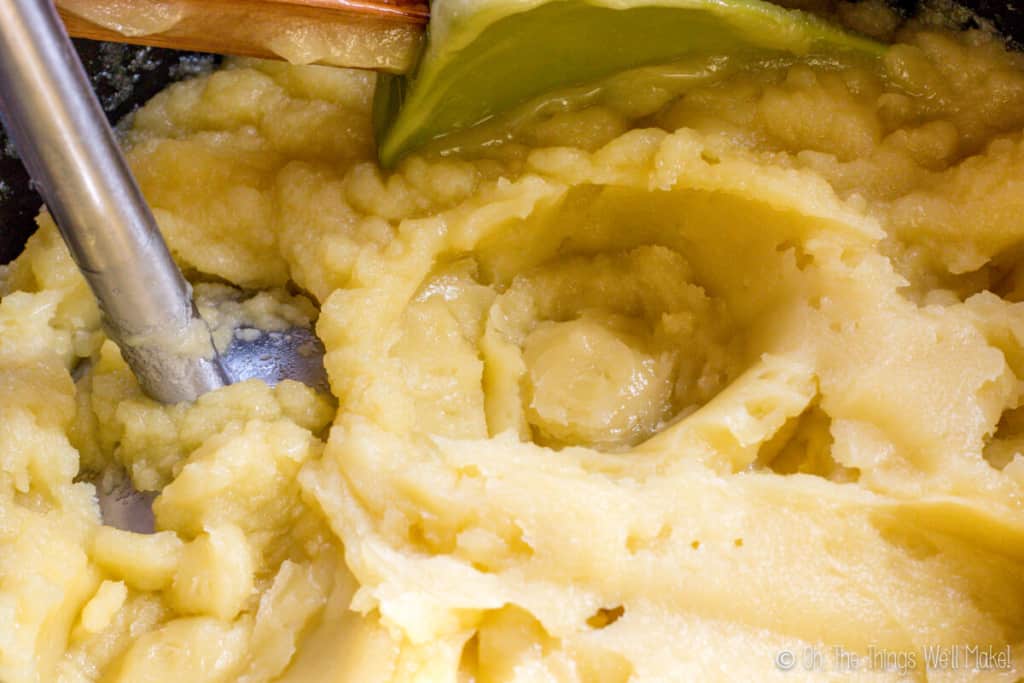
A few minutes later, the mixture will begin to look grainy and look like mashed potatoes or applesauce. Continue to blend.
If, at any point, the mixture becomes too thick to blend with the immersion blender, switch to mixing with a spatula or wooden spoon. It’s also a good idea to take breaks during the blending process so as not to burn out the blender.
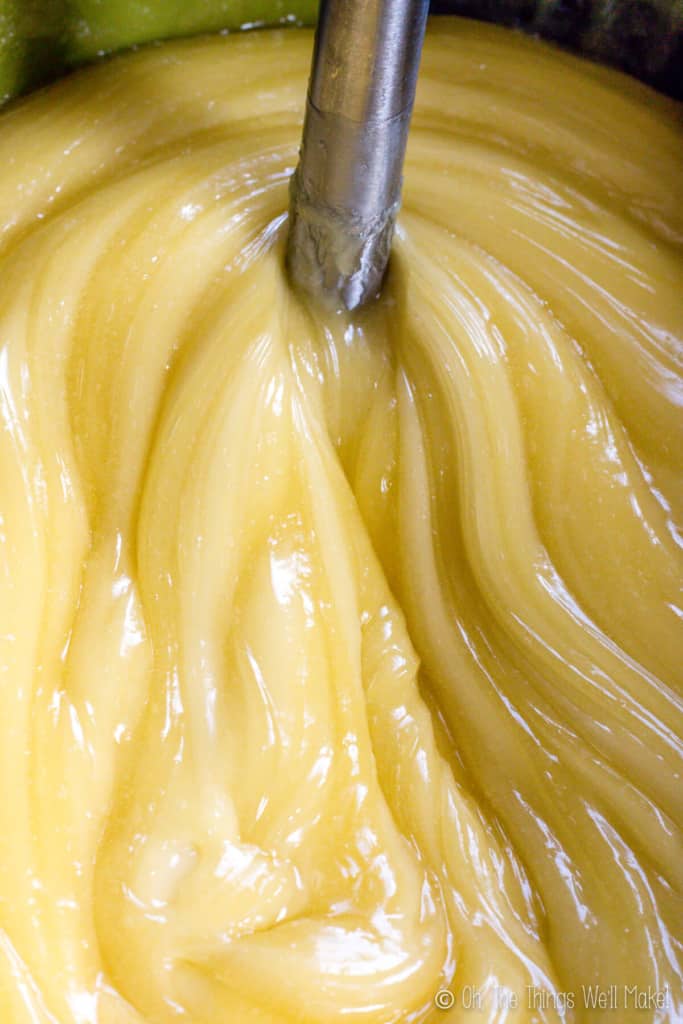
As you continue to blend, it will start to get creamy again. It is now time to cover it and cook it for a while.
Cooking the soap paste
Cooking the soap paste will allow the soap to finish the saponification process and will also help achieve a perfectly clear liquid soap immediately. The process will take 3-4 hours, and you will want to check on it and stir it up every half an hour or so.
As you cook the mixture, it will begin to thicken up and become more translucent.
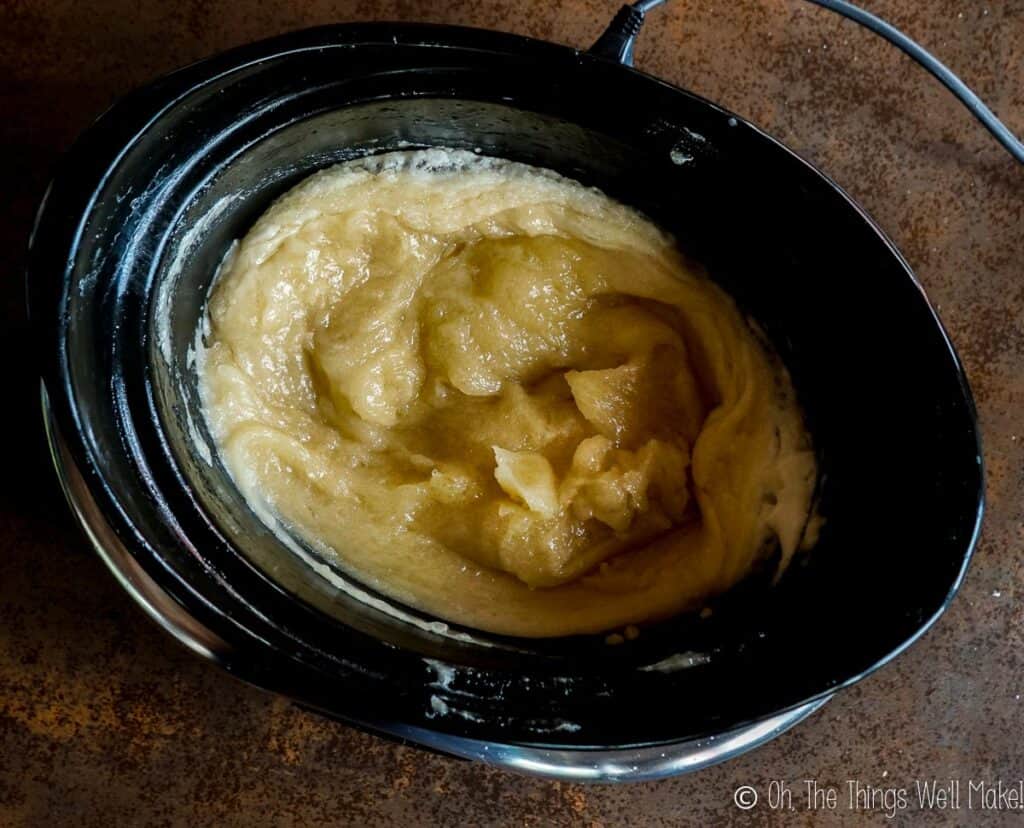
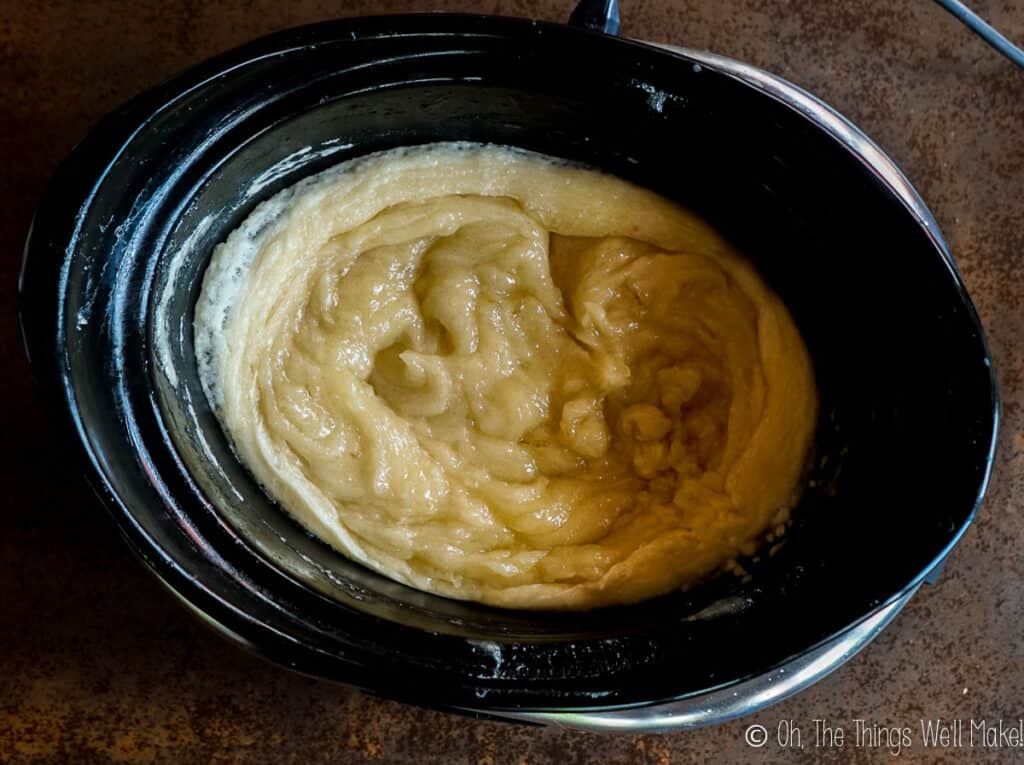
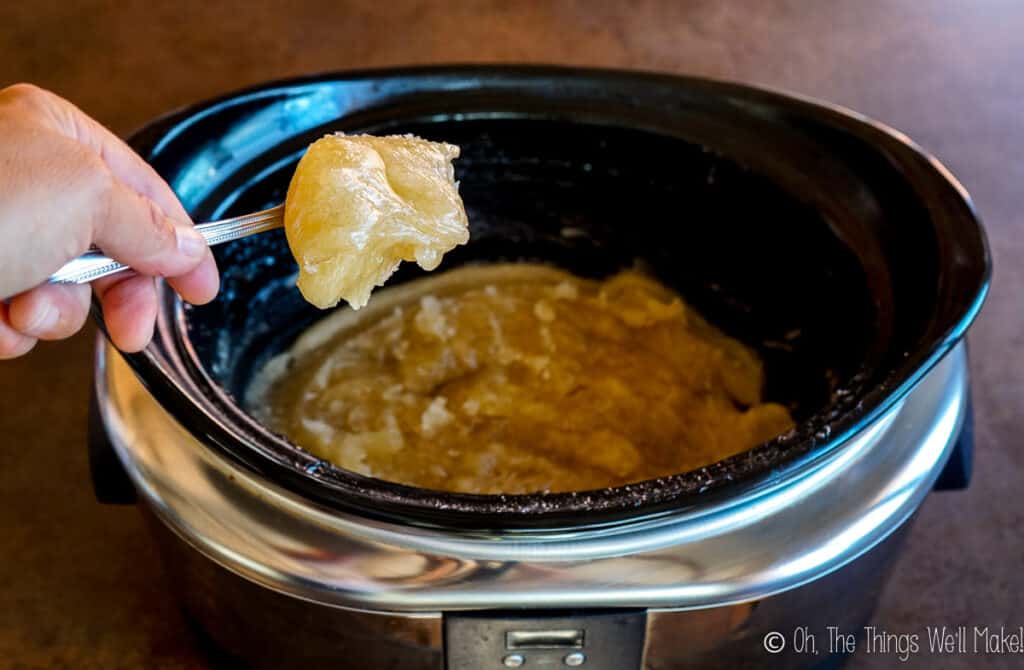
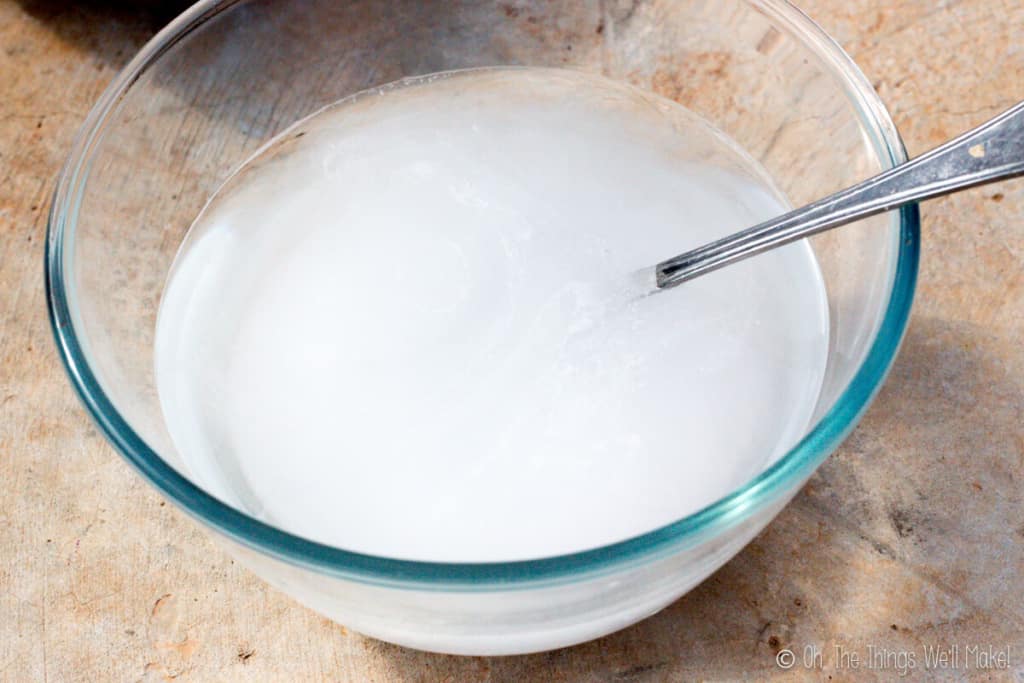
To check for “doneness,” we will look to see if our paste is dissolving into a completely clear liquid soap. To do this, take a small amount of the soap paste and dissolve it in water, and look to see if the water is clear once the soap paste is dissolved.
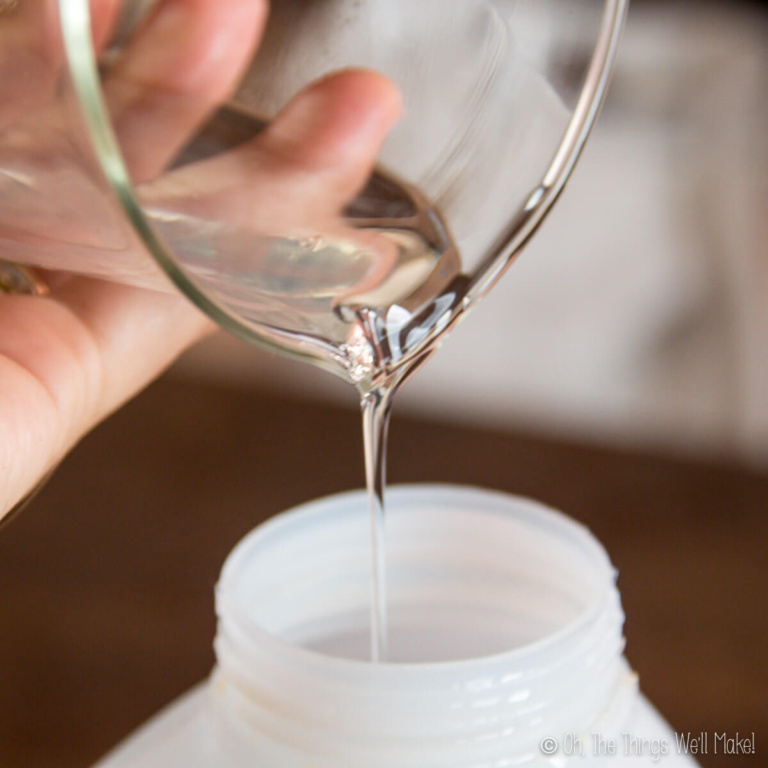
If the liquid is cloudy, you should continue to cook the soap in the slow cooker. Let it cook another half an hour before checking on it again. If it dissolves clear like the soap in my picture, you are finished making the soap paste.
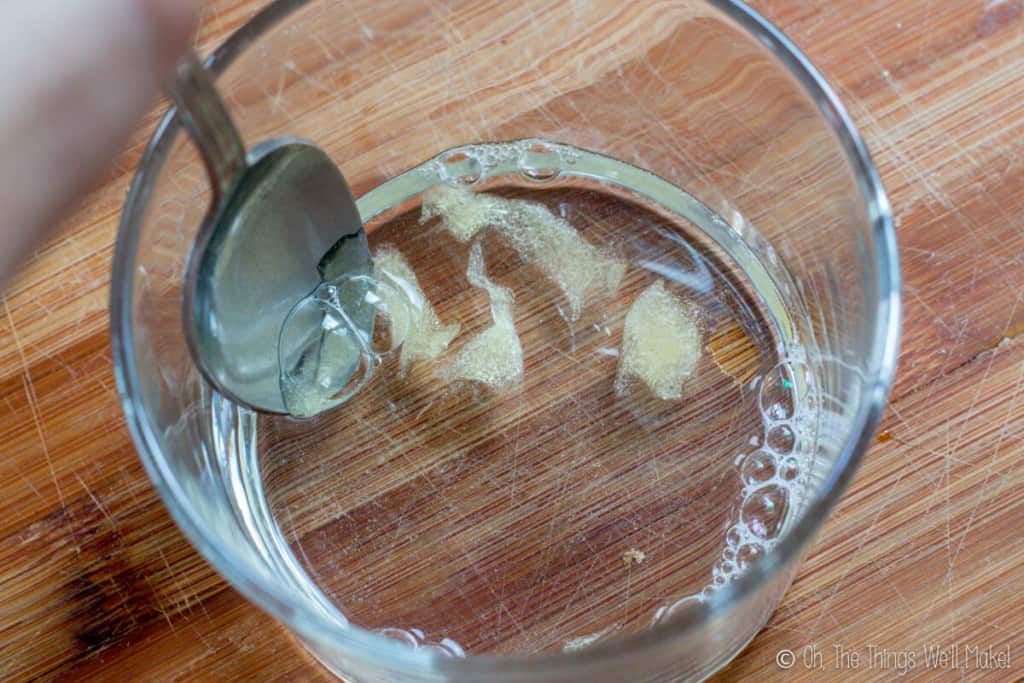
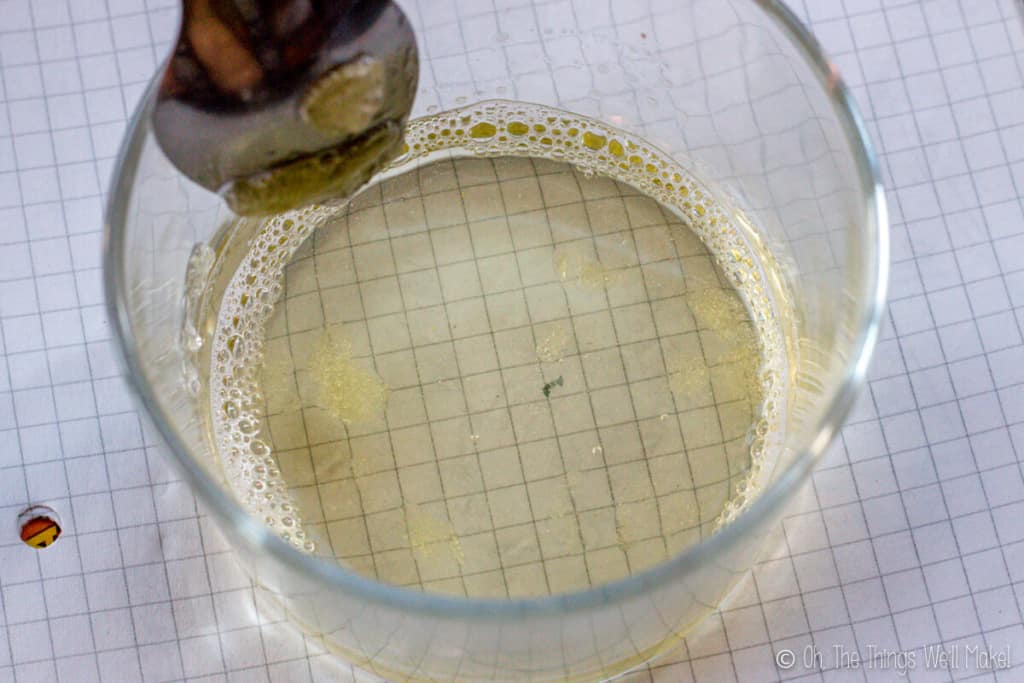
Note: If you aren’t using distilled water, the soap paste may stay cloudy no matter how long you cook it! (For more reasons your soap paste may be cloudy, read my post about troubleshooting liquid soap problems.
How to dilute the soap paste
Once you have made your soap paste, you’ll need to dilute it to obtain a liquid Castile soap.
To dilute a soap paste you can:
- Let it dissolve by itself into water over the course of several hours (or overnight).
- Speed up the process by warming the water and soap paste over the stove or other heat source (like the slow cooker).
For clear soap, use distilled water. That will also help ensure the water is free of contaminants and the soap will keep as long as possible. By choosing distilled water, not only are you keeping the possibility of microbial contamination to a minimum, but you are also ensuring that minerals and other substances in your tap water won’t cloud your soap.
If you are making small batches that are going to be used relatively quickly (and aren’t concerned about clearness), you can probably get away with tap water without any issues. I still recommend using distilled water when possible.
Read more about how to dilute a soap paste here.
Customizing your liquid soap
How else can you personalize your soap?
Adding fragrances
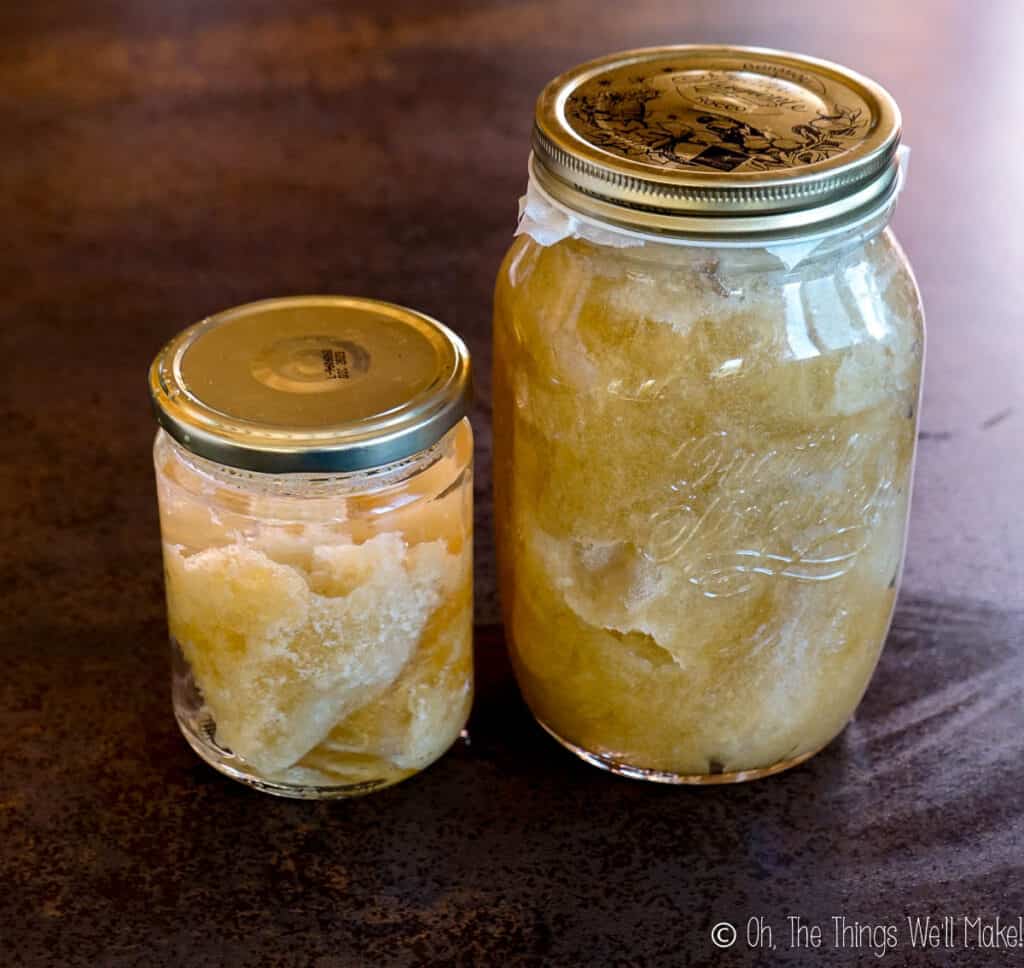
Unlike with bar soap, you can add in additives like essential oils after the fact. So, you don’t have to divide your batch at trace and work quickly to make soaps with a variety of fragrances. Instead, you can make a large batch of concentrated liquid soap paste base. The soap paste can be stored away and keeps well for a very long time. (I’ve successfully stored soap pastes for several years without issues.)
You can then add in the essential oils or fragrance oils as you dilute the soap paste. This gives you the freedom, even months after making the soap, to play with fun combinations.
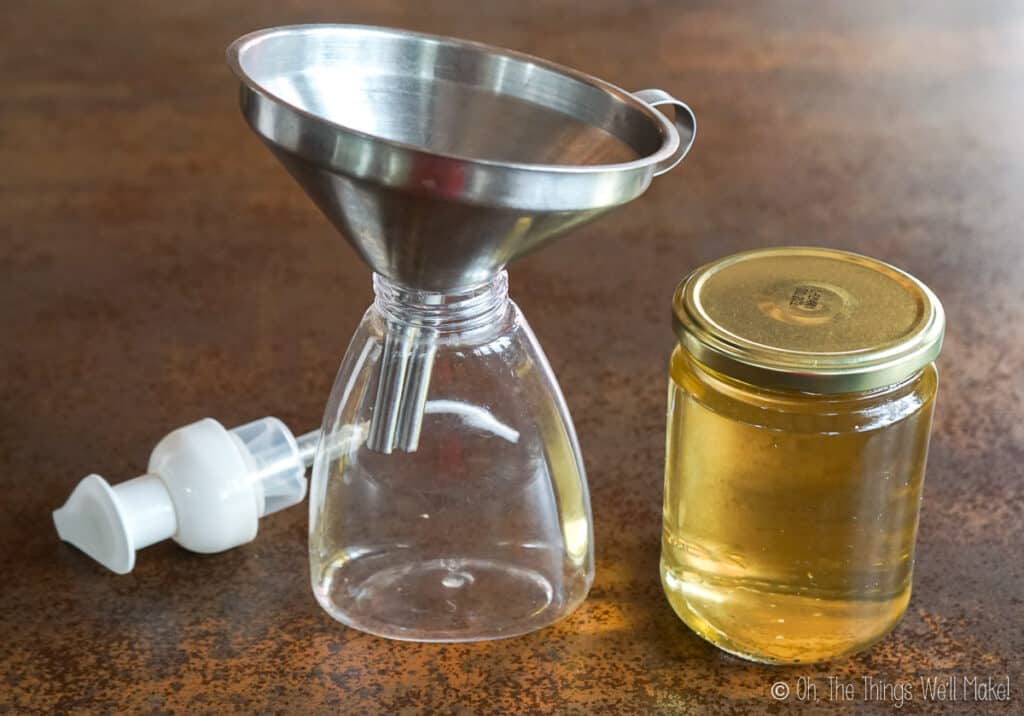
At the time of dilution, I mix the soap paste with distilled water and then I add essential oils to give my soap a personalized fragrance.
Does it need a preservative?
Whether or not liquid soap needs a preservative is a controversial subject. Personally, I don’t use one as the pH of soap is high enough that it’s not a favorable environment for the growth of most of the microbes that we’re trying to avoid.
If I were going to sell a liquid soap, though, I’d do proper microbial testing of the liquid soap to see if a preservative was needed or not. Most natural preservatives on the market aren’t effective at the high pH of soap anyway. (Euxyl® K 900 is an exception and would be a great preservative to consider for using in soap.)
For more liquid soap FAQ’s, read my post How to Make a Liquid Soap: Start Here.
Video
Easy liquid castile soap (made from scratch with olive oil)
Materials
Instructions
- Measure out the olive oil and add it to the slow cooker on low heat.
Make the lye solution
- Weigh out the glycerine, water, and potassium hydroxide (KOH).
- Mix the water and glycerin.
- Carefully add the KOH to the water and glycerin mixture. (Not the other way around!) Do this step in a well ventilated area.
- Stir the KOH into the water until it dissolves. It will be cloudy at first, but then it will clear up.
Make the soap paste
- Slowly add in the the KOH mixture to the warm olive oil, and gently stir them together in the slow cooker.
- Once they are mixed together well, use an immersion blender to blend the ingredients together. In a few minutes the mixture will begin to thicken and look like mayonnaise. It will later look like a creamy pudding.
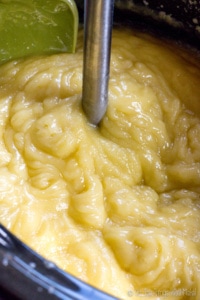
- The mixture will go through stages, from creamy to grainy and back to smooth.
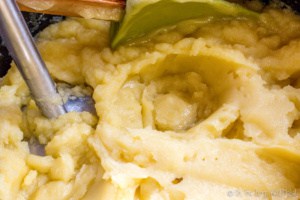
- As you continue to blend, it will start to get creamy again. Once you reach this point, you can stop blending with the hand held blender and can leave the soap paste cooking covered in the slow cooker.
Cook the soap paste
- As you cook the soap, it will continue to thicken and will become more translucent. To achieve a clear liquid soap we'll need to cook the soap paste for 3-4 hours. During that time, check on it and stir it up every half an hour or so.
Check for doneness
- To check for "doneness," we will look to see if the soap paste dissolves clear. To do this, take a small amount of the soap paste and dissolve it in distilled water. If the resulting soap is clear, the soap is finished cooking. If it's cloudy, continue to cook the soap paste for another half an hour before checking on it again.
Dilute the soap
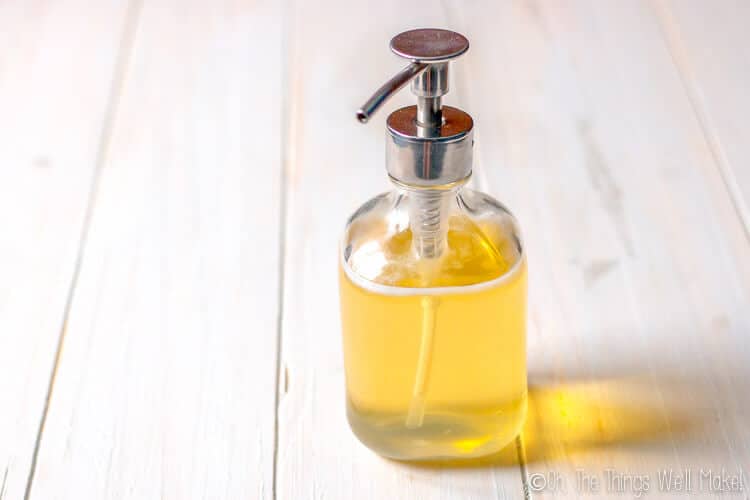
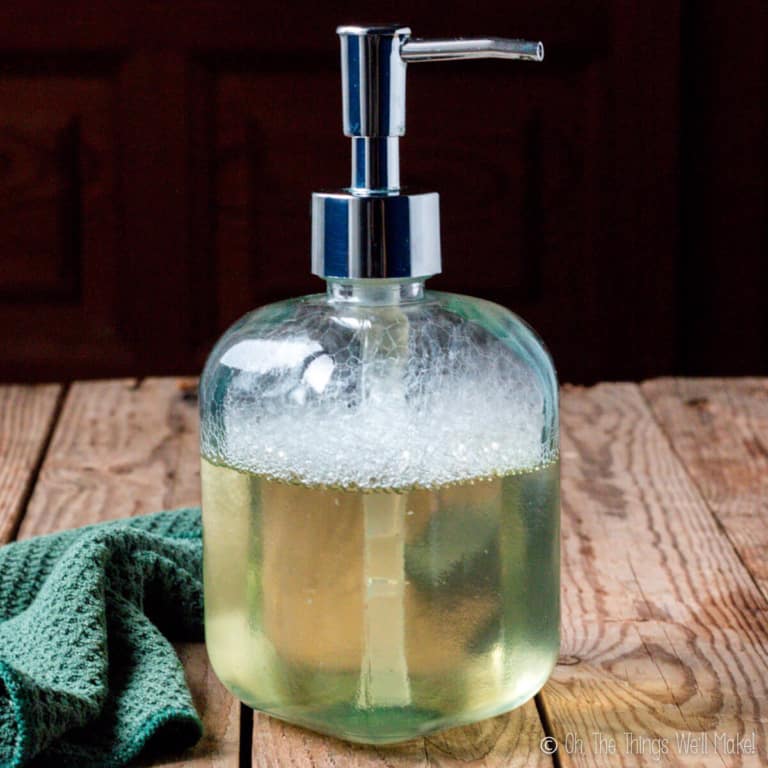
- To make a liquid Castile soap, dissolve some of the paste in distilled water. I ususally use a ratio of one part soap paste to 2-3 parts distilled water. Let it sit until dissolved, or gently heat to speed it up.
Notes
- A slow cooker is perfect for this because it gently heats without burning and keeps everything at a steady temperature. If you don’t have a slow cooker, you can bake the paste in the oven or cook it in a double boiler.
- Take breaks while blending so you don’t burn out the motor of your immersion blender. If your blender gets too hot, you can pause and let it cook before continuing.
- If the mixture becomes too thick to blend at any point, switch to mixing with a wooden spoon.
- If you’ve cooked it for more than 3–4 hours and it still isn’t clear, there may be other issues. Tap water can cause cloudiness. For other possibilities, see my post on troubleshooting liquid soaps.
- This recipe makes about 4.5–5 pounds of soap paste, which can be diluted to 10–20 pounds of liquid soap or more, depending on how concentrated you want it. That’s roughly 1–2 gallons or more.
- Keep in mind that liquid soap is not as thick as commercial gels or surfactants. It has a thinner consistency and doesn’t need to be thick to be concentrated and work well.
- Undiluted soap paste can be stored in glass or plastic containers in a cool, dry place for more than a year. I’ve had some last for several years without any problems. It may eventually develop a slightly rancid smell, but can still be used for general cleaning.
DIY liquid body soap recipe:
If you would like to combine this soap with a liquid coconut oil soap to obtain a bit more lather and a squeaky clean feeling, try using this ratio:
60-70% liquid Castile soap (made with only olive oil)
30-40% liquid coconut oil soap (for bubbly lather, link goes to the recipe post)
Essential oils of choice.
Mix all of the ingredients together, and keep a bottle in the shower to use instead of shower gel.
Add essential oils for fragrance. Lavender essential oil gives a lovely herbal scent. I also like citrus blends using lemon and bergamot.
What are your favorites?
This post was originally published on June 29, 2016. It was rewritten and republished in June of 2021, adding new information, more photos, and video.
Hello there Tracy!
I came across your site and am SO impressed with your clarity and passion! This is obviously a “labor of love” for you; evident in the time (and patience!) you’ve taken responding to all the posts you’ve had. Kudos to you, Tracy!
I also have a question that I haven’t seen in the posts. I would like to make an organic liquid Castile soap, and therefore do not want to use KOH (Potassium Hydroxide) aka caustic potash, which is inorganic. I read somewhere that NA²CO³ (Sodium Carbonate) aka washing soda, soda ash, soda crystals, which is organic, can be used in making Castile soap. Also, it’s a natural foaming agent.
Do you have any advice about using this instead KOH? I’m wondering about how this would affect the process – and the ratios.
Looking forward to hearing you thoughts on this!
Sincerely, with so much respect,
Joni
Hi Joni,
Thanks so much for your comment! It really made my otherwise not so great day! 🙂
Now to the challenging part of your question…
One of the reasons that soap can’t be labelled as “organic” in the US is because it can never reach 95% of its ingredients as organic. I remember reading that even water isn’t considered “organic,” so lotion makers will sometimes infuse organic herbs into their water to call it an organic ingredient. (Just found the link now.) Are you sure that sodium carbonate is considered organic? All of the terminology is so confusing- especially when comparing the different meanings of organic, of course. (Is it made from organic farming? Is it an organic or inorganic compound (organic chemistry)?)
Either way, I’m not really sure why it would be to your advantage to use it over KOH. If it’s to make a saleable product, I’m not really sure you can ever really call a soap “organic.” Most people who choose organic products would still choose a soap over a chemical detergent, especially if they know reasonable effort has gone into using quality ingredients and organic oils, etc., when possible.
In any case, back to the question…
I’ve tried to do a search of how to make soap using sodium carbonate, but haven’t found a lot of information. I did find someone who did a not-so-successful experiment.
Sodium carbonate isn’t a strongly basic as NaOH lye, so if it is possible, you’d need more of it. Of course there are lots of stories about how people used to make soap by using ashes from their chimney and mixing it with water to use as their lye. They then mixed that with homemade tallow or lard, or whatever fat they had on hand, to make their soap. The problem with those methods is it’s really hard to get the soap “right” so to speak. It may be a lot more harsh (too much lye) or have too much fat and not be very cleansing. With the ability to buy soda ash now, it seems feasible to be able to calculate an amount and make soap with it, but I’ve never tried it myself.
In any case, using sodium carbonate, if you did make a successful soap, it would almost positively be a bar soap and not a liquid soap. I tried making liquid soap with sodium hydroxide and it definitely doesn’t work the same way.
Sorry that I can’t be of more help. At least I tried. 😉
Hii Tracy,
The recipe looks great and I want to make it.
With what calculator are you using?
Thank You
Oana
Hi Oana,
I cross checked it on a couple of different lye calculators. Right now I can’t remember the specifics, but I can try to take a look at my notes and see if I can find more information about how I chose to use what I did.
There are a couple of them that do help you out with liquid soap recipes, and they now seem to compensate for the humidity that can be found in the KOH crystals.
Hello, I am at the soap paste stage. It looks really good and like it is supposed to. However, when I do the clarity test it is still cloudy. Is this a problem? It seems like you said that it should be okay if I made it to the clear, gel paste stage. Also, if I store it In Paste form will it keep longer? How long does it keep in paste form? How long does the soap keep after dilution? Thank you so much. I’m sorry if these questions were already answered, but I couldn’t find specifics and I don’t want to hurt anyone with the soap. Again, thanks for your detailed and useful recipes.
Hi Shiloh,
I’m going to guess you’re going to be fine.
It may even end up clearing up for you as the weather gets warmer or with time.
The soap being transparent or not is just aesthetic.
I do keep most of it in paste form because I figure that without water, it should keep longer.
I’ve had a batch for 2 years now that is still fine to use (both what I have in paste form and the part I have partially diluted). With time, it may start to smell a bit rancid, which is when you might consider tossing it. That said, you can still use it for general cleaning.
I go more into detail about how I dilute it in my post about diluting liquid soap.
I did have part of the paste stored in a tin that had metal, and it looks like the metal affected the paste. I’m going to try it out in the next few days to see if it’s salvageable or not.
When in doubt, you can always try using it for general cleaning around the house. 😉
I hope that helps!
Hello, made your beginner soap yesterday worked so well, this is my next endeavour, I just wanted to check you keep your mix in paste form and dilute as necessary, if you do keep it as a paste, may I ask how you store it. Unless I missed part of the post 🙂 thank you. Love your work!
Hi Gina,
I’m so happy your soap worked out!
I usually divide up my paste. I leave some in paste form, and semi-dilute some of it for easier combining with the coconut oil soap when I want to mix up another batch. I then fully dilute the small amounts I want to actually use.
This is my reasoning: the paste will keep the best and takes up the least amount of room, but it takes awhile to dilute, and it’s harder to work with when you want to mix up batches of liquid soap.
I pretty much am always using a combination of both this soap and the coconut oil liquid soap, so it’s easier for me to keep both on hand partially diluted.
I talk more about my process in my post about diluting liquid soaps.
Oh, I forgot to answer how I store my paste.
I keep it in a wide mouth glass jar in a dark cabinet in my pantry. 🙂
Thank you! One quick question do you cover the crock pot or leave it open? Asking because the lid makes condensation not sure if that matters. I made it today, I will say that heat makes a difference not all crock pots seem to have the same temps. I struggled in the beginning to get it to thicken but when I turned the crock pot to high it worked very quickly. (I got the crock pot off a freebie site so not 100% familiar with it yet.) I love it I will feedback once I’m done.
It’s perfect looks just like yours! I weighed it for the sake of interest and it was 1.250kgs. Thank you so much for sharing this excellent tutorial
Yay!
I’m so happy to hear than, Gina!
Liquid soap making is really rewarding. I love it.
I hope the coconut oil soap goes well for you too. 🙂
Traté de buscar esta receta en la sección en español pero no la encontré, pero igual entiendo inglés aunque prefiero comentar en español, espero no te moleste. Estoy haciendo una receta que pusiste en los comentarios:
Aceite Castor 1oz
Aceite Coco 1oz
Aceite Oliva 6oz
KOH 1.68
Liquido 5oz
peeero, doblé la receta para q no me salpicara al batir, de esta manera:
Aceite Castor 2oz
Aceite Coco 2oz
Aceite Oliva 12oz
KOH 3.36oz
Agua 7.5oGlicerina 2.5oz
Por alguna razón por más que batí no llegué al estado de “apple sauce” sino que me quedó más gelatinosa y empecé a ver que se separaba el aceite y en el fondo de la olla se hacían como rios líquidos… Sabes que pude hacer mal? La idea es aprender de los errores. Gracias por tu ayuda! Me encanta tu página
Hola Nancy,
No me suena nada la receta esta, y he buscado en los comentarios de esta receta y no lo encuentro.
Sea como sea, nunca he hecho un jabón líquido con esa combinación de aceites. Tengo pensado hacer un jabón líquido con varios aceites para los que no quieran hacer 2 jabones distintos como yo, pero hasta ahora no he probado de hacerlo. Estoy muy contenta con mi sistema de mezclarlos una vez hechos.
Eso dicho, he mirado con una calculadora de jabones, y parece ser buena la receta. A mí me sale que hay que usar 1.66 oz. de KOH, pero eso sería para salir exacta la receta.
Con 1.68, quedaría un poco de KOH, algo común en recetas de jabón líquido para que salgan transparentes. (Después, si causa irritación el jabón, se podría “neutralizar.”)
Sin haber probado con ese jabón en particular, no sé la textura “normal” para ese jabón.
Verás, si miras el proceso de hacer jabón líquido con aceite de coco, la textura era completamente diferente y la pasta de jabón se hizo muy duro en seguida y casi no lo pude remover.
Igual no has hecho nada mal y la receta necesitaba más tiempo de calor y removerlo de vez en cuando hasta que se quedara translucido en algunas partes.
Hi Tracy,
I found your idea to do separately olive oil and coconut a grea idea. So I did the same and it came out well.
I wonder if you have already tried different % combinations to use for toilet cleaner, shampoo, dishwashing liquid, etc using these as base?
Hello!
I’m happy to hear your soaps turned out well! 🙂 Yay!
I don’t really measure anything out, to be honest. I just add a lot more coconut oil soap when I’m doing cleaning. For washing clothes, I only use coconut oil soap. For the shower, I make a mixture of around 50%/50%. I’d probably use more olive oil castile soap than that if it were for just me, but my husband likes the lather and the “clean” feeling that the coconut oil soap gives, so it’s really a matter of your skin and preferences. I use the same for hand washing for the same reason. We use it up pretty quickly, so you can keep experimenting.
For dishes, toilet, etc., you could even use pure coconut oil soap too, or you can add in some of the olive oil soap to help use it up more quickly. I find that I use the coconut oil soap much more, so it gets used up a lot more quickly.
Perhaps I should come up with a hair shampoo idea that combines the olive oil soap with conditioning ingredients or something. 🙂
You can read more about how I dilute and combine it in my post about diluting liquid soap.
Hi Tracy, I was wondering if I could use this instead of Dr. Bronner’s Castile soap. I buy the one without sent and use it for my stain remover recipe and other cleaning stuff. Also in my hand soap foam dispenser. Can I just use the olive oil or the coconut one, or combination?! since Dr. Bronner’s is a combination. This looks like a great recipe and I would also want to safe some money:) Thank you
Hi Klara,
Yes, Dr. Bronner’s is a combined soap that uses more coconut oil than olive oil. Having made both types, I can totally smell the coconut oil in the unscented version that I bought to compare. 🙂
I’d suggest using the coconut oil one if you are going to be using it for cleaning mostly. For hands, I prefer using a combination with some of the olive oil one to make it milder, but you could use just the coconut oil one.
I’ve found it really convenient to make both to add different combinations for what I need for each situation. I use the coconut oil one for cleaning and adding to detergent for washing fabrics, etc.
That said, would you be interested in me posting a combination recipe so that you only have to make one for most general needs?
I could make it a priority to try to come up with a new recipe and make it, film it, and post it as soon as I can get to it.
I’m seen other articles where castile bar soap was turned into liquid castile soup without adding other ingredients, including KOH. (essentially dissolving the cut up bar soap in water…I’m simplifying of course). What would be the difference in usage or functionality between the two methods?
Hello,
I have tried dissolving bar soap into water, and have never been satisfied with the results. I have tried with both homemade and several store bought soaps. Usually I end up with a clumpy mess that ends up separating into a thick, opaque layer and a very thin, watery one.
Functionality wise, I would guess that you would end up with a soap that “works” either way.
The difference I see is that with KOH you end up with a true liquid soap base, that will dissolve into a translucent soap that doesn’t separate. As I’ve mentioned, in cold weather it will likely turn cloudy and thicken up too, but I still personally quite prefer it to a dissolved bar soap.
I recently dissolved a bar soap I made for my dog, and much preferred using it as a bar rather than use it as a liquid on her. I really needed to use a lot more of the liquid, which was very concentrated, than what I used when using the bar itself. I’m not really sure why, though. In any case, it’s just one more example of why I don’t like dissolved bar soaps.
From reading the comments, I can see that people drastically different experiences while making this soap. One this that people need to consider is that a lot of olive oil sold in stores (especially in the US) is adulterated. That means it has been mixed with other oils to make it cheaper (and it usually listed on the label) or it is a blend of olive oils from a variety of locations. In Spain, you are pretty lucky to be able to get EVOO or VOO from a local manufacturer but in the US it can be a challenge. I would suggest that people research the source of the oil that they are using to find out if it is pure.
Hi Sara,
I’ve been wondering if that could be one of the problems, myself.
With soap making, the type of oil used makes a huge difference for the calculations to turn out correctly, so obviously if you are using a mixture of oils, you aren’t going to have a same results as somebody who uses pure olive oil. For some oils, you’ll need more or less KOH.
I think there are a lot of factors that could be contributing to people’s different experiences, but, yes, if they aren’t using a pure olive oil, that could mean the difference between things turning out perfectly, and not making soap at all!
I think the temperature outside and the temperature of each person’s slow cooker could also have a huge difference of how long the process takes, which could make people give up too early too.
I need to make this again soon, so I can make a video of the process and get a better feel for some of the nuances in the process. Hopefully I’ll be able to give some more ideas about things that could go wrong.
I really appreciate your insight, though, to help with one more possible problem area. Thank you!
Tracy HELP!!
Followed your recipe…down to the letter.
Everything was going well; even though it took a bit longer due to winter weather to move thru rhe different stages.
Got it to trace after the mashed potato stage, covered the crockpot and brought all my tools inside to wash and put away. I came back out to give the soap a quick stir and it was completely solid!!
Did my best to chisel it into chunks with 2 heavy duty wooden spoons.
What happened?!
It is still in the crockpot (uncovered) but it resembles whole potatoes that weren’t cooked long enough to mash! Just big chunks!
What should I do?
The coconut oil recipe went so well!
Theresa
Hi Theresa,
I just came to the blog for one quick look on my way to bed, and decided I should at least try to help you out with an answer, even though I have to admit that I don’t know what is going on to make your experience so much different than mine.
Mine never got hard at all, and stayed soft enough to use the blender the entire time (unlike the coconut oil soap).
If it were me, though, I’d actually keep going with it to see if it goes translucent like the other one. I’ve read of other people who have done mixed recipes (ones that use coconut oil and olive oil) that end up with a very solid stage in the middle that they break up as well as they can throughout the process. I assumed that it had to do with the mixture of oils that they were using, but it could just be differences in environment, etc.
I really need to try both recipes again soon. I haven’t made these as often as the bar soaps because I end up with a rather large batch and have enough to not have to make it again in a long time. It’s been so long now that I barely remember the process.
I wouldn’t worry too much about trying to stir it that much. I’ll keep my fingers crossed for you!