

DIY Liquid Laundry Detergent Recipe (No Soap)
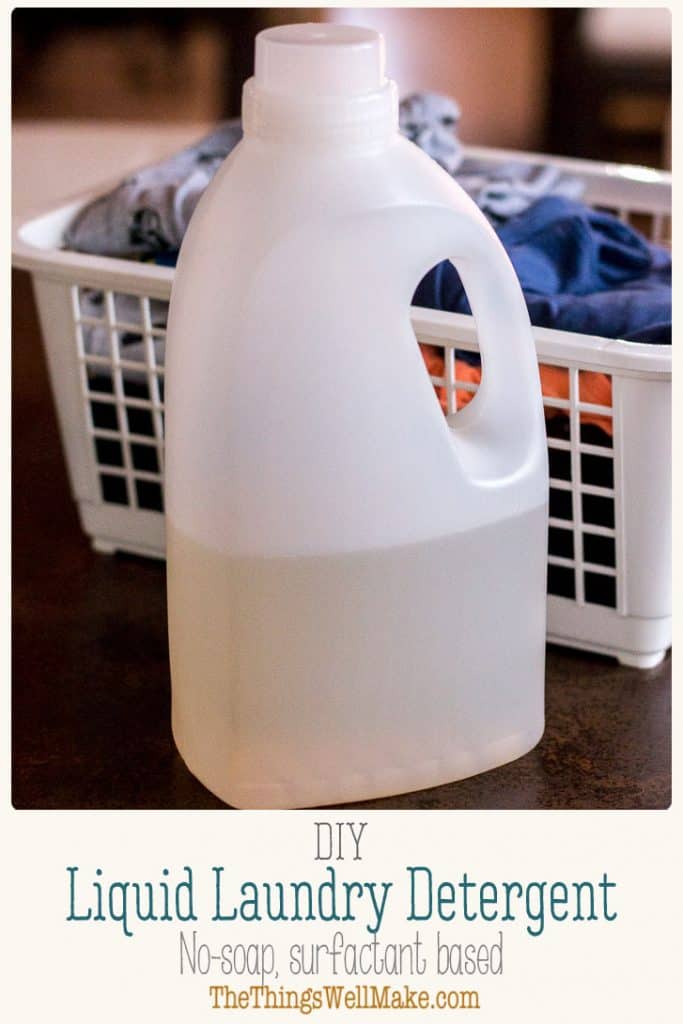
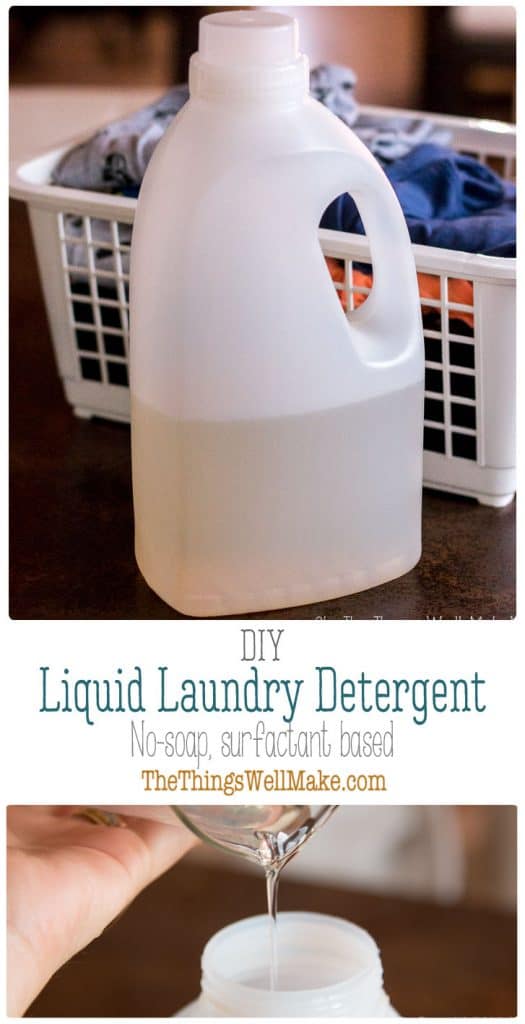
Learn how to make a DIY liquid laundry detergent without soap. This easy recipe works well in hard water, cleans effectively, and avoids heavy fragrances.
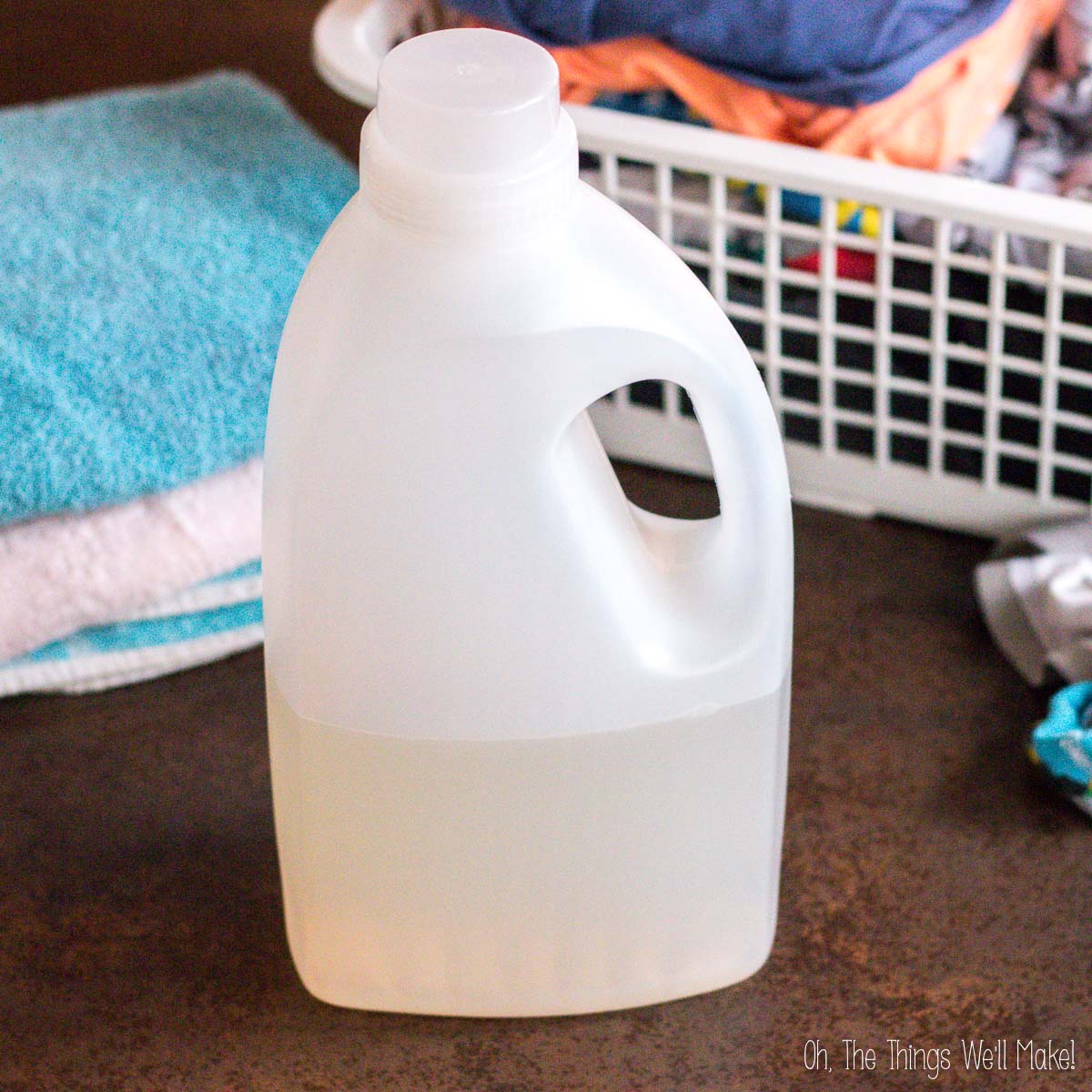
I used to make soap-based laundry “detergents,” and they can work… especially if you have soft water.
But over time, I realized they aren’t the best option for most people.
If you have hard water, soap can react with minerals like calcium and magnesium, leaving a residue on your clothes. That buildup can trap dirt, make fabrics feel stiff, and leave everything looking a bit dull over time.
That’s why I switched to making a simple surfactant-based detergent instead.
It cleans more effectively, works well in any water type, and is still inexpensive and easy to make at home.
If working with surfactants sounds intimidating, don’t worry. This is one of those recipes that’s actually very simple once you try it, and it gives you much more control over what goes into your laundry.
If you prefer to see the process, here’s the video:

The problem with soap-based laundry detergents
Soap doesn’t just clean. It also reacts with minerals in hard water.
When it comes into contact with calcium and magnesium, it forms a residue known as soap scum. Over time, that residue can build up on fabrics, trapping dirt and making clothes look dull or feel less clean.
This isn’t always noticeable right away, especially in soft water. But in areas with hard water, like where we live in Spain, the difference becomes much more obvious over time.
That’s one of the main reasons I moved away from soap-based laundry detergents and started using surfactant-based formulas instead.
Some people try “stripping” their clothes to remove buildup, but it’s usually easier to avoid the problem in the first place.
Why soap can be a problem in laundry
Soap reacts with minerals in hard water, forming a residue (soap scum). Over time, that buildup can trap dirt, make fabrics feel stiff, and leave clothes looking dull instead of clean.
But that doesn’t mean soap is completely off the table. There are still times when it can be useful.
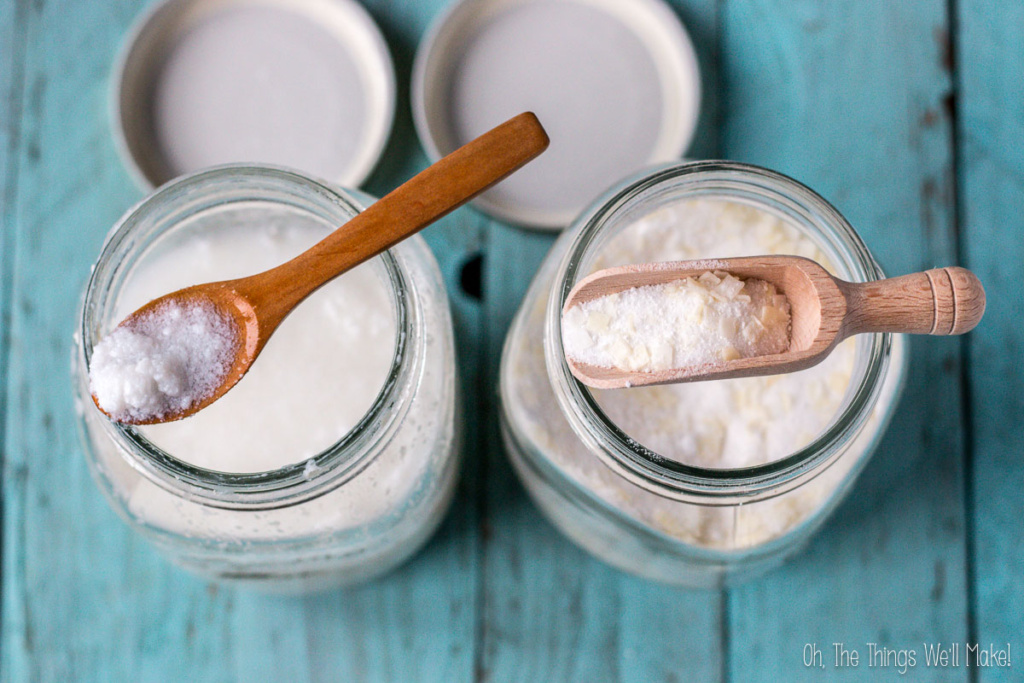
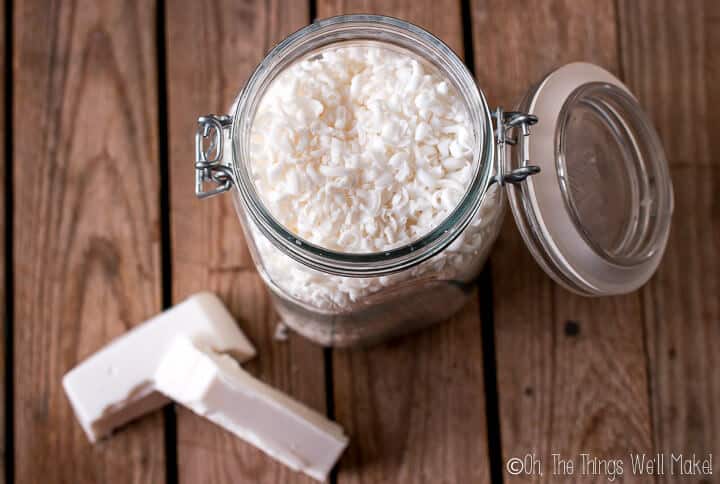
What I use now (and when I still use soap)
I used to make and use soap-based laundry detergents, and they can work… especially if you have soft water.
Over time, though, I started noticing the downsides, especially in hard water. That’s why I switched to surfactant-based detergents for regular washing.
That said, I still make laundry soap and use it for specific things like stain removal or pre-treating heavily soiled areas.
Why make your own Laundry detergent?
One of the biggest advantages of making your own detergent is the cost. Most store-bought detergents, especially “natural” ones, are surprisingly expensive for what they are. They’re mostly water with a small amount of surfactants, which are relatively inexpensive when you buy them yourself.
Making your own also gives you full control over the ingredients. Many commercial detergents use strong synthetic fragrances that can be overwhelming or irritating. I’m quite sensitive to those scents, so I usually keep my detergent unscented.
If I do want to add fragrance, I prefer to scent my laundry separately using wool dryer balls or sachets. It gives a lighter, more natural scent without being overpowering.
Another benefit is that you can tailor the recipe to your needs, avoiding any ingredients that don’t work well for you or your family.
Ingredients
This detergent is made with a simple blend of surfactants, along with water, salt, and a preservative.
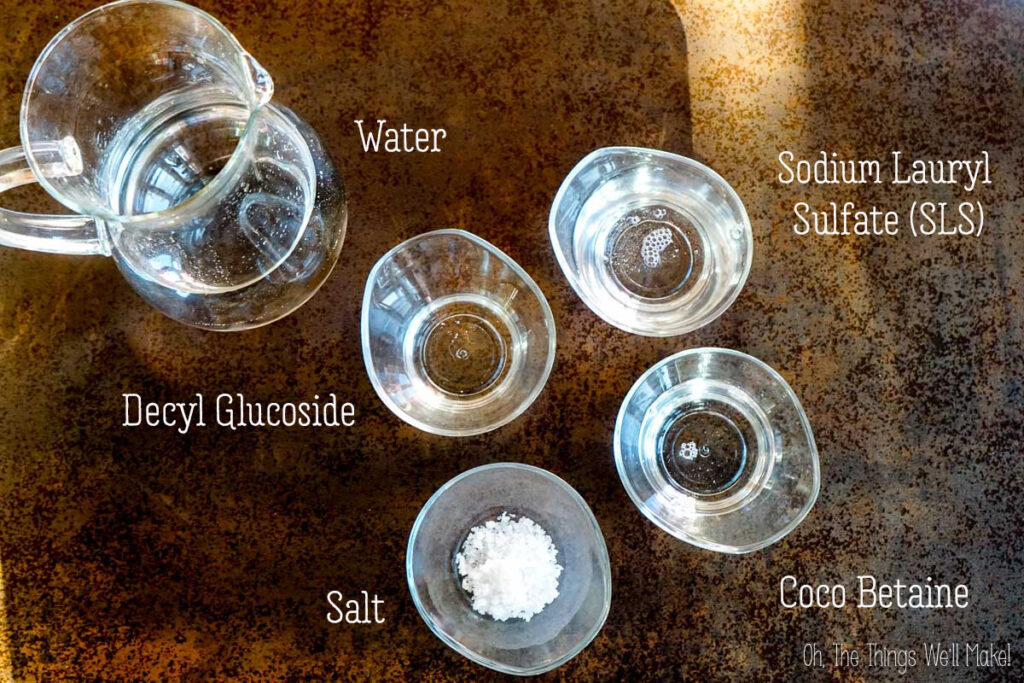
The main surfactants I use are sodium lauryl sulfate (SLS), coco betaine, and decyl glucoside. Together, they give a good balance of cleaning power and mildness.
Salt is used to thicken the mixture.
To keep the detergent stable over time, you can either add a preservative or adjust the pH. I’ll explain both options below so you can choose what works best for you.
About sodium lauryl sulfate (SLS)
Sodium lauryl sulfate (SLS) is a surfactant that’s very effective at removing grease and dirt, which is exactly what we want in a laundry detergent.
It does have a bit of a negative reputation, especially in personal care products. It can be irritating on the skin for some people, which is why I don’t usually use it in things like shampoos or toothpaste.
You may have also seen claims that SLS is linked to cancer. From what I’ve found, there isn’t solid evidence supporting that. Reviews of the available research have not shown SLS to be carcinogenic, and much of the concern online seems to come from misunderstandings or misinterpretations of how it behaves. If you’re interested in looking into it further, you can read a published review on SLS safety and toxicity and also see how Lisa Bronner from Dr. Bronner’s addresses common concerns about SLS.
That said, laundry detergent is different from personal care products. It isn’t a leave-on product and gets rinsed out completely, so using a stronger surfactant here makes sense. In this context, SLS works very well and helps get clothes thoroughly clean.
While it isn’t the most “natural” ingredient, it is biodegradable and widely used in cleaning products. I tend to prioritize safety and effectiveness over whether something is completely natural.
If you prefer to avoid SLS, you can experiment with other surfactants. Just keep in mind that gentler surfactants usually need to be used in higher amounts or combined carefully to get similar cleaning power. If you’re new to working with surfactants, you can learn more about how they work and how to combine them in my guide to natural surfactants.
This recipe uses a blend of surfactants to balance cleaning power with mildness, making it effective without being overly harsh.
About “harsh” ingredients like SLS
SLS is often criticized in personal care products because it can be irritating on the skin for some people. In laundry detergent, though, it’s used differently. It helps remove grease and dirt effectively and gets rinsed out completely, so it doesn’t stay on fabrics.
How to make a DIY liquid laundry detergent
Making this detergent is actually very simple once you have your ingredients ready.
Add the surfactants to your container. The easiest way to do this is to place the container on your scale, tare it, and add each ingredient one at a time, resetting the scale between additions.
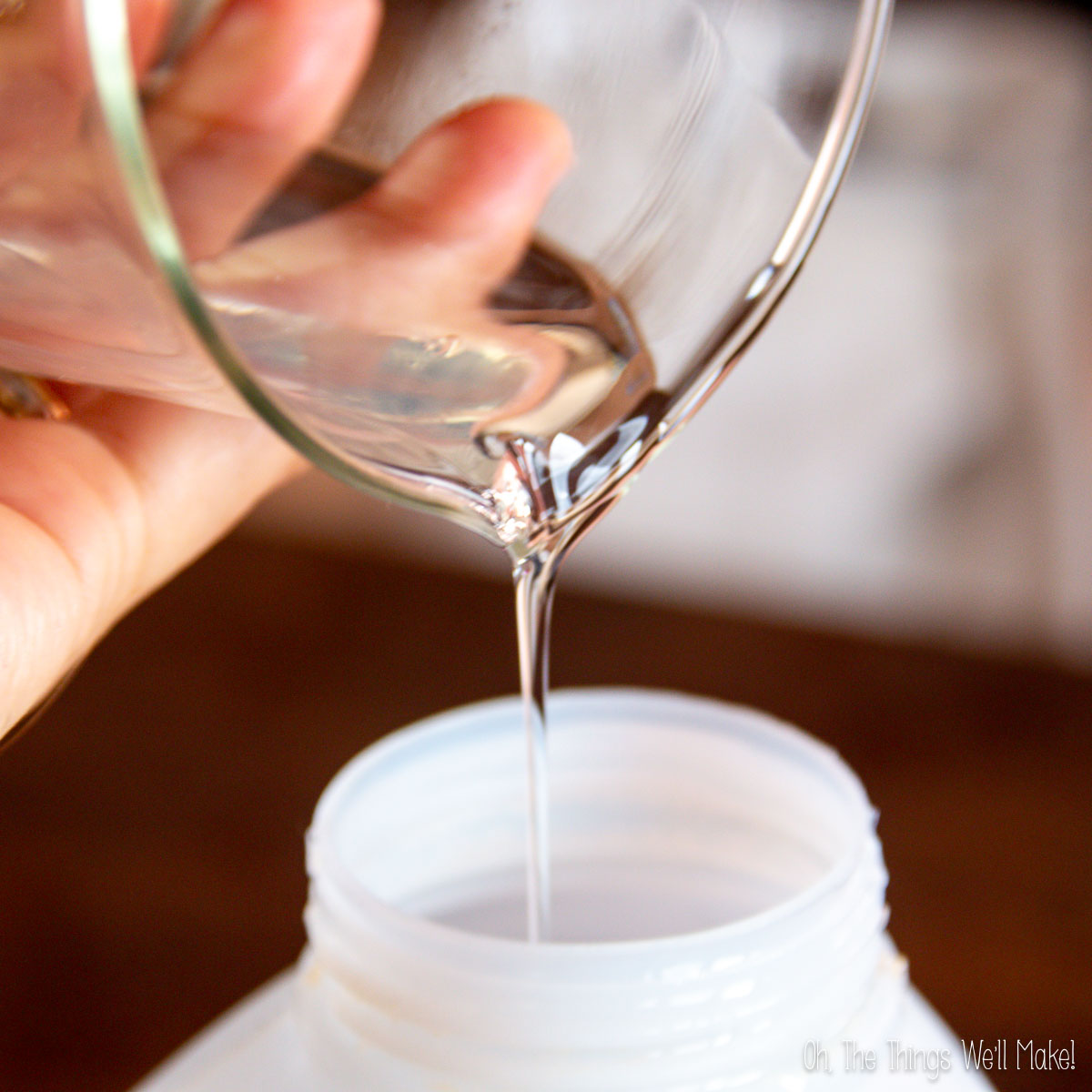
Once the surfactants are in, add most of the distilled water and gently stir or swirl to combine everything, trying not to create too much foam.
In a separate small container, dissolve the salt in a portion of the remaining water. Once fully dissolved, add it to the detergent mixture and stir gently. As it incorporates, the mixture will begin to thicken.
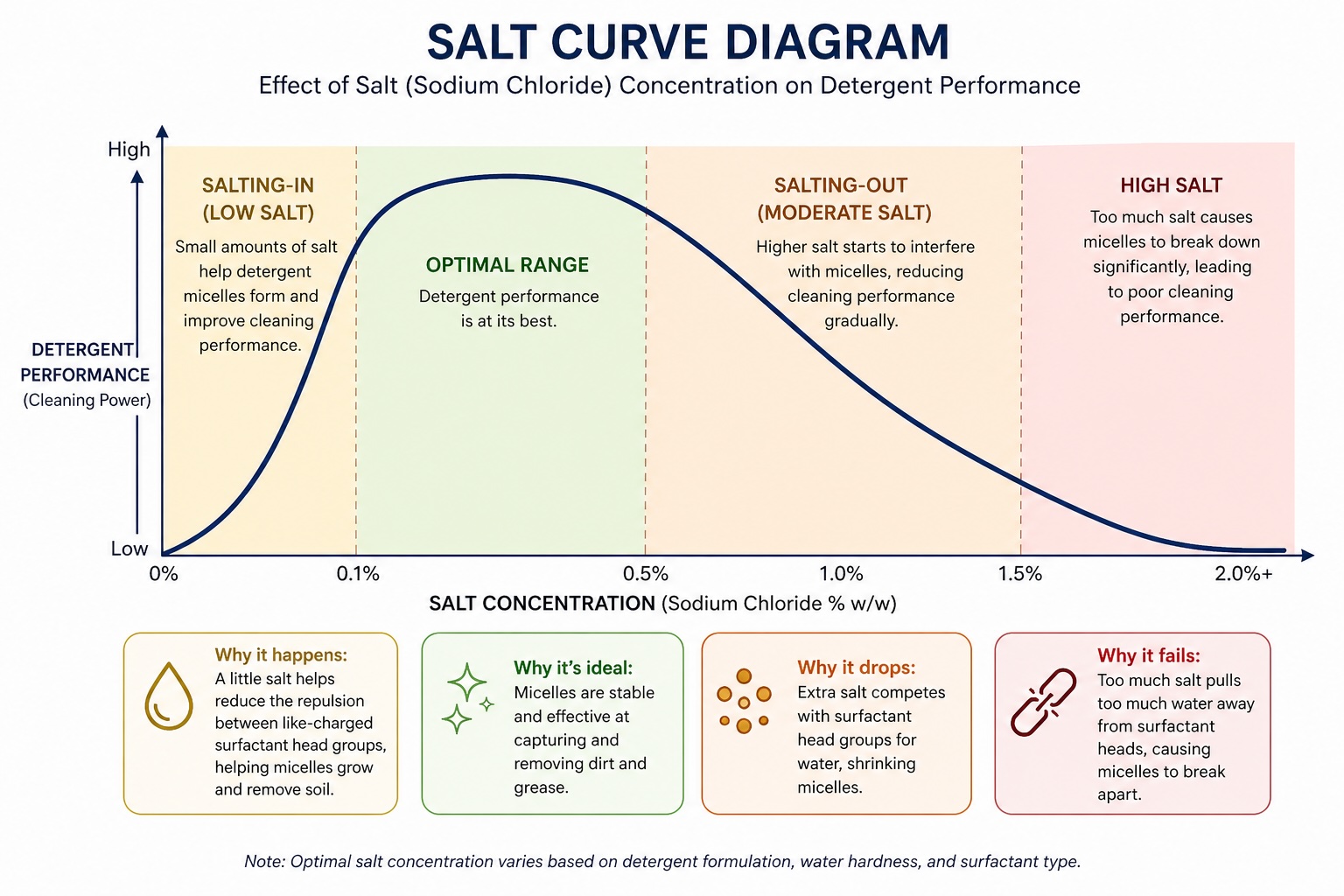
Salt is often used to thicken liquid detergents, but it doesn’t just affect the texture. It also changes how the surfactants behave.
A small amount can help improve structure and cleaning, but adding too much can actually reduce both thickness and effectiveness. That’s why it’s best to add salt slowly, mixing well between additions, and stop once you reach the consistency you like.
If you’ve ever had a detergent suddenly thin out again after adding more salt, this is why.
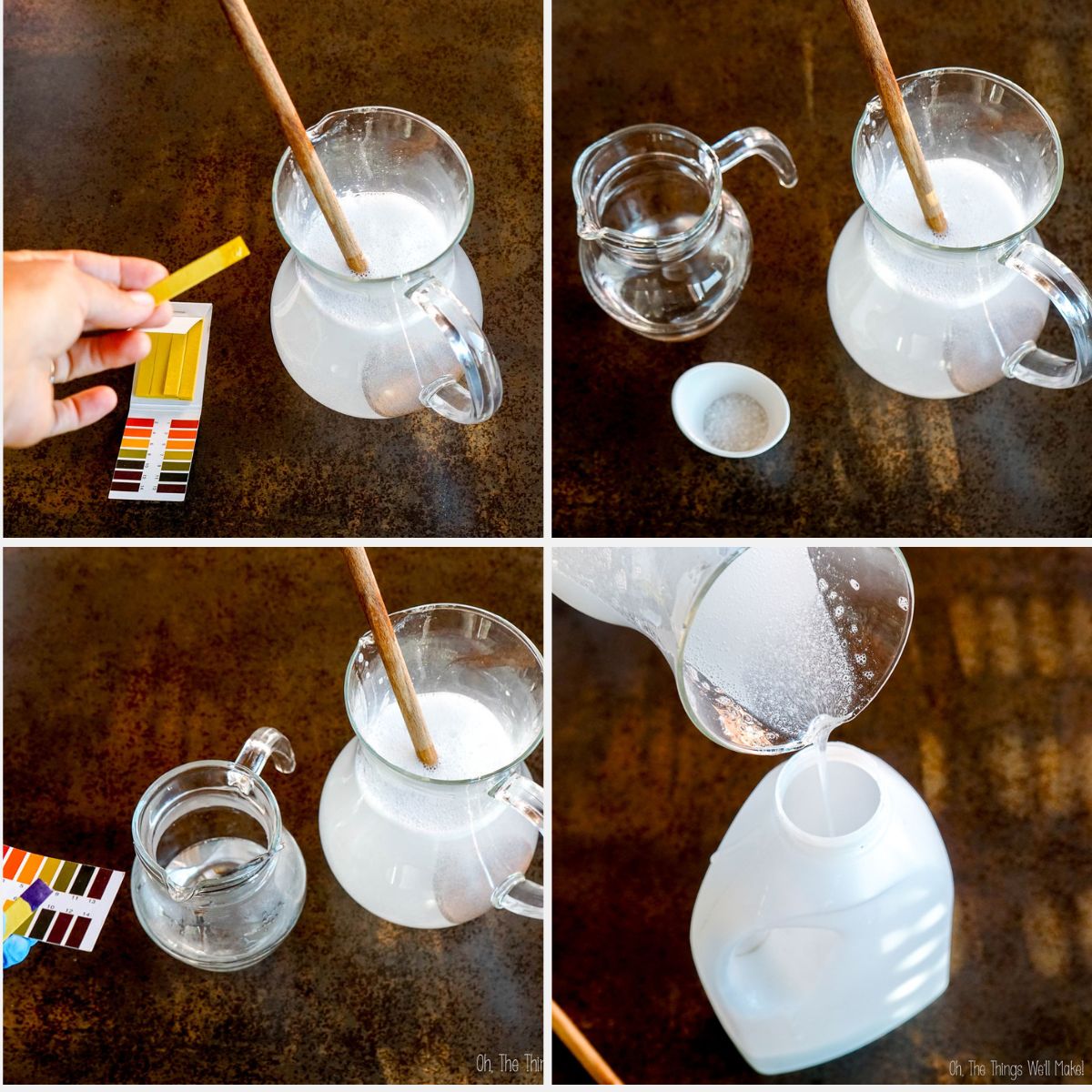
At this point, you can choose how you want to preserve your detergent. You can either add a broad-spectrum preservative or raise the pH of the mixture using a small amount of lye solution. See the notes below for more details on both options.
Do you need a preservative?
Because this recipe contains water, you do need a way to keep it from growing bacteria or mold over time. There are two main ways to do that, and I’ve used both.
Option 1: Use a preservative
You can add a broad-spectrum preservative that works within the pH range of your detergent. This is the simplest option, especially if you prefer not to work with lye. When I first started making my own laundry detergent, this was the method I used!
That said, laundry detergent is usually made in fairly large batches, so using a preservative can get expensive depending on what you choose and where you buy it.
When I first started making this detergent, I used Sharomix 705 because I was able to buy it in large quantities fairly inexpensively here in Europe. It worked well for this type of formula.
One important thing to keep in mind is pH. Before adjusting the pH, this detergent usually falls around a slightly acidic range (mine was around pH 5, but that can vary depending on your ingredients and suppliers). You’ll want to make sure that whatever preservative you choose is effective within the pH range of your final product.
Option 2: Raise the pH
Another option is to raise the pH of the detergent to make it less hospitable to microbial growth.
I actually started doing this after looking at an older bottle of Dr. Bronner’s Sal Suds. At the time, the ingredient list included potassium hydroxide. It made me wonder if they were using it to help preserve their detergent, and since I already had it at home from making soap, I decided to give it a try in my recipe.
By raising the pH (generally above around 9), you create an environment where many microbes can’t grow. This is why traditional liquid soaps don’t usually need a preservative.
This is the method I’ve been using for years now. It’s simple, cost-effective, and works well, especially if you already make soap and have lye on hand.
If you choose this method, be sure to handle lye carefully and follow basic safety precautions.
Here’s what that process looks like:
Which option should you choose?
- If you’re not comfortable working with lye, using a preservative is the easier and more straightforward option.
- If you are familiar with working with lye, raising the pH can be a very practical and inexpensive alternative.
Customizing your homemade laundry detergent
This recipe is pretty flexible, but changing the ingredients can affect how it turns out.
The blend of surfactants I use gives a good balance of cleaning power and mildness. You can experiment with other combinations, but keep in mind that not all surfactants behave the same way. Some clean more gently, while others are stronger and more effective at removing oils and dirt.
If you want to avoid SLS, you’ll probably need to use more surfactants or combine a few different ones to get similar results.
Thickening
You can also adjust the thickness of the detergent. I use salt to thicken it, which works well with this blend of surfactants.
As you add salt, the mixture will usually get thicker at first, but only up to a point. After that, adding more can actually start to thin it out again, so it’s best to add it gradually and stop once you reach the consistency you like.
While small amounts of salt can affect how the surfactants behave, in this recipe it’s mainly being used to adjust thickness rather than improve cleaning.
It also doesn’t need to be very thick to work well. A more liquid version will clean just as effectively, so thickness is mostly about how it feels and dispenses.
If you change the surfactants, keep in mind that not all combinations will thicken with salt, so you may need a different thickener or simply leave it more liquid.
Fragrance
You can leave the detergent unscented or add a small amount of fragrance if you prefer. I usually leave mine unscented and add scent separately, like a couple of drops of essential oil on wool dryer balls or using sachets in the closet. It gives a lighter, more natural scent without being overpowering.
If you do add essential oils or fragrance oils to the detergent, it’s best to use small amounts.
FAQs
Yes. This detergent is low-sudsing compared to traditional soap-based recipes, so it works well in HE machines. Just avoid using too much.
I usually use about 2–3 tablespoons per load, depending on how dirty the clothes are.
If your detergent is more liquid, you may need a little more, but try not to overdo it. More isn’t necessarily better.
Yes, you can, but the final result may be a bit different.
SLES is generally milder and may not clean quite as strongly, so you may need to adjust the amounts or combine it with other surfactants to get similar results.
You can, but you’ll need to dissolve it well before using it. Powdered versions can be a bit trickier to work with and may take more time to fully incorporate.
Technically, yes, but I wouldn’t recommend it.
Using a blend of surfactants helps balance cleaning and makes the detergent easier to work with. On its own, SLS can be a bit harsh and less well-rounded.
You do need some way to keep the detergent from growing bacteria or mold over time.
You can either:
use a preservative
or raise the pH (what I usually do now)
If you don’t want to work with lye, a preservative is the easier option.
Possibly, but you’ll need to make sure it works within the pH range of your detergent.
Some common options like sodium benzoate or natural extracts (like rosemary extract) aren’t always effective on their own in this type of formula, so you’ll want to research carefully before substituting.
Not all surfactant combinations thicken with salt.
If you’ve changed the surfactants, the salt may not work the same way. In that case, you can either leave it more liquid or try a different thickener.
Yes, but you’ll need to experiment.
You’ll likely need to use more surfactants or combine different ones to get it to clean as well. Gentler surfactants usually need a bit more help to be effective.
Yes, that’s one of the main advantages of this type of detergent.
Unlike soap-based detergents, it won’t form buildup with minerals in hard water.
You can, but you may want to reduce the amount slightly or experiment with a milder surfactant blend if you’re washing very delicate fabrics.
It depends on where you live, but many of these can be found from cosmetic ingredient suppliers or online shops that sell soapmaking or DIY cosmetic ingredients.
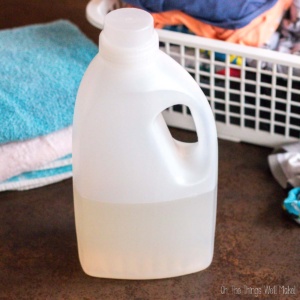
DIY Liquid Laundry Detergent (Non-Soap Recipe)
Materials
- 740 g distilled water
- 150 g sodium lauryl sulfate
- 50 g coco betaine
- 30 g decyl glucoside
- 20 g salt
- preservative or lye solution
Instructions
- Add the surfactants to your container, weighing each one directly into it and taring the scale between additions.
- Add most of the distilled water and gently stir or swirl to combine, trying not to create too much foam.
- In a separate container, dissolve the salt in a portion of the remaining water. Once fully dissolved, add it to the detergent and stir gently. The mixture will begin to thicken as it incorporates.
- At this point, choose how you want to preserve your detergent. You can either add a broad-spectrum preservative or raise the pH using a small amount of lye solution. (See notes below for more details.)
Option 1: Use a preservative
- Add a broad-spectrum preservative that works within the pH range of your detergent. This recipe is usually around pH 5 before any adjustments (though that can vary), so choose a preservative that works in that range and use it at the recommended rate, typically around 0.5–1% (about 5–10 g for this batch). Mix well, and your detergent is ready to use.
Option 2: Raise the pH (no preservative)
- Instead of using a preservative, you can raise the pH of the detergent to help prevent microbial growth. Add a small amount of lye solution (sodium hydroxide or potassium hydroxide), mixing well and checking the pH as you go, until you reach a pH above around 9. You don’t need much, so it’s best to add it slowly and adjust as needed. Once you’ve reached the desired pH, your detergent is ready to use.
- Once everything is fully combined, your detergent is ready to use.
- Use around 2–3 tablespoons per load, adjusting as needed.
Notes
Now that you’ve made your own laundry detergent, why not make your own natural fabric softener and wool dryer balls too?
Originally published November 29, 2018. Updated April 2026 with clearer explanations, additional details, and a full video tutorial.
As mentioned, if potassium hydroxide is added to this recipe, no fat will bind to the KOH. Wouldn’t adding it to the detergent be too harsh and irritating? Unless the amount is so small that KOH is not even noticeable, please let us know if you tried it out. Thank you so much for all the testing and sharing.
– Marion
Hi Marion,
That’s a great question—thank you for asking! 😊
I’ve been using a small amount of sodium hydroxide solution to preserve mine for years now. This isn’t a soap recipe, so we’re not trying to saponify anything—just raising the pH enough to make it inhospitable for most pathogenic microbes. I generally aim for a pH around 10–11, which keeps it effective and still gentle on fabrics. I’ve never had any issues with harshness or irritation. 💕
Thank you for all the information; it’s invaluable. I searched for Sharomix 705 in the US, but it’s unavailable. Can you suggest an alternative preservative suitable for laundry detergent? Thank you so much.
Kind regards,
Marion
Hi Marion,
That’s a great question. 😊 For a preservative that’s easy to find in the U.S. and works well for this type of formula, you could try Optiphen or Cosgard (also known as Geogard Ultra or ECT). Both are broad-spectrum and widely available from cosmetic ingredient suppliers.
Optiphen tends to work better in higher-pH products, while Cosgard is more effective in slightly acidic ones (around pH 3–6). If you prefer, you can also skip the preservative and simply raise the pH slightly—to around 10–11—to make the formula less hospitable to microbes. I’ve been adding a little sodium hydroxide solution to bring up the pH of mine for years now! 💕
Hi! I use the liquid soap (water, borax, washing soda, Fels-naptha, and baking soda) I also just made some and added salt and coco glucoside. Do you think I should add more surfactants? I am wanting to stay natural and away from harsh ones.
Hi Hannah,
Soap-based detergents behave quite differently from surfactant-based ones. Adding a small amount of coco glucoside may help with cleaning, but if the main ingredient is still soap, you may still run into the same issues with soap scum buildup, especially in hard water.
If you want to move toward a detergent rather than a soap-based cleanser, you’d generally want the primary cleaning ingredients to be surfactants rather than soap.
Hi Tracy,
Thank you so much for the information. Have you had a chance to try this recipe with Potassium Hydroxide yet? I would love more guidance on how to preserve the detergent and where to order preservatives from.
Hi Kelsey,
I haven’t tried adding potassium hydroxide to this particular recipe yet. The idea would be to raise the pH enough to make the environment less hospitable to microbial growth, similar to how liquid soaps are preserved.
If you’d rather use a preservative, there are several broad-spectrum options available from cosmetic ingredient suppliers. Many online shops that sell soapmaking or cosmetic ingredients carry them, so it may be easiest to check with suppliers you already use for DIY products.
Hey Tracy, I, like Melanie and SO many others would LOVE to have a cost effective, surfactant base, powder detergent!! If you still have any interest in concocting this I think so many of us would be so grateful.
If not, I have a few questions about exploring this topic on my own (which currently makes me a little nervous lol).
Would I use Borax, washing soda, baking soda and 2 or 3 types of surfactants? If so, what percentages of each might you guess would work? Also I am presuming I do not need the salt or preservative for this. Is that correct?
Thank you! And if you find yourself responding to this comment please also include the ratio or percentages of ALL of the potential ingredients (borax, washing s, baking s etc.) needed plus off course the percentages of certain surfactants that would think would do the trick.
Hi Rachael,
I’d really have to investigate as I’m not sure of what the best ratio would be. I would use a mix of different types of surfactants, though, if possible. That said, yes, you are correct that you wouldn’t need a preservative for the powder detergent. I’ll keep it in mind and see if I can come up with a recipe for you when my son starts school again mid-September!
Hi Tracy, Thank you for all the information and work you do! I am hoping you had a few ideas for the cost effective, surfactant base, powder detergent. Right now, I am using a mix of super washing soda, homemade coconut soap shavings and citric acid. I am putting essential oil on dryer balls instead of in the laundry mix. I thought about adding sodium percarbonate to the mix as a friendly bleach for colors and whites. Not sure if I should mix it directly with citric acid though. As it is, it works fine, but I would love to have more of a detergent than soap.
What do you think about adding ground soap nuts (soap nut powder) as a natural surfactant? I have never used them in any form so I am not sure how well they work. I read about them in your article “A Beginner’s Guide to Working with Natural Surfactants”. Do you think it would need any additional surfactants?
Thank you!
Hi Dawn,
Your current mix sounds like it would work more like a traditional soap-based laundry mix. Adding sodium percarbonate can definitely help with stain removal, but I’d be cautious about mixing it directly with citric acid because they can react with each other.
Soap nuts do contain natural saponins that act as surfactants, but they tend to be fairly mild and sometimes inconsistent in powdered form. If you want something that behaves more like a detergent, it’s usually easier to work with known surfactants rather than relying on soap or plant powders.
can this be used in an HE machine or does it make too much suds?
thanks!
I would just use a small amount and you should be fine. In Spain, front loaders are common. Although they are not marketed as high-efficiency (HE) machines, I believe ours are generally considered to be HE. I use it without problems, but, of course, I’m not positive I’m using a HE machine. 😉
Thank you so much for this recipe and instructive post! I’m finding it quite difficult to find diy recipes using surfactants instead of soaps. We have very hard water here so soaps don’t work well for us.
I’m interested in adding enzymes (protease, amylase and lipase) to your formula. Do you have any advice on amounts of enzymes to add or good places to source them? And do I need to worry about the pH or preservative affecting the survivability of the enzymes?
Also saw in a comment above that you are experimenting with a recipe for automatic dishwashing. I would be very excited to see one, especially if it came in tablet form!
Thank you!
Hello!
I tried looking into the enzymes for a dishwasher detergent, but couldn’t find much information either. I need to work on the recipe again. I was experimenting with different ratios and list my paperwork. Sigh.
I’ll put it on my to-do list.
Hi Tracy! Have you had a chance to come up with a surfactant-based powder detergent yet? Also, a later post discusses the addition of enzymes to detergent. Have you gotten around to experimenting with enzymes too?
Hi Kham,
I haven’t developed a surfactant-based powdered detergent yet. Most powdered detergents rely on different types of surfactants and fillers that behave quite differently from liquid formulations, so it takes a bit more experimentation.
I also haven’t experimented much with enzymes yet, but they can definitely help improve stain removal in laundry detergents. It’s something I may explore more in the future.
Hey Tracy,
I am looking to make a powder laundry detergent with a surfactant instead of soap. I’ve got really hard water and I don’t like soap. I want a powder detergent though. Do you have any ideas on percentage to add to a recipe?
Hi Melanie,
I’ve considered making one myself at one point and never got around to it. Powdered SLS is pretty easy to find. I figured that a simple detergent could be made with that in the largest percentage and a smaller percentage of some other powdered surfactant from one of the other groups. (SLS is anionic, like soap. Coco betaine is amphoteric and coco glucoside is non ionic.) Having a mix if different types of surfactants can help balance things out. The anionics tend to clean the best but can be on the harsher side.
I never really got a look at what powdered surfactants I could buy around here, other than the ones I bought specifically for making shampoo bars. The percentage probably isn’t that big of a deal- and it’s all about experimentation. What I would say is that they probably add fillers to the ones they sell, so if you only use the surfactants, you probably wouldn’t need very much for each load!
I love this recipe and have used it for years. I can no longer get liquid SLS, only powdered. Do you know the strength I should make this solution? I’m having a hard time finding any info! Thanks.
Hi Cindy,
Thanks!
I did a bit of investigation and the liquid SLS for sale is generally somewhere between 25-30%.
So, you could either make your own liquid SLS and make the recipe from there, or do a bit of math to find out how much powder to add.
I’m on vacation now, but was planning on updating this recipe soon after I get back. I can try to figure it out then, maybe. (Enjoying a pool deck right now, watching my son play,so not really in the best math calculation mode!) 😉
I wonder if SLSa would work. It’s powder form, though & probably more expensive. Maker could keep their “natural” card though, haha
It should work in the same way, keeping a similar dilution. I’ve tried with powdered SLS, but it’s also generally more expensive and more of a pain to work with.
I just tried making this recipe last night using powdered SLSa. I keep the same recipe with the same amounts because powdered SLSa dilution for liquid soaps is up to 50%. And with the amount of water the dilution was 20%. So I keep the recipe. It took me a bit to get it to dissolve into the water and even then I still had clumps that wouldn’t mix in. But I thought I got it sorted until I woke up in the morning and all the SLSa settled out in the morning…. Bah! It says SLSa readily dissolves in water.. but I think it’s only because it’s a fine particulate powder that it’s actually suspended.. so I’m still researching how to get it to mix…
Hi Sara,
That’s likely because SLSa behaves quite differently from SLS. SLSa doesn’t truly dissolve the same way in water and tends to stay suspended rather than forming a clear solution, which is why you’re seeing settling and clumping. The recipe was designed for liquid SLS, so substituting powdered SLSa usually won’t give the same results.
If you want to experiment with SLSa, it would probably work better in a powdered detergent rather than a liquid one.
I feel like I’m learning a lot from your postings, so thank-you very much.
So if I understand correctly, if I’m not concerned about thickness, I don’t need to use the salt (which we want to avoid as we’re switching to using our greywater in the farm’s landscape). And I don’t need to use the essential oils as I’m not interested in fragrance in the washer (husband’s sensitivities). And I only need the preservative if I’m using water.
So would it work to just mix the 2 surfactants together (going to try to avoid SLS as trying to avoid sodium for greywater and as we have a number of sensitivities in the household), use ~1 TBS per load, and just add tap water when actually doing the laundry (it’s just getting mixed with tap water at that point anyway)?
Yes, you can definitely give it a try and just use a small amount. Keep in mind that the SLS is the best cleanser of the surfactants as it is anionic. You may want to find a different anionic surfactant to add if you find it isn’t cleaning well enough.