

DIY Conditioner Bar
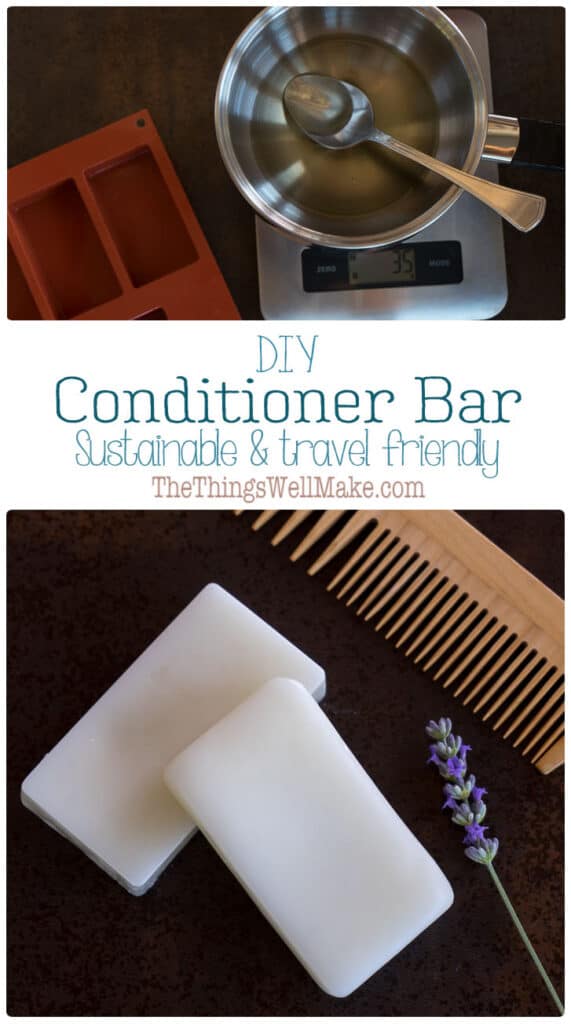
Sustainable and travel-friendly, a conditioner bar is a convenient way to keep your hair healthy, conditioned, and tangle-free. Learn how and why to make your own conditioner bar.
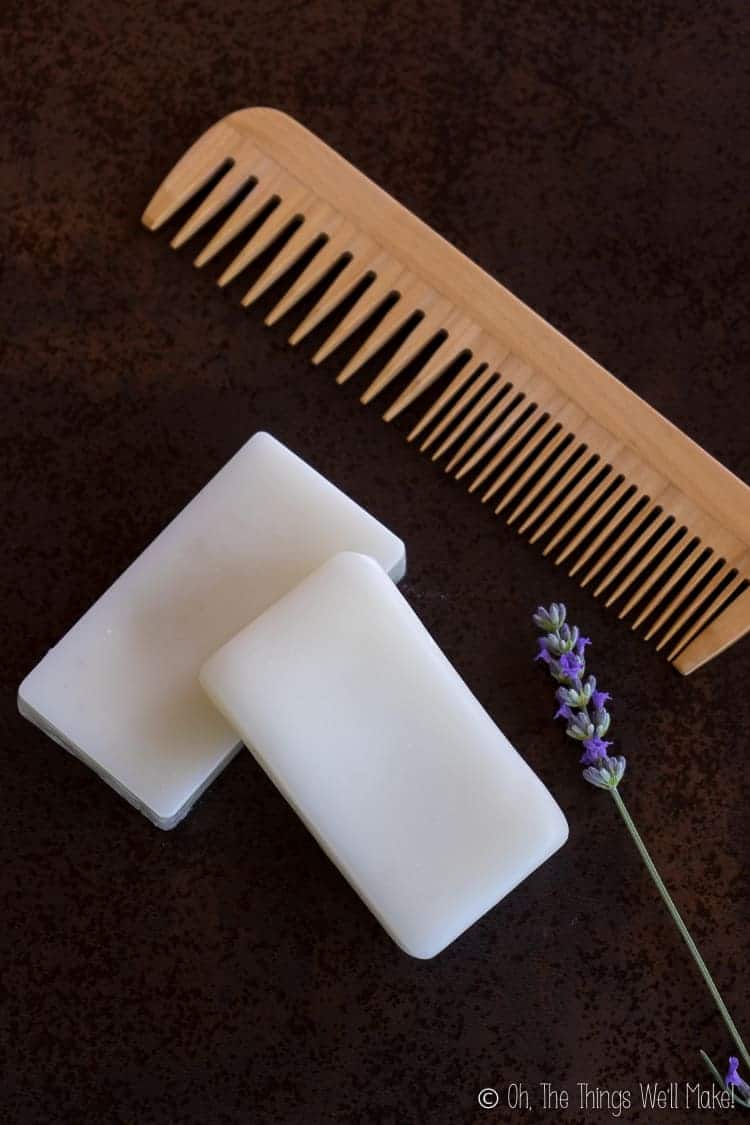
Over the last months, I’ve been a bit absent and busy with summertime activities. Between having my son home from school, the town fiestas, and a family vacation, I feel like I’ve left you all a bit abandoned. I’m now home and finished with most of it, and ready to share some of what I’ve been making lately.
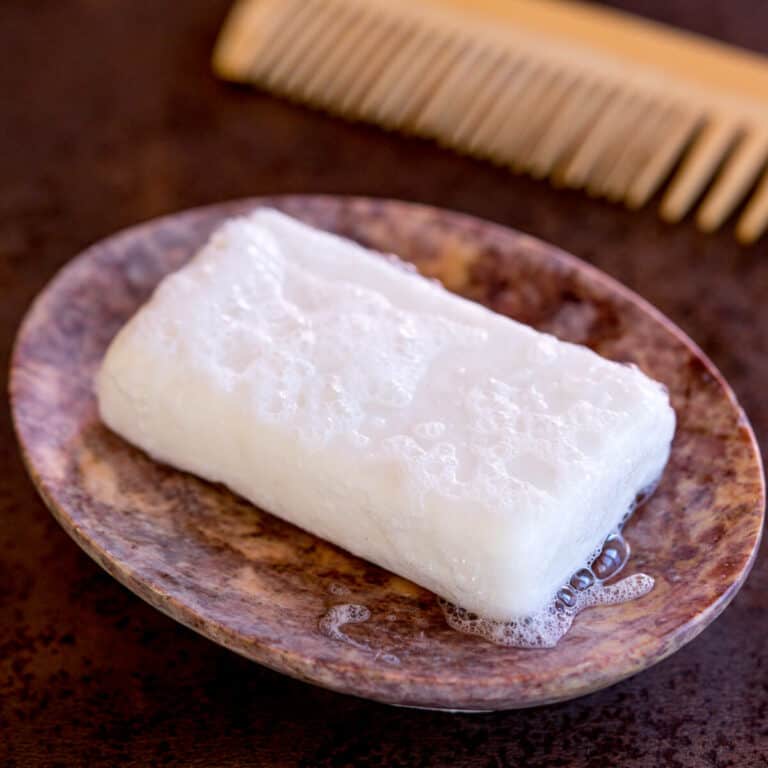
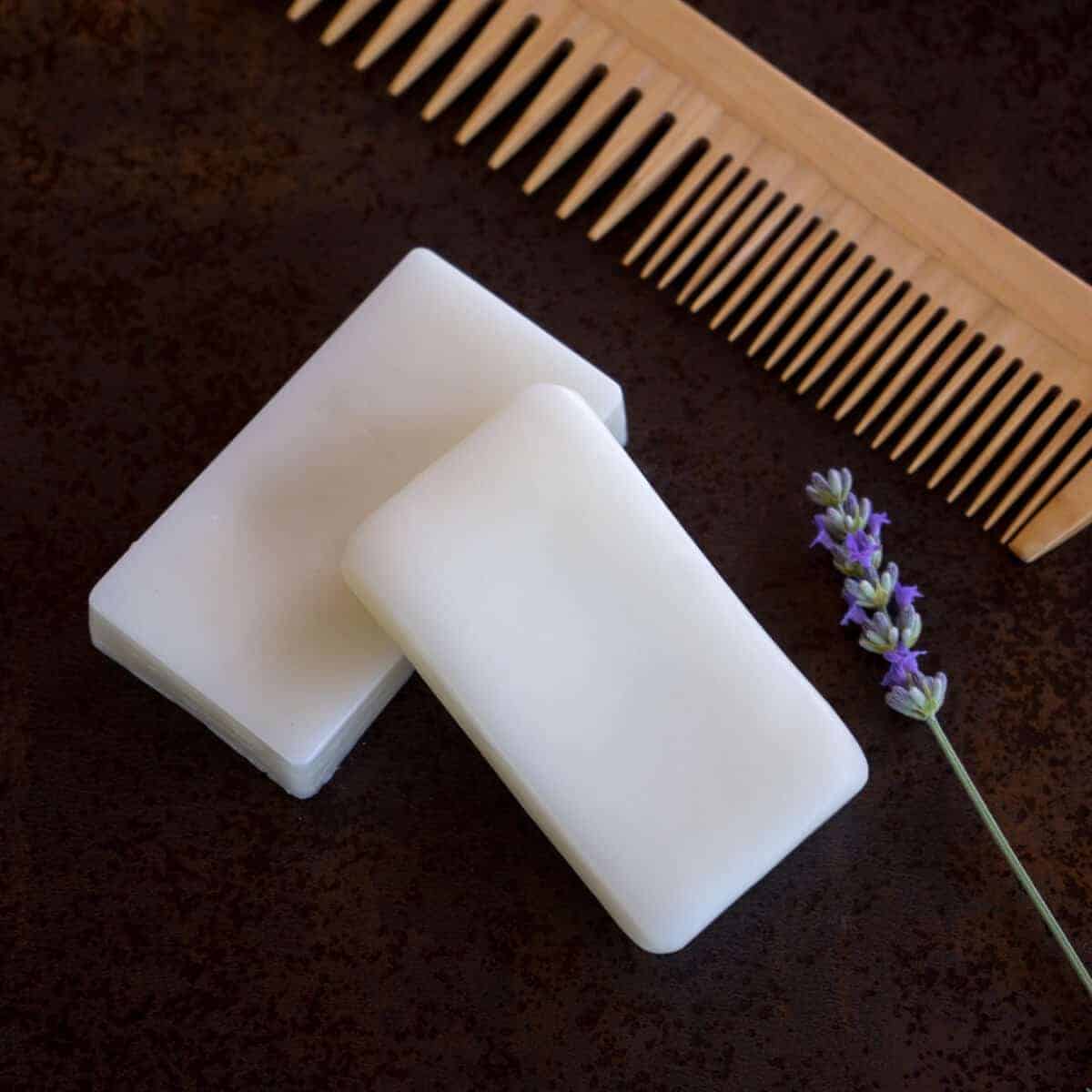
One of the handy products that I made was a homemade conditioner bar.
Let me begin by admitting that I wasn’t even sure I would like using a solid conditioner. I really like the slip and feel of how easy it is to use my “normal” homemade conditioner. It glides easily and I can effortlessly comb through to spread it evenly throughout my hair.
Over the last year or two, though, shampoo and conditioner bars have gained a lot of popularity.
Why make a conditioner bar?
There are a few great reasons to consider making a solid conditioner.
A conditioner bar is a sustainable option
For those who are trying to go “no waste” or who wish to contribute as little waste as possible, making your own shampoo bars and conditioner bars is about as no waste as you can get. I can’t promise you’ll have zero waste unless you can get your hands upon a supplier that allows you to recycle packaging or will fill containers you bring to them, but the products that you are making themselves don’t need any sort of packaging.
Because you aren’t using any packaging for your homemade conditioner bar, you don’t have to worry about if the packaging that you are using is safe or not. (Are toxins from plastic packaging leaching into your products?) You also save yourself the hassle of having to properly clean and sanitize your containers before using them.
Conditioner bars are travel-friendly
With all of the new regulations regarding liquids that can be taken aboard airplanes, having a solid option means less hassle when traveling. You don’t have to worry about separating your shampoo and conditioner in a plastic baggy when passing through security nor will you have to worry about a TSA agent taking your homemade conditioner away from you for not following regulations regarding liquids.
Even if you aren’t flying, there are advantages to traveling with shampoo and conditioner bars versus their liquid counterparts. You don’t have to worry about your homemade shampoo and conditioner spilling all over your other luggage, potentially ruining your clothes and your trip.
Concerned about preservatives?
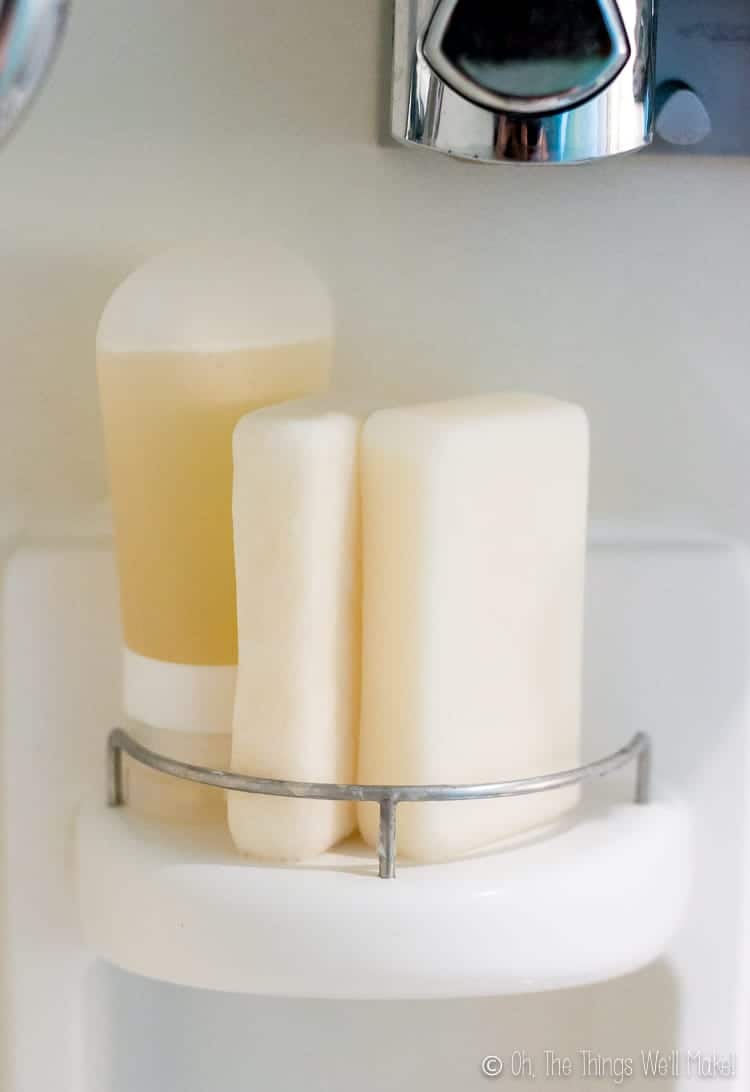
Just as with the shampoo bar, I recommend that you use a preservative when making your conditioner bar. This product is going to be stored in a humid environment and will be used with water often. It is very possible for mold or other microbes to form on the exterior of your bars, especially if you aren’t careful about drying the product properly between uses.
That said, if you are set against using a preservative, this is the safest way to go.
I personally don’t recommend making a liquid conditioner and keeping it in the fridge. Some people try doing that to avoid using a preservative. Even in the fridge, though, you should really only keep homemade emulsions for around the same amount of time as you would keep homemade food-based emulsions like homemade dressing or mayonnaise. (Seven to ten days is the absolute maximum amount of time that I would recommend.)
Conditioner bars, on the other hand, technically don’t need a preservative themselves. They don’t use any water-based ingredients, so there is no need to preserve the bars themselves. You are really only using them because of the way the bars are used. These bars have fats and are quite solid which keeps them more protected from water than the shampoo bars. They tend to repel water quite well. So, if you are careful about getting them dry between uses, yes, you could probably be fine not-using a true preservative. (Yes, I still recommend it.)
Very frugal!
With conditioner bars, you use a lot less product on your hair than what you would use when using a liquid conditioner. So, not only are you wasting less, which is, again, more environmentally friendly, but they are also great for saving money. I’ve been using the same conditioner bar for months now, and I’m not sure I can appreciate much of a difference in size from when I first started using it!
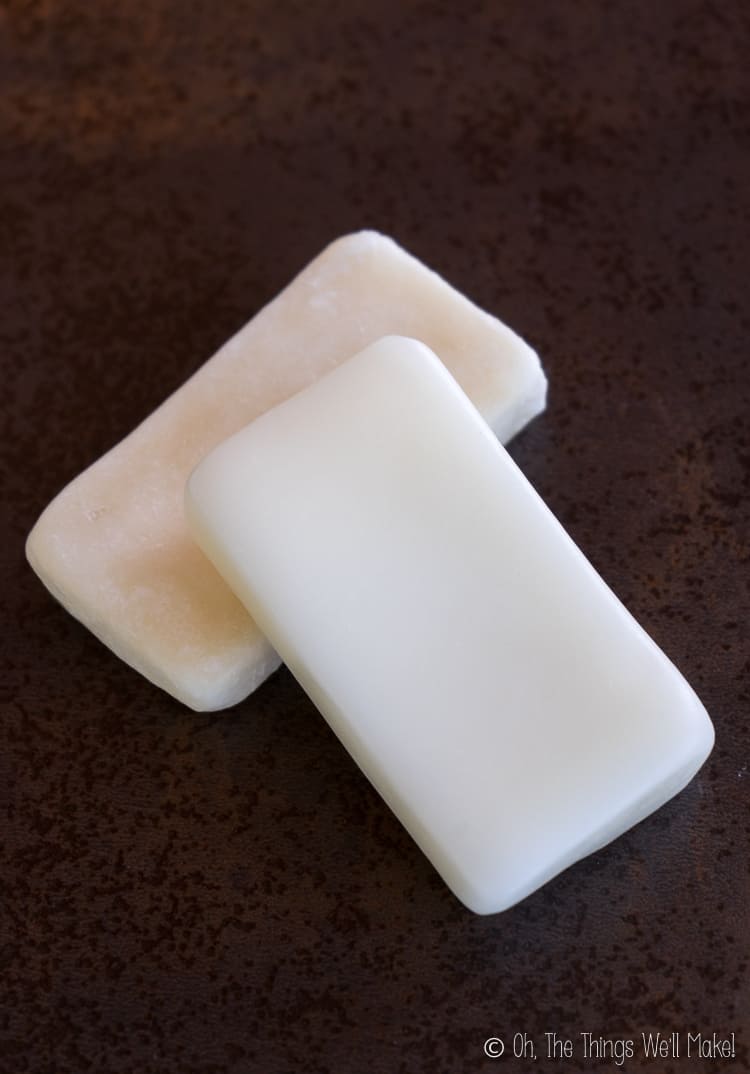
Watch how to make a homemade conditioner bar

How well do conditioner bars work?
If you’re used to applying a large amount of conditioner to your hair, you may find it frustrating to adapt to a conditioner bar at first. The hard, solid quality of the conditioner bar needs to glide over your hair. It rubs off and onto the hair as you rub the bar against it.
With shampoo bars, you can tell that something is happening immediately. You get a lot of lather when you rub water over them, and you can use the abundant lather on your hair with or without the bar in hand. When you run water over the conditioner bar, though, nothing appears to happen. In fact, the water will be repelled by it. You have to patiently run the bar over your hair.
I’m not an especially patient person. I can be patient with people and with formulating weird DIY experiments, but have little patience for slow technology and don’t like wasting my time on certain tasks that I think should be quick. That’s why I didn’t expect to like using a conditioner bar (and why the first time I used it, I wasn’t completely convinced). In the end, though, the conditioner bar has definitely grown on me.
With either type of conditioner, I use my comb to spread the product through my hair. For those who are having a hard time using a conditioner bar, just that small tip may make all the difference for you. With the conditioner bar, not much product is needed. You just need enough to easily get your hair untangled. I run the bar over my hair, comb through, and then rub the bar again over the areas where my comb appears to stick.
DIY Conditioner Bar Recipe
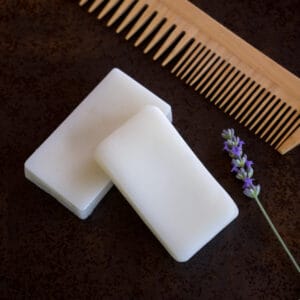
Homemade conditioner bar
Materials
- 70 g BTMS
- 10 g cetyl alcohol
- 5 g cocoa butter
- 5 g coconut oil
- 2 g d-panthenol
- 2 g lavender essential oil or other essential oils or a combination of oils
- 1 g Sharomix or another natural preservative at the correct percentage for the recipe
- .5 g vitamin E
Instructions
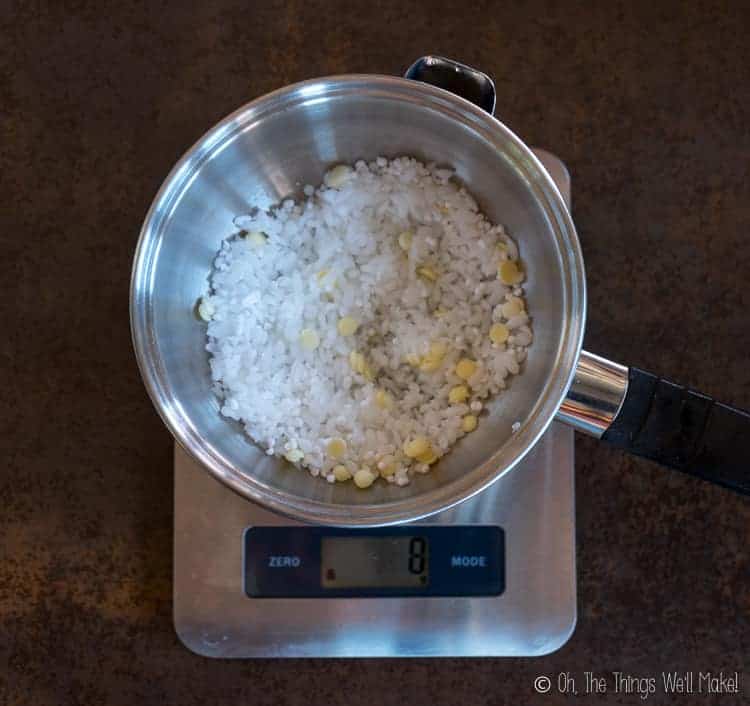
- Weigh out the BTMS, cetyl alcohol, cocoa butter, and coconut oil in a double boiler insert or a stainless steel bowl that can be used over a pan of water.
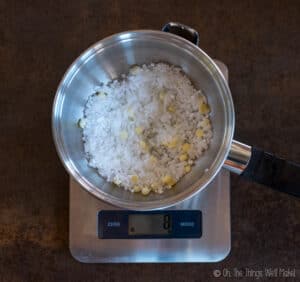
- Gently heat (over a double boiler) until all of the ingredients have melted. Stir them well to combine them.
- Remove the pan from the heat source.
- Weigh out the other ingredients (preservative, essential oils, etc.) and add them to the melted oil-phase ingredients. Mix together all ingredients.
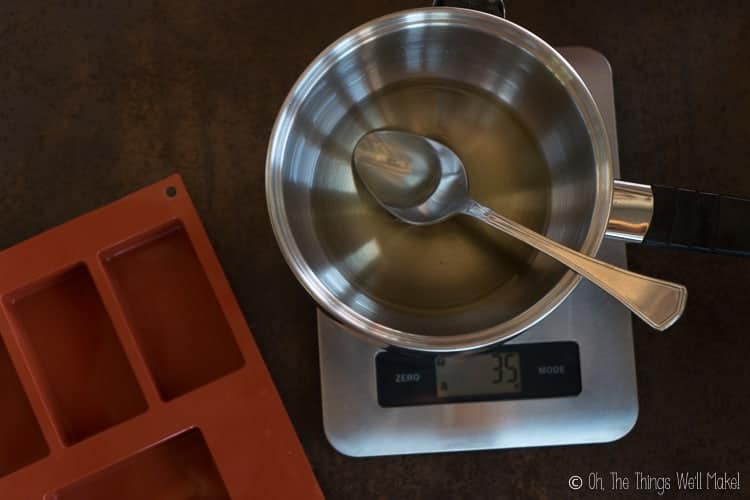
- Immediately pour into bar sized mold. (I used a silicone mold meant for soaps or mini loaf-shaped muffins.) You can find something similar here: https://amzn.to/2SAxYMj
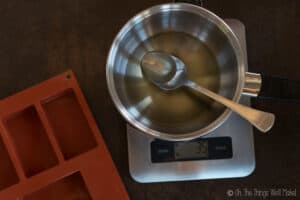
- Allow the bar(s) to cool completely.
- Remove the conditioner bars from the molds.
- You can now immediately use your homemade conditioner bar.
Hello! I’m learning about homesteading and will definitely add this (and your other recipes) to my “wish list”. However, I’d like to make the conditioner bar sooner. I wanted to let you know that the Amazon links in the recipe portion of this aren’t working! You deserve every bit of commission that you can get!!! I will try to hold off before purchasing so you can get some earnings! Thanks for sharing your wisdom!
Hi Amy,
Thank you so much for letting me know, and I really appreciate that! I’ll take a look at those links and update them. I’m glad you’re enjoying the recipes. 😊
I cannot get Sharomix here in the states (at least not that I’ve been able to find). I do have some Benzyl Alcohol-SAL and Benzyl alcohol-DHA. Both of which say to add after mixture has cooled to 100F, but this stuff seems to start solidifying as soon as I take it off the heat. Any thoughts? Also the cetyl alcohol container says to wear a mask to avoid breathing in dust. But these seem to be waxy pellets. Can you give me any more information about safety with working with this ingredient?
Hi Danielle,
Sharomix can be tricky to find in the U.S., so substitutes like the ones you mentioned can work. Since the bar does start to solidify quickly, you can try adding the preservative right after removing the mixture from the heat while it’s still fluid enough to stir in well.
As for cetyl alcohol, the warning is mainly for when it’s handled as a fine powder in manufacturing settings. The waxy pellets used for cosmetic formulation are much less likely to create airborne dust, so normal handling is generally fine.
Tracy, I love your website for many reasons (not the least being the easy name for me to remember 🙂 one is the amount of information you share… in this case of BTMS and cationic emulsifiers I’m making a conditioner bar for someone is on many medications who cannot use storebought shampoo nor conditioner because she gets an allergic reaction on her scalp. So if I used either more natural options in place of BTMS (i.e. Emulsense, or Varisoft) would they be added in the same proportion as the BTMS? I still want to make this as a bar and not a liquid conditioner.
Thanks in advance, Alicia
Hi Alicia,
Thank you! I’m glad you find the information helpful.
Emulsense or Varisoft can work as alternatives to BTMS, but they don’t behave exactly the same way, so you may need to experiment a bit with the percentages. BTMS is particularly good for conditioner bars because it provides both conditioning and structure. If you substitute it, I’d start with a similar percentage and adjust if needed to get the texture and conditioning effect you want.
Now, why on earth would you leave the United States just to make things from scratch?..mmmm
Hi Adrienne,
Life just took me in a different direction. 😊 I ended up staying in Spain after meeting my husband here, and the blog grew out of my interest in making things myself and sharing what I learn along the way.
Hi – have you ever tried making a solid hair gel …. ? Or just turning a hair gel into a solid for easy travel—- I have the perfect shampoo… hair conditioner, face cream solid … now need hair gel …
I want to got through security with no liquids ,or gels…
Hi Nathalie,
That’s an interesting idea! I haven’t tried making a solid hair gel yet. Most hair gels rely heavily on water-based ingredients, which makes turning them into a solid a bit tricky. It might be possible to experiment with waxes or butters to create a styling bar, but the texture and hold would likely be different from a traditional gel.
what other oils besides coconut oil can I use?
Hi Jodelle!
Pretty much any oil should be fine. Argan is a great oil for hair. You could also use some of the soft butters like mango butter or even tallow!
I love this website!
Just a quick question, what BTMS do you recommend 25 or 50?
I tried the link and I think it’s broken.
Hi Jamie,
Sorry about that. I generally use BTMS 25. I write more about that in my original conditioner recipe.
and I am sorry I called you Allison twice…. 😉
hahaha- no worries!
HI Allison,
It’s me again with another question. I don’t have cetyl alchohol. I do have witchhazel. Again after some googling, I’m not finding the answer. Could I use witchhazel instead? Same amount?
Thanks again,
Petra
Hi Petra,
No, witch hazel is nothing like cetyl alcohol. (It’s a waxy co-emulsifier and not a liquid alcohol!) If you can’t find it, I’d just try increasing the BTMS a little more, but I can’t promise the outcome will be jsut like mine.
This recipe makes only I bar? if I want to make more like 8 at a time can you share the recipe? Thank you so much.
Hi Laura,
Yes, the recipe as written makes one large bar. If you’d like to make more, you can simply multiply all of the ingredients by the number of bars you want to make. So for 8 bars, just multiply each ingredient by 8.
Hi Allison,
I have a question to BTMS. I have Fluidlecithin BE10 at home that I use for my bath bombs. Can I use this for the conditioner bars as well instead of BTMS? I tried googling and didn’t get very far.
Also I found it under BMS. What’s the difference?
thanks so much,
Petra
I’m assuming that BMS is just someone who is abbreviating differently. (It should have behentrimonium methosulfate and cetearyl alcohol).
For a conditioner to be, well, conditioning, you need a cationic emulsifier like BTMS. Other emulsifiers will give more of a lotion feel that won’t give the same slip/detangling as BTMS.