

How to Make Turkish Delight
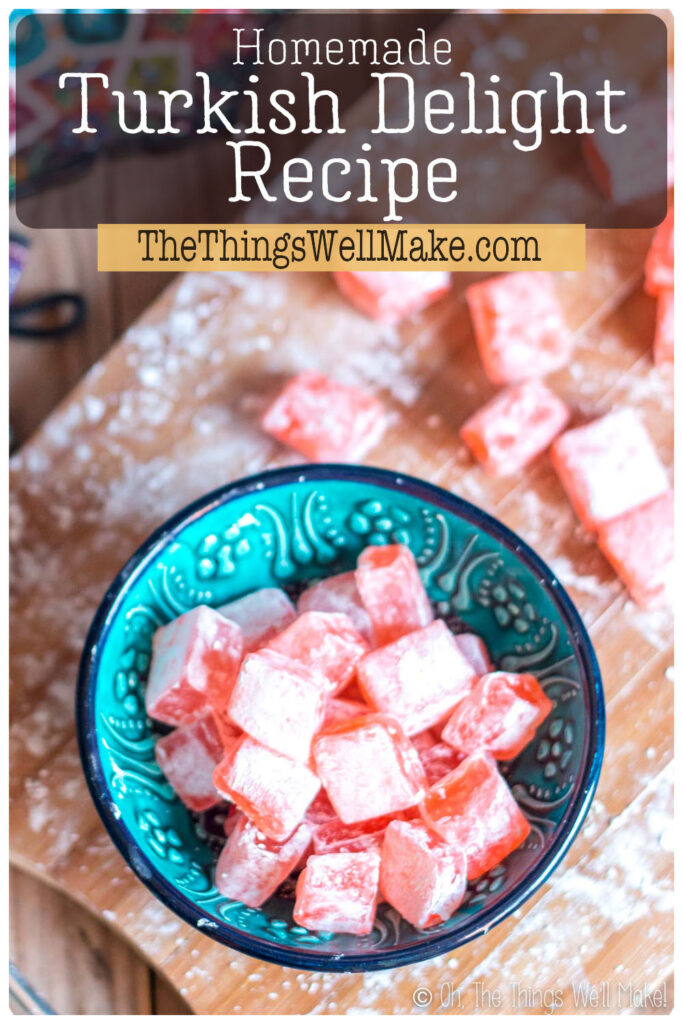
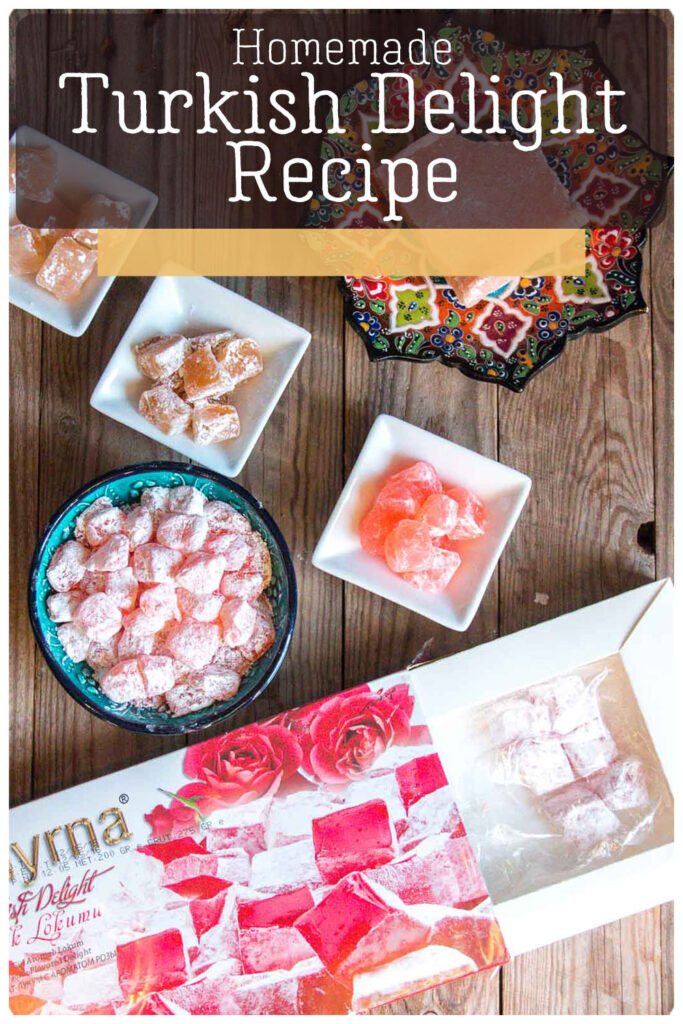
Sweet and slightly exotic, Turkish delight is a popular Middle Eastern candy that can be made and flavored in a variety of ways. Learn how to make it at home and customize it to suit your taste.
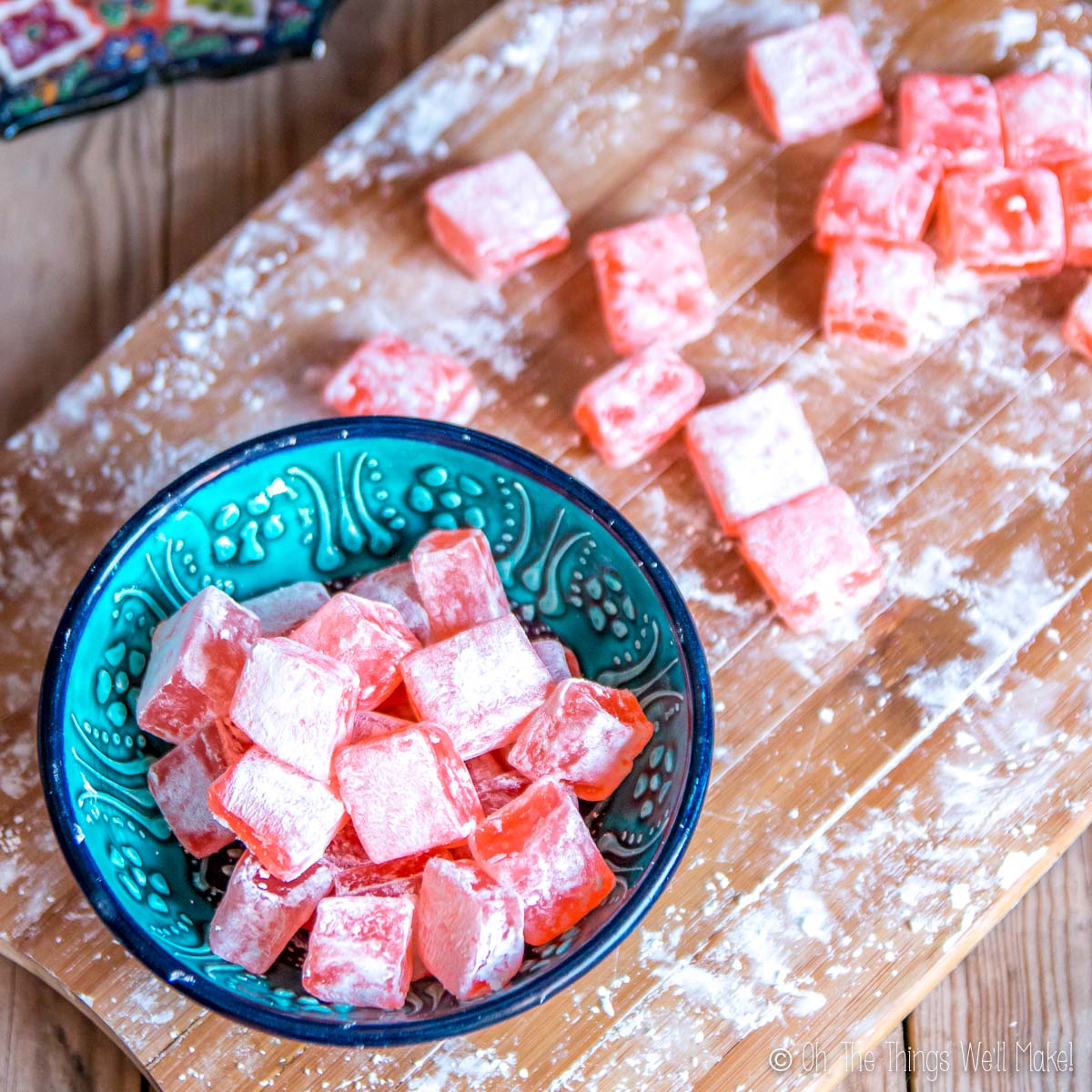
Several years ago, our family went on a European cruise that brought us to Italy, Croatia, Greece, and Kusadasi, Turkey. Of course, when cruising, you only make short stops in touristy areas. So, of course, I do not proclaim myself an expert in anything Turkish.
While I was there, though, rather than picking up an “authentic fake watch” (Yes, that was on a sign I saw!), I bought two beautiful hand-painted bowls and several boxes of Turkish delight.
What is Turkish delight?
Turkish delight, also traditionally known as lokum, is a sweet gel confection made with sugar and starch. It can be flavored in a number of ways, often with nuts, citrus fruits, and/or rose water. The most common is probably the pink-colored rose-flavored lokum, but other popular varieties use pistachios and walnuts. It’s very popular in the Middle East but has gained popularity in other parts of the world.
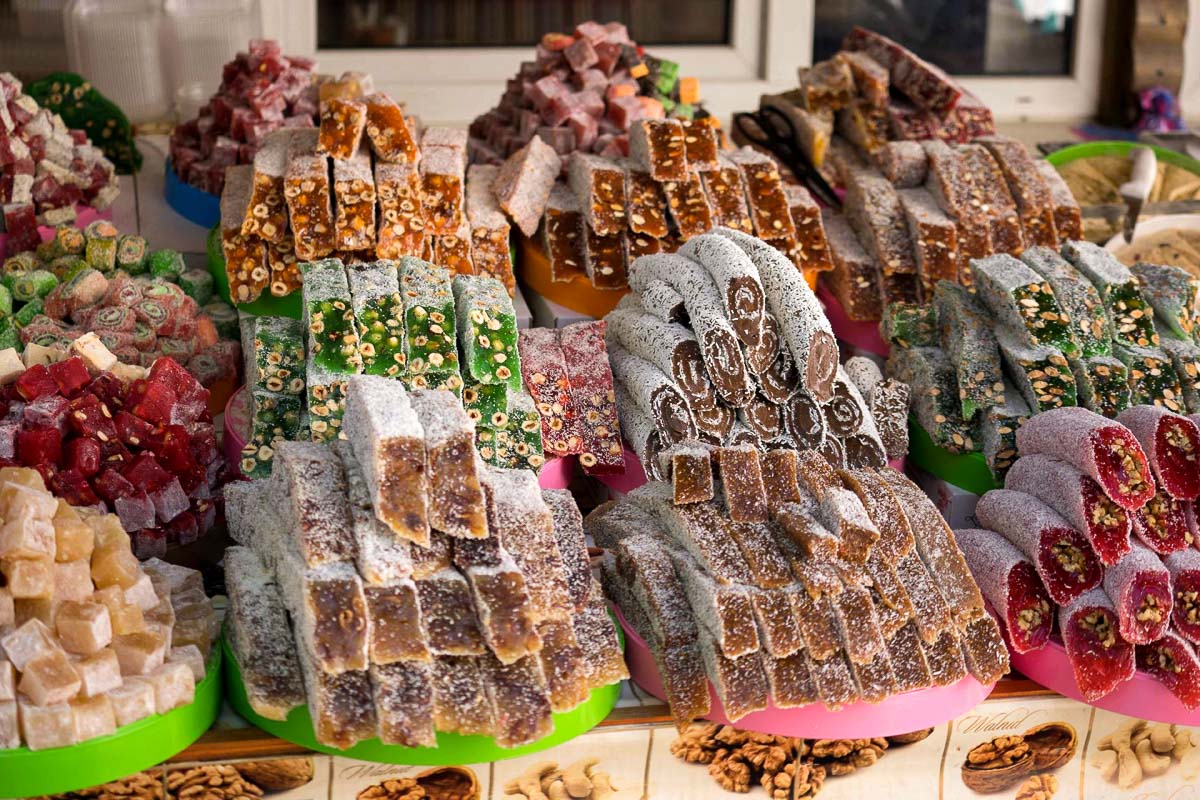
This gel-based sweet has piqued my interest ever since I watched an animated movie of The Lion, The Witch, and the Wardrobe (from the Chronicles of Narnia) at my grandparents’ house as a kid. In the story, the white witch lures young Edmund Pevensie with this delectable treat. His love of Turkish delight was enough to get him to betray his family and join her.
With my love of trying new things, especially anything exotic or with a “perfumed” type flavor (like litchees or roses), I knew I had to give it a try.
What does it taste like?
I suspected that I would like Turkish delight, but wasn’t prepared for how much I would like it. Normally, I don’t eat a lot of sweets. In fact, I really only have a hard time passing on licorice and its chewy texture.
With my first bite of rose-flavored Turkish delight, though, I was immediately taken in by its exotic flavors combined with that chewy texture that I adore. Unfortunately, the boxes I had bought were a bit deceiving. They were quite large but were well padded. I was a bit disappointed to find that I had really only brought back a few pieces of this new treat I loved so much.
The other variety I bought was more like a nougat with peanuts and pistachios. Both were delicious.
Making a traditional Turkish delight
So, I was determined to learn to make Turkish delight from scratch at home. After seeing numerous recipes, I figured making it must be easy. Unfortunately, after numerous attempts, I wasn’t completely happy with the outcome. I ended up with a sweet treat with a delicious rose flavor, but felt that it lacked a bit of chewiness.
Traditional Turkish delight is made with a starch and sugar. You have to play with the gelling of the starch and the hardening of the sugar mixture to get the right texture. (In contrast, some modern versions use gelatin or a similar gelling agent to achieve its characteristic chewiness.) While my boxes of Turkish delight had corn starch as the main starch used, I imagine that the truly traditional versions of this treat called for other starches instead.
When I published my first Turkish delight recipe on this blog, I used corn starch (as most recipes do) and avoided adding wheat because I was testing out a gluten-free diet at the time. (Wheat flour was on the list of ingredients of the lokum I had bought.)
Many people enjoyed the recipe, but I still wasn’t happy. I didn’t get consistent results with the recipe and found it to be finicky. I also wasn’t sure about the texture achieved with corn starch alone.
What didn’t work
While my first attempts resulted in a flavor that was spot-on, the texture was a lot lighter and softer, not at all chewy like the Turkish delight I had bought in Turkey. So, I tried numerous times to get it right.
I’m almost embarrassed to say how many times I have tried to make this.
Experimenting with the texture
When you rely on the cornstarch to thicken the candy, you end up with a semi-solid mass of candy, but it is more like a solid gel and not at all chewy. On the other hand, a chewy candy such as taffy is made by achieving a certain temperature with a mixture of sugar and water. So, I decided to experiment using different temperatures for the sugar and water mixture.
During my first attempts, I brought the sugar to 240ºF, just above the point where the sugar is inverted (more on that in a sec), and then added in the cornstarch solution. I ended up with a rose-flavored jelly treat that wasn’t at all chewy. It was sort of gelatinous in texture (although that doesn’t really describe it well either).
I then tried heating the sugar solution to the hardball stage before adding in the cornstarch solution. The result? A chewy Turkish delight that wasn’t so powerfully sweet, but with a caramelized sugar flavor reminiscent of flan.
The challenge was to get something in between.
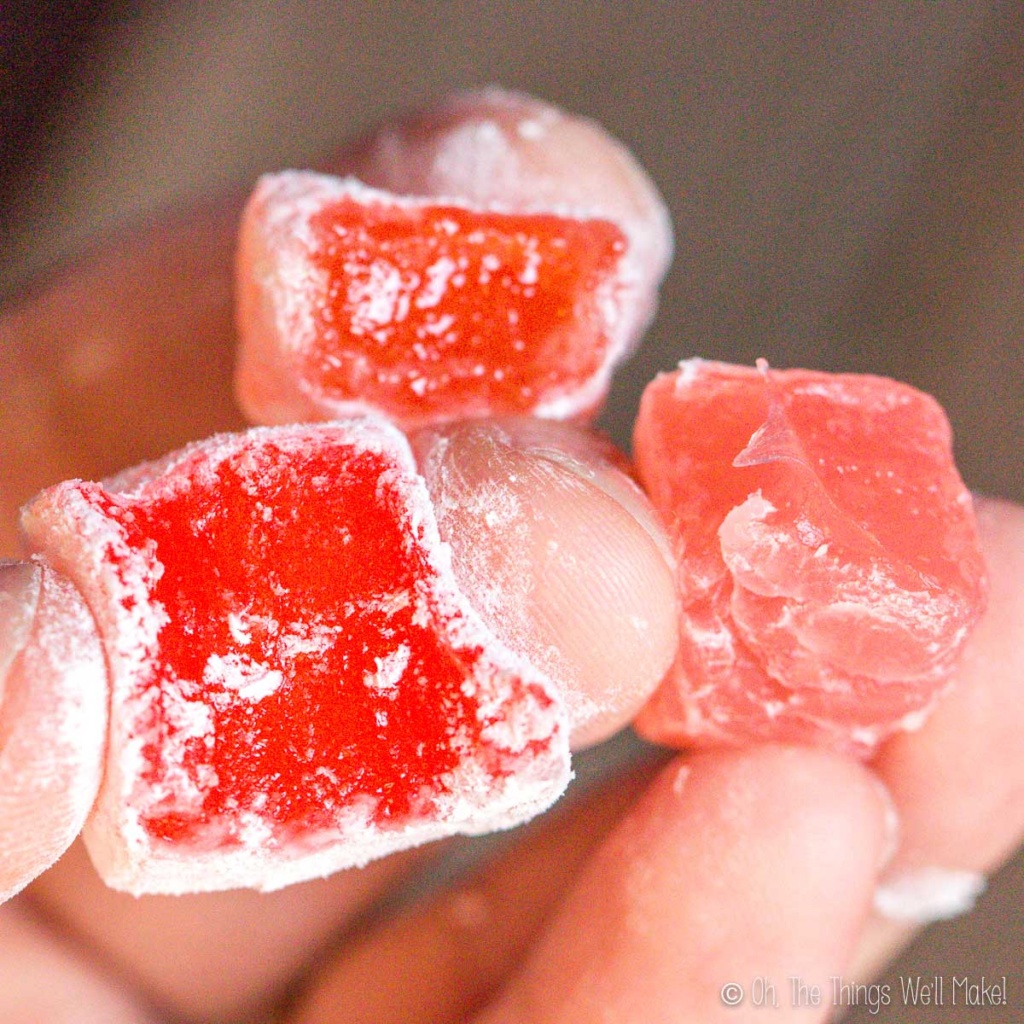
Comparing the textures of the store bought Turkish delight (left, bottom) to a softer, early attempt (right, bottom) and a chewier version (top) 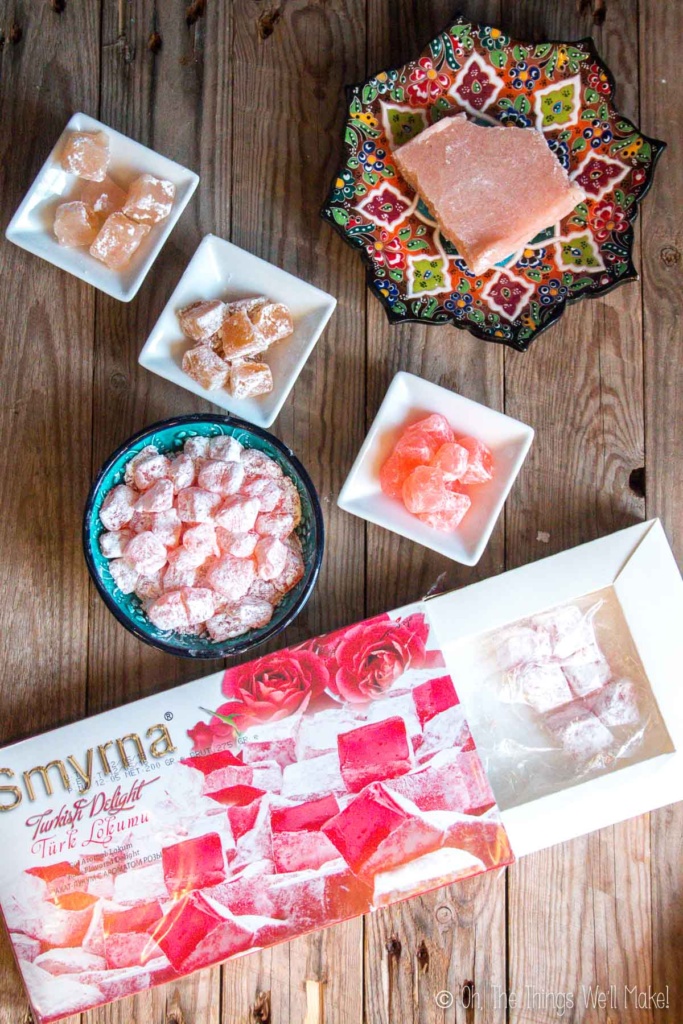
Various attempts at Turkish delight by the boxed candy I bought in Turkey. 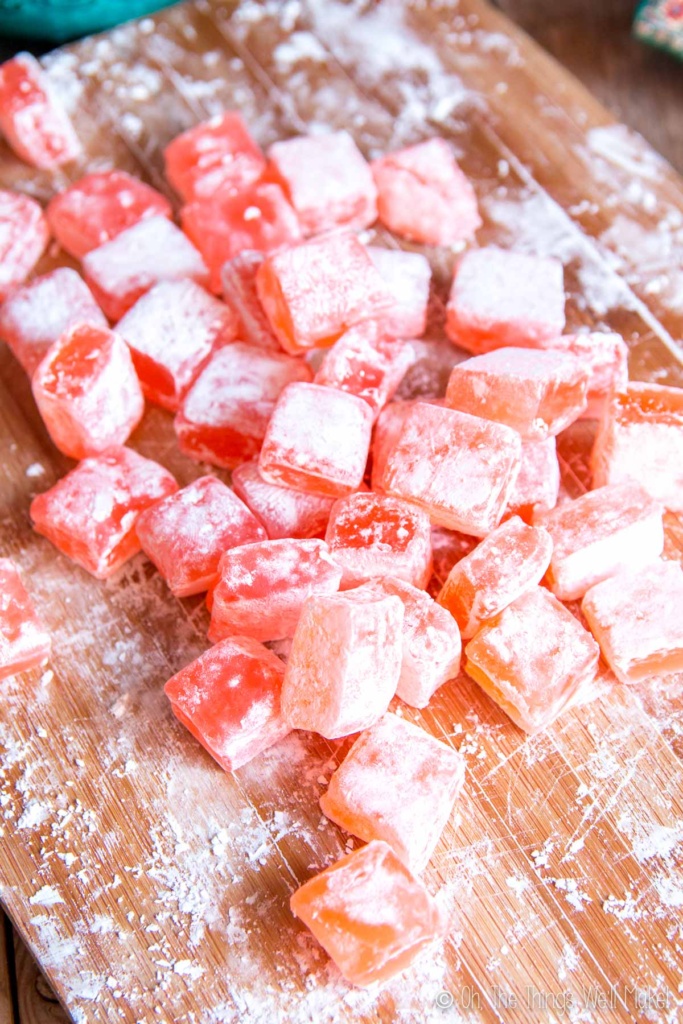
Two versions of homemade Turkish delight
In my first published recipe, I settled on heating the syrup to 260ºF. (Even at that temperature, though, the candy can take on a more caramelized flavor.)
Unfortunately, with that first recipe, I found there was a lot of room for error, even when following the recipe carefully and monitoring temperatures along the way. The final result depended on the cooking time, the humidity of the cooking space, etc.
I have since found that using other starches is the key to getting great texture without all of the hassle.
Adding the starch mixture
Many recipes online tell you to make a sugar syrup first and then make a separate paste out of the starch (normally cornstarch) and water. You are then supposed to mix everything together and cook the mixture longer. While I tried that method first, I didn’t see any benefit to making a separate paste out of only starch and water. It only made for difficult blending later on. Instead, I found it much easier to add an uncooked mixture of water and cornstarch to the sugar syrup and cook them together to thicken them.
From what I have read about Turkish delight production, it seems to be the usual way of making it anyway.
Adding the flavoring
Most recipes have you add the rosewater or other flavorings right before pouring the mixture into the mold, once you’ve achieved the desired consistency.
Adding flavorings such as rose water at the end, though, adds more moisture to the mixture. That, of course, inevitably changes the final texture, softening the candy. I’ve found that with my new recipe, it’s fine to add the rose water as part of the water used at the beginning. The flavor holds up quite well through the cooking process.
Another option? I found a recipe from a Turkish girl who flavored her Turkish delight with rose oil. While that sounds like a great solution, it’s also an expensive one for most of us.
Ingredients
So, after years of experimentation, I’ve finally found a recipe that I’ve been able to reproduce successfully several times now. The key to getting the texture and flavor I wanted was to use a different starch.
My first success used a 50/50 mixture of wheat flour and cornstarch. The wheat flour helped get a chewy texture that worked really well for this recipe. Still, it was tricky to cook it down enough to get the candy firm enough. (Those who’d like to give it a try, though, can substitute out half of the cornstarch in my original cornstarch-based recipe.)
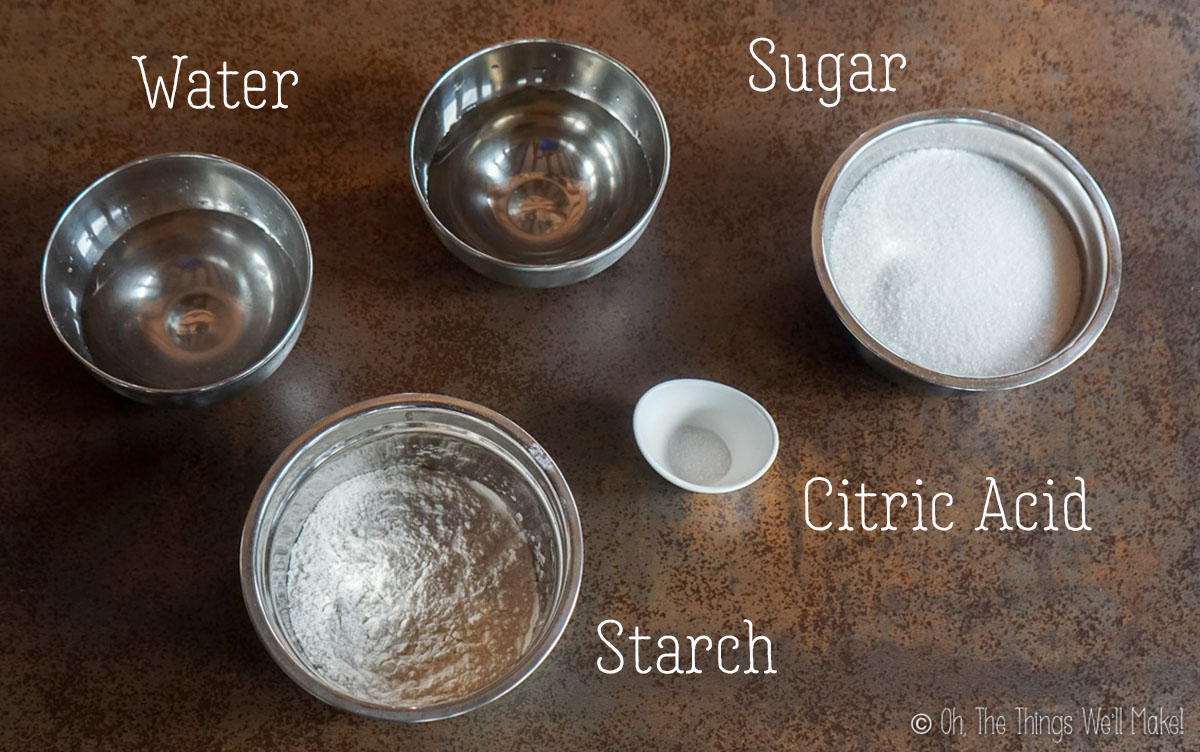
In the end, my favorite version uses rice flour instead of cornstarch.
Other than the rice flour, I used white sugar, water, and some citric acid. I flavored my candy with rosewater, but you can add other flavorings instead. If you want to make pink candy, you’ll also want to use some red food coloring. (On my first attempt, I used homemade beetroot powder and it worked quite well as a natural food coloring!)
Perhaps in the future I’ll try with other starches. I’d love to hear from those of you who have done that sort of experimentation!
Does it need cream of tartar?
Most recipes for Turkish delight use cream of tartar, many insisting that it’s very important for the recipe. My conclusion, after some investigation, is that the cream of tartar is only being used to acidulate the mixture. The sugar syrup you make at the beginning is also known as invert sugar. It helps keep your final candy from crystalizing.
As cream of tartar isn’t easily available in Spain (nor was it listed on my box of Turkish delight), I used citric acid instead. To make invert sugar you slowly cook the water, sugar, and citric acid (or cream of tartar) until you end up with a syrup around 236ºF. If you don’t have citric acid, you can also use lemon juice to bring down the pH.
Incidentally, some recipes added the cream of tartar to the cornstarch mixture rather than to the sugar syrup. I’m not really sure what they were intending to do, but I feel like they sort of missed the point of what the cream of tartar was actually meant to do.
Making Turkish Delight with Cornstarch
Before beginning, prepare the mold you plan on using. I used a small silicone mold greased with coconut oil. If you don’t have silicone pans, line a small baking pan with wax or parchment paper. (Consider greasing the paper with oil or butter to keep the candy from sticking to it.)
Mix together the sugar, water, and citric acid in a heavy bottom pan over medium to high heat. Bring the mixture to a slight boil before lowering the heat.
Continue to cook the mixture over low to medium heat until you reach 240ºF. While you shouldn’t stir the mixture throughout the process (as this can affect the temperature), you can occasionally use a spatula to wipe down any sugar crystals from the side of the pan.
As the sugar syrup cooks, mix together the cornstarch, water, and rose water.
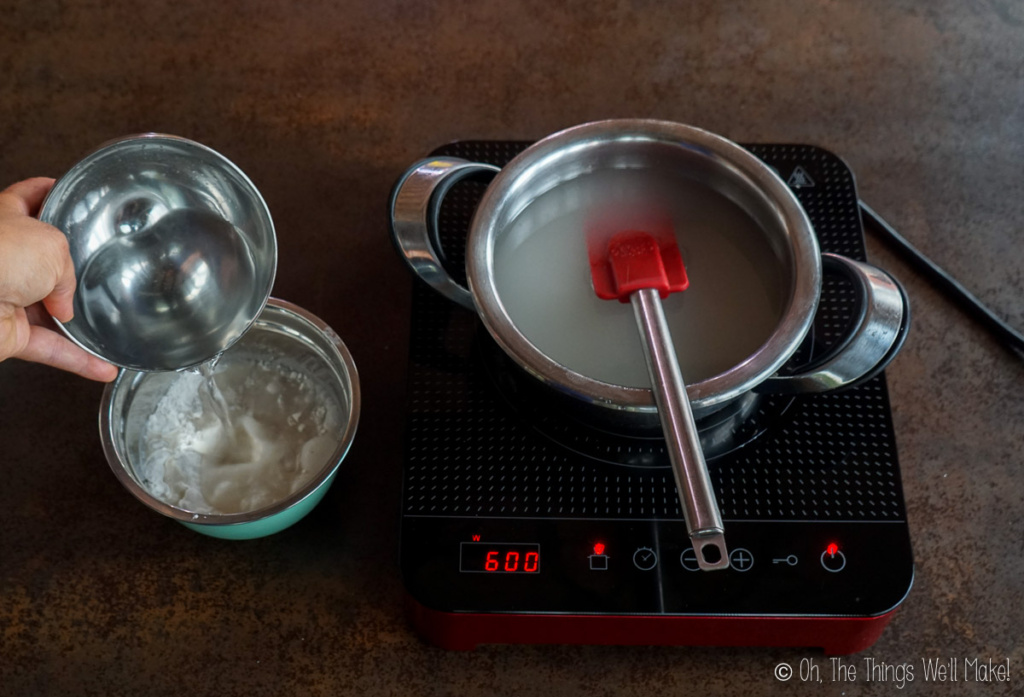
Mix starch and water. 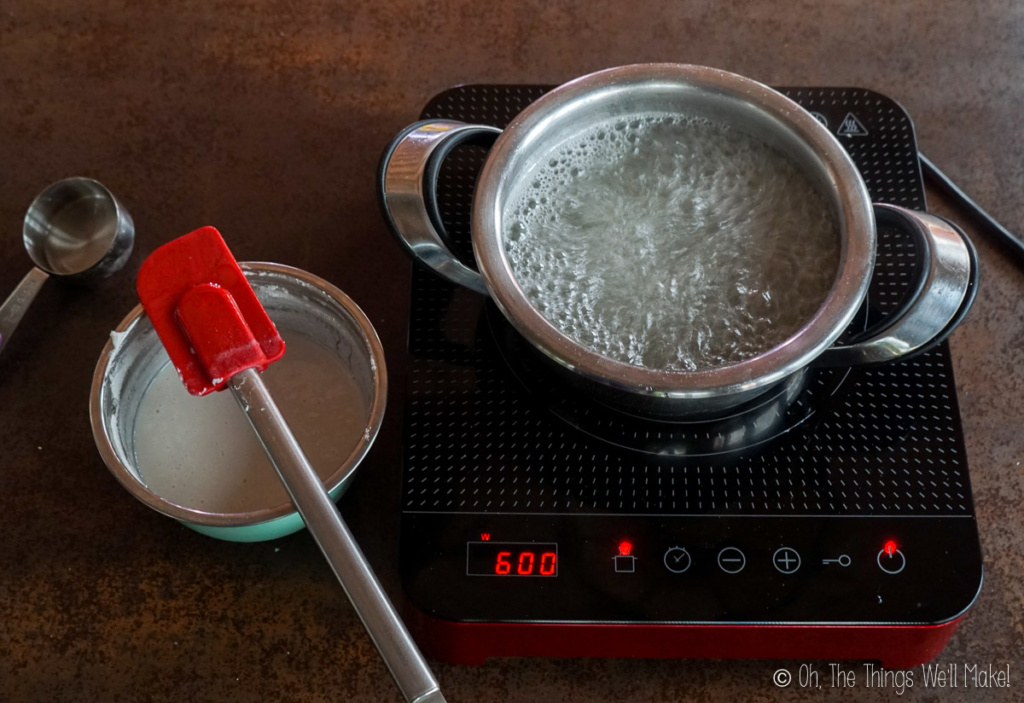
Bring sugar syrup to 140ºF. 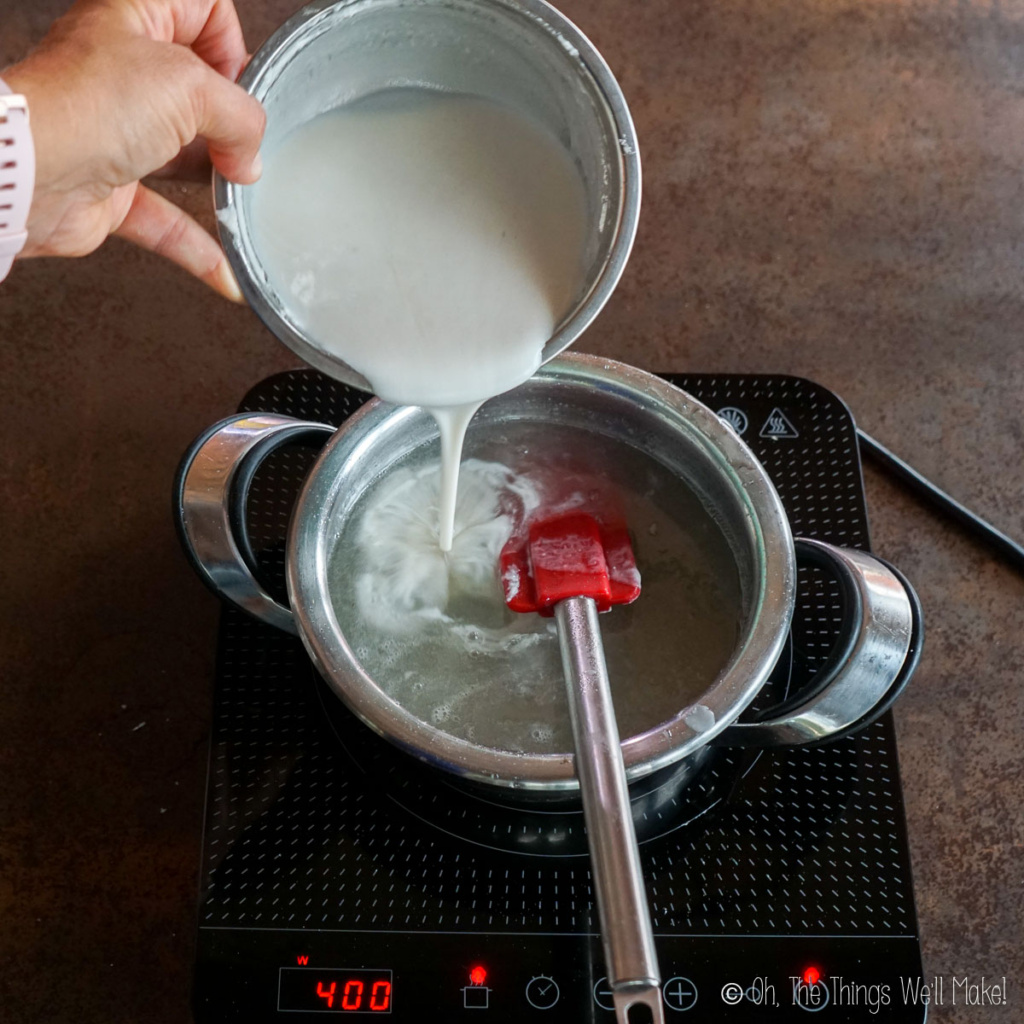
Add the starch mixture to the sugar syrup.
When the sugar syrup reaches the right temperature, take it off the heat source. Pour some of the sugar syrup into the starch solution to warm it. Then, drizzle the starch mixture into the hot sugar syrup while continuously stirring them together.
Once combined, cook the mixture over low heat, stirring constantly. It should soon get quite thick. If you have a hard time removing the lumps, you can use an immersion blender to help achieve a smooth texture.
To achieve a chewy candy, you will want to reduce and thicken it even more. That can be achieved by cooking it for quite some time over low heat until you get the desired consistency.
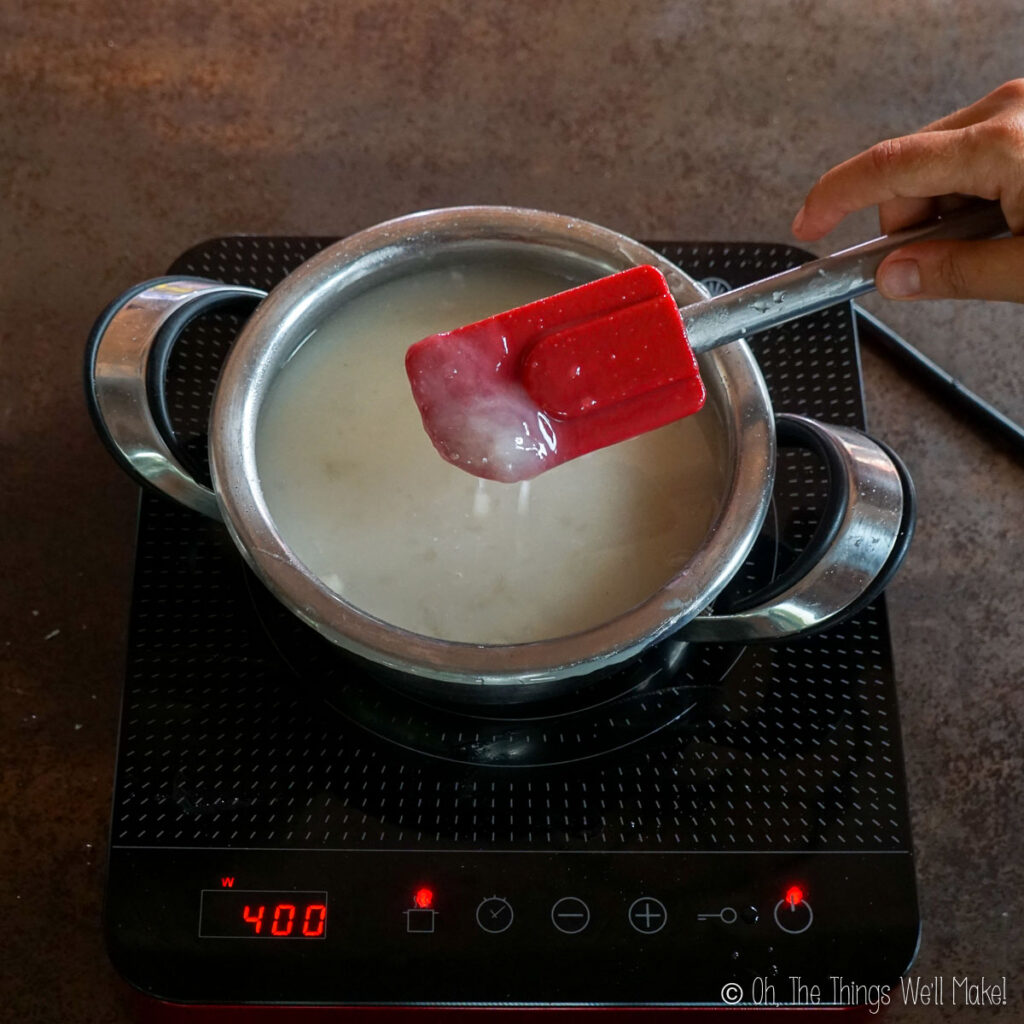
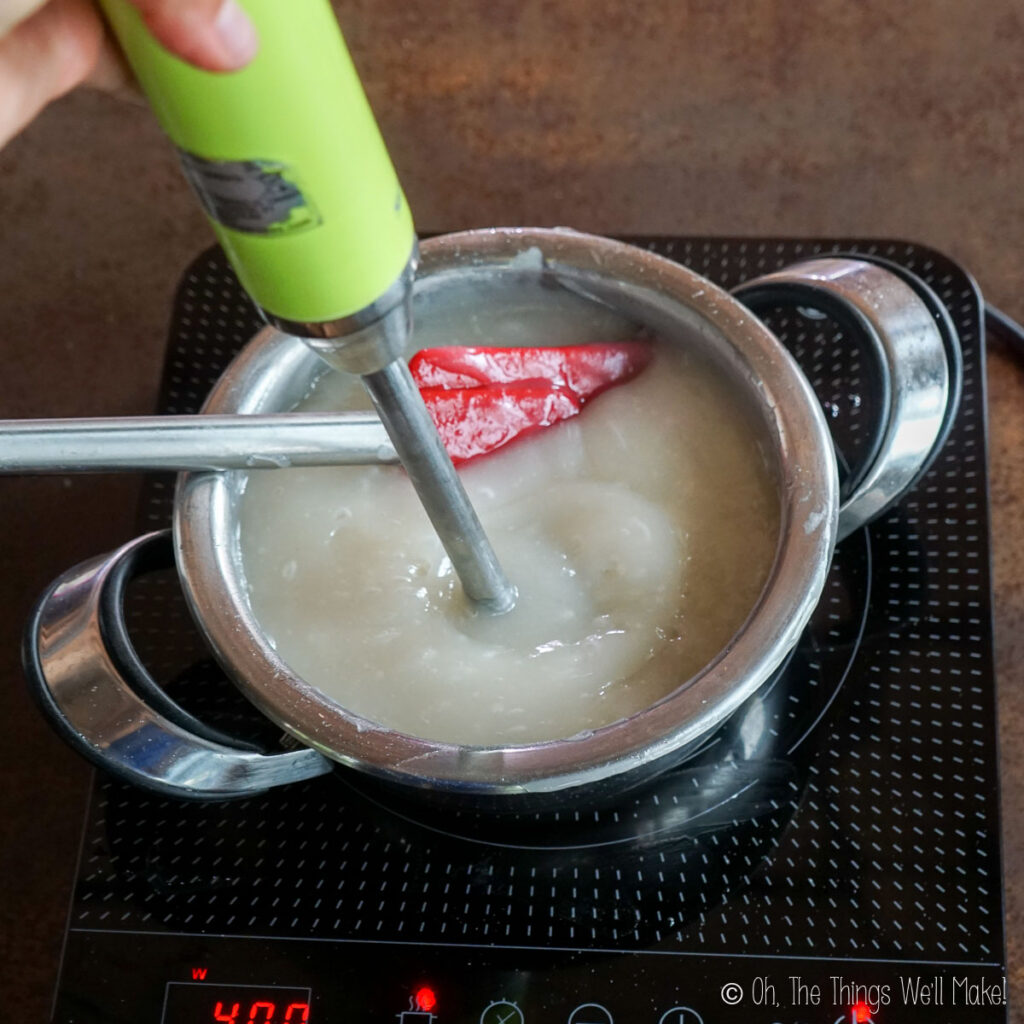
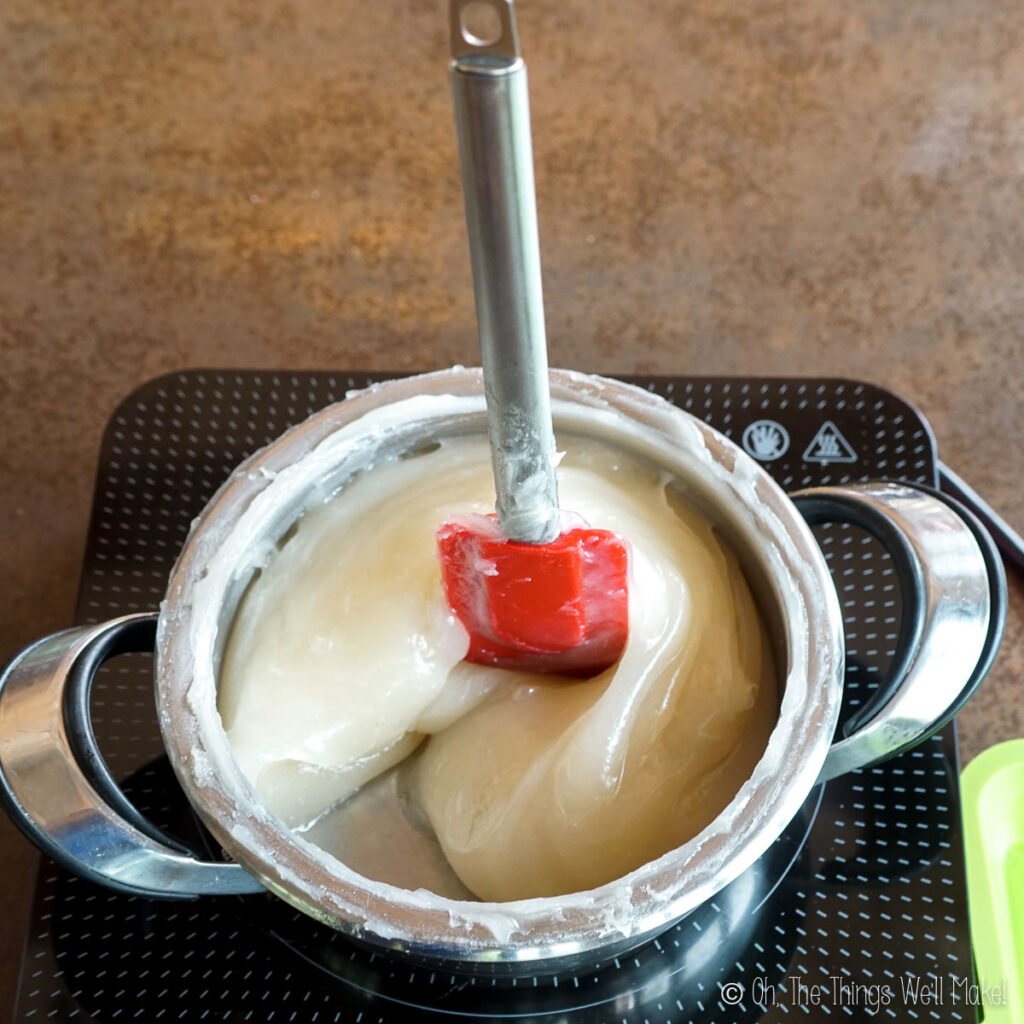
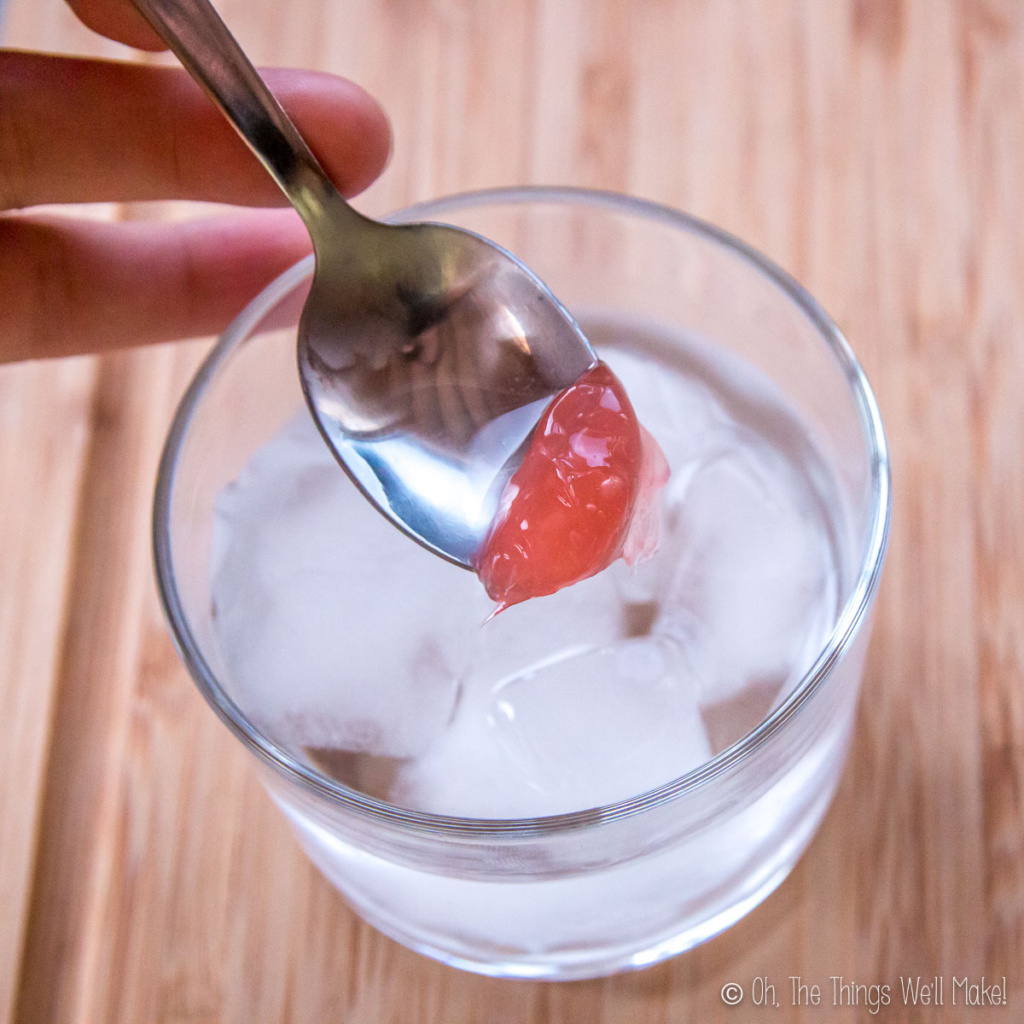
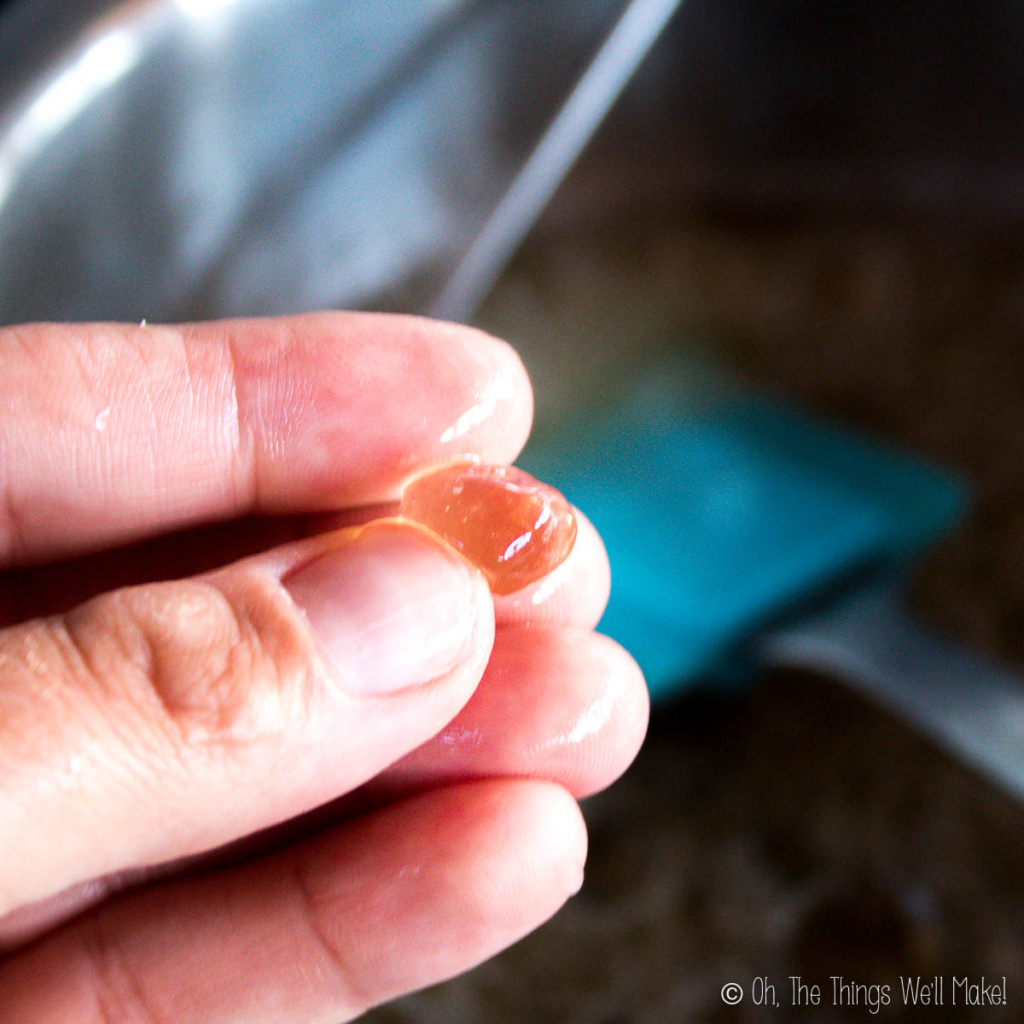
Check the consistency by adding some of the hot mixture to cold water to cool it. When the cooled mixture can be shaped well and hold its shape, the mixture is ready and you can pour it into the prepared mold. Spread it out as best you can with a spatula. It should be very thick and sticky.
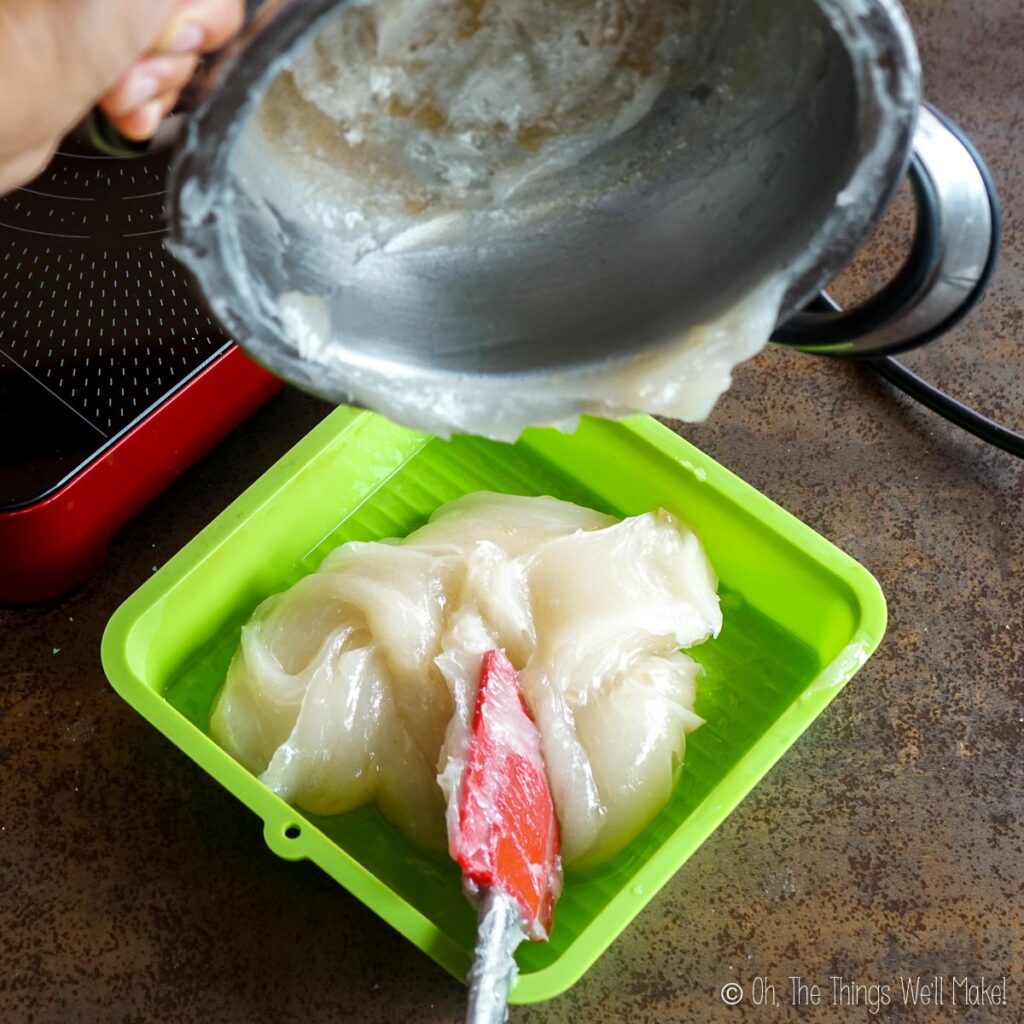
Let cool for several hours.
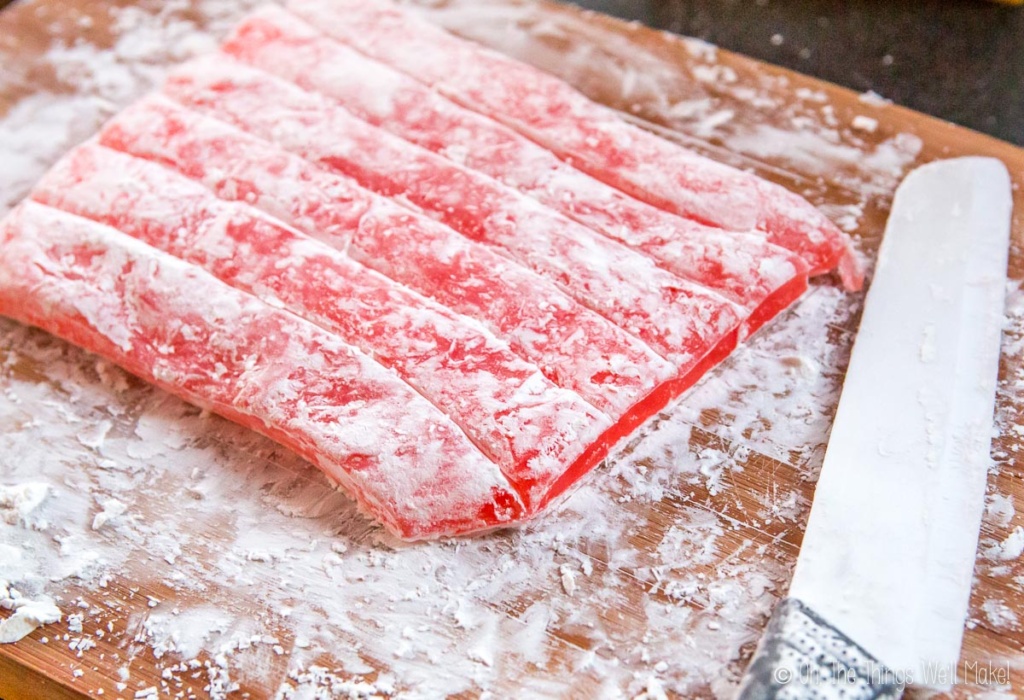
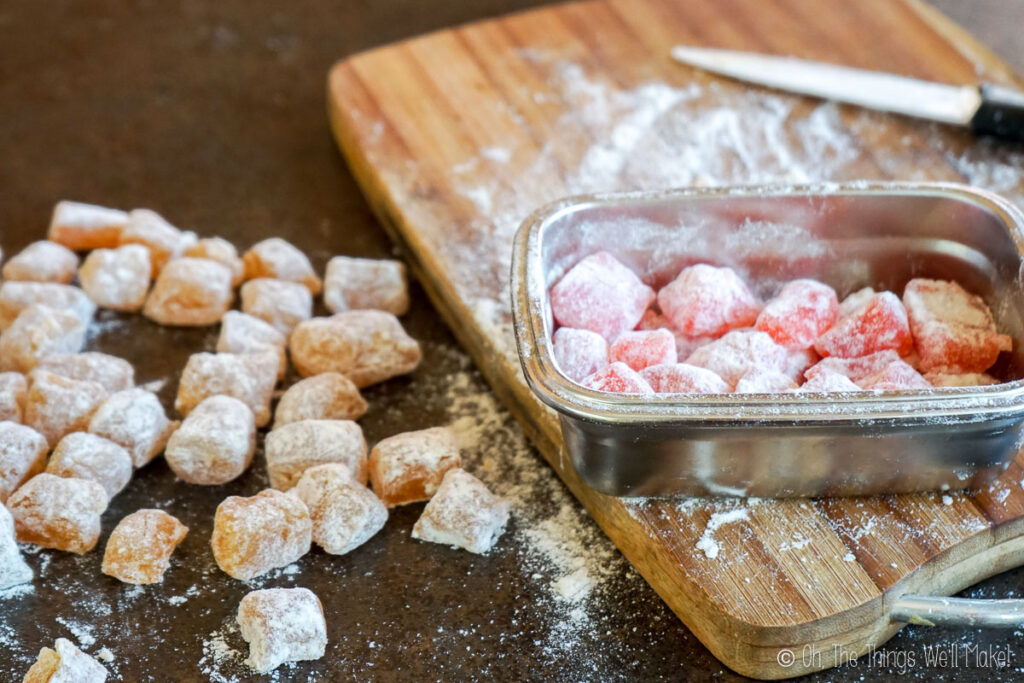
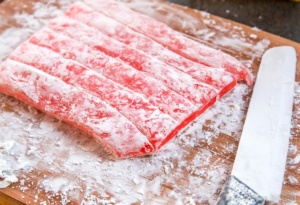
Unmold the mixture onto a clean counter sprinkled with cornstarch. Cut the candy into small squares with a sharp knife, coating each of them with cornstarch to keep the candies from sticking to one another.
Preventing sticking
Most recipes call for coating the candy with powdered sugar or a combination of powdered sugar and cornstarch to prevent them from sticking to one another. The Turkish delight I bought in Turkey was only dusted with cornstarch and not with sugar. Turkish delight is already very sweet. Plus, the candy may “sweat” causing the sugar coating to “melt” off of the candy. That’s why I don’t recommend coating the candy in powdered sugar.
I recommend coating the candy with the starch you’ve used instead. If using sugar, you may have to add starch to it or reapply the coating before serving your candy.
Making Turkish delight with rice flour
You can probably guess by my introduction, that my new favorite method for making Turkish delight uses rice flour. The process is simpler, and I prefer the result. You don’t even need a candy thermometer!
To make Turkish delight with rice flour, mix together all of the ingredients in a saucepan. Whisk the ingredients together, concentrating on getting out any lumps. Cook the mixture over medium to high heat until it begins to boil. Then, lower the heat to low to medium, stirring often.
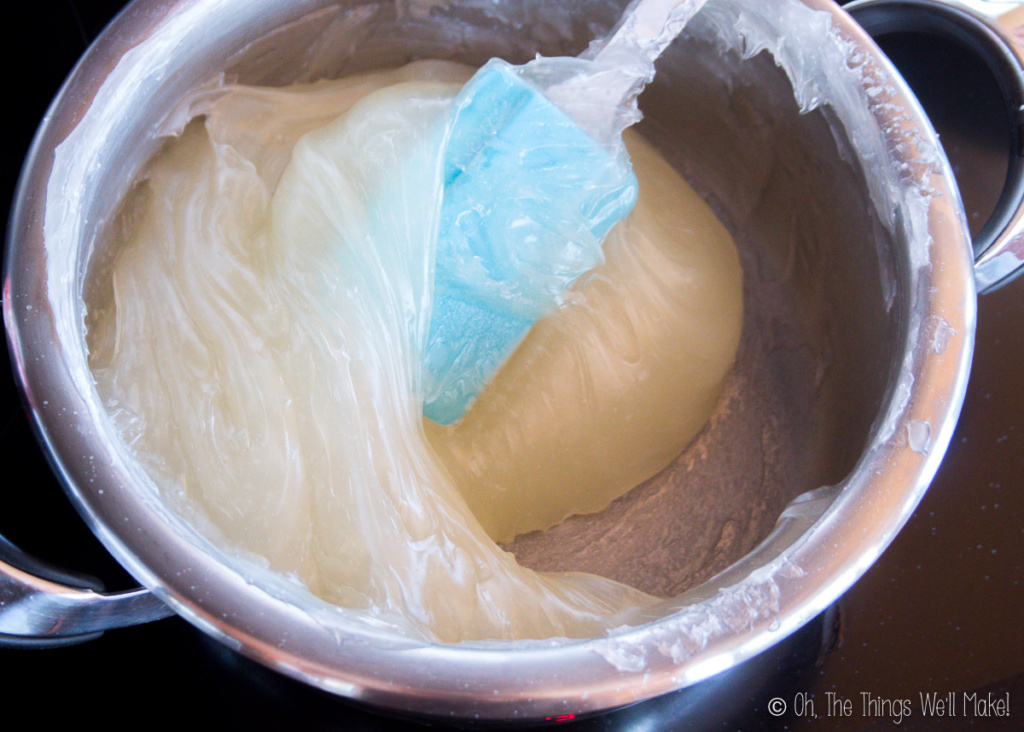
As you cook the mixture, it will get thicker and thicker. It will also turn a more golden color. When you notice it changing color and getting quite thick, turn the heat down to very low, stirring occasionally.
Check on the candy by placing some of the mixture into very cold water. When you can form it and it holds its shape, it’s ready to pour into a prepared mold. (Silicone molds can be greased with butter or oil. Other molds can be lined with a clean cloth covered with a thick layer of starch or lined with parchment paper that has been greased with oil or butter.)
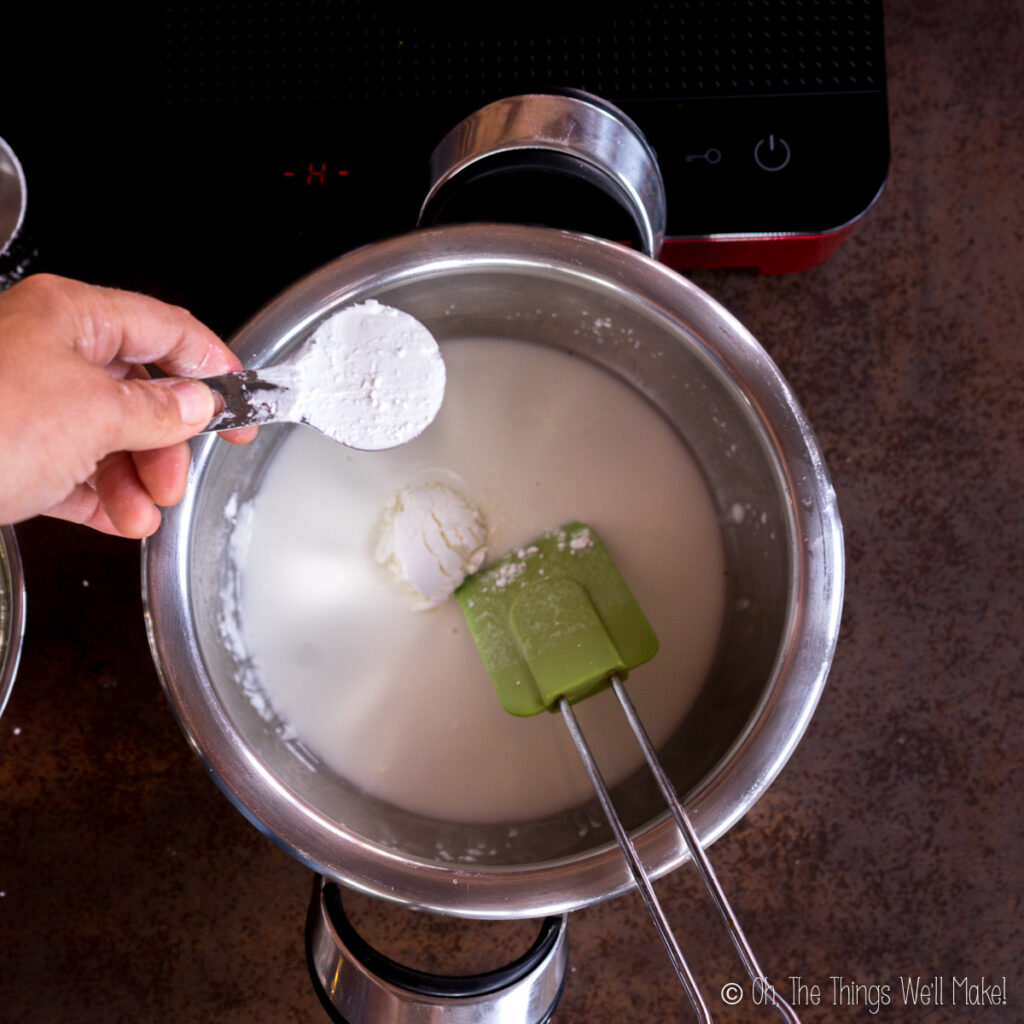
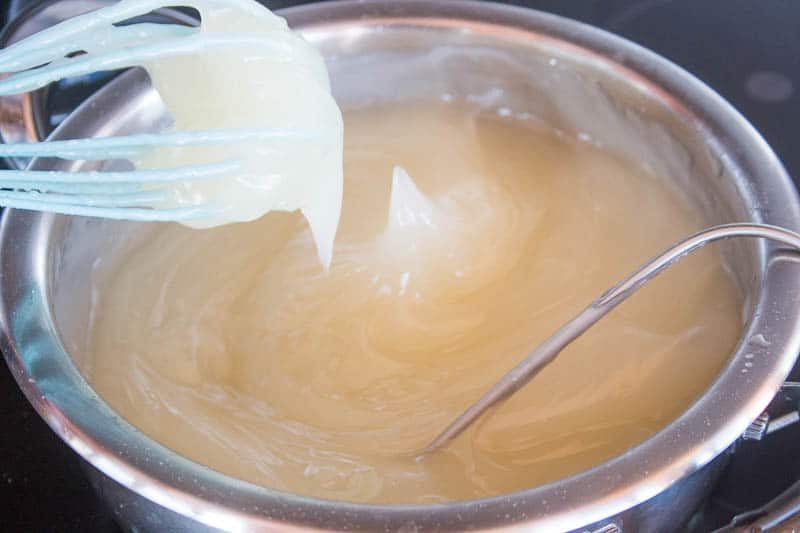
Combine all ingredients. 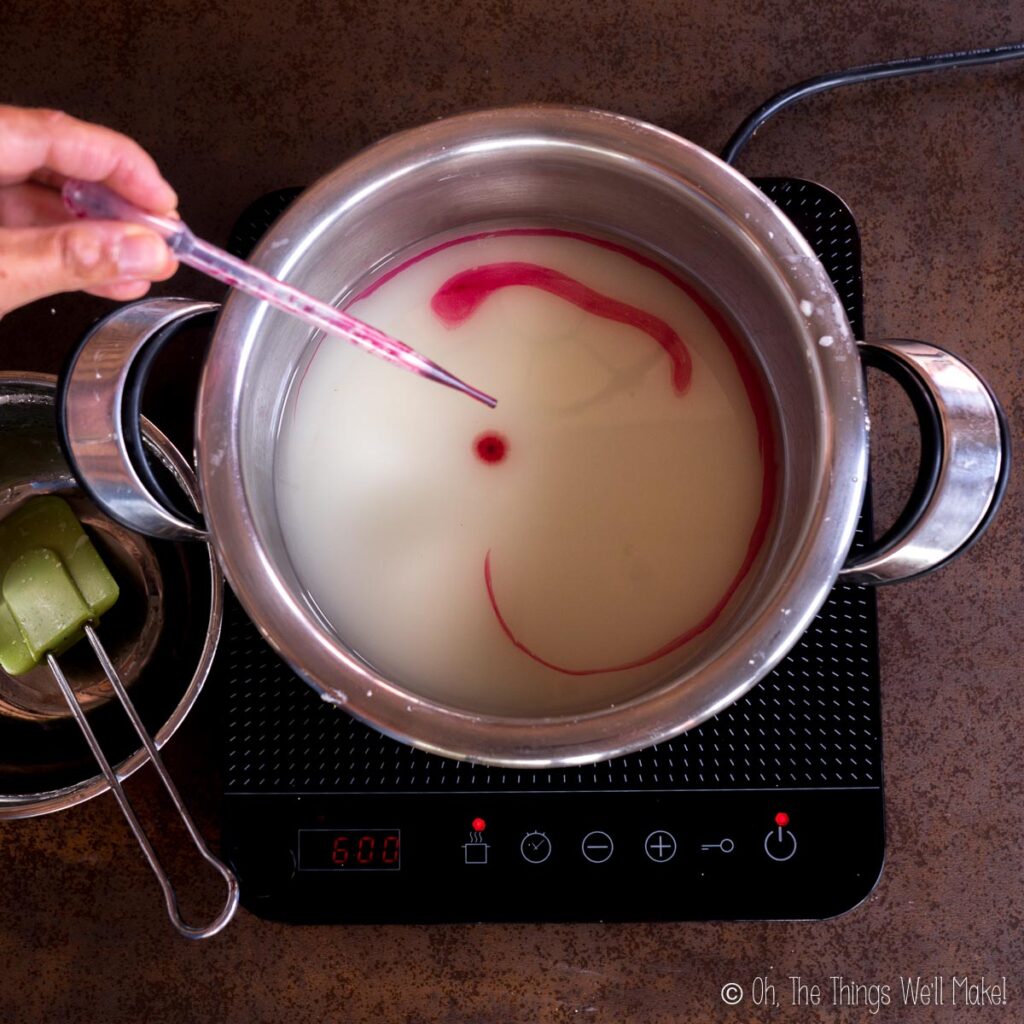
Optionally, add food coloring. 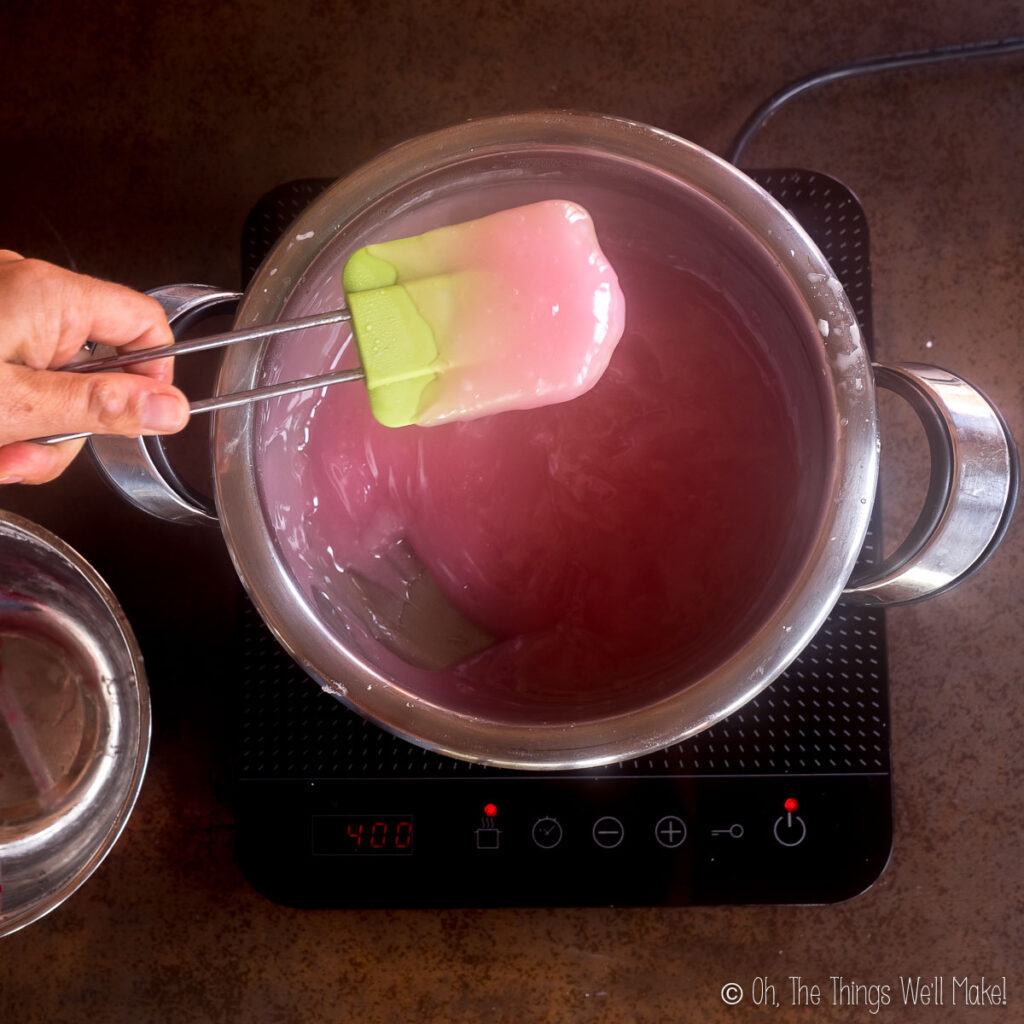
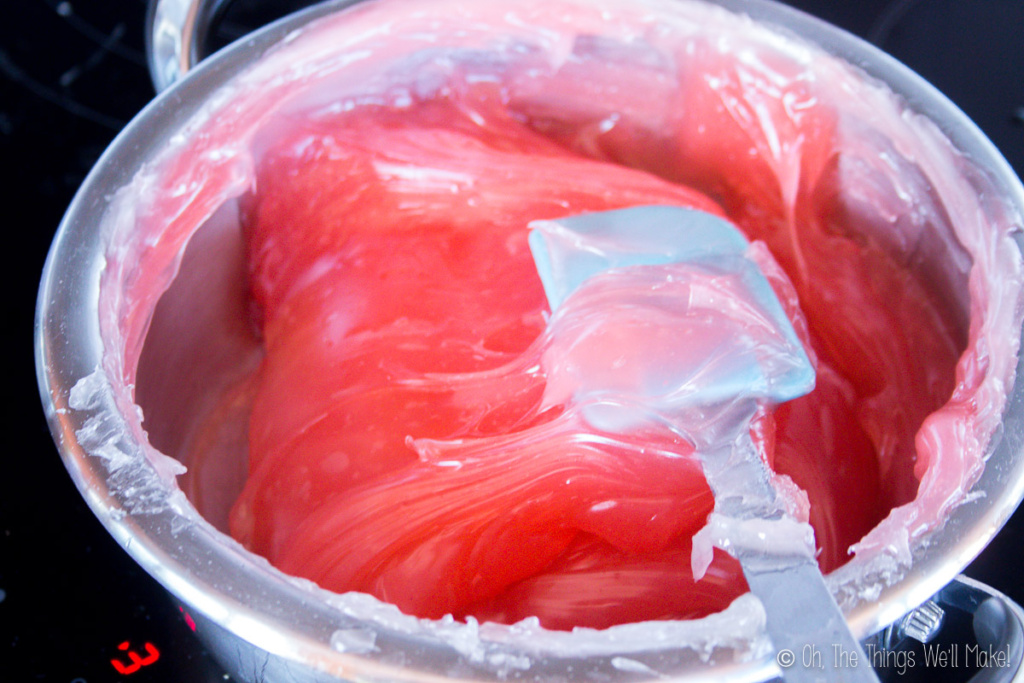
Cook until thickened. 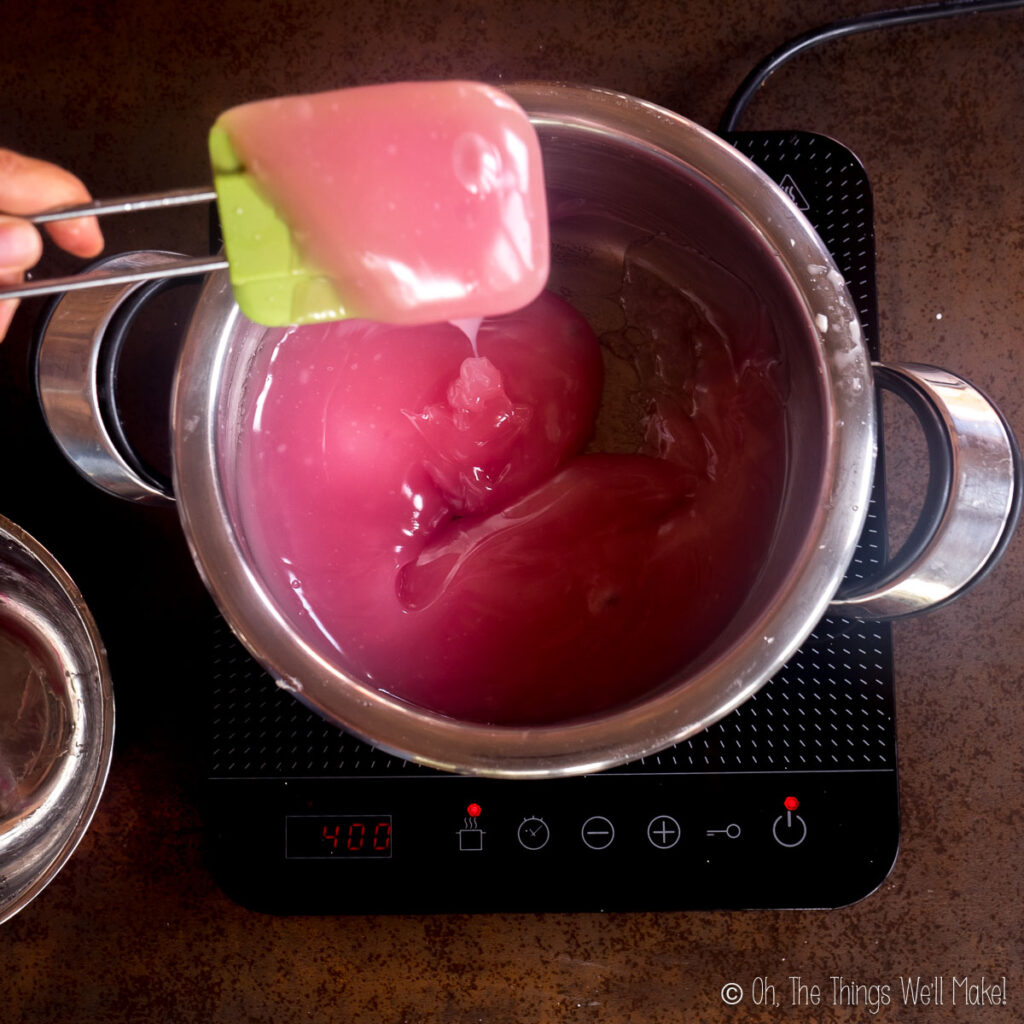
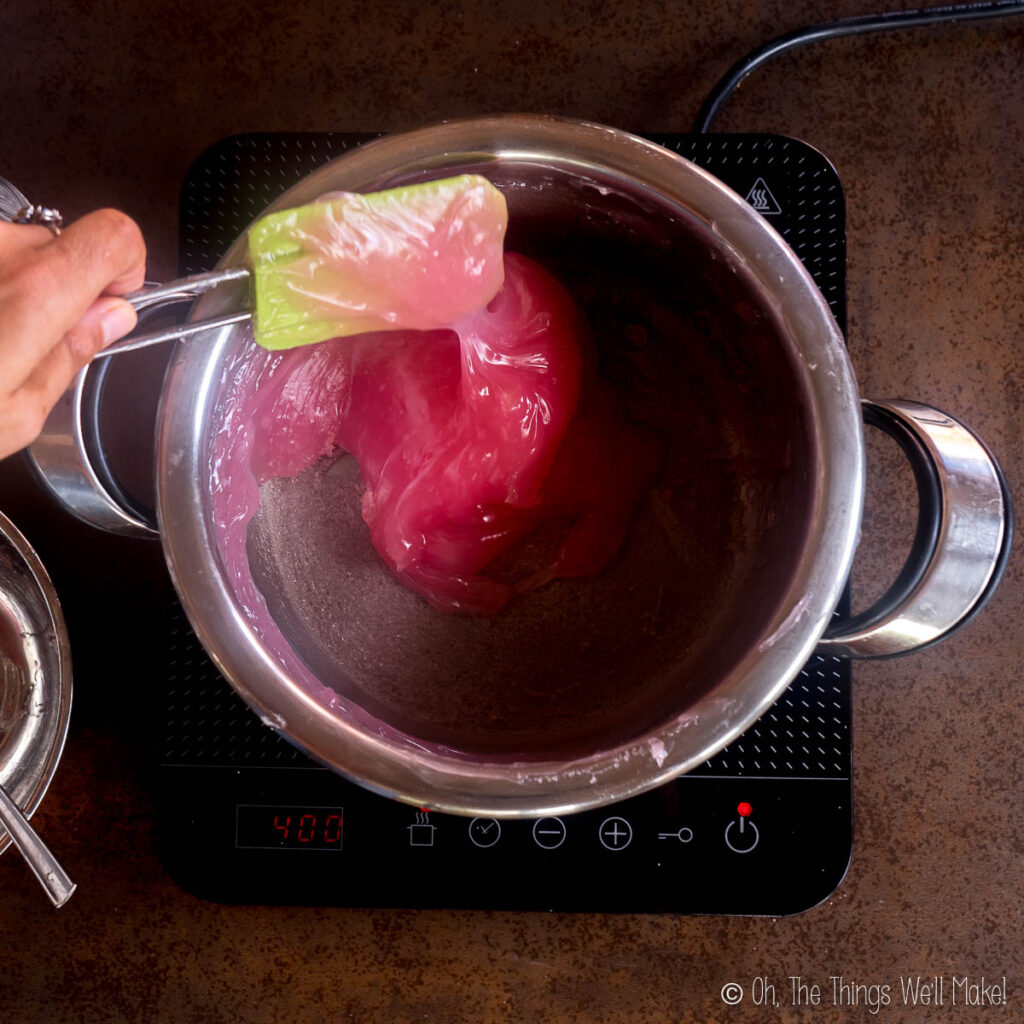
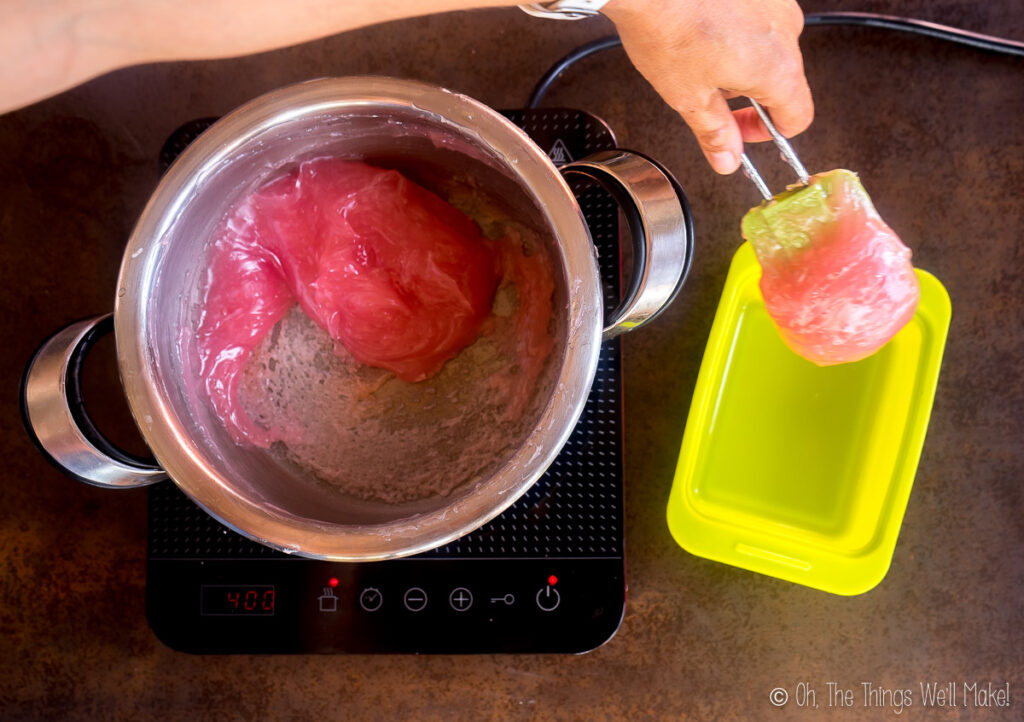
Allow the candy to fully cool before cutting into small pieces.
Troubleshooting
The trickiest part of making Turkish delight is to get the texture just right. If you don’t cook the mixture long enough to evaporate off all of the excess water, the mixture won’t be firm enough.
Some people prefer a softer Turkish delight. To obtain that, it won’t be as necessary to cook off as much moisture.
I, on the other hand, prefer the candy to have a bit of “bite”. To fix a batch of soft Turkish delight, you can reheat it and continue cooking off the excess water. You can then pour it back into the mold when you feel it’s ready.
Trying to cook off all the water, though, is easier said than done. Even on low heat, it’s easy to start caramelizing the mixture (or even burning it) when there isn’t a lot of water left. To prevent that, you should continuously stir it, but there is an easier way…
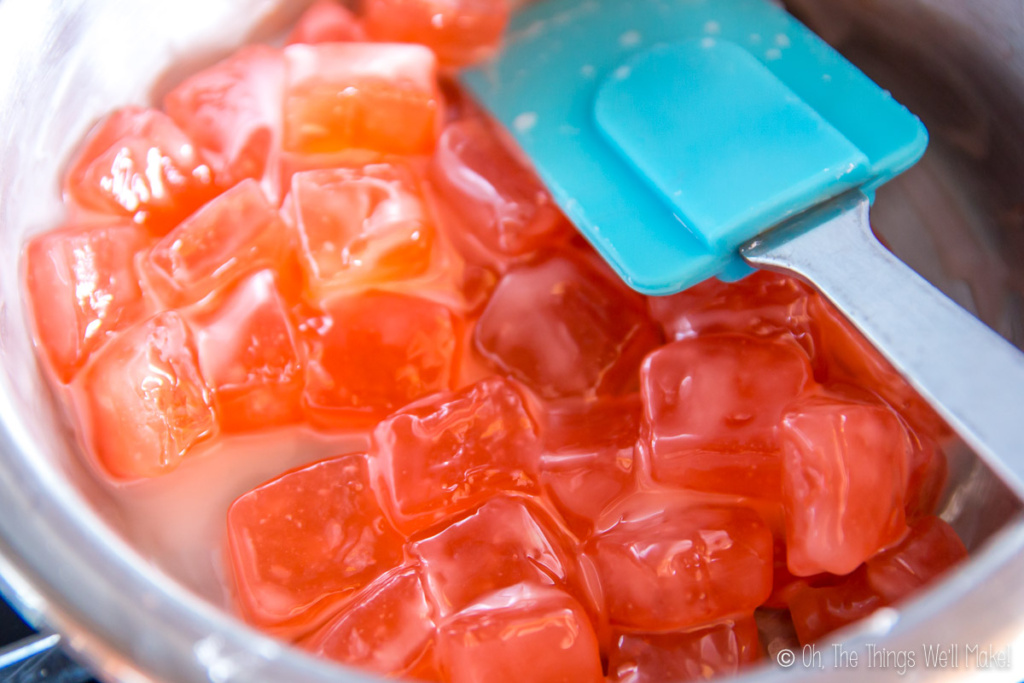
Melting Turkish delight to further cook it. 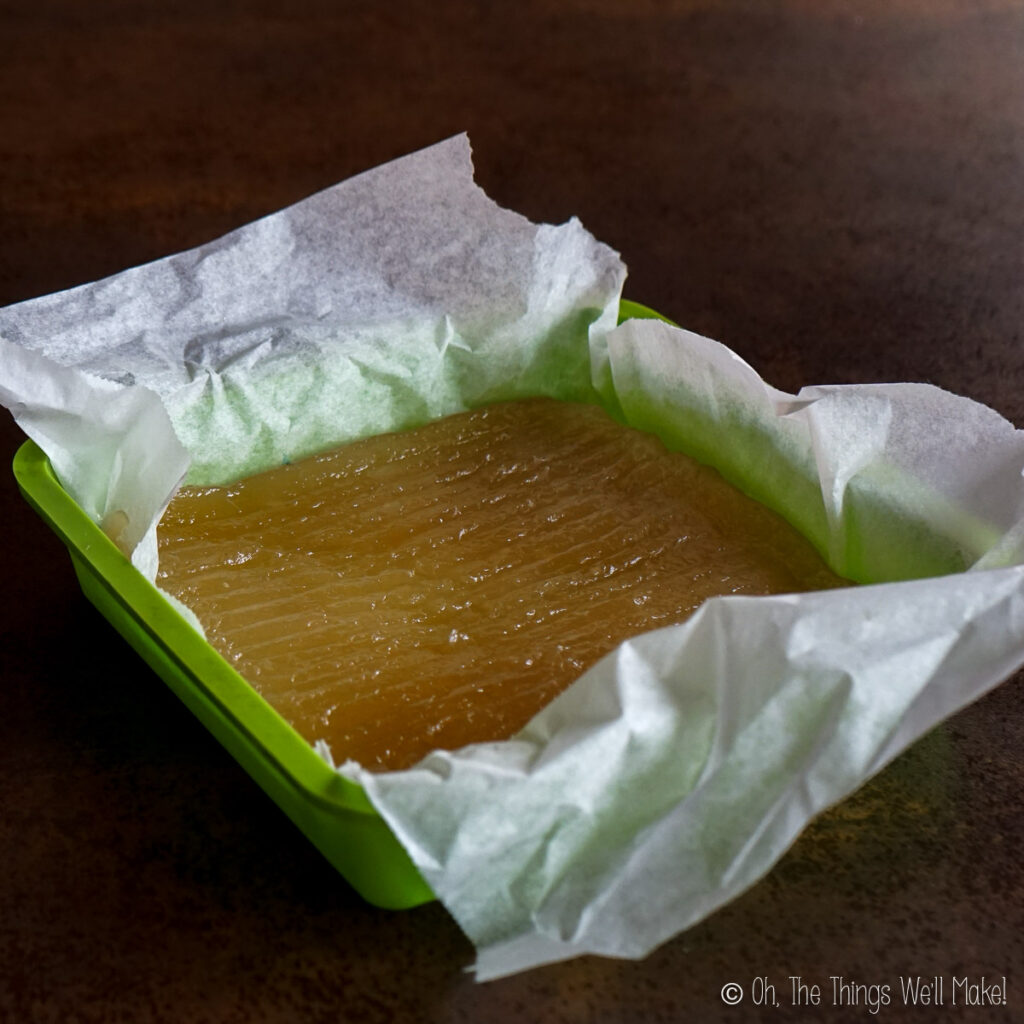
Baked Turkish delight 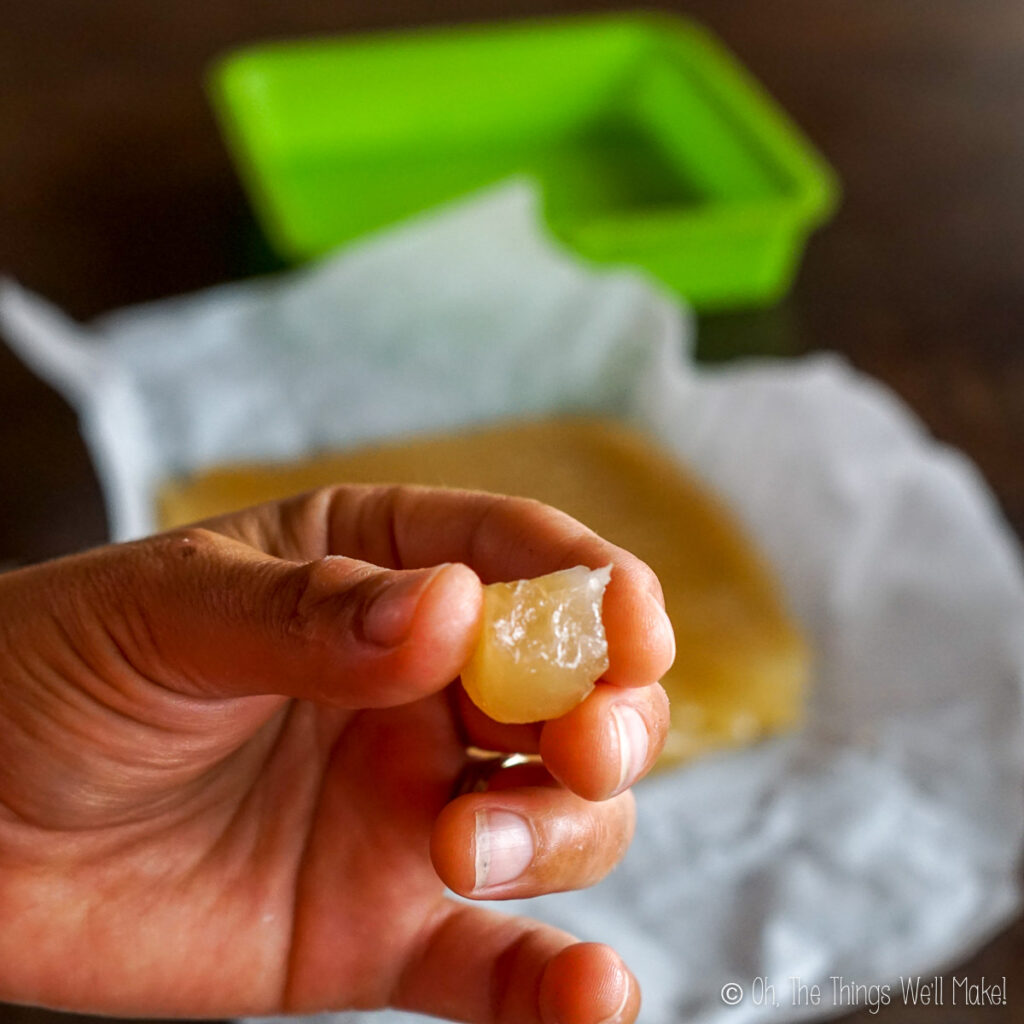
A great trick I’ve found is to bake the almost finished mixture directly in the mold! This allows you to gently heat and evaporate away the excess water without overly cooking and caramelizing the sugar! If you try this method, keep the oven at its lowest setting. (I bet a dehydrator would also work well!)
Storage
Store Turkish delight in an airtight container at room temperature, coated in starch. Because of the high sugar content and the low moisture, it is safe to eat for many weeks/months, but will lose freshness with time.
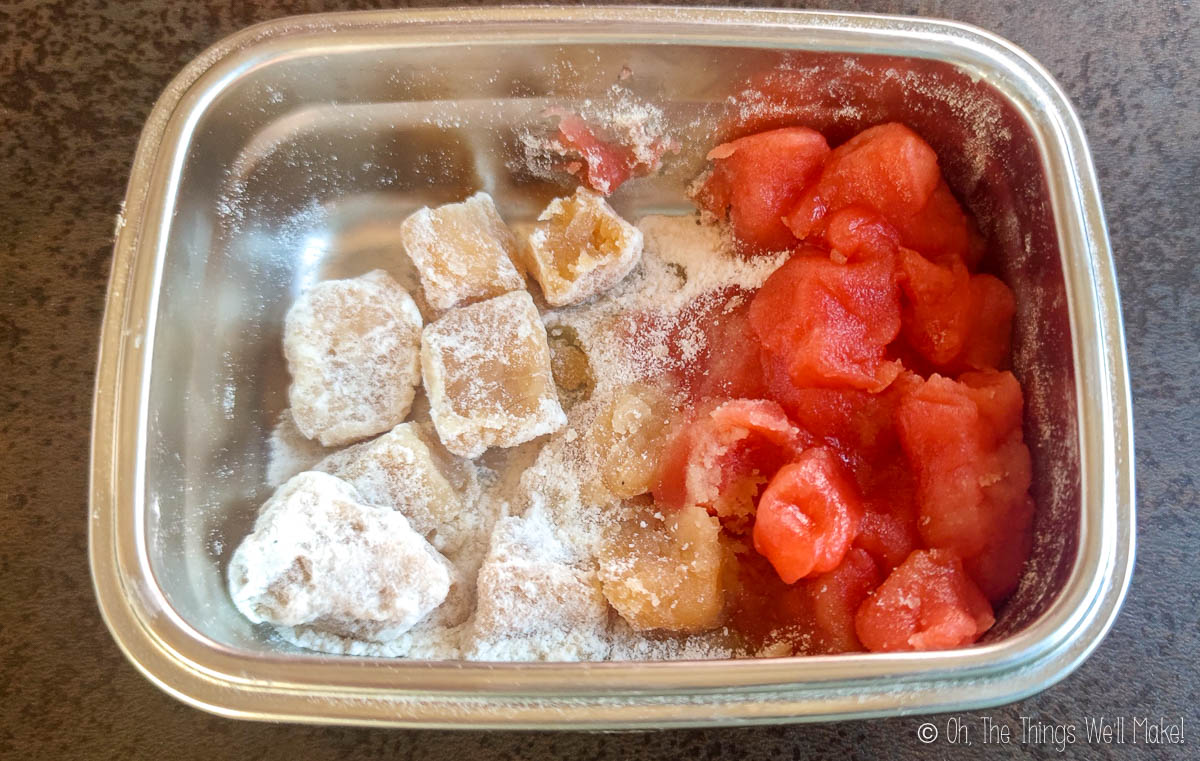
I’ve found that the Turkish delight made with cornstarch is more likely to “sweat” and become soggy with time while the one made with rice flour gets dry with time.
Video
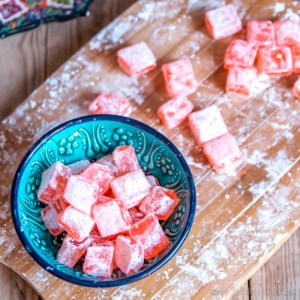
Traditional Turkish Delight Recipe (Using Cornstarch)
Ingredients
- 2 cups sugar
- ¾ cup water
- ⅛ teaspoon citric acid or lemon juice or cream of tartar
- ½ cup water
- ⅝ cup cornstarch
- Rose flavor to taste- rose water, syrup, or oil
- Red coloring (optional)
- extra cornstarch for dusting
Instructions
- Prepare your molds. I used silicone molds greased with coconut oil. If you don’t have silicone pans, line other pans with greased wax or parchment paper. (The final candy will be sticky, and that will help with the unmolding process.)
- Begin by mixing together the first 3 ingredients (sugar, 3/4 c. water, and citric acid) in a heavy bottom pan, and bring to a slight boil before lowering the heat.
- Heat, without needing to stir, over low to medium heat until you reach 260ºF. You can occasionally use a spatula to wipe down any sugar crystals from the side of the pan throughout this process.
- Meanwhile, mix together the solution of cornstarch and the remaining ½ cup of water.
- When the sugar syrup has reached the right temperature, temporarily take it off the heat source and ladle in a bit of the sugar syrup into the cornstarch mixture to warm it.
- Slowly drizzle the cornstarch mixture into the sugar syrup while continuously stirring them together.
- Once all of the cornstarch solution has been completely incorporated, begin to stir the mixture over low heat. You will notice that the mixture should get quite thick almost immediately.
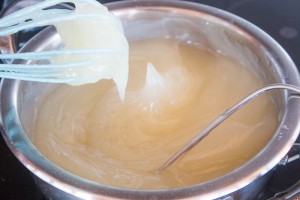
- Despite the fact that the mixture is quite thick, you will want to reduce and thicken it even more before adding in your flavorings. I found it was best to keep the mixture over a low heat so that the sugar wouldn’t caramelize on the bottom, affecting the flavor of the final product.
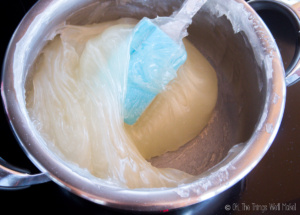
- As you heat and stir, you should notice that the gel becomes quite transparent. It will also reduce slightly in volume.
- To determine the point when you should add your flavoring, test the consistency of your candy by dipping a spoon into the gel, and then dipping the gel covered spoon into a glass of ice water. As the candy cools, you can judge the consistency and stop when you are happy with it. The longer you cook the candy at this stage, the chewier it will become and the more it will hold its shape at room temperature.
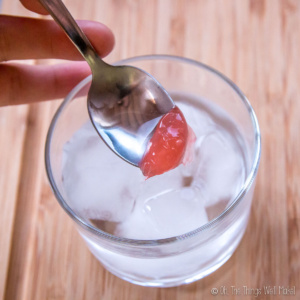
- Add in your flavorings and colorings. I wanted a strong rose flavor like the one in the turkish delight I bought in Turkey so I used a combination of 2 Tbsp. rose water, and 2 Tbsp. rose syrup. (In the first trials, I used only rose water, and it seemed to be enough for the softer versions of the candy. As you heat it more, though, the flavor gets more subtle, so I needed to add more flavor to compensate for that. You can check the flavor when you check the texture in ice water.)
- Once you’ve incorporated all of your flavorings, check the texture once more to make sure that the addition of any new liquids hasn’t affected the consistency of your candy too much. If necessary, slightly mix and warm your mixture a little longer at very low heat to help evaporate a little water, but be careful and take into account that doing this for too long can alter and diminish the flavorings you have added.
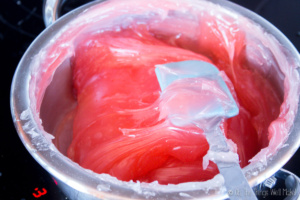
- When you are happy with your result, pour the mixture into your prepared molds and spread it out as best you can with a spatula. It should be very thick and sticky.
- Let cool for several hours.
- Cut into small squares, using cornstarch to keep the candies from sticking to one another. All of the recipes I found online either used powdered sugar or a combination of powdered sugar and cornstarch for dusting the candies, preventing them from sticking to one another. The turkish delight I bought in turkey was only dusted with cornstarch and wasn’t dusted with sugar, something I find to be unnecessary as the turkish delight is already very sweet. If you do choose to use powdered sugar for dusting, keep in mind that the candy may sweat and the sugar coating may end up “melting” off of the candy so you may have to add in more cornstarch or reapply the coating before serving your candy.
Turkish delight (Rice Flour version)
Ingredients
- 2 cups sugar
- 1 cup rice flour
- ¾ cup water
- 2 tablespoons rose water
- ⅛ teaspoon citric acid
Instructions
- Prepare a mold for the candy. Silicone molds can be greased with butter or oil. Other molds can be lined with a clean cloth covered with a thick layer of starch or lined with parchment paper that has been greased with oil or butter.
- Mix together all of the ingredients in a saucepan, whisking to remove lumps.
- Cook the mixture over medium to high heat until it begins to boil. Then, lower the heat to low to medium, stirring often.
- As you cook the mixture, it will get thicker and thicker. It will also turn a more golden color. When you notice it changing color and getting quite thick, turn the heat down to very low, stirring occasionally.
- Check on the candy by placing some of the mixture into very cold water. When you can form the cooled mixture and it holds its shape, it's ready to pour into the prepared mold.
- Allow the candy to fully cool before cutting into small pieces.
This post was originally published on July 28, 2015. It was rewritten, adding a new rice flour recipe, new photos, and improvements to the recipe instructions.
I probably should have read through the comments before commenting myself, but on texture and dryness, is it at all possible that if you let your batch sit as long as the purchased batch, perhaps it would be dryer and firmer, with the mere passage of time?
How long has that sat in the box? Fresh is always looser than anything that’s been boxed or is older than a few days.
I felt pretty confident about making this, until I read through your blog here, and suddenly I have more questions than answers.
Ha, yes!
That’s another consideration- as is the fact that I’ve also seen some with wheat flour added in.
I may give it another go again soon.
There have been some things I’ve wanted to try, but was in the midst of a kitchen remodel which kept me out of the kitchen for the last month or so. I’m just now finishing painting and getting caught up on the blog- then I’ll get back to trying to experiment. I really want to try to get this one right.
Dear Tracy,
I found succour on your recipe for Turkish delight in this wonderful site! The reasoning behind using cream of tartar convinced me that you are definitely a curious and courageous cook, with probably a hint of a innate chemist! Congratulations for the well reasoned approach to this exotic recipe. I shall implement your tips on my next attempt at tackling this recipe.
All the best!
Thanks so much, Ricardo, for your kind comment!
This is probably the trickiest recipe on my entire blog, and I still have plans to try to figure out a way to share this so that it more often turns out successfully.
I find that right now a lot of factors affect the success of the recipe. (Even the weather!)
I wish you the best of luck. 🙂
I love lokum and have made it a few times. I will definitely try your recipe.
I struggle with the coating melting on the squares. How do you handle the coating part of it. A blend of corn starch and icing sugar, I’ll try just corn starch this time. But, even with no coating the squares end up sweating. Should I leave them uncoated and exposed to dry air for a bit longer after I cut them into cubes?
Thank you for any hints you can share!
Hi Vicky,
I haven’t really had a problem when using a good coating of only cornstarch. I never add icing sugar because that does melt very easily. I had the same problem with regular sugar sprinkles when I made marshmallow peeps. In that case, I ended up making sprinkles with dried coconut instead and that worked out wonderfully.
It probably all depends a lot on the humidity in your area too. That said, it’s almost always super humid here, so I can’t imagine that you are in a place that has a lot more than me. 🙂
honestly, when the humidity is high, the whole recipe is difficult. These sorts of recipes are very temperamental.
I really need to try this recipe again, though, and see if I can come up with some better ways of explaining the process so that it doesn’t fail as much.
Oh hey Tracey! I’ve been make TD before for 3x but it kept mission failed haha.. Is wheat flour same as Corn flour I’m a bit confuse. And after I Finished make TD, i put it in fridge for nights. Then after i took it out it’s still wasn’t become jelly… ? Then i put it back in. Again the nxt day, still.. It wasn’t become jelly and candy. Could u please tell me if i do the right thing? Haha. If I’m wrong could you correct me? I don’t got thermometer candy in my country also. Well my TD it does slimey and tricky.. But it doesn’t become jelly still haha. Wouldvlove to try your recepie after this
Hi Sharifah,
Wheat flour and corn starch are not the same thing and have very different properties when heating them up. Corn starch makes more of a gel when heated, which is why it is used in a recipe like this one.
I need to try to make this recipe again and see if I can adjust the recipe instructions to make it easier to replicate without a candy thermometer, which should also make it a recipe that is easier to replicate with the same or at least similar results each time. I learned a lot when making my recipe for Spanish hard turrón this year, and I think what I learned will help with this recipe.
I will admit that this recipe is very tricky, and even I have been getting different results with the same recipe- and I think a lot of that has to do with humidity, how much you stir when trying to get to a certain temperature (that will bring the temperature down again), etc.
That’s why I want to update the recipe, trying it again with what I have learned when making turrón. I’ll also try to record video of the process so that people can have a better idea of what is supposed to happen at each stage.
Hi again Tracey!
well i didn’t count how much i stir to get the temperature but all i did is kept it boiling for a little bit longer which boiling the sugar part with lemon juice until it become sticky. Well when i adding the sugar syrup into the flour step by step(i refer from a vid called Titles Busy Kitchen) it should boil 1 hour with gentle boil. (But mine didn’t get to reach for an hour because my pan will get burned inside and the colour turn very brown and really smells burn ?). So the part that i didn’t know is put it in the fridge or just leave it on the table. Yes it is very tricky ! so much frustrating haha. oh sure can’t wait to see your recode video! wow Spanish hard turron. Wow you’re really hard working women in parts of cooking hehe. Oh i see wheat flour is not the same as Corn starch. Anyway thanks for telling me hehe.
Have you tried making any other flavors? I got to try some real turkish delight this christmas which makes me want to try making it. The christmas box had lemon, mango, pineapple and pomegranet.
I think that I could make orange turkish delight using orange juice, orange syrup, and orange zest instead of rose water.
Do you think that will work?
Hi Aaron,
No, I haven’t tried making any other flavors. I did try a plain one with pistachios in it when we were in Turkey. It was pretty good, but mango, pineapple, and pomegranate sound a lot more fun! You probably picked my favorite fruits. 🙂
I really need to revisit this recipe and try again. I learned a lot about the textures of candy and how the temperature wasn’t an accurate way to judge the consistency when you start adding in other ingredients and stirring, etc. when I was developing a recipe for turrón de Alicante.
I’d like to try to make this again, this time applying what I learned to help give a result that is easier to replicate and get a good result every time. I feel like right now, you can make this recipe 3 times the very same way and get 3 different results, and that really frustrates me.
I think I’ll also keep the sugar temp from getting to the hard ball stage so that it doesn’t give such a caramelized flavor.
As for the orange. I have a feeling that an orange essential oil would work great in a recipe like this one. The flavor is much more concentrated than the juice, and isn’t as likely to change because of the heat. Plus it wouldn’t add as much moisture, so you could add it at the end without the need of evaporating off the liquid again. I have heard of people using rose oil in turkish delight, but from what I can tell, rose oils are all too pricey for this sort of experimentation. Orange oil is a lot more inexpensive.
Good luck! I’d love to hear how it goes.
I used your excellent tutorial to make Turkish delight for my Narnia themed Trunk or Treat this year! Thank you so much for your experimentation and thoughtful write-up. I wrote about the experience on my blog today (http://tikkido.com/blog/Homemade-Turkish-Delight-Candy), but didn’t include the recipe on my website, and instead directed them here. I couldn’t improve on your excellent work.
Hi Nikki,
Thanks so much for your comment and post!
I just headed over there and saw you had a lot of fun. 🙂
I need to play with this recipe some more some day. Most of us who have spent hours and many attempts trying to get this recipe just right feel that something is still missing.
I love getting comments here on this post because I think that every comment helps with another piece of the puzzle that we will someday put together just right- maybe? 🙂
In any case, it still is a fun recipe that makes a decent candy, I think.
Thanks again!
Hi – I too spent way too long trying to create the perfect TD recipe. As you’ve mentioned, the time spent in the final cooking phase is critical and almost impossible to precisely quantify. I suspect that making TD in a domestic setting is an exercise in variation.
In any case, my final recipe is here:
https://dl.dropboxusercontent.com/u/39323648/Recipes/Turkish%20Delight%20Recipe.docx
It is similar to yours, but does include a corn starch cooking step prior to combining with the syrup. The results I have achieved varied between OK and excellent.
Hi John,
Thanks so much for your comment and recipe!
This is really the only post on my blog that I sort of think of as unfinished because I’m not 100% happy with it, and I really feel like I need to revisit this and give it another try.
I posted anyway because I really wanted to get a dialogue going, and I also wanted to see if by working together we could really figure out a decent recipe for making at home since most of the recipes I tried didn’t work well if at all.
I would love to post your recipe underneath mine if I get a chance to try it out, and would love to comment on how it works out, especially if I find I like your contribution better than mine 😉 – That is totally dependent on how you feel about it, of course, and with full attribution given to you however you choose. What are your thoughts?
Hi, just wondering what kind of sugar you used in the recipe please? Was it caster sugar, confectioners sugar, cane, raw, white?
Hi Jamie,
I just used regular white sugar.
I may try this. Sounds so yummy.
On the topic of why a candy may turn out differently from batch to batch even when made identically, often weather plays a big factor. Growing up, we learned from mom not to make candies that had critical textures on certains days (usually rainy or very humid ones). Make peanut brittle during a rainstorm or a southern heat wave, you get peanut sticky instead. Taffy is also sensitive to humidity. So it is possible that the humidity is affecting the batches just as much as the ingredients and timing are.
Hi Shanna,
Thanks for your insight.
I hadn’t really thought about that, but it makes a lot of sense! I have the same issues when I try to make my son’s fondant birthday cake each year. Unfortunately, I can’t choose my day for making his birthday cake. 😉
I still need to give the turkish delight another go, though. I want to find a way to get it chewier without heating up the sugar so high. I think heating up the sugar so much gives the sugar a caramelized flavor that I don’t notice so much in the original recipe.
I’ve been playing lately with adding a bit of tapioca flour, and that seems to help. (My package did say it had wheat flour in it, but since I blog gluten free…)
Hello! Thank you for sharing your detailed experience! I was wondering if you knew how well these could ship in the mail. I’m not sure if the store bought has fillers/preservatives to allow it to hold up better than homemade. I’m sending a friend a care package with some goodies and she loves turkish delight, so I thought maybe I’d take on the challenge. Or possibly not worth the trouble for the risk of melting/sweating?
Hi Annie,
If you pack them in cornstarch rather than powdered sugar, I don’t think you’d have a problem with sweating and melting.
There’s so much sugar, there’s citric acid in there, and there’s not a lot of moisture left to them, so I don’t think they’d really go “bad” very quickly, even at room temperature.
The real issue is getting the recipe to work out.
I was actually playing with the recipe again last week, and made a version with tapioca flour and gelatin this time. I ended up with a great consistency, but I decided that I’m not sure I love the taste of the sugar when heated up so high. I thought it had something to do with the cornstarch in my last batch, but now I’m realizing the sugar gives a bit of a caramelized flavor that, while not unpleasant, distracts from the rose flavor of the candy.
I’m thinking of trying again without heating the sugar as high and seeing what I can do with either cornstarch/tapioca flour plus gelatin as a stabilizer/something to help give the chewy texture.
You can probably tell that I’m still not 100% satisfied. hahaha