
How to Make Boba, aka. Tapioca Pearls, From Scratch
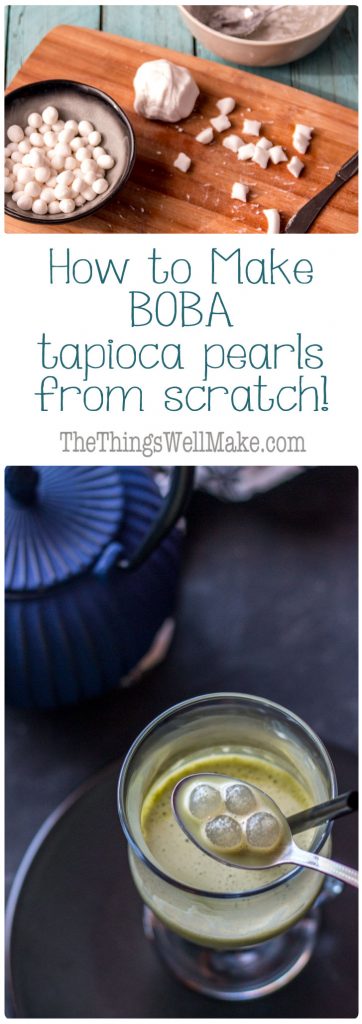
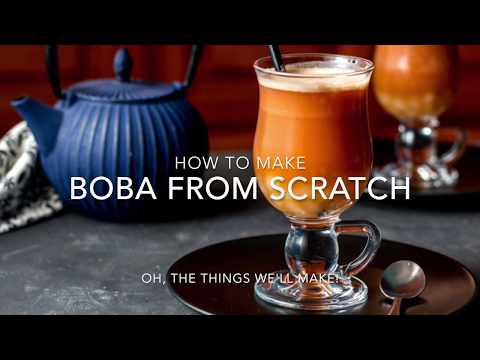
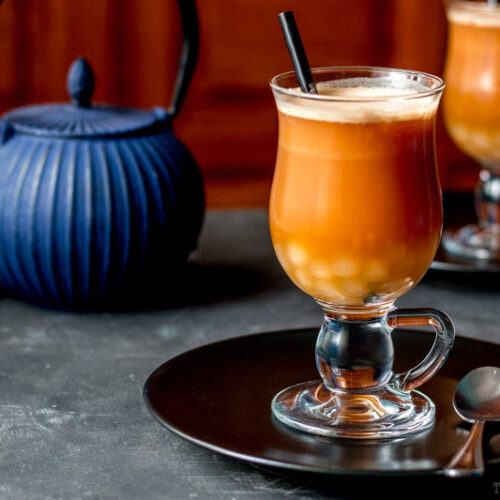
Store bought tapioca pearls can be tricky to cook. That’s why I’ll show you how to make boba from scratch at home for homemade bubble tea. It doesn’t take long to prepare them, and they’re so much better than dried tapioca pearls found in stores.
In the middle of the summer heat, you may have noticed that I haven’t been posting as often lately. In part it’s due to my new philosophy of blogging. In part it’s due to having my son home for the summer, and him wanting to play with me most of the day. (I can’t be complaining about having to play in the pool and cuddle up with a sweet, adorable little 5 year old, can I?)
Mostly, though, it’s due to me not being completely caught up from my trip to the US a few weeks back. Amidst the fiestas here in my town, lots of birthday parties and being a full time mommy, it’s taking me longer than I expected to get back into the swing of things.
The first week of our adventures in the US, we stayed at my dad’s house in Connecticut, not too far away from good old New York, New York.
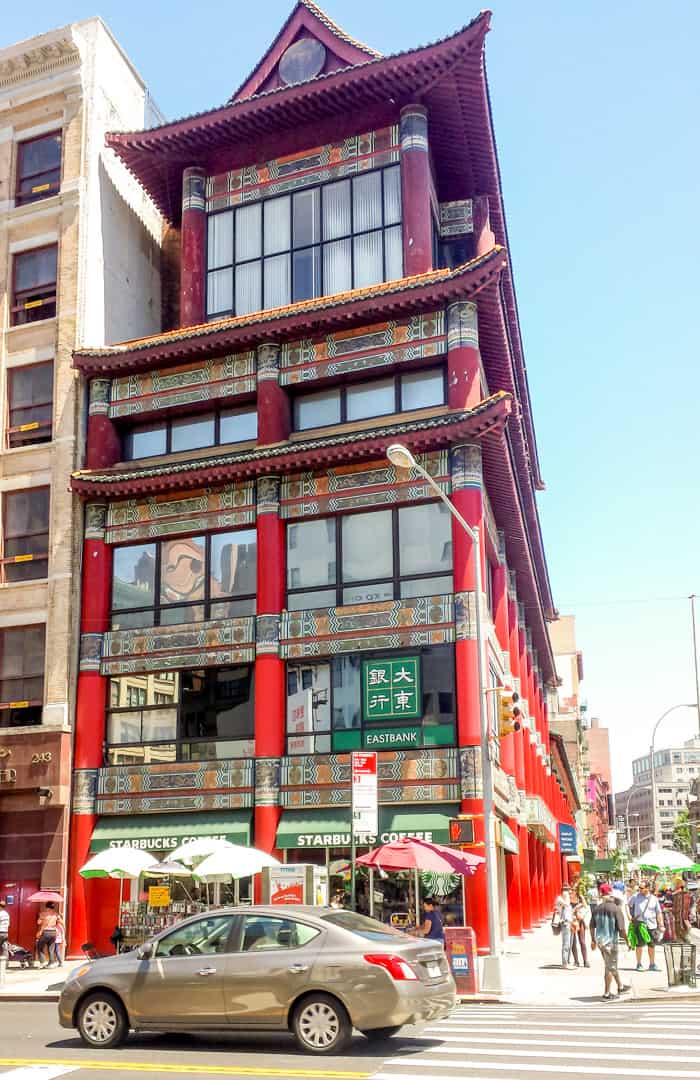
Most of that week was pretty relaxed, but we did manage to throw in a fun day of exploring NYC which included a delicious meal in Chinatown. I had been to NYC as a kid, but don’t remember ever visiting Chinatown, so it was a new, fun adventure for me. I loved marveling at the Asian style architecture of normally American styled places like Starbucks, and if I hadn’t been trying to travel lightly while walking the city, I probably would have bought a few kilos of Asian fruits like lychees, mangosteen, dragon fruits… all of the fun fruits that I can rarely (if ever) find here in Spain.
Another delicacy that I wasn’t able to try was boba bubble tea.
After our meal, I eyed the bubble tea for sale at the shop across the street, and hinted at perhaps going over to get some dessert. Normally I don’t go for buying specialty teas and coffees outside the house because I know they’ll be sugar-laden and definitely not paleo. 😉 How often am I going to get the chance to try bubble tea made in Chinatown Manhattan, though, right?
Unfortunately, everybody else was full, except for my boring practical husband who had no interest in trying something as absurd as bubble tea, so in the interest of not drinking alone, I decided to pass and never got to try bubble tea before heading on towards Times Square and Central Park.
Fast forward a few weeks, and I was hanging out at the Asian store here in Spain, browsing all the fun, unusual treats the shop had to offer, and I saw tapioca pearls for sale. I couldn’t help but buy some to make boba at home so that I could try to make homemade bubble tea.
The problem with store bought tapioca pearls
Unfortunately, despite having watched numerous videos and reading numerous blogs about how to cook the darn things, I couldn’t get the store bought boba to cook right!
After some research, I’ve found that it’s probably because the people who have the most success with store bought boba use tapioca pearls that have been sealed in shrink wrap and that need to be stored in the fridge and used up within a week once opened. I’m guessing those are packaged without being completely dehydrated, making their reconstitution easier later on. I have only been able to find the fully dried tapioca pearls here, though.
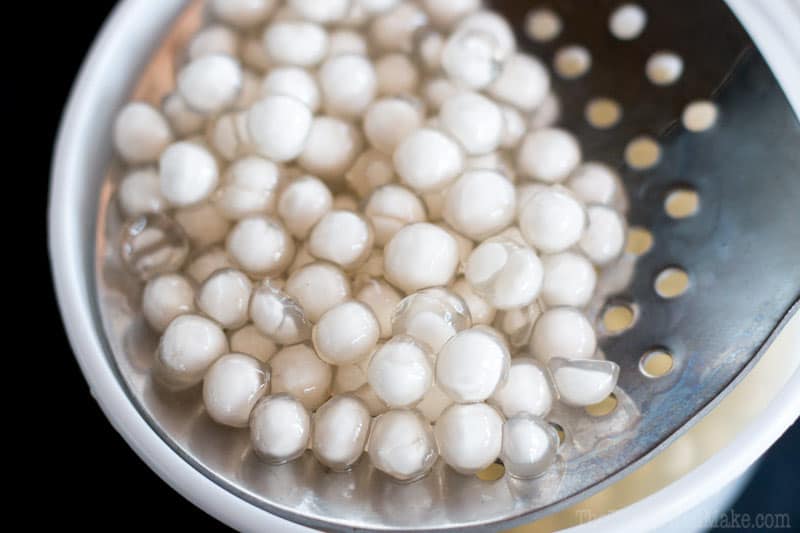
I tried everything from…
pre-soaking the pearls… which ended in a tapioca starch water and powdery mess…
bringing the water to a boil with the boba tapioca pearls already in the pan… which ended up with a gluey mess and no pearls to be seen…
boiling the water and then adding the boba…which, despite boiling for over an hour ended up with rubbery, transparent balls with an opaque, raw, hard, tapioca flour center. Yuck!
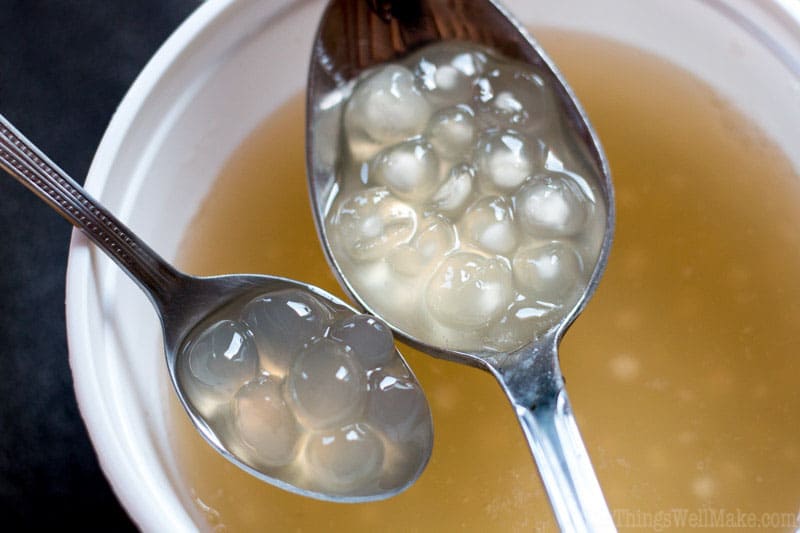
The only thing that sort of worked was to boil for very long periods, followed by very long periods of cooling, usually followed by boiling and cooling again at least once more. Even the boba that almost cooked all the way through (see the picture below) weren’t very appealing, and I decided to give up on making homemade bubble tea!
Or did I?
The tapioca pearls that I bought showed only 2 ingredients: tapioca starch and water.
Making tapioca pearls/boba from scratch
Making boba from scratch can’t be that difficult, right?
I thought about how I used to always make pasta from scratch. People used to think I was crazy when they heard that I always made my own pasta from scratch.
Doesn’t that take forever?
Well, actually, no!
Apart from the clean up, it took me about the same amount of time to make homemade pasta as it did for me to boil the store bought stuff. Plus, mine was just so much better and fully customizable!
Why is homemade pasta and boba so quick to make?
Faster cooking time
Because store bought pasta has been dehydrated so that it will keep for longer. Boiling it to cook it takes much longer than cooking the pasta that you have freshly made.
I no longer make homemade pasta very often; not because it takes too long, or because it’s not great, but because most of the time I have completely eliminated gluten from my diet. I have tried coming up with gluten free and grain free pasta recipes, but so far the closest I’ve come to a paleo pasta is the dough I used in my paleo dim sum recipe. (It actually tastes very similar to pasta, and has a similar texture once cooked, it’s just a lot more delicate to work with so it’s not as practical for making something like spaghetti.)
My logic, though, was that homemade boba tapioca pearls would cook similarly. Because they are fresh and haven’t been dehydrated, they would cook up almost immediately.
And I was right!
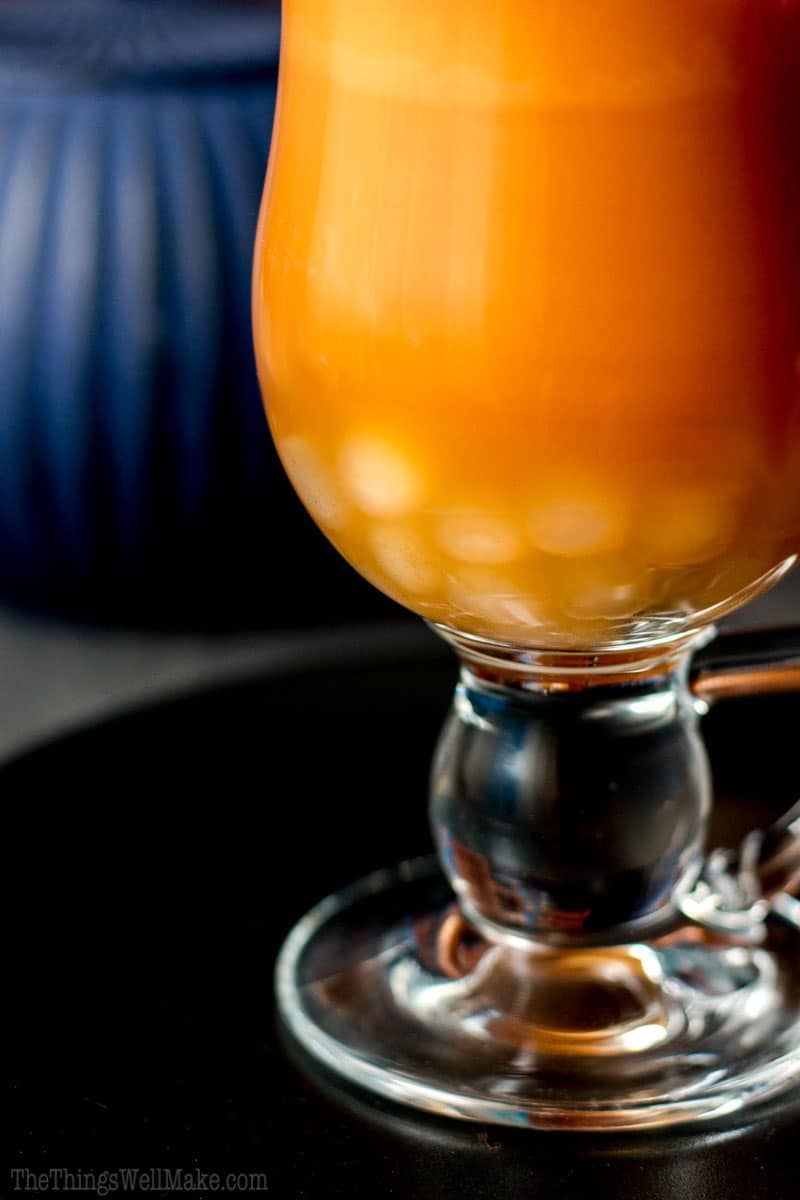
It took me less time to make boba tapioca pearls from scratch than it did for me to try to cook the store bought boba!
Seriously!
It’s super quick and easy to make, and it’s actually even kind of fun.
Plus it uses only 2 ingredients, tapioca starch and water, so it’s gluten free, grain free, and, thus, arguably paleo. 🙂
After me having thrown out some of his dried up, unusable playdough, my son was only too happy to help make little tapioca pearls too. Win-win!
(I may or may not have actually used his.) 😉
Wow, I’m chatty today…
Let’s get to it!
Video
Boba, aka. Tapioca Pearls, From Scratch
Instructions
- Boil the water.
- Add the tapioca starch to a bowl, followed by the boiling water. I work the water in little by little in case it isn’t all needed. Kneading with your hands is the best way to incorporate the water and make a non-sticky dough. Be careful not to burn yourself, though.
- Once you have a workable dough, the easiest way to make tapioca pearls is to roll the dough into long snakes of dough, cut them into small pieces and roll them into tiny balls.
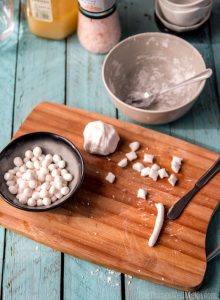
- To cook your homemade boba, boil at least twice as much water as the volume of tapioca pearls that you are going to cook.
- Add your homemade boba to the boiling water. The boba should float to the top. When that happens, turn the heat down to medium
- You’ll notice that the boba begin to cook and get their chewy texture almost immediately. At any point after a couple of minutes, you can use the boba and they will be better than the dehydrated store bought pearls. I later found, though, that if you keep simmering until they fall back to the bottom of the pan, and then remove them, they will be more transparent once removed and allowed to steep in honey for a few minutes. (They will still be pretty opaque when you remove them from the water, but they start to become translucent once removed from the boiling water and stored in honey.)
- Remove the boba from hot water with a slotted spoon, and transfer them to a bowl with some honey. The honey will help preserve them until you are ready to use them, slightly sweeten them, and keep them from sticking to each other.
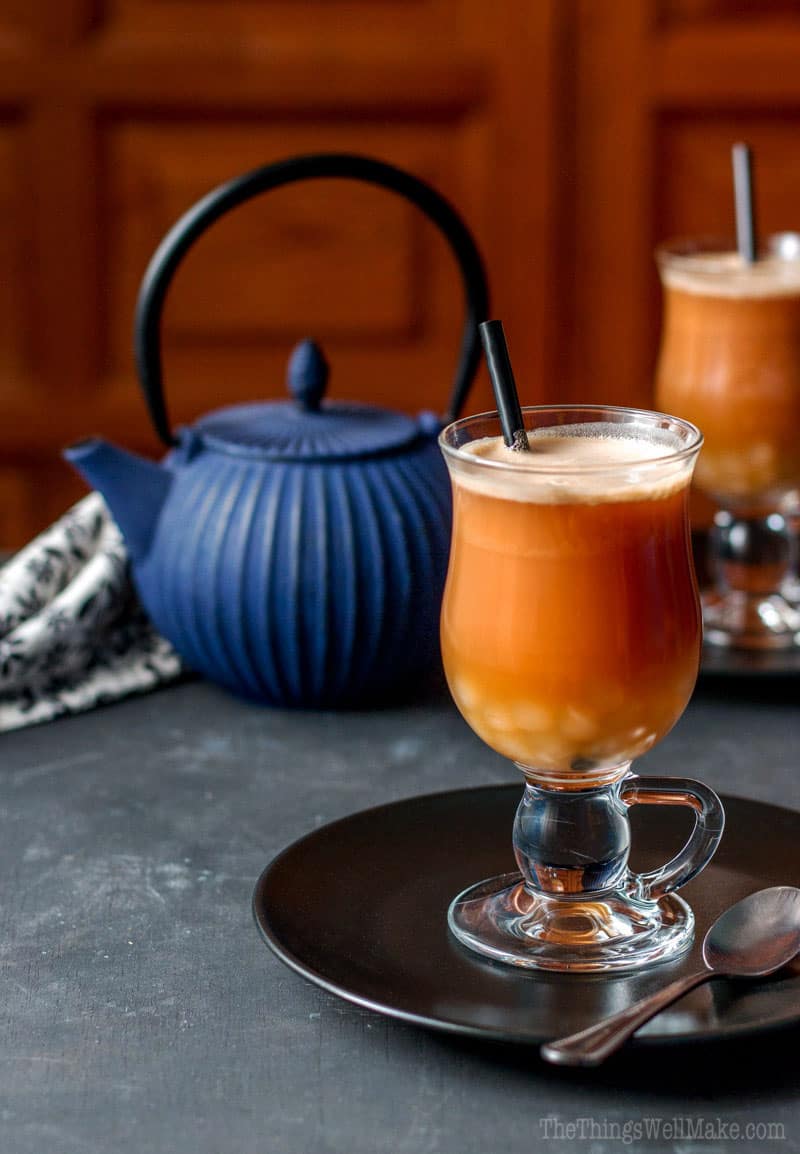
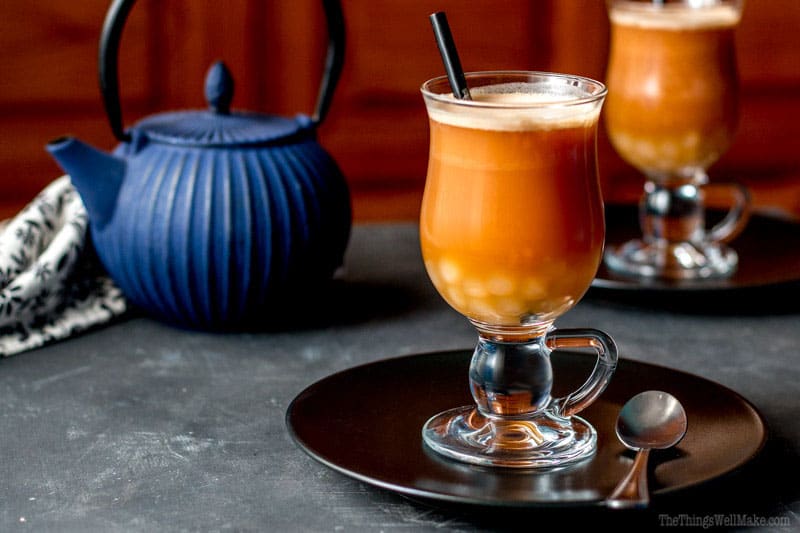
- Add them to your tea! I’ve found that they have the best texture when warm, so if you want cold bubble tea, it’s best to add them first to your glass while they are warm, and pour the cold tea over top, serving immediately!
- Enjoy!
Can you store homemade boba tapioca pearls for later?
I’ve been experimenting with different ways to store them.
Can you let them dry out and then use them later?
Yes, but you end up with the same sort of problem that can be had with store bought dehydrated tapioca pearls. It takes a lot longer to cook them, and you may end up with opaque, raw tapioca flour centers.
Can you freeze the cooked boba?
You can, but they will get opaque and hard. I found that out the hard way when I thought it was a good idea to make popsicles with boba! Some people swear that boba popsicles are great, but I can’t imagine how! I found the frozen boba to be unpalatable and hard. No more boba tea popsicles for me! (I did find one blog post that said that you had to use mini pearls in popsicles for them to stay chewy, but I found the frozen boba to be so gross that I probably won’t be giving it a try!)
If you boil them again, they will warm up and turn translucent again. The texture will come closer to the original chewy texture, but I didn’t find them to be as pleasant as the ones made from scratch and served immediately.
Can you freeze the tapioca pearl dough and form the boba later?
Freezing the dough works pretty well, but the dough can get a bit crumblier and harder to work with once it thaws than when it was freshly made. The cooked boba made from frozen dough seemed pretty much identical to the boba made fresh, so if you get sick of making boba in the middle of the process, freezing the excess dough is definitely an option. I wouldn’t personally make a big batch just to freeze it, though, as it is easy enough to make when needed, and the fresh dough is easier to work with.
Can you freeze the formed, uncooked tapioca pearls?
Yes, and I’ve found that to be the best way to make boba ahead of time and store them for later. They may not turn out exactly like the ones made from scratch, but they are pretty close.
I boil them right from frozen, and boil them a little bit longer than I normally do with freshly made tapioca pearls.
Can you color and flavor homemade boba?
So far, I’ve only tried adding in a pinch of salt and some honey to my homemade boba. They turned out well, and may have been slightly sweeter than the ones that are only soaked in honey, but I didn’t really notice much of a difference in the final outcome. The flavor didn’t really change too much.
A lot of people have asked me about how to make black boba.
So, I began to research the topic. At first, I was pretty sure that the black boba just added food coloring to the boba. That’s probably still the case with most inexpensive black boba for sale. (As you probably know by now, I’m not big about adding colorants to my homemade food, so I haven’t tried using food coloring yet.)
That said, other commenters have brought other theories…
Black sugar
Some people have told me that the difference is that the black boba use dark sugar. There is even a type of Asian sugar called “black sugar” that many have claimed is used in black boba. That said, I’m still of the belief that no matter how much dark sugar was added to the boba, it wouldn’t be enough to make them black!
They may use black sugar in the boba, but it it likely supplemented with some other colorant to make them the deep shade of black that you’re used to seeing in shops.
What does seem more plausible, is another theory offered by readers…
Activated Charcoal
It has been brought to my attention that sometimes activated charcoal is used. One reader saw a video on Facebook showing how activated charcoal was used to make black boba from scratch at a café.
Other colors…
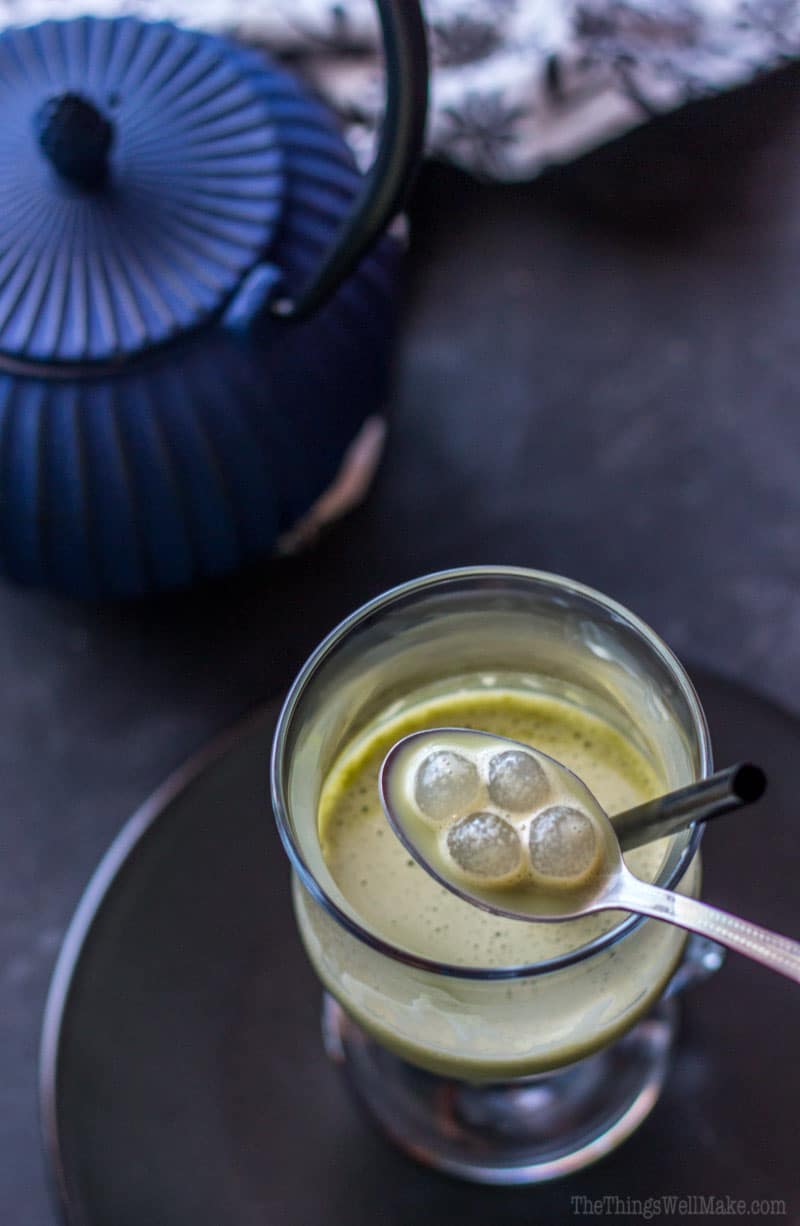
I’ll probably try adding things like matcha or substituting the water with fruit juices in some of my next batches, and I’ll try to keep you updated on the outcome.
I’d love to hear what combinations you come up with!

I love your recipe on homemade boba. However, I worked at a boba tea establishment in college and have been making store bought boba for years. While your idea on making homemade boba is correct, your concept on how to cook store bought boba is completely inaccurate. If premade boba was that hard to heat, boba tea places wouldn’t even bother using it. I highly suggest that you spend some more time researching your method cooking boba than putting false information out there. The trick to cooking store bought boba is rinsing it in cold water for about 5 to 10 minutes before bringing them to a slow boil for about 15 minutes, where you then let them cool down in warm water for about 10 minutes.
Hi Mimi,
I’m sorry you think that I didn’t spend enough time researching how to make the only store bought boba I could find here.
I actually DID try your method. The boba I had completely dissolved within seconds of being in cold water. While I did mention how that didn’t work for me, I guess I didn’t specify clearly enough. I wrote that presoaking didn’t work for me. In that category, I meant to include that I had tried pretty much every version of pre-soaking of one form or another in both cold and warm water. There is no way I could have rinsed it in cold water for 5-10 minutes, or I would have had nothing left. Mine dissolved into tapioca starch immediately on contact with cold water (both brands I tried) and no boba remained.
After researching over 30 different sites trying to find an answer to my problems, the ones that addressed the problem seemed to agree that it is highly dependent upon the quality of the boba you buy, with the ones sealed in shrink wrap being the best.
Perhaps those aren’t the only ones that can be made successfully using your method, but the boba I have access to buying here definitely can’t be made successfully that way.
I’m not trying to put out “false information.” I’m trying to let people know that if they are having the same issues that I had, that it may not be their fault, and it is probably the boba that they are using.
If you were working at a boba establishment, I’m sure they worked at finding a decent brand of boba to work with. They would be stupid not to.
There are different brands and some are meant for boiling quick, others are made for recipes like pudding. The normal white tapioca at most Asian marts does not go completely soft even if boiled for 5 hours plus. Tapioca made for boba boils in minutes. I carry both at home 🙂
That’s so interesting!
The two brands I bought really didn’t specify anything, and only said to boil in water. It is very possible that they could have been meant for some other purpose, though. I just can’t imagine them ever getting nice, even in something like pudding. I have looked, but haven’t been able to find any tapioca meant for boba here in Spain. So, for now, I’m still making them myself. It’s nice to have the option in any case. I pretty much always have tapioca flour on hand. 😉
Hi Tracy!
I’ve developed an unhealthy obsession with boba. I’ve had it all through my childhood, then lived somewhere not as culturally diverse, hence losing access to it. I recently moved again to a new area that has boba everywhere!
I decided it was time to figure out how to make these for myself because it’s breaking the bank. These turned out way better than I thought possible. I made the recipe exactly as you stated.
Just as a note for other people trying this, you really do have to put the water in BOILING. I used a spoon and was stirring the flour before putting in the boiling water and continued to stir vigorously. That little amount of water may not seem like enough at first but keep stirring and it will come together.
I tried them as soon as they were floating, and some with several minutes of boiling. The texture is pretty much the same to me. They were soooooo soft and chewy! No slime.
Thank you for putting this together, I appreciate it!
Hi Renee,
Thanks so much for your contribution and tips!
I agree 100% with you on both observations.
Yes, the water needs to be boiling to get the flour consistency to change and become elastic.
I also agree that the texture doesn’t change much after cooking for longer. Some people find that it changes for them, so I invite people to try it out and see for themselves. In my experience, though, I think it’s pretty much the same once they float too.
Oh, and I’m so happy I was able to help you out! 🙂
Is the result going to be the same if you use tapioca flour instead of tapioca startch? Thank you!
Hi Sofie,
Depending on where you are, the terms are often used interchangeably. Normally what is different is cassava flour, which is made with the whole yucca root, and not just the starch. Even that, though, may not always be true.
That said, I’ve heard people say that they’ve had better luck with some brands over others. If you have one at home, give it a try. It only takes a couple of minutes.
Oh, and I should say that I’ve never tried making boba with cassava flour because it isn’t something that I can easily find here in Spain yet. I’ve never had issues with the various brands of tapioca flour/starch that I’ve tried, though. I hope that helps.
Hi Tracy. Thank you sharing your hard work. It’s fun, creative, and preservative/chemical free. If you’re short in time, however, there are store bought brands that are not at all inferior. The brand I’ve used is WuFuYuan Black Tapioca Pearl. Here in the US, it’s in many Chinese markets and on Amazon. It takes less than 5 minutes… just pour any amount of boba in boiling water until they all float, which takes about 2-3 minutes. Strain and serve. It’s probably the same amount of time to brew coffee. This is the popular dark boba with a taste and aroma that can be hard to mimic at home. The dark color SHOULD come from dark sugar, but who really knows if you didn’t make it yourself. I’m pretty sure there are other great brands out there, but WuFuYuan is what I’ve personally used for years. FYI I would take these boba to a Starbucks and pour it into their drinks. Armed with a boba straw, everyone would ask “Starbucks has boba now?”
Hi Jay,
Thanks for your feedback! I haven’t found any here in Spain. That said, I also haven’t seen any of the black varieties here.
From what I’ve read, though, the black varieties are mostly colored with artificial colorings. I can’t imagine that any sugar would be dark enough to make a black boba, especially when you consider it is mixed with a bright white starch.
Hi Tracy. Thanks for sharing your recipe. I was able to make the pearls successfully, soft and chewy. It was great to consume when they were warm but I had a problem when I added them to cold tea or smoothie, they turned hard right away, especially in the center. Do you have any tips for this ? Thanks.
Hi Joline,
I think that’s just part of the way tapioca is. I had the same problem, but not only with my homemade tapioca pearls, the store bought ones did the same thing. I’d seen people recommend boba popsicles, but I tried it with both types of boba, and I thought the pearls were gross cold.
One of my readers told me that they also used glutinous rice flour in the boba pearls where he lived. He suggested I use around 55g tapioca flour, 30g glutinous rice flour, and 80 ml water. I haven’t tried that yet, but was considering trying it and giving it as an option if it held up better in the cold. All of the tapioca pearls sold in the local Asian market only use tapioca, though.
If you do try it out and it works well, I’d love to hear about it. 😉
Hi! I tried this recipe recently and I was wondering how long they should cook for. I left mine in for about 25 minutes and they seemed to still be slightly raw and firm inside. This reminded me of when I tried store bought dried tapioca pearls, since those took very very long to cook as well.
Hi Kevin,
Mine cooked through right away- I mean in just a matter of minutes.
Were they especially large? Or did you let them dry out before cooking them?
I cook mine immediately after making them, and they really only take about 5 minutes (more or less depending upon the desired consistency).
Without more information, it’s hard to pinpoint what the problem was.
Your boba recipe turned out excellent!!! It tasted delicious, just like boba from a tea house. Definitely going to make again!
Yay!
I’m so happy, Arianna! 🙂
I live in an area where the closest bubble tea shop is about a 6 hour drive away and I so much miss bubble tea! I was kind of skeptical that this would really be as good as the boba that you get in shops, but it was wonderful! It all worked perfectly on the first try! Out of curiosity, do you know why homemade boba are white/clear and store bought dried boba are black/brown? Thank you so much for the wonderful recipe!
Hi Trula,
I’m so glad you liked the recipe and it worked out well for you.
I’ve seen that some places use the black boba, and I’ve also seen multicolored, fruit flavored boba. Interestingly enough, I’d only tried boba at once place before moving here to Spain, and the boba were served white.
From what I can gather, it’s all just food coloring that is added to make things look fun.
I personally try to stay away from added colorings in my food, when possible, so I’m happy to be able to make them without.
Hi Tracy,
Your recipe is amazing and by cutting the dough into small bits then rolling them is such a brilliant idea! It saved me so much time and helps with size consistency. But I have a question. If I wanted to sweeten the pearls, if possible, what’s the best way to do that?
Thank you!
Hi Trang,
I’m glad my tips helped you! I definitely found it was the quickest way of doing things. 🙂
Yes, you can sweeten the boba by adding sugar to the water before mixing it with the flour. You can also add a bit of powdered sugar to the flour instead. Don’t go overboard on either method or it can affect the consistency or cause other problems…
Keep in mind that to get the tapioca flour to get to the right consistency, you need the water to be very hot, almost boiling still. When you add sugar to water, hot sugar solutions can burn your skin if you aren’t careful. If you only add a little bit of sugar to the water, which is what I would suggest, and heat it to dissolve the sugar and get the solution almost boiling, you should be fine. I wouldn’t suggest making a thick sugar solution that has been boiling for awhile, and if you were to try that, definitely don’t use your hands to mix it all together! Just use a bit of common sense, and be careful not to burn yourself. 😉
Omg please help me! I have my tapioca balls made from scratch and when I cook them they are not getting cooked in the very center! The outsides are perfect and chewy but the middles are still hard dough… I’ve boiled them for over 1 hour and have soaked it in cold water after. I’ve tried making tiny dough balls that are smaller than the nail on my pinky and still the same thing happens… I’m about to give up ????? any suggestions?
Hi Celia,
Did you cook them right away? Or let them dry out.
I’m afraid if you let them dry out, they are just as difficult to cook as the store bought ones. If you use them freshly made, they should be soft and chewy almost immediately.
The only other problem I can think that you may have had is that they didn’t form correctly if you didn’t use boiling water. The water needs to be very, very hot when you add it to the tapioca starch. In the winter, it could be difficult to keep it warm, and you may want to add the tapioca to the water in the hot pan you used to heat the water. The hot water changes the consistency of the tapioca starch and makes it chewy/rubbery.