

Easy, Beginner DIY Liquid Castile Soap Recipe
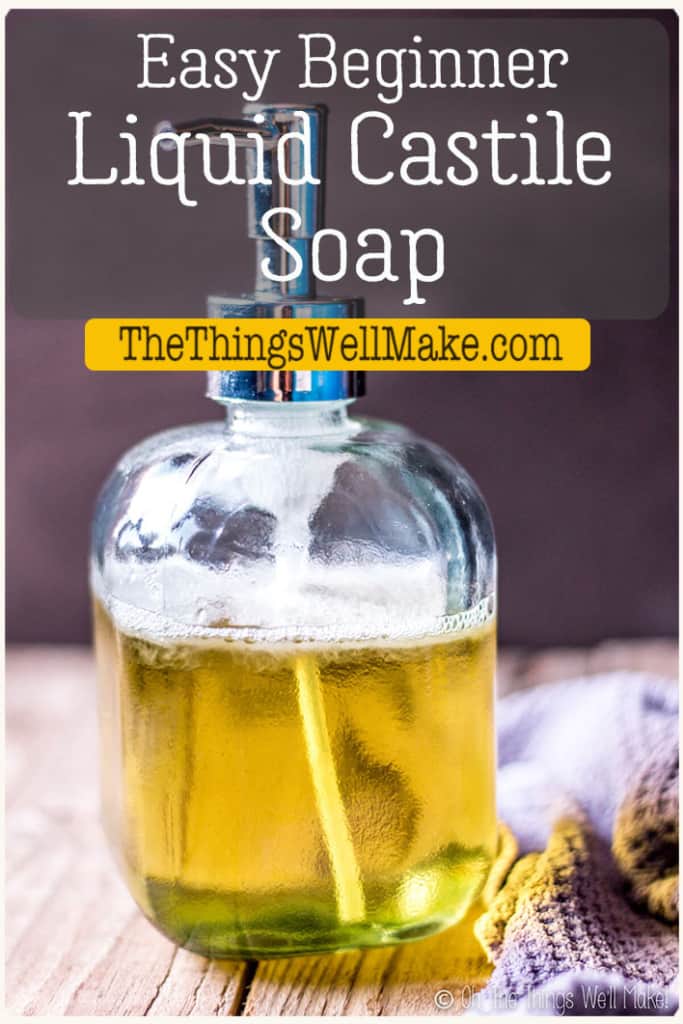
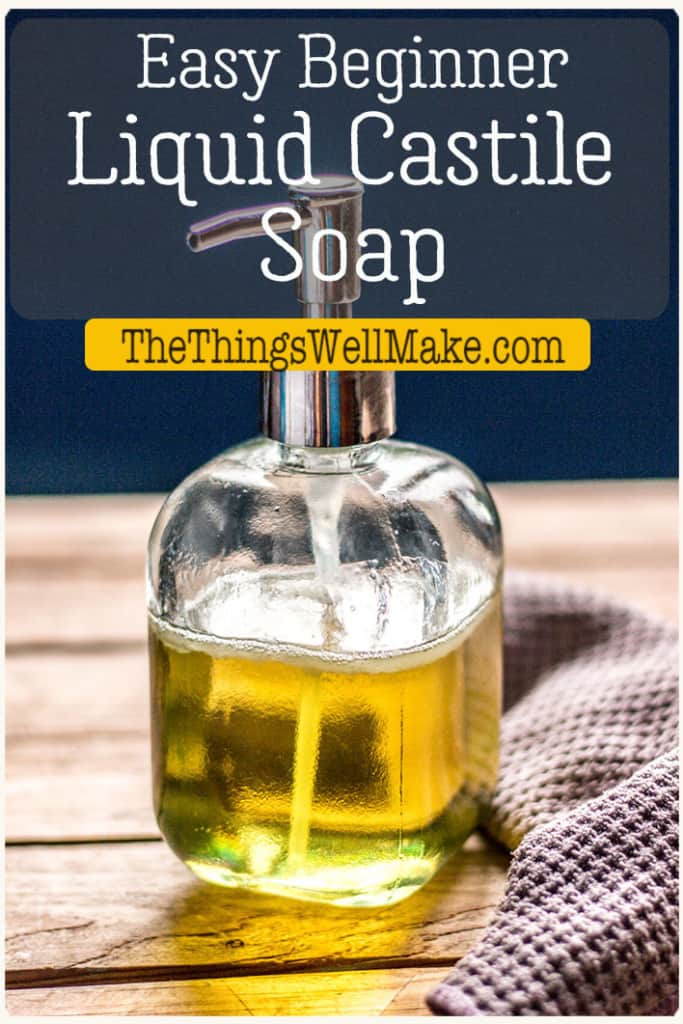
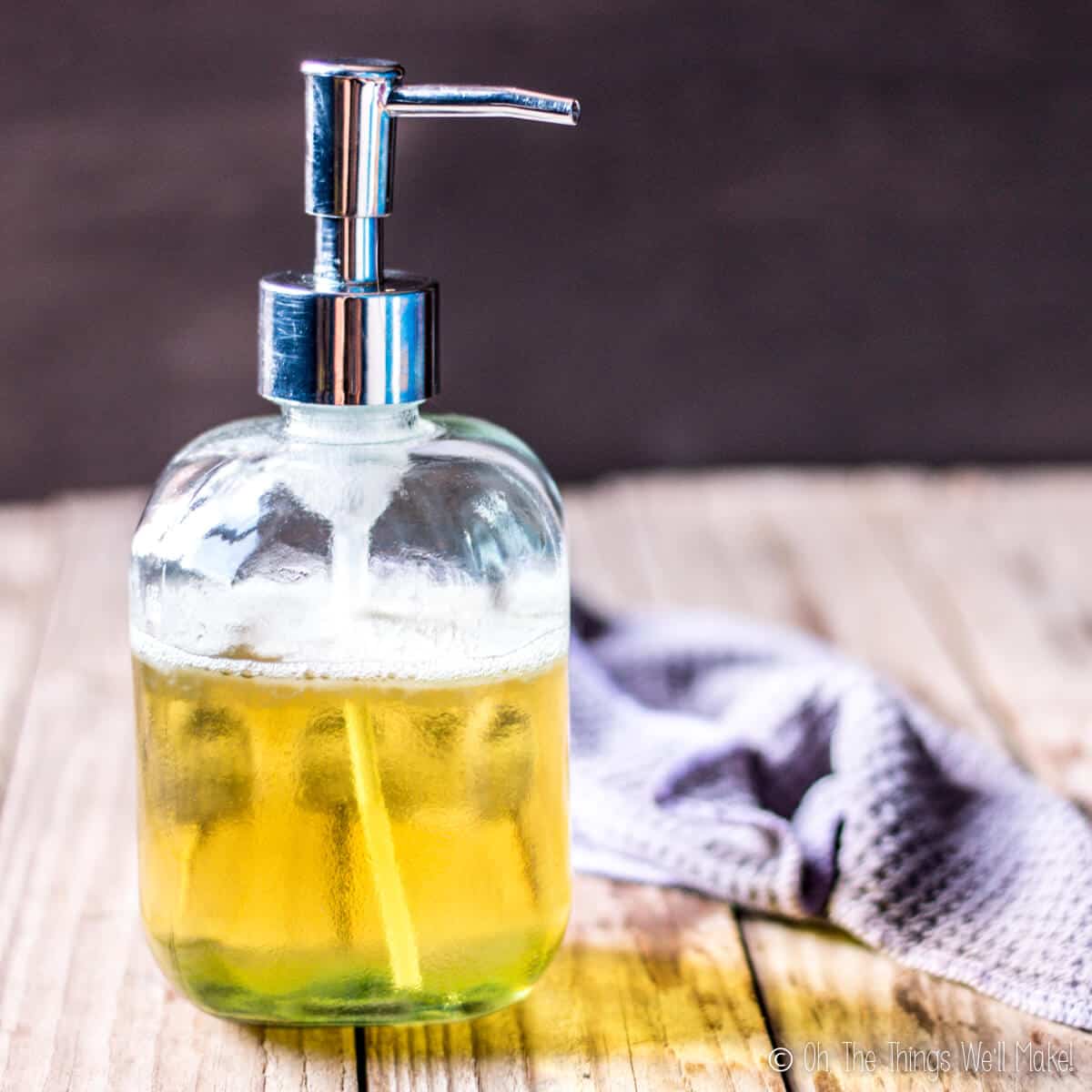
Made with only olive oil, this pure liquid Castile soap is easy to make and mild. It’s perfect for face and body, and for cleaning around the house.
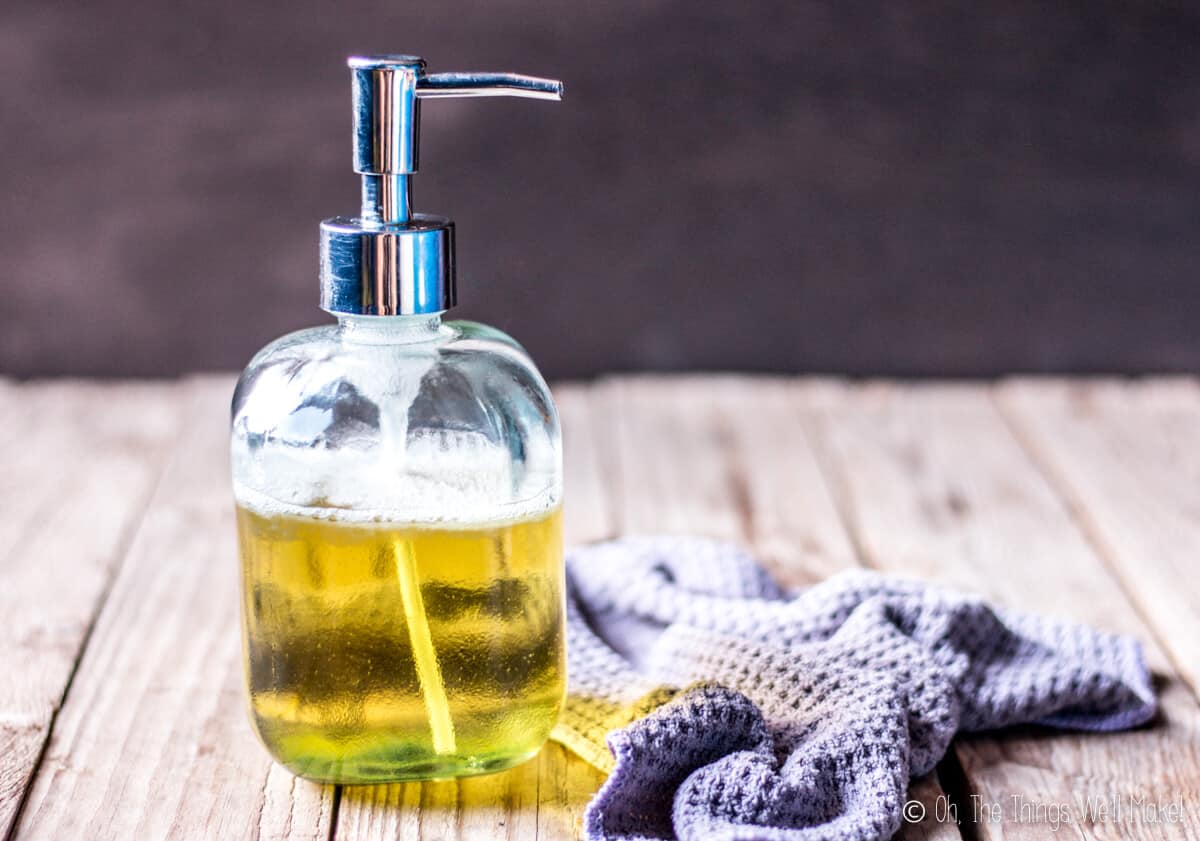
A couple of years ago, I showed you how easy it was to make a basic beginner soap, even if you’ve never done it before.
Making solid soaps can be a lot of fun, but not everybody likes using bar soap. Many people prefer using something in a dispenser like a shower gel or a liquid soap.
I made many different types of bar soaps before attempting to make a true liquid soap. There aren’t as many resources about making liquid soaps, so I had to do a lot of trial and error before posting this first liquid Castile soap recipe.
Once you find a good recipe, it’s pretty simple to make. While it does take a little more time and effort than whipping up some bars of cold process soap, I think you’ll find that it’s well worth it, especially when you take a look at the price of a store-bought liquid castile soap.
How does liquid soap differ from bar soap?
The main difference between bar soaps and liquid soaps is the type of lye used to make them. Liquid soaps are made with KOH, or potassium hydroxide, rather than NaOH, or sodium hydroxide.
You can read more about the different types of lye in my post about lye and why it is needed in soap.
While some people like to make a “liquid soap” of sorts by diluting bar soaps in water, you can’t really get a true, transparent liquid soap that way. Some people are happy with the result, but every time I’ve tried it, I’ve ended up with a gloopy mess. It doesn’t have the same cleaning power as either a bar soap or a true liquid soap, and the texture and appearance aren’t the same either.
What is pure Castile soap?
Technically, by definition, Castile soap is a type of soap made with only olive oil. The name “Castile” soap originates here in Spain. (You can read more about the origin of Castile soap and other soaps in my post with a recipe for pure Castile bar soap.)
Over the years, the definition of Castile soap has broadened to include other types of vegetable oils such as coconut oil. Dr. Bronner’s liquid Soap, which may be the most famous commercial liquid Castile soap, actually has a greater percentage of coconut oil than olive oil. (I made a Dr. Bronners liquid Castile soap copycat recipe for those who are interested!)
When it came to making a homemade liquid Castile soap, though, I was a bit of a purist and made the real deal: a soap made with only olive oil.
Olive oil in soap
Soaps made with different oils have different properties.
Soaps made with olive oil are more conditioning for your skin than soaps made with coconut oil. On the other hand, they don’t lather up as much as a coconut oil soap, nor do they leave you feeling squeaky clean in the same way (partly because they are more conditioning).
Some people find pure Castile bar soap to be “slimy” and not cleansing enough. On the other hand, pure coconut oil bar soap can be drying.
- Pure coconut oil soaps are great for general cleaning and for laundry. That’s why I made my homemade laundry soap only with coconut oil.
- Pure olive oil soaps tend to be gentle on the skin and great for gentle body cleansing.
Read my post about the properties of different oils in soaps.
Ideally, you’d combine different oils to get the qualities you want for your soap. That’s exactly what they did when they formulated Dr. Bronner’s soap, and what I did when I showed you how to make a basic beginner soap which uses a combination of olive oil and coconut oil.
Combining liquid soaps
When you make a bar of soap, you have to decide what combination of oils you want to use from the very beginning and your entire batch will have that very same combination.
With liquid soaps, though, you have the advantage of being able to combine your various soaps after the fact, making it easier to experiment with smaller combinations until you find the perfect soap for your need.
That’s why I made a pure liquid castile soap, using only olive oil, and then later made a pure liquid coconut oil soap. Once you’ve made both of them, you can combine them, as needed to get the type of soap you want.
Coconut oil liquid soap vs. liquid Castile soap
When I first started making liquid soap, I assumed that liquid soaps would be just like bar soaps. The difference between a pure Castile bar soap and a coconut oil-based bar soap is HUGE!
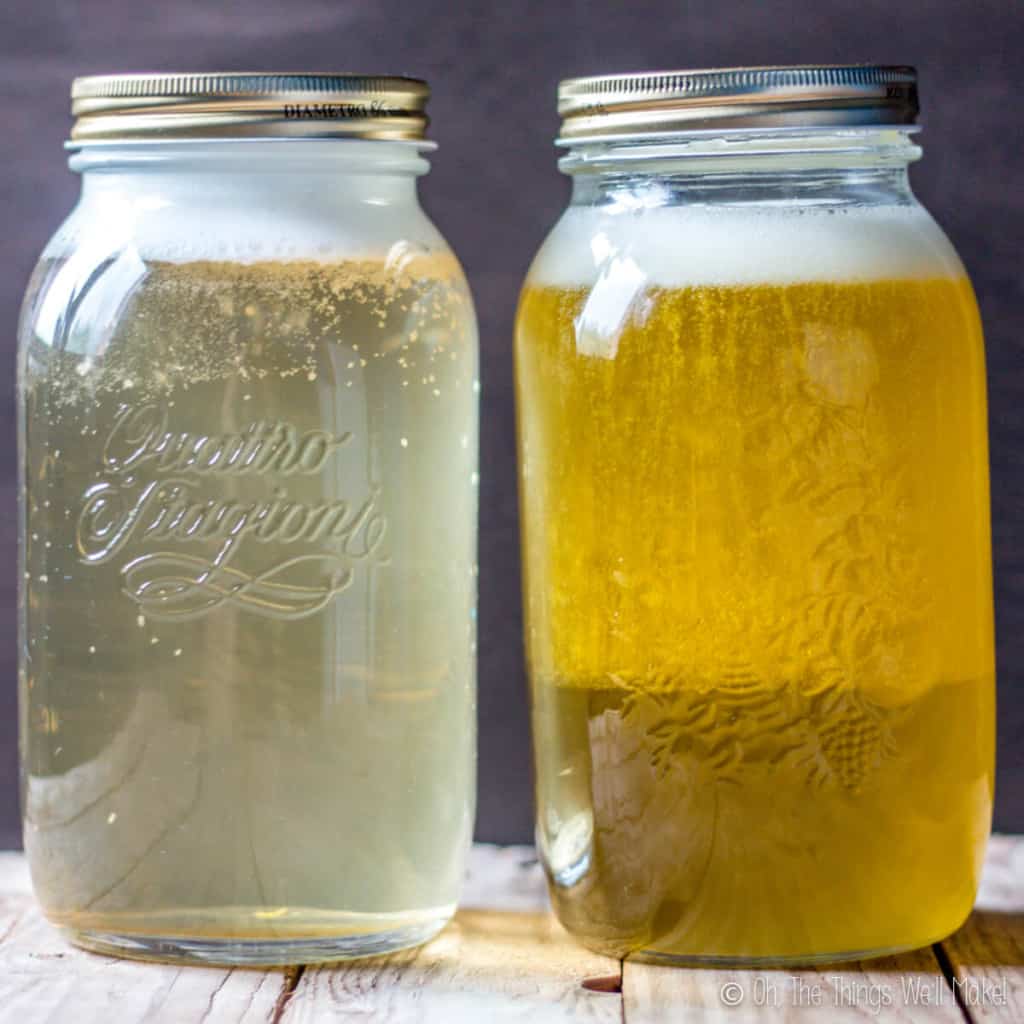
I was very surprised to find, though, that liquid soap made with coconut oil was actually quite similar to that made with olive oil. Sure, the olive oil-based liquid soap was darker in color than the coconut oil-based liquid soap. For me, that was probably the most notable difference.
Yes, the coconut oil soap does make a bubblier lather than this one and may be slightly more drying. It does give more of a “squeaky clean” feeling.
In the end, though, the difference isn’t as pronounced as I expected. In fact, I normally just make the coconut oil liquid soap recipe these days. I can buy refined coconut oil cheaper than olive oil, but also love the look of a lighter-colored soap. I also love the fresh, subtle scent of the coconut oil soap when left unscented.
Both soaps give a decent lather. They are also both relatively mild for skin. If you have sensitive skin, though, this soap is probably the better choice.
Those who have very sensitive skin may find that they have issues with the higher pH of any soap. In those cases, it may be best to use something like my DIY Baby Wash and Shampoo. (I made it pH balanced for a baby’s delicate skin.)
Ingredients
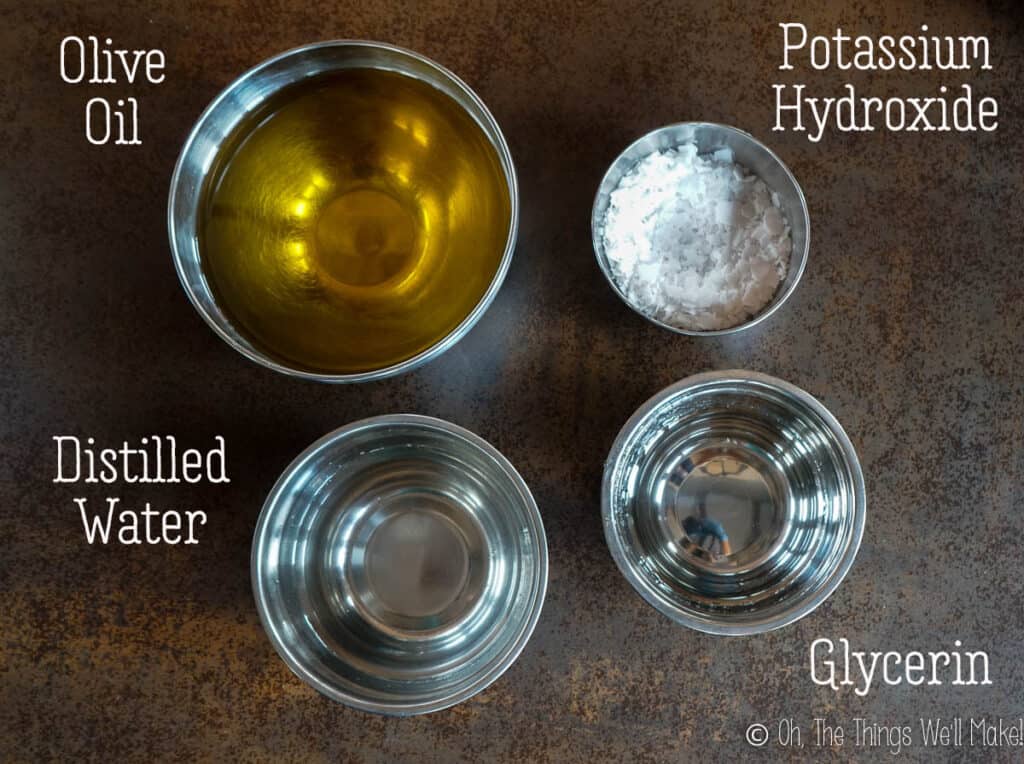
This soap uses 4 main ingredients: olive oil, potassium hydroxide, water, and glycerin.
You can use extra virgin olive oil or a lighter olive oil. What is important, though, is that you are using pure olive oil. (If it’s not pure olive oil, it may need a different amount of lye.)
For the water, it’s best to use distilled water. Tap water has minerals and may have other impurities that can affect the clarity of your soap.
Why use glycerin when making liquid soap?
One of the methods of making liquid soaps is called the glycerin method. It replaces part of the water with glycerin.
Adding glycerin moves the soap-making process along more quickly. Because I wanted to share a beginner liquid soap recipe, I chose the glycerin method to have this soap be as quick and fool-proof as possible.
Using glycerin may have some other benefits:
- The resulting soap paste dissolves very easily in water. I don’t need to heat the water nor do I need to leave it for days at a time. I can cover my soap paste with distilled water and usually, in a couple of hours, I have a beautiful, clear liquid soap effortlessly.
- Glycerin is a humectant, meaning it draws moisture into the skin. I find that even my liquid coconut oil soap doesn’t feel drying, despite the fact that it hasn’t been superfatted at all. I think the extra glycerin helps to make a really great, hydrating soap that is clear and doesn’t need extra oils. (I think my homemade glycerin bar soap has the same benefits.)
Materials
To make liquid Castile soap, you only need a few basic tools. An immersion blender helps mix the oils and lye solution quickly so the soap reaches trace faster. A slow cooker works beautifully for keeping the soap at a steady, gentle heat while it cooks. A kitchen scale is also important here, since soap making relies on accuracy. Measuring by weight instead of volume helps ensure that your recipe turns out perfectly every time.
Procedure
Making a liquid Castile soap isn’t difficult and it can save you a lot of money.
To get the clearest soap we can, we’ll use a hot-process method. That means that we will be cooking the soap. During the cooking process, the saponification process will complete and our soap will be ready to use immediately afterwards. (Liquid soap doesn’t need a curing time in the same way as bar soap does.)
The easiest way to make this and have it come out perfectly is to use a slow cooker. If you don’t have access to a slow cooker, though, you can also try baking it in the oven. (I showed how I used this method in the post and video for the coconut oil liquid soap.)
Making the lye solution
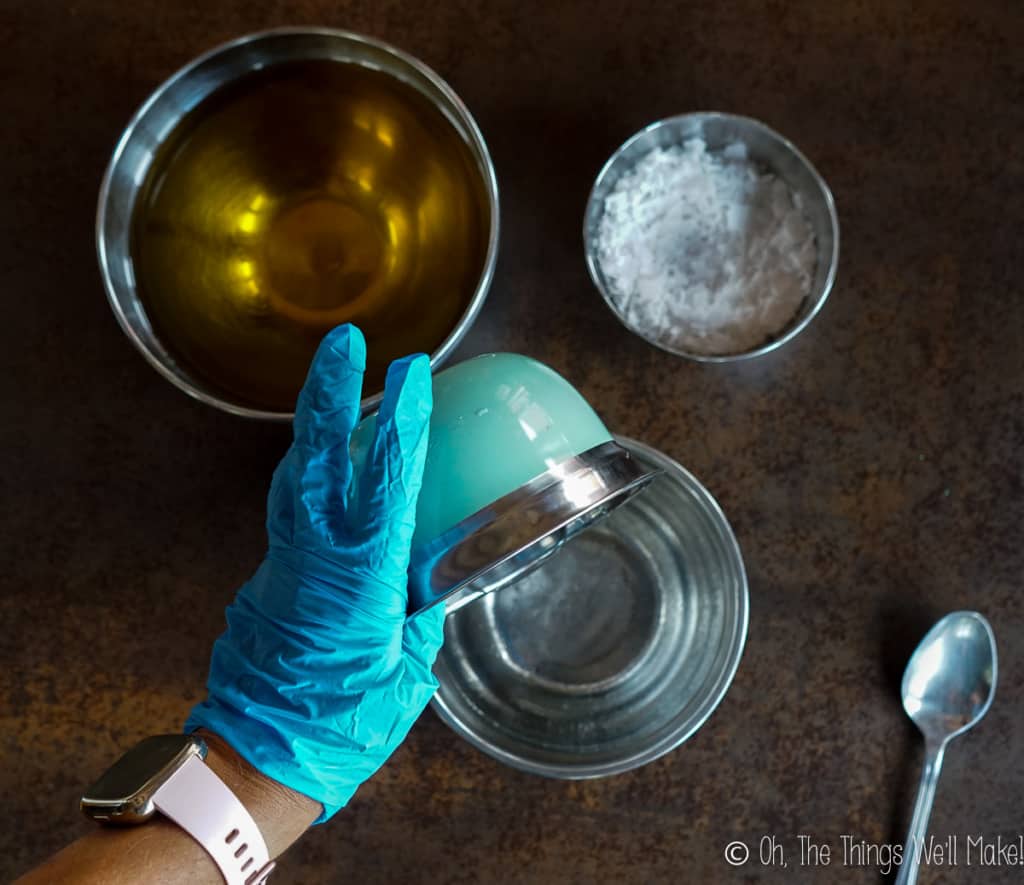
Weigh out the glycerine, water, and potassium hydroxide (KOH).
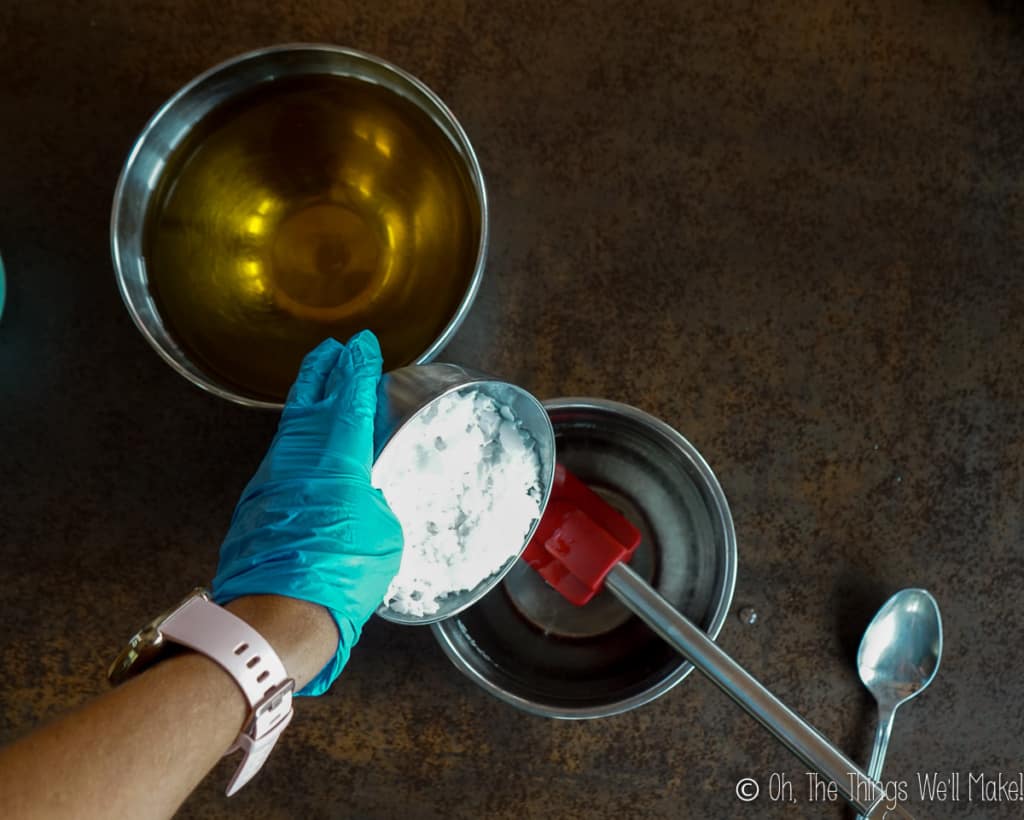
Add the glycerin to the water and then carefully add the KOH to the water and glycerin mixture. (Not the other way around!) Make the lye solution in a well-ventilated area.
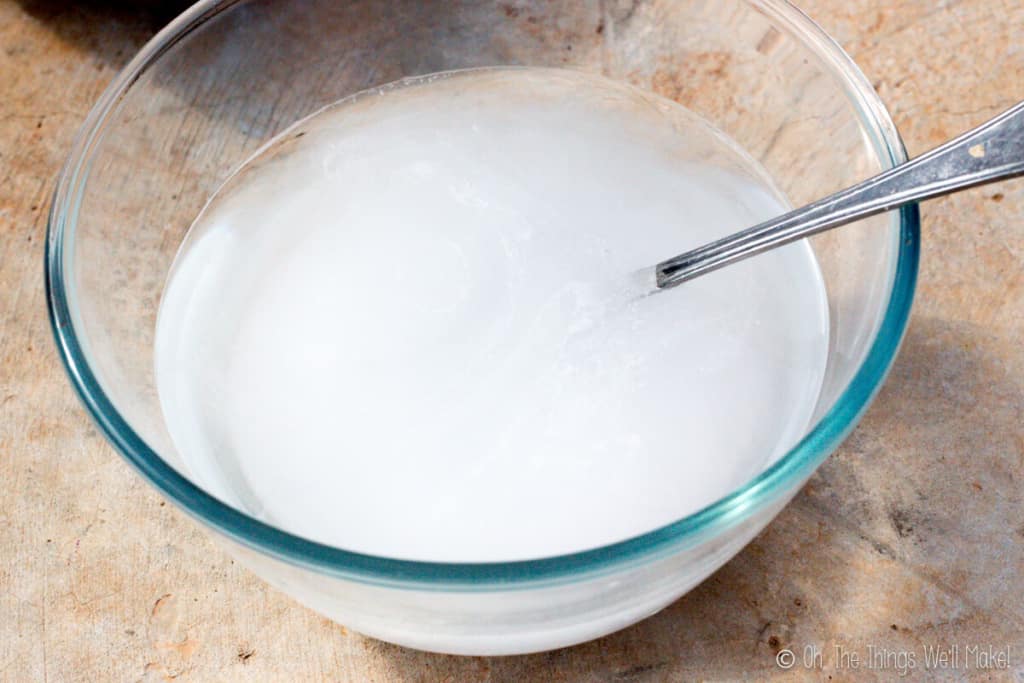
Stir the KOH into the water until it dissolves. It will be cloudy at first, but then it will clear up.
Making the soap paste
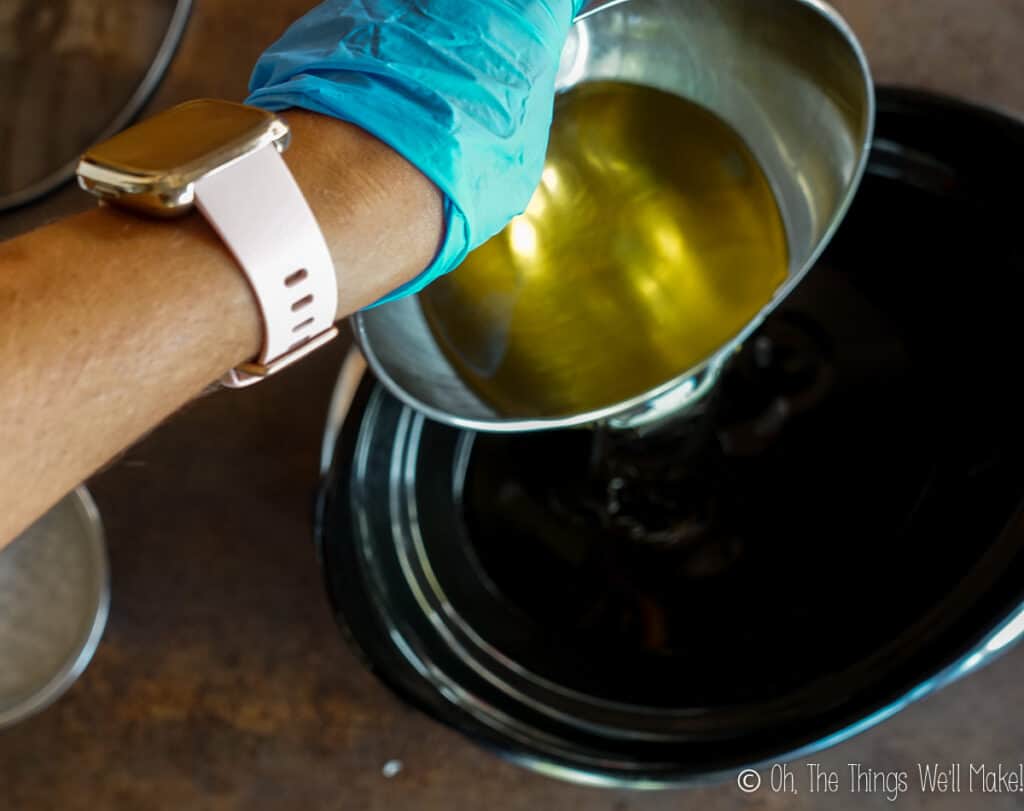
Measure out the olive oil and heat it over low heat directly in the slow cooker.
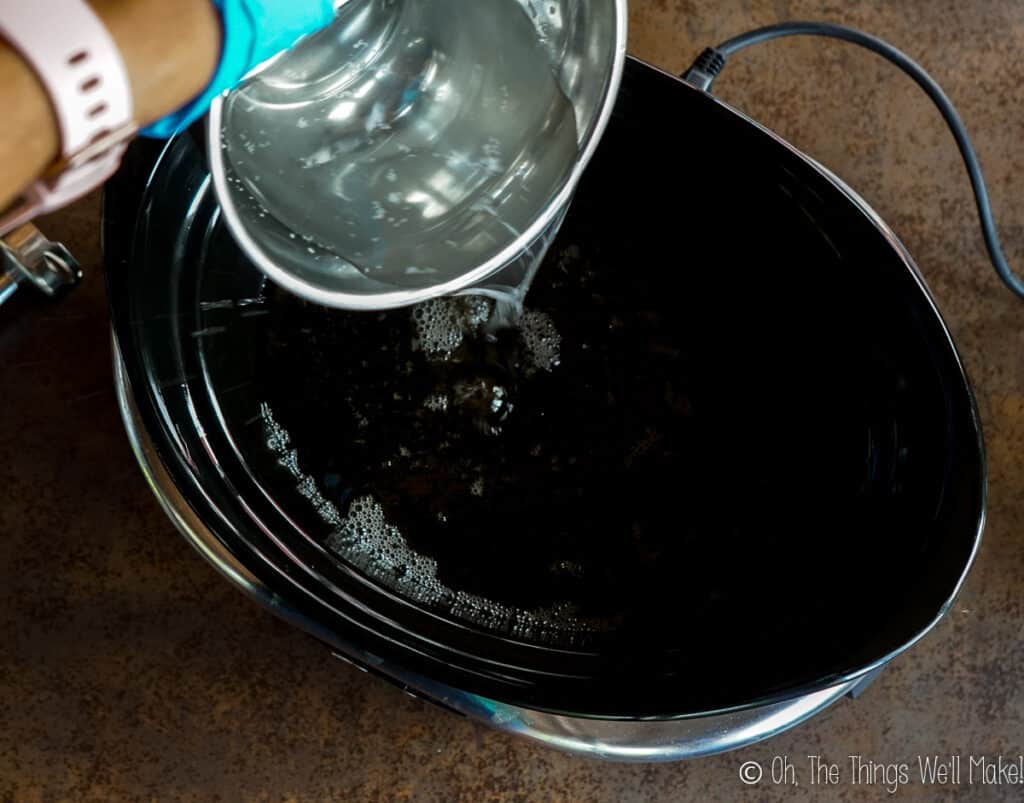
Slowly add in the the KOH mixture to the warm olive oil, and gently stir them together over low heat.
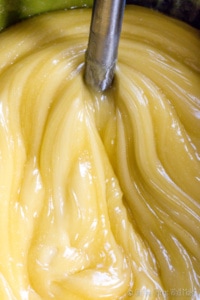
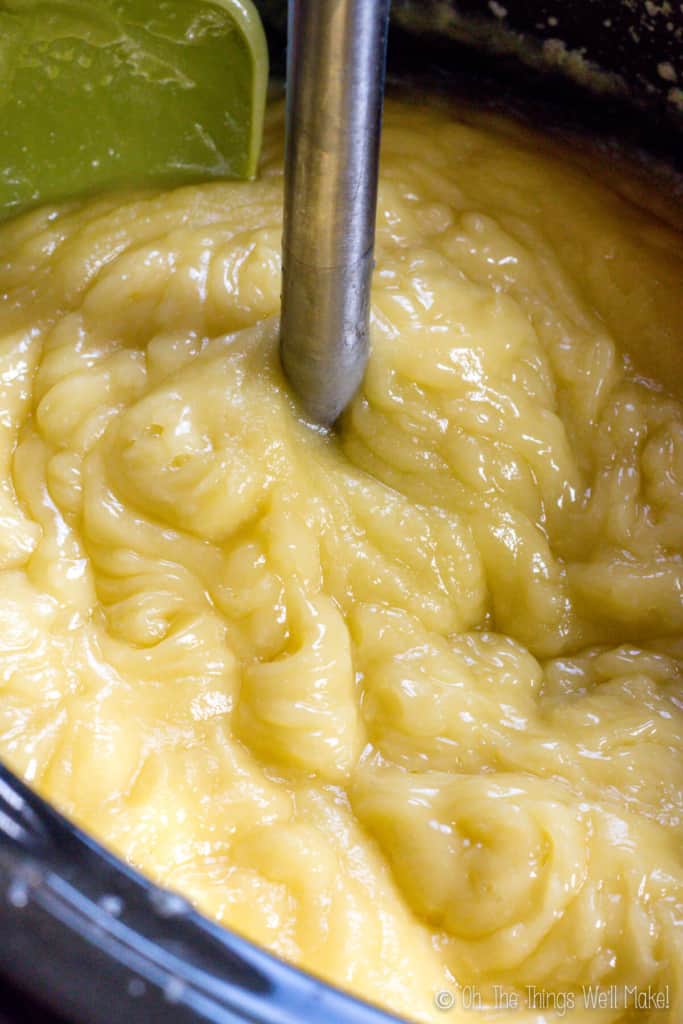
Once combined, use an immersion blender to blend the ingredients together in the slow cooker. In a few minutes the mixture will begin to thicken and look like mayonnaise. Soon after, it will look like a creamy pudding. (If you aren’t doing this over heat, it will take a bit longer.)
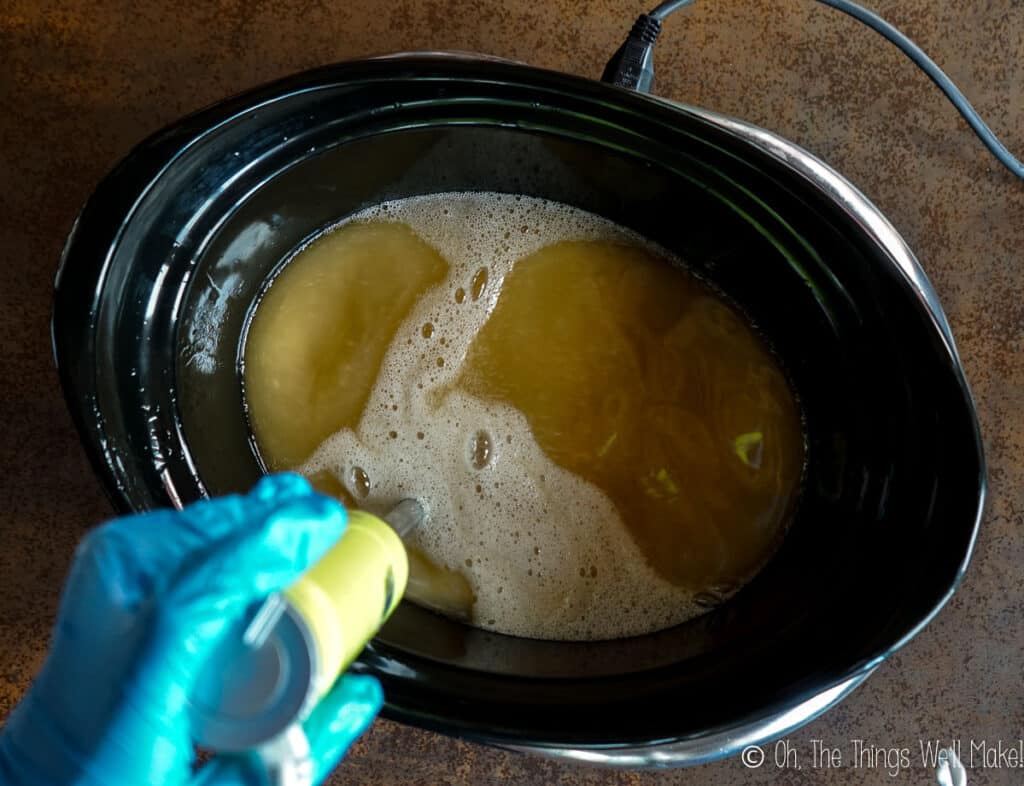
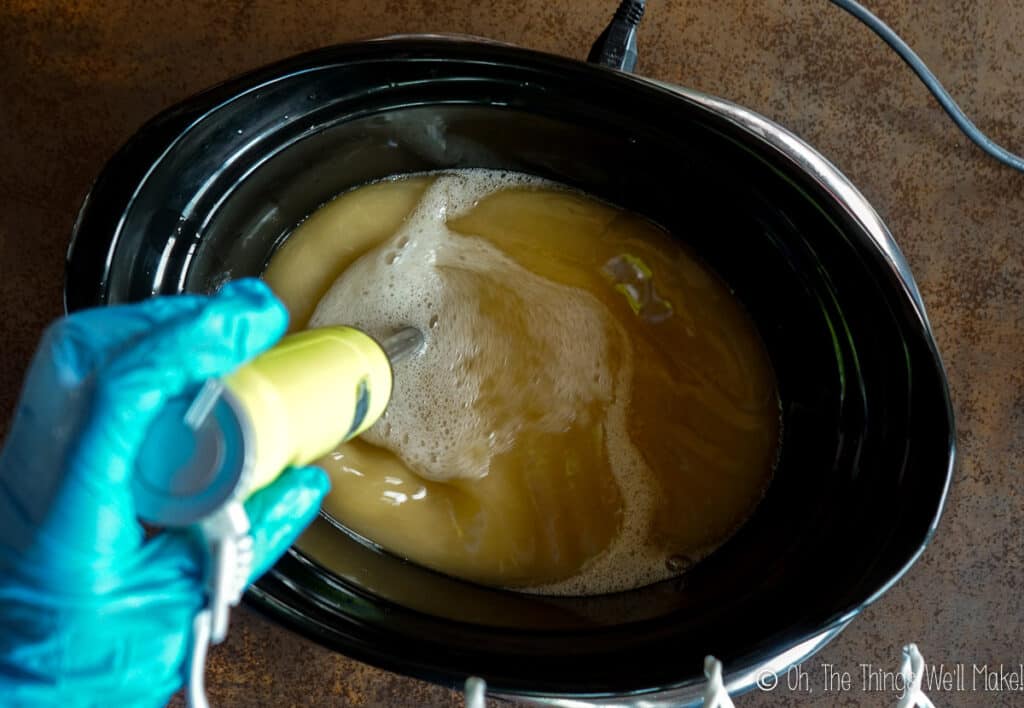
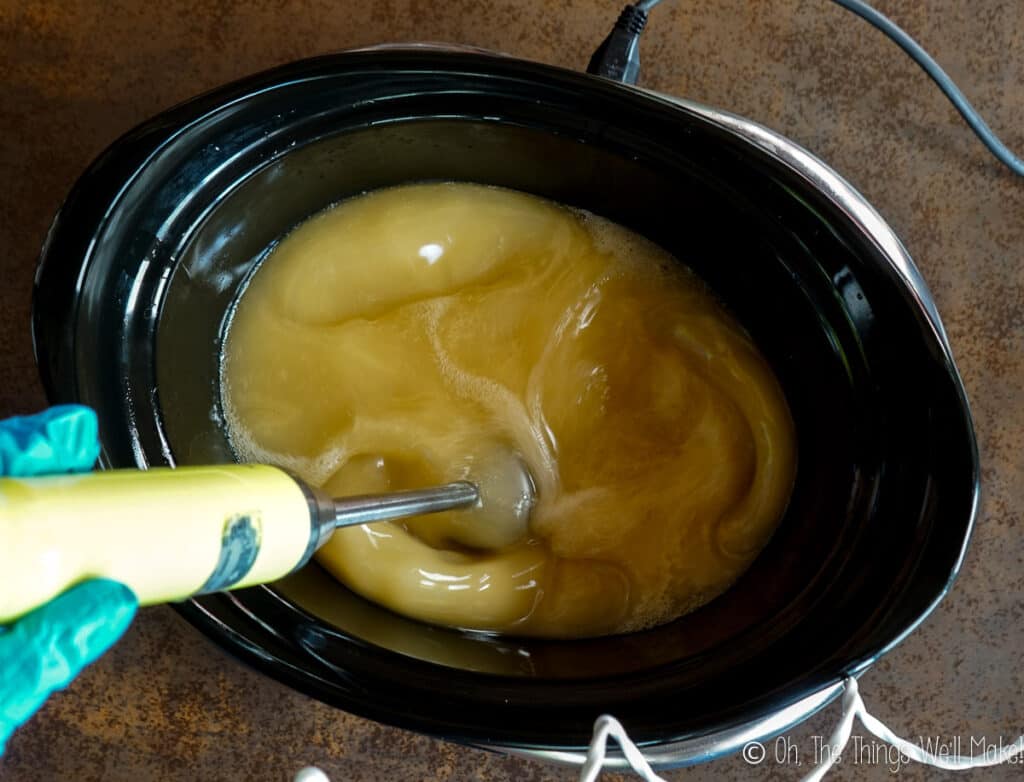
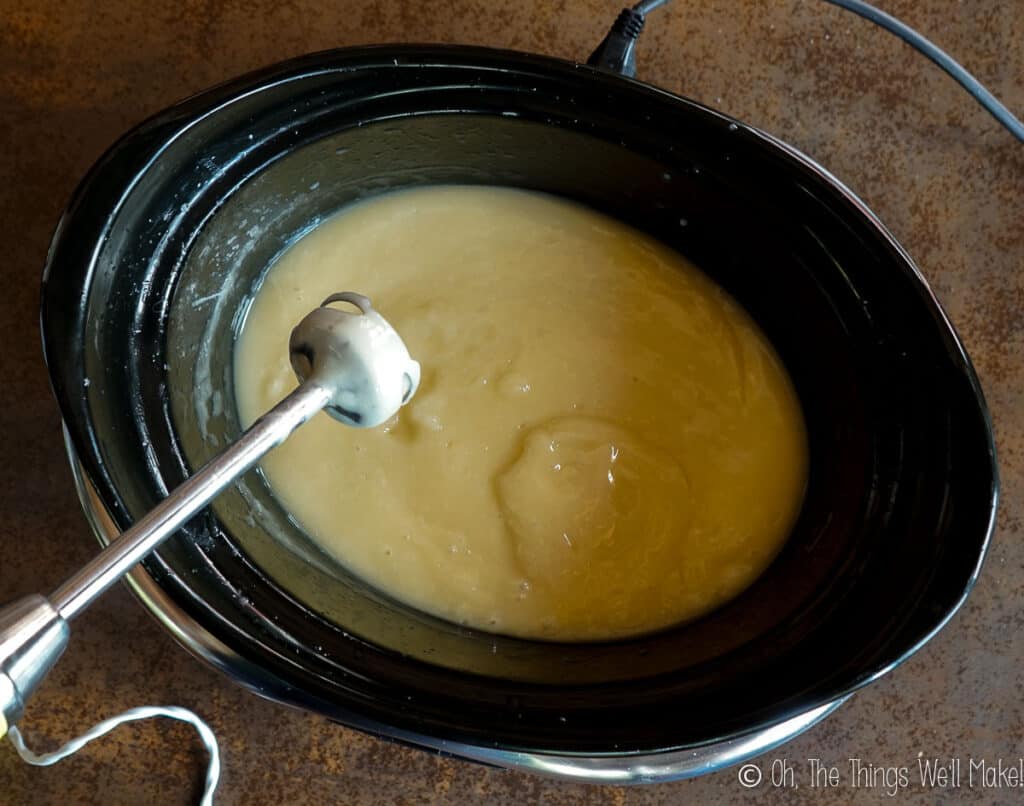
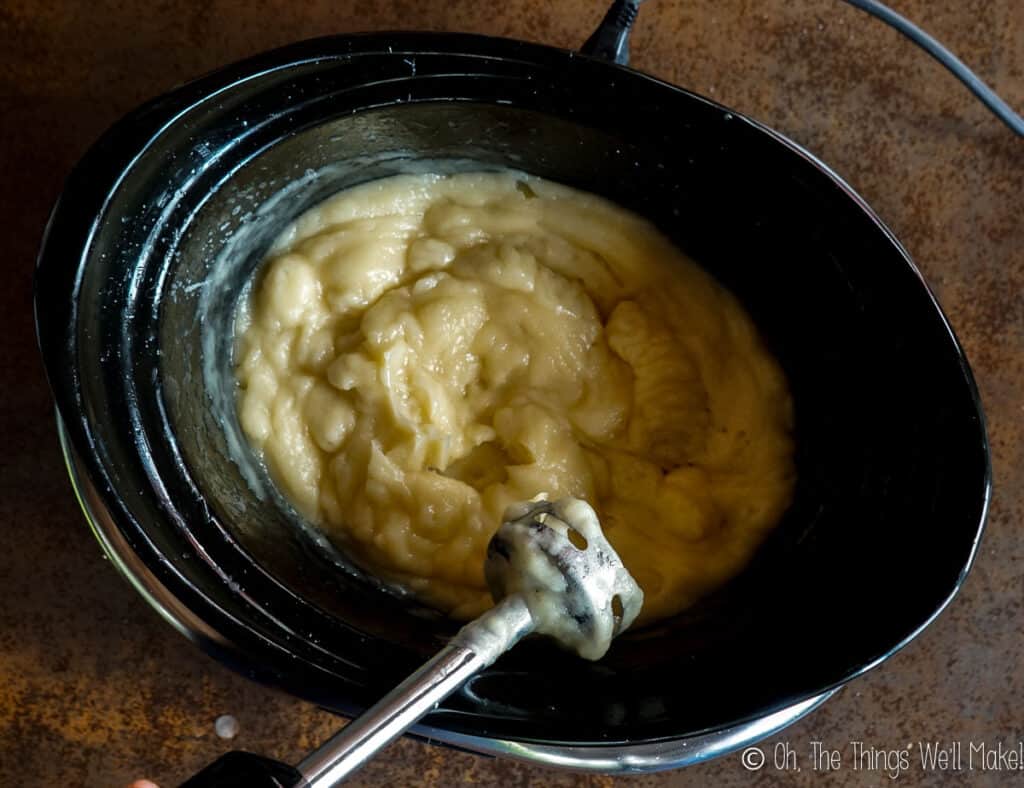
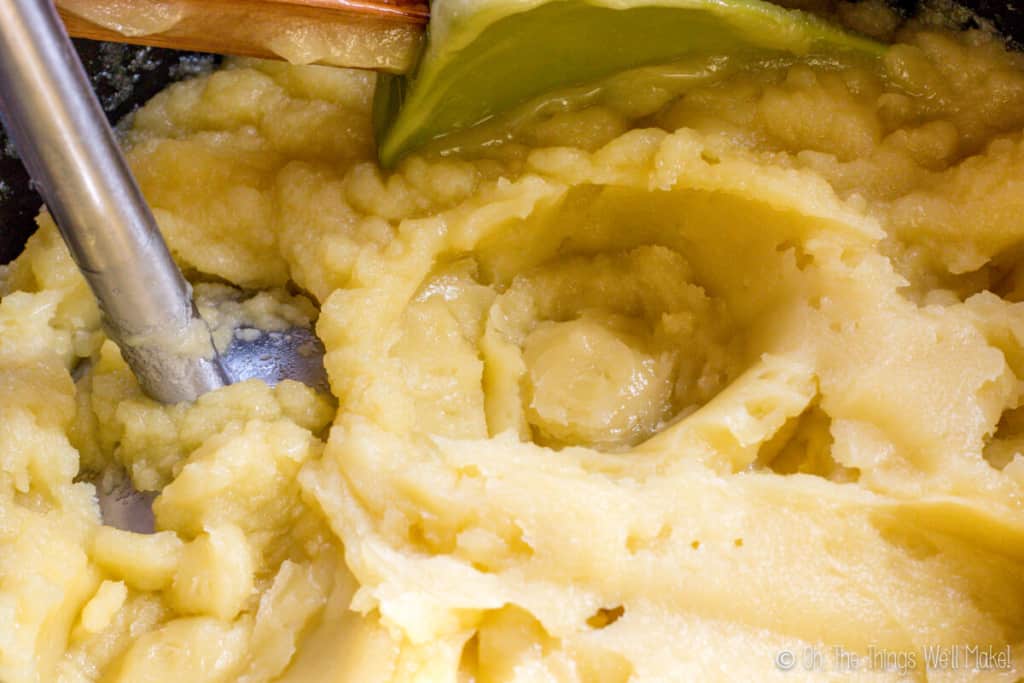
A few minutes later, the mixture will begin to look grainy and look like mashed potatoes or applesauce. Continue to blend.
If, at any point, the mixture becomes too thick to blend with the immersion blender, switch to mixing with a spatula or wooden spoon. It’s also a good idea to take breaks during the blending process so as not to burn out the blender.
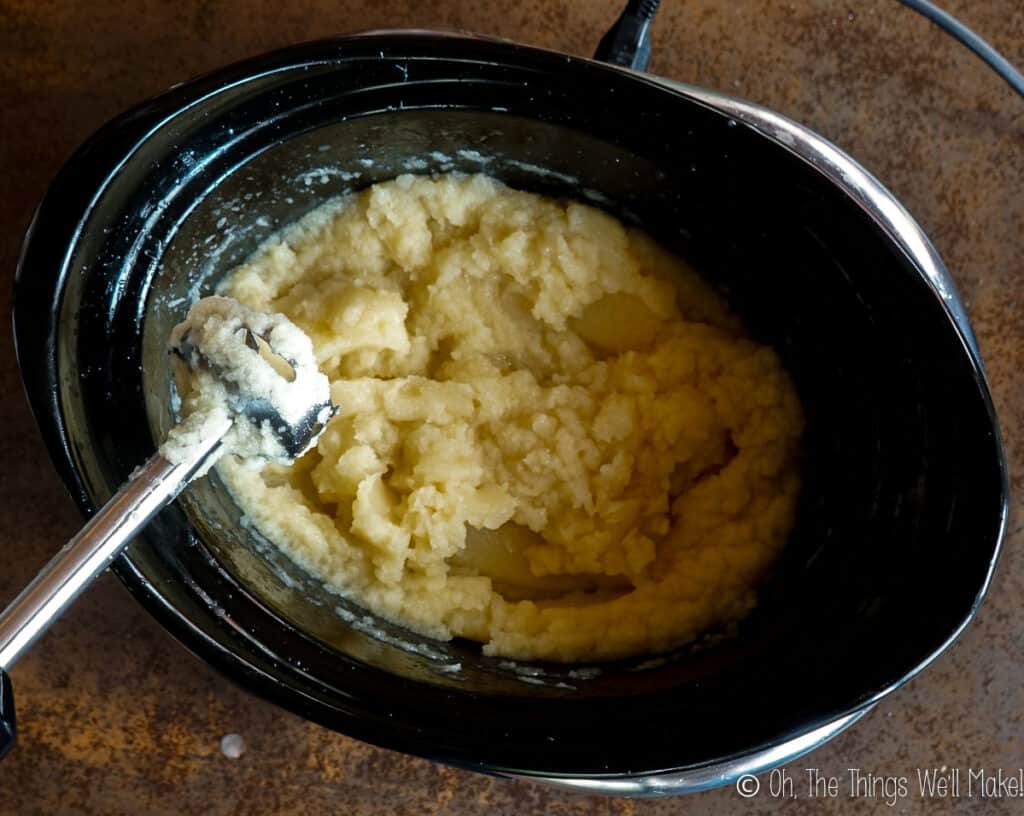
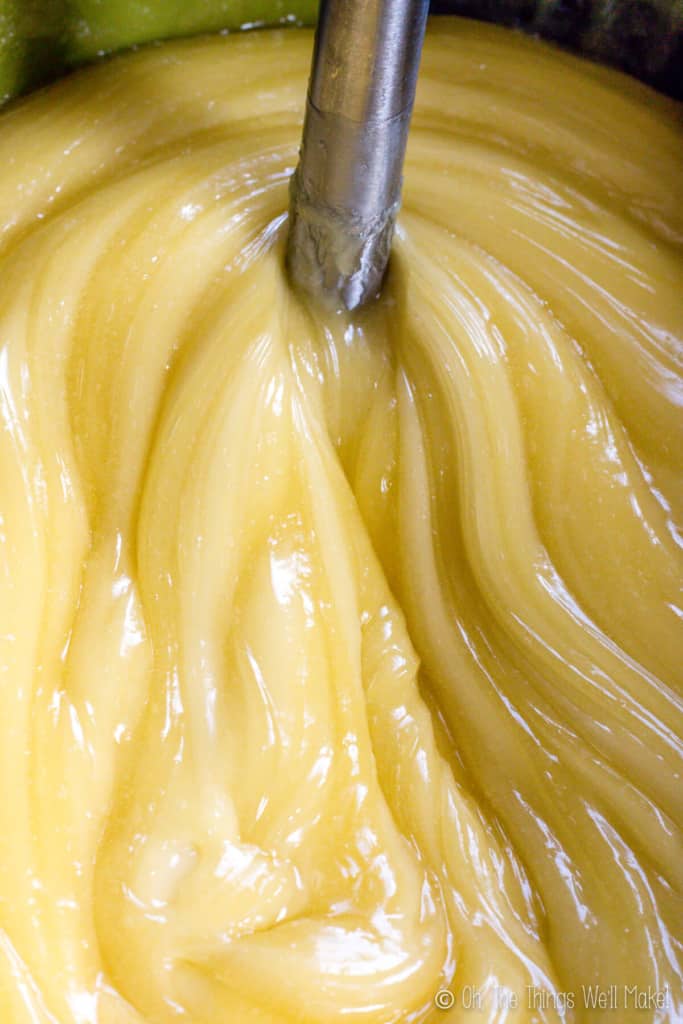
As you continue to blend, it will start to get creamy again. It is now time to cover it and cook it for a while.
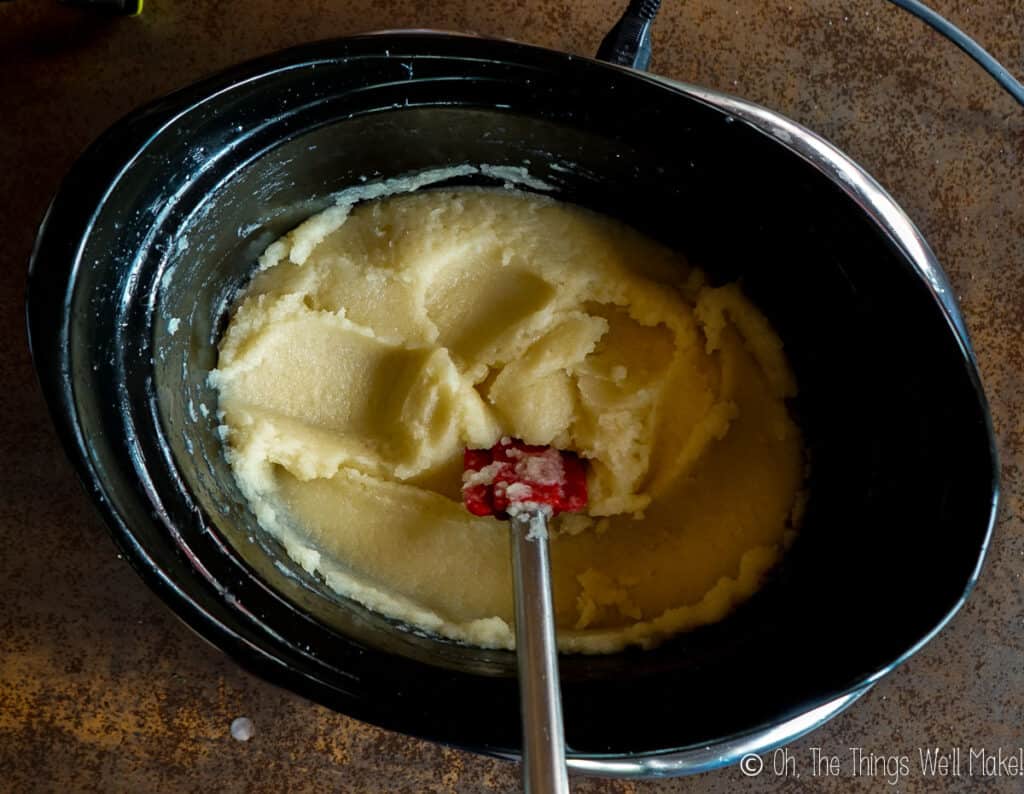
Cooking the soap paste
Cooking the soap paste will allow the soap to finish the saponification process and will also help achieve a perfectly clear liquid soap immediately. The process will take 3-4 hours, and you will want to check on it and stir it up every half an hour or so.
As you cook the mixture, it will begin to thicken up and become more translucent.
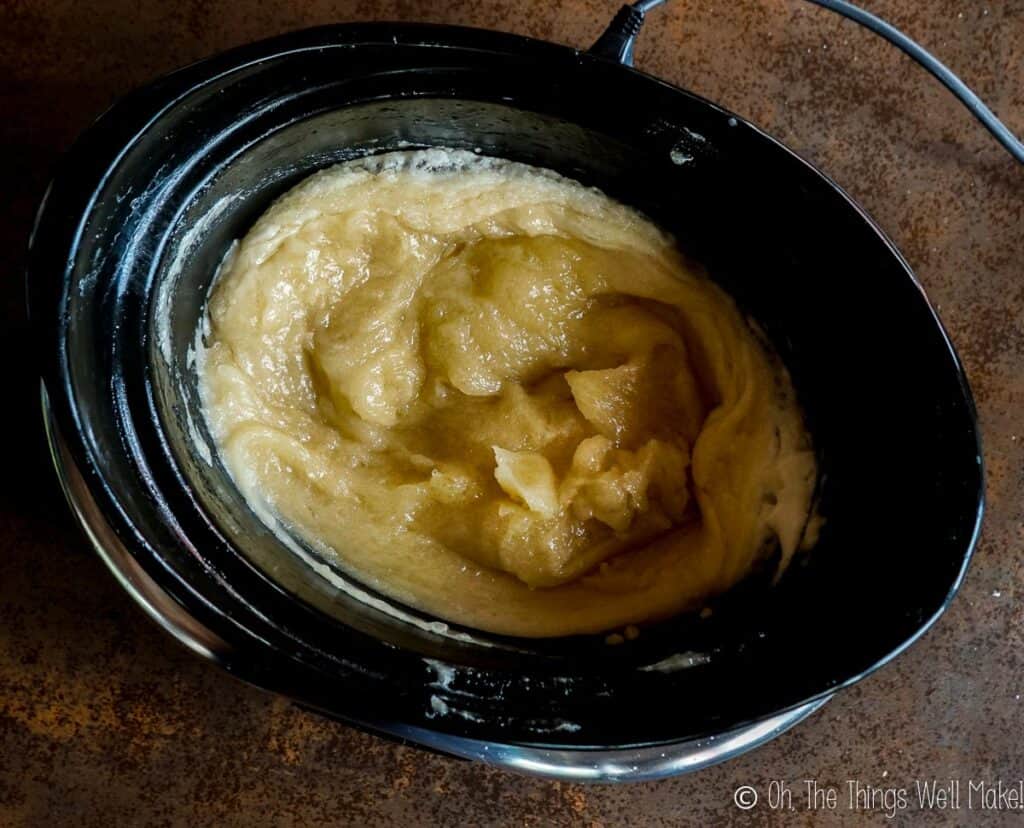
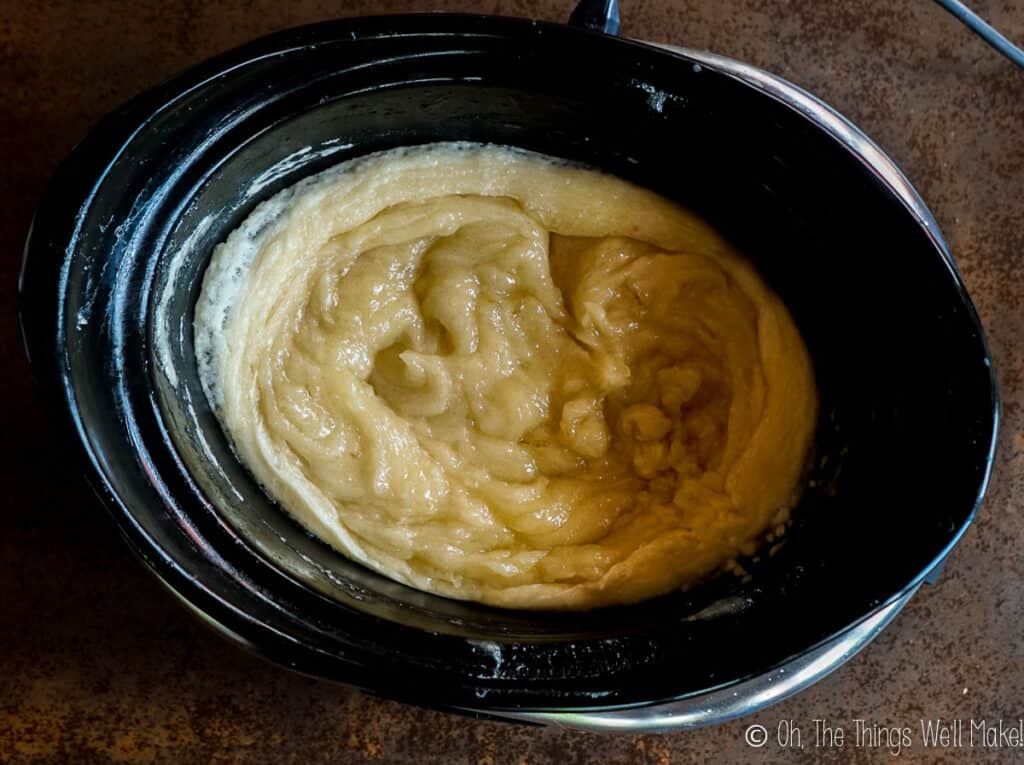
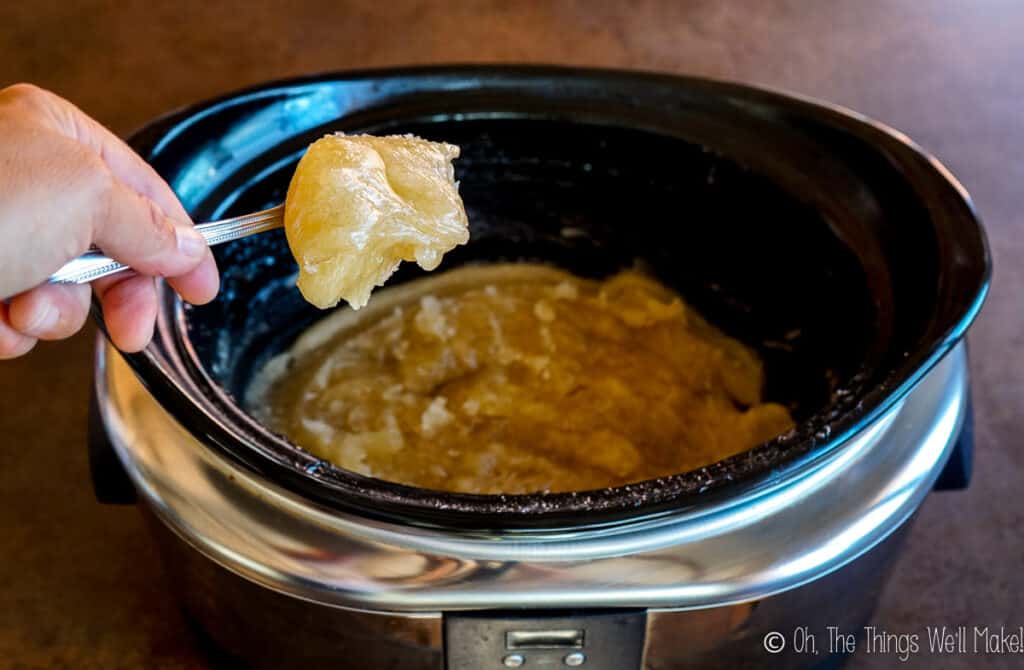
To check for “doneness,” we will look to see if our paste is dissolving into a completely clear liquid soap. To do this, take a small amount of the soap paste and dissolve it in water, and look to see if the water is clear once the soap paste is dissolved.
If the liquid is cloudy, you should continue to cook the soap in the slow cooker. Let it cook another half an hour before checking on it again. If it dissolves clear like the soap in my picture, you are finished making the soap paste.
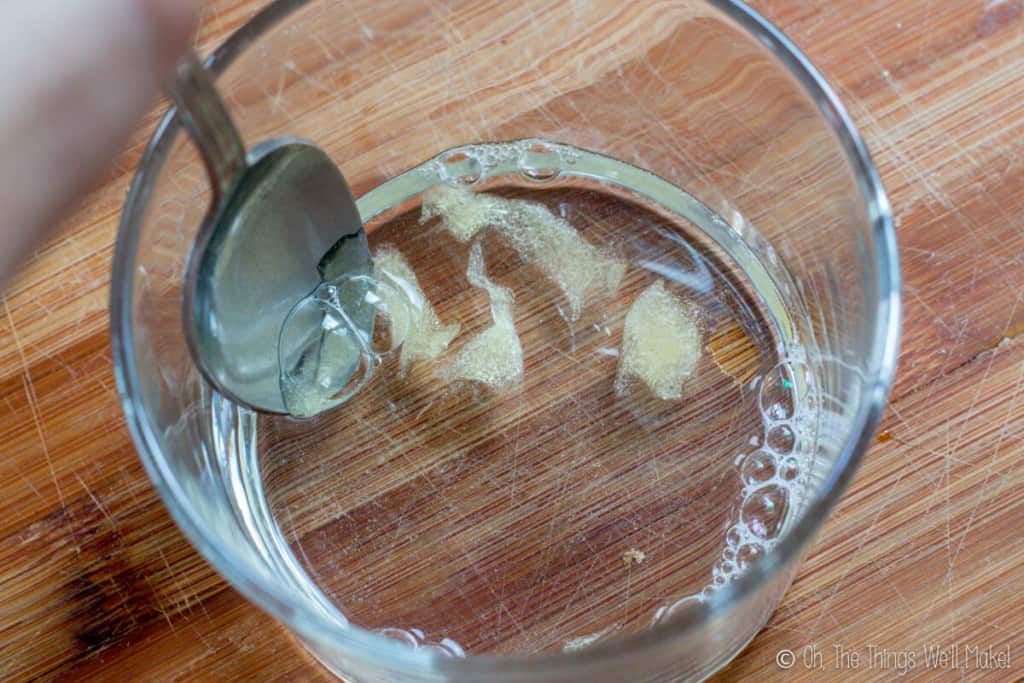
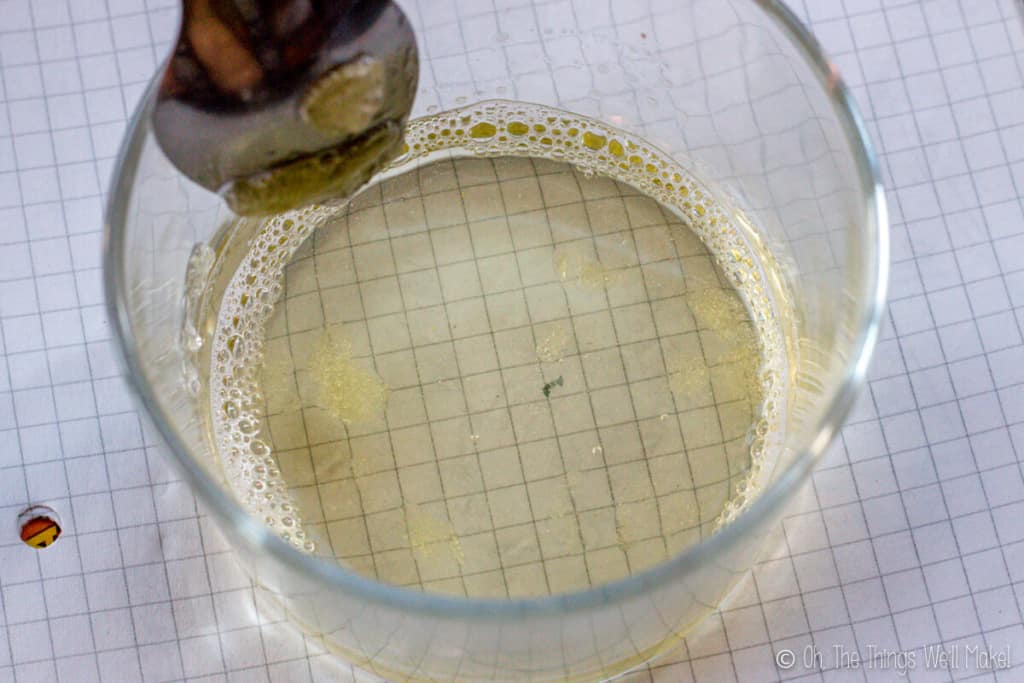
Note: If you aren’t using distilled water, the soap paste may stay cloudy no matter how long you cook it! (For more reasons your soap paste may be cloudy, read my post about troubleshooting liquid soap problems.
How to dilute the soap paste
Once you have made your soap paste, you’ll need to dilute it to obtain a liquid Castile soap.
To dilute a soap paste you can:
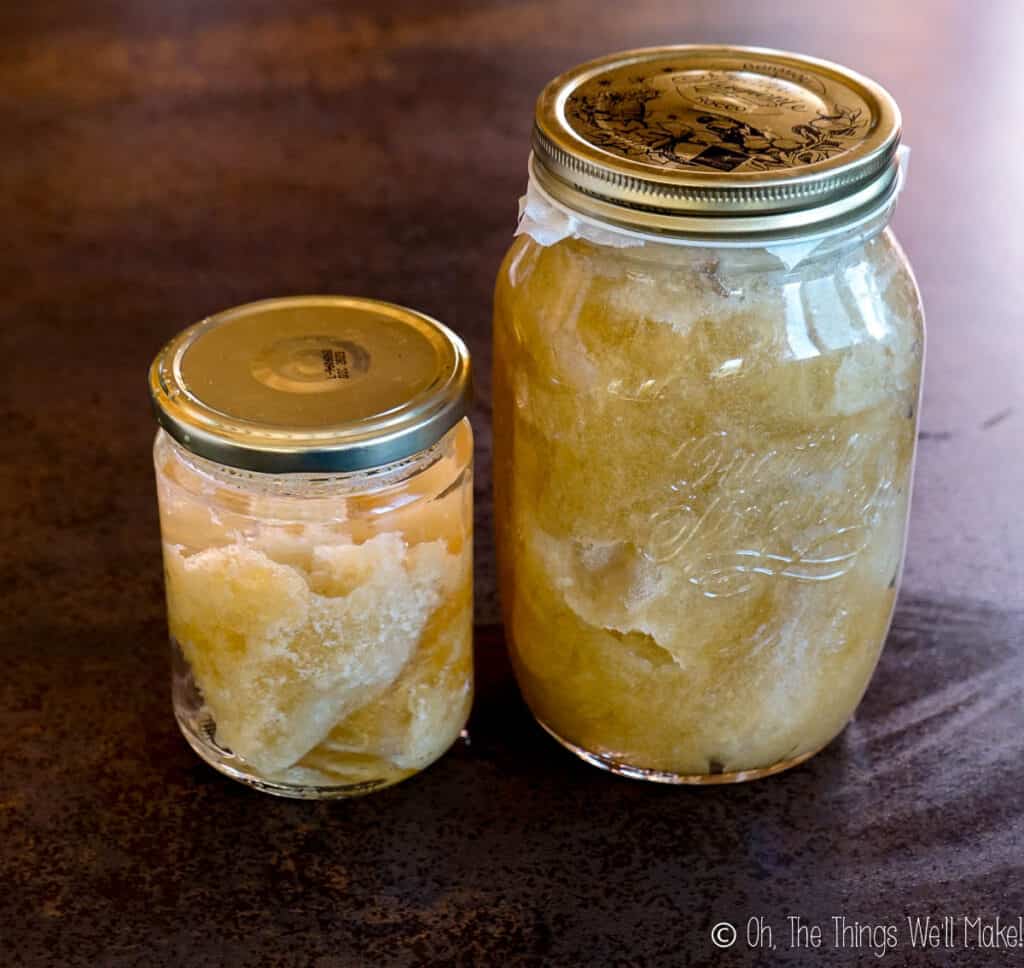
- Let it dissolve by itself into water over the course of several hours (or overnight).
- Speed up the process by warming the water and soap paste over the stove or other heat source (like the slow cooker).
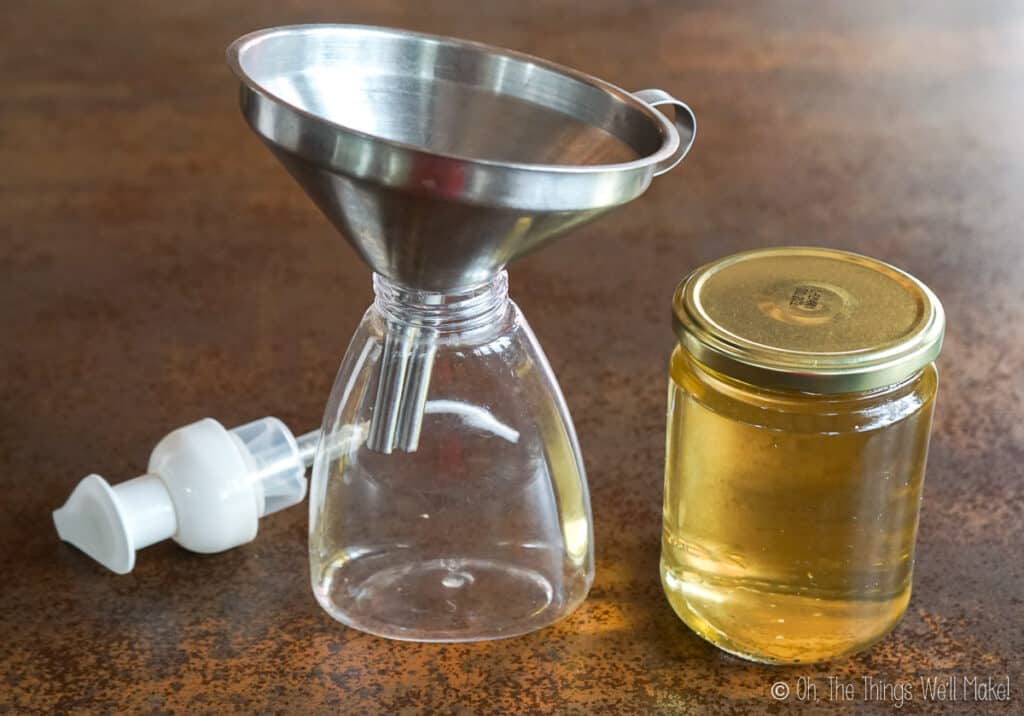
For clear soap, use distilled water. That will also help ensure the water is free of contaminants and the soap will keep as long as possible. By choosing distilled water, not only are you keeping the possibility of microbial contamination to a minimum, but you are also ensuring that minerals and other substances in your tap water won’t cloud your soap.
If you are making small batches that are going to be used relatively quickly (and aren’t concerned about clearness), you can probably get away with tap water without any issues. I still recommend using distilled water when possible.
Read more about how to dilute a soap paste here.
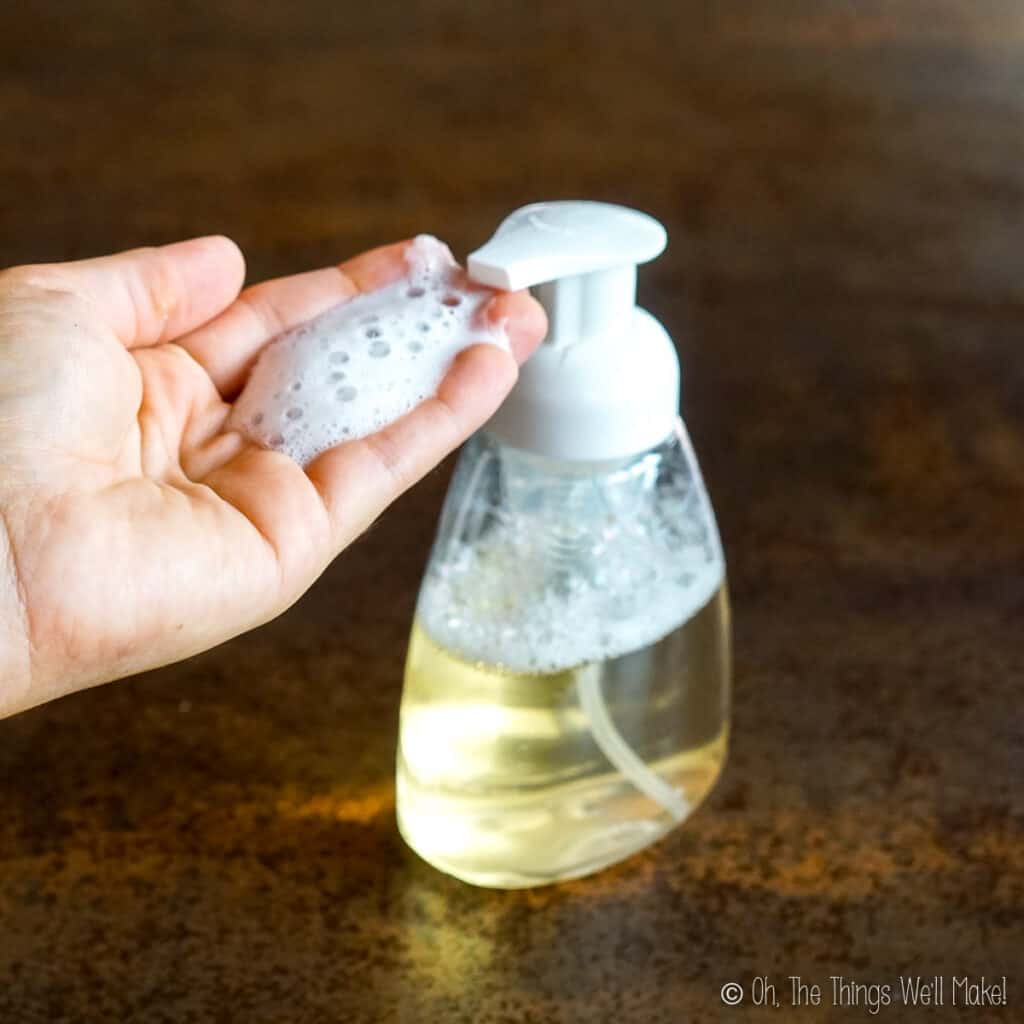
Customizing your liquid soap
How else can you personalize your soap?
Adding fragrances
Unlike with bar soap, you can add in additives like essential oils after the fact. So, you don’t have to divide your batch at trace and work quickly to make soaps with a variety of fragrances. Instead, you can make a large batch of concentrated liquid soap paste base. The soap paste can be stored away and keeps well for a very long time. (I’ve successfully stored soap pastes for several years without issues.)
You can then add in the essential oils or fragrance oils as you dilute the soap paste. This gives you the freedom, even months after making the soap, to play with fun combinations.
At the time of dilution, I mix the soap paste with distilled water and then I add essential oils to give my soap a personalized fragrance.
Does it need a preservative?
Whether or not liquid soap needs a preservative is a controversial subject. Personally, I don’t use one as the pH of soap is high enough that it’s not a favorable environment for the growth of most of the microbes that we’re trying to avoid.
If I were going to sell a liquid soap, though, I’d do proper microbial testing of the liquid soap to see if a preservative was needed or not. Most natural preservatives on the market aren’t effective at the high pH of soap anyway. (Euxyl® K 900 is an exception and would be a great preservative to consider for using in soap.)
For more liquid soap FAQ’s, read my post How to Make a Liquid Soap: Start Here.
Video
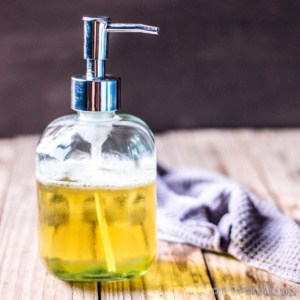
Easy liquid castile soap (made from scratch with olive oil)
Materials
Instructions
- Measure out the olive oil and add it to the slow cooker on low heat.
Make the lye solution
- Weigh out the glycerine, water, and potassium hydroxide (KOH).
- Mix the water and glycerin.
- Carefully add the KOH to the water and glycerin mixture. (Not the other way around!) Do this step in a well ventilated area.
- Stir the KOH into the water until it dissolves. It will be cloudy at first, but then it will clear up.
Make the soap paste
- Slowly add in the the KOH mixture to the warm olive oil, and gently stir them together in the slow cooker.
- Once they are mixed together well, use an immersion blender to blend the ingredients together. In a few minutes the mixture will begin to thicken and look like mayonnaise. It will later look like a creamy pudding.
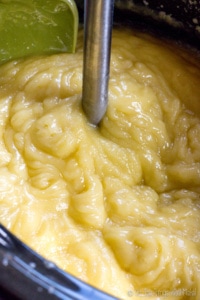
- The mixture will go through stages, from creamy to grainy and back to smooth.
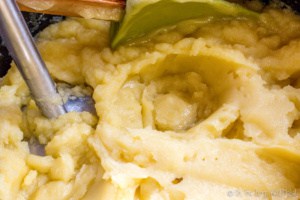
- As you continue to blend, it will start to get creamy again. Once you reach this point, you can stop blending with the hand held blender and can leave the soap paste cooking covered in the slow cooker.
Cook the soap paste
- As you cook the soap, it will continue to thicken and will become more translucent. To achieve a clear liquid soap we'll need to cook the soap paste for 3-4 hours. During that time, check on it and stir it up every half an hour or so.
Check for doneness
- To check for "doneness," we will look to see if the soap paste dissolves clear. To do this, take a small amount of the soap paste and dissolve it in distilled water. If the resulting soap is clear, the soap is finished cooking. If it's cloudy, continue to cook the soap paste for another half an hour before checking on it again.
Dilute the soap
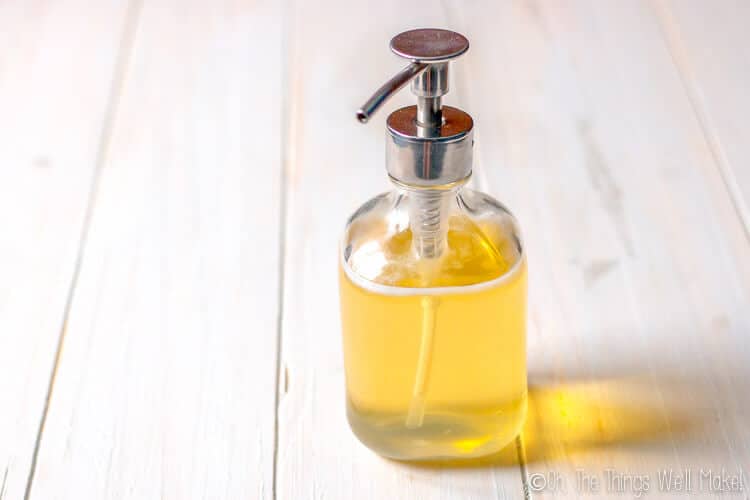
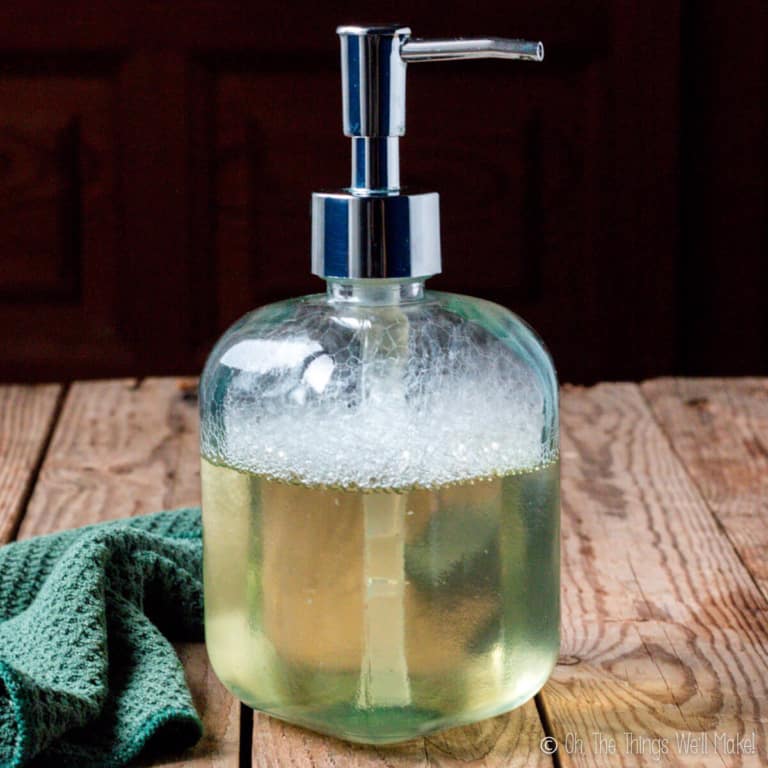
- To make a liquid Castile soap, dissolve some of the paste in distilled water. I ususally use a ratio of one part soap paste to 2-3 parts distilled water. Let it sit until dissolved, or gently heat to speed it up.
Notes
- A slow cooker is perfect for this because it gently heats without burning and keeps everything at a steady temperature. If you don’t have a slow cooker, you can bake the paste in the oven or cook it in a double boiler.
- Take breaks while blending so you don’t burn out the motor of your immersion blender. If your blender gets too hot, you can pause and let it cook before continuing.
- If the mixture becomes too thick to blend at any point, switch to mixing with a wooden spoon.
- If you’ve cooked it for more than 3–4 hours and it still isn’t clear, there may be other issues. Tap water can cause cloudiness. For other possibilities, see my post on troubleshooting liquid soaps.
- This recipe makes about 4.5–5 pounds of soap paste, which can be diluted to 10–20 pounds of liquid soap or more, depending on how concentrated you want it. That’s roughly 1–2 gallons or more.
- Keep in mind that liquid soap is not as thick as commercial gels or surfactants. It has a thinner consistency and doesn’t need to be thick to be concentrated and work well.
- Undiluted soap paste can be stored in glass or plastic containers in a cool, dry place for more than a year. I’ve had some last for several years without any problems. It may eventually develop a slightly rancid smell, but can still be used for general cleaning.
DIY liquid body soap recipe:
If you would like to combine this soap with a liquid coconut oil soap to obtain a bit more lather and a squeaky clean feeling, try using this ratio:
60-70% liquid Castile soap (made with only olive oil)
30-40% liquid coconut oil soap (for bubbly lather, link goes to the recipe post)
Essential oils of choice.
Mix all of the ingredients together, and keep a bottle in the shower to use instead of shower gel.
Add essential oils for fragrance. Lavender essential oil gives a lovely herbal scent. I also like citrus blends using lemon and bergamot.
What are your favorites?
This post was originally published on June 29, 2016. It was rewritten and republished in June of 2021, adding new information, more photos, and video.
Hi Tracy…I’m back with another question. So I filled a few Mason jars halfway with distilled water and the remainder of the jar with the soap paste. The paste did dissolve but was very thick so I poured the mixtures into a crockpot and added more water. It ‘cooked’ for several hours, resulting in a layer of waxy foam over a clear concentrated liquid soap. Do I only use the clear soap and dispose of the waxy foam, or does that waxy foam dissolve?
Sorry for all the questions. The next time will be much smoother, I’m sure.
Hi Carol,
No need to apologize. I’m happy to help however I can.
I’m not quite sure how to answer this question, though, as I haven’t found any of my liquid soaps to have a waxy foam like that. If you have any sort of strange layer that doesn’t match the rest (I have had an oily layer form on top with certain liquid soaps I’ve experimented with- especially when using waxy oils like jojoba in them), you can just skim it off. You could try to use what you skim off, as sort of an experiment to see if it’s also just soap that hasn’t fully dissolved or something like that. If it behaves like the rest of the soap, either mix it in, or skim it off for cosmetic reasons.
I find that especially at colder temperatures, sometimes my soap will form layers or get cloudy, and then it tends to clear up when things heat up again. That may be another determining factor. I hope that helps. Sorry I don’t have a more concrete answer for you.
Tracy, I am thinking to make the soap in small quantities. So, is it ok to reduce the quantity in half or do we need to calculate the lye? Your advice is really important to me.
Hi Maddy,
Yes, it’s fine to reduce by half, and also fine to double the recipe. I’ve calculated it out for people both ways before. Just make sure you cut everything in half.
Before halving the recipe, though, consider that the final soap paste lasts for a very, very long time. I don’t dilute it all at once, and only dilute smaller portions at a time. I’ve had soap pastes stored away for more than a year without any issues. Once you do the work, why not get a decent sized batch out of it? 😉
Tracy, I think I’m guilty of impatience. I read more of your article, and I think my mixture is just fine. I expected it to dissolve in a couple of minutes. My bad!!! Now I’m looking forward to the finished product again. Thank you.
Hahaha, No worries, Carol. 🙂
I know how that goes. I’m not always the most patient person myself.
I saw your first message on my phone, and was just going to advise that you leave it in water for awhile, perhaps even overnight if need be, but now I’m happy to see that you figured that out.
I find that these liquid soaps made with glycerine dissolve pretty well without having to do a lot to them. The ones without the glycerin are often really difficult to dissolve in water. Either way, it isn’t immediate. You could speed things up with a bit of heat, but I usually just leave it be overnight and that does a pretty good job of mostly dissolving the paste. Then you just need to mix it to help even it all out.
Good luck!
In researching DIY personal care products, most people, me included, are trying to avoid the use of chemical additives. Isn’t KOH a chemical? Most DIY products use castile soap made with potassium hydroxide.
Hello,
KOH is potassium hydroxide; they are one in the same. All soaps are made with some form of lye. Liquid soaps normally use potassium hydroxide (KOH), and bar soaps normally use sodium hydroxide (NaOH). Are they chemicals? Well, yes. As is water (H2O), and carbon dioxide (CO2). We can’t really avoid chemicals, but we can try to avoid toxic ones. Lye isn’t really toxic, but it is highly alkaline, making it very caustic. That’s why you need to be very careful when working with it. You need to react the oils with lye to get soap, but if you do things correctly, and don’t use too much lye for the amount of fat/oil used, you won’t have any lye left in the final product.
Soaps are still usually more “natural” than surfactant based cleaners, but they are developing more gentle natural surfactants these days for those who don’t like using soap. I’ve also been experimenting with some of those and will be sharing DIY’s using the more natural surfactants hopefully soon.
To add to my earlier comment….I returned to my Crock Pot and discovered the mixture was thickening so I continued to mix, and it did go through all the phases in your instructions. When I got to the final phases, it got REALLY thick so I stopped whipping it, but it quickly turned to a hard waxy texture. Is that what I should see?
Hi Carol,
Yes, it sometimes takes longer to get through the different stages for some people. I think a lot of that has to do with the varying temperatures in slow cookers. It also seems to take longer in the winter. It all sounds pretty normal to me.
In the end, you should end up with something that’s sort of like a thick putty that can be molded. Yes, I guess it’s sort of waxy like. 🙂
If you cooked for a really long time, because it wasn’t going through the stages as quickly, you may have evaporated more water off, leaving you with a more solid paste. That isn’t a problem, though. Once you dilute it, it will all be the same.
I hope it works well for you! I love making liquid soaps! My favorite is probably the coconut oil liquid soap. That one moves more quickly, and gets super thick and solid much earlier on. So, the varying behavior between batches could also be dependent upon which olive oil you use. (I tend to use extra virgin because it’s pretty cheap here in Spain to use the good stuff.) 😉
Thank you for responding so quickly. I don’t think the final product is right. I now have a Crockpot full of a solid wax product. I took a small amount out and added it to water, but all of it did not dissolve after stirring it for 5 minutes. I also tried boiling a small amount in water (since it looks like wax). Do you have any suggestions?
Hi Carol – did you manage to find a way to salvage your soap in the end? because I have just had exactly the same thing! Any suggestions much appreciated … Kathryn
Hi Kathryn,
If you look at the newer comments, you’ll see that Carol ended up with a soap she was happy with. She thought the paste would immediately dissolve, but gave it time and it was fine. (Which is why I didn’t respond on that comment because she had already written me an updated comment later on that day.)
Your soap paste is probably fine. It can appear a bit waxy or almost like a translucent silly putty. That’s perfectly normal.
Are you having other issues with it?
Hi Tracy! Thanks so much for your answer (which I have just found, sorry!). Yes, I eventually had the sense to read through everyone else’s answers and eventually my solid turned to a liquid, hooray! It’s now 24 hours later (although it was turned off overnight) and I think it’s getting more translucent, and certainly runnier (although very creamy when I stir it). It doesn’t dissolve clear, but it sounds like that might not matter …? Should my hands feel very slightly greasy after using it? Thanks again!
PS (Sorry, think I’m having more problems with the internet than with the soap!) Think greasy texture meant the soap was too thick! Have decanted most into a jar now and attempting to dissolve the rest in equal amount of water – funnily enough it went stiff when I added the water, but guess it will dissolve eventually …?
Hi Kathryn,
Yes, I think it should be fine. It does have a bit of a weird texture and you can definitely play with the amount of water you use depending on how thick you want your soap to be and what you plan on using it for.
I am a bit surprised that yours isn’t translucent, but that may be because you have a very thick mixture so far. No, it doesn’t matter if it is translucent or not and it still will work. I’ve cold processed liquid soap before (basically meaning that I skip the cooking process) and I end up with an opaque paste that works just fine. Sometimes liquid soap just needs time to settle. (They call this sequestering.) I haven’t found that I normally need to do that, but I have made some liquid soaps with certain oils like jojoba that make a cloudier soap which can separate into layers. You can skim off the top and leave whatever settles to the bottom alone and just use the middle layer of the soap and it ends up being transparent. If you mix it, you end up with a cloudy soap that also works just fine. 😉
It’s all about experimentation. (I tend to do a lot of it.)
I hope it all works out for you, and thanks for the updates!
Thanks Tracy!! Yes, I have diluted it now and it’s quite clear. Now for the tricky part of selecting which essential oils to use! Think I have overdone with the tea tree oil for the first bottle already … 🙂 Thanks again for your reassurance! Kathryn
I’m so happy to hear that!
Yes, for me it’s all about experimentation with the essential oils. I think I use different ones in almost every batch. Ha!
I still go back to lavender mixed with citrus oils quite a bit. 😉
I made the mixture according to your directions, however, my mixture never changed texture. when I reached step 5, I blended for 15 minutes, but it still looks the same. It just feels like warm oil.
Greetings!
I am here commenting to ask if how much can this recipe make because I am using your recipe as a soap paste for my project. And I am just not sure if this recipe will be too much or too little.
It would be a pleasure if there can be some container references like a 1 Liter bottle or something else that is known in order to give me an idea of how much your recipe of Liquid Castile Soap.
Hoping for your response from your most convenient time.
Hello Jan,
The amount of paste obtained does vary a bit, depending upon how much water evaporates away, etc.
I usually can fill up a one liter jar with soap paste after having already dissolved some for my soap. Next time I’ll have to try to better measure its volume. I’ll be making more soon, so I can try to figure it out, but you should end up with more than a liter of paste.
Thank you so much!!! With this I’ll get closer to what i just need.
Great! Yes, it’s my personal favorite and super easy! (It does get thick faster than the others, but that’s not a problem.) 🙂
I hope it goes well for you, and I’m always happy to help if you have any trouble along the way!
Nice Presentation. I appreciate.
You have explained in a very clear words.
Thank you, Vishnu!
Is there any way to make this soap without a stick blender?
Hi Greta,
Theoretically, yes, you can make it without a stick blender, but I’ve never done it that way myself. You may be whisking for awhile. That said, the heat of the slow cooker in this recipe should help move things along more quickly. Just keep mixing until things thicken up. By that point things won’t be much different from if you had made everything with the stick blender to begin with.
I make liquid shampoo using my own recipe. I use citric acid or borax or mix of both to neutralise. I didn’t notice you using any in your recipe. Shampoo needs a lower pH than body soap.
Hi Helen,
My hair doesn’t react well to soap, or even most shampoos for that matter. So, no, I don’t normally make “shampoo” with liquid soap nor do I make shampoo bars. I think they tend to work better for people with oily and/or thick hair. Even if you “neutralize” the soap with citric acid or borax, you still end up with a high pH for what is recommended for many hair types. You can add it, and it can work well to bring down the pH a bit and make the soap milder, but too much throws off the chemical reaction of the soap. I’m curious as to how much citric acid you add because I’ve always read that too much will just make the soap fall apart and separate. (Thus really ending up with oils, and lye that is neutralized with the citric acid, in a way.) I’m totally open to trying it out again, though, as I am a person who likes experimentation more than relying on what I read. 😉
I do remember the soap getting cloudy right away as you lower the pH, but I guess most shampoos aren’t as clear as liquid soap anyway.
I’ve been finishing up a course in natural surfactants and am working on elaborating recipes for people with hair like mine. 🙂
But, yes, it would be nice to have a soap “shampoo” alternative for those that prefer soap to surfactants.
Oh, and Helen, one more thing I forgot to mention… If you start lowering the pH of the soap- even if it were to work well without compromising the integrity of the soap itself, it then pushes the soap into a dangerous zone when it comes to microbial contamination.
The reason you don’t need to add preservatives to liquid soap is because the pH is normally 9 or above. I talked with a cosmetic chemist who assured me that liquid soap doesn’t need a preservative because most anhydrous solutions that have a pH of 9 or above can be stored without the need for preservatives for up to a year. (There may be some exceptions as some liquids like milks and aloe are more prone to microbial growth. That said, aloe tends to be acidic, so you’d probably need to add a lot of alkaline ingredients to bring the pH up by that much, meaning your concentration of the aloe would be quite low and it’s probably in the safe zone again.) As soon as you try to bring down the pH below 9, you’ll have to worry about finding an effective preservative that would work to allow you to store your “shampoo.” Most of the natural preservatives I use aren’t effective over a pH of 7-8, and I’m not sure you’d ever be able to really get a soap to have pH that low. I think it would be a hard thing to juggle.
I guess you could mix up your shampoo before each use, but who has time for that? 😉