

Homemade Moisturizer for Oily, Acne Prone Skin
Making your own facial moisturizer isn’t difficult, and it can save you a lot of money. Learn to make a homemade moisturizer for oily, acne prone skin, and customize it to suit your skin.
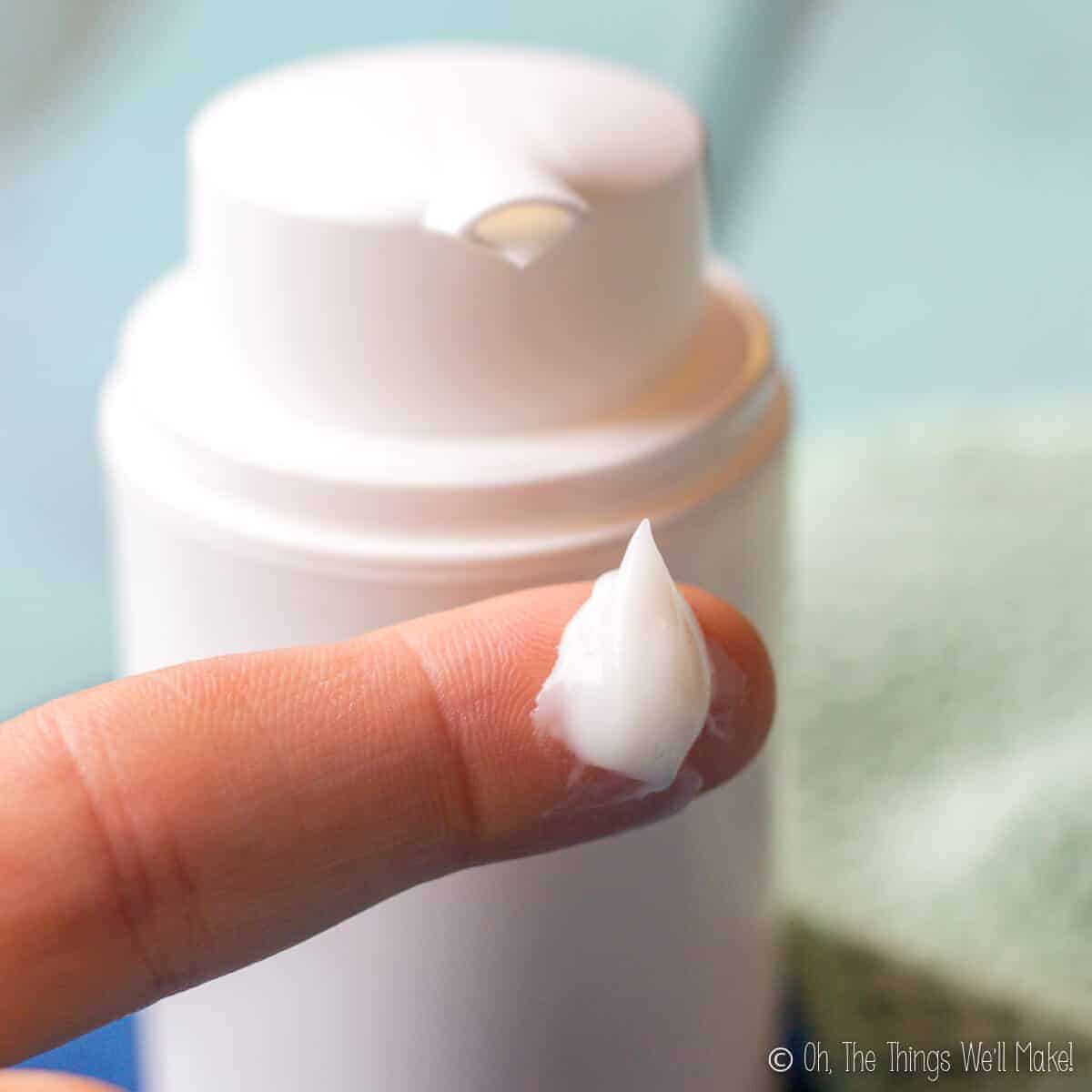
For the last 30 years or so, I’ve struggled with oily, acne prone skin. When I was 13 years old, it wasn’t that unusual. I could blame it on the hormonal changes of adolescence. When I hit 20, I was excited that it was finally time for my skin to clear up, but it didn’t; nor did it when I hit 30, or 40!
To be honest, I’ve always avoided wearing any type of facial moisturizer because I was afraid that it would make my skin break out more than it already was.
As I’ve gotten older, though, I have new concerns. I want to use some sort of moisturizer to prevent age lines and wrinkles. While my homemade hyaluronic acid serum does seem to work quite well to help my skin stay youthful, I wanted to make myself a moisturizer to use with my serum.
Why make your own moisturizer?
Making your own moisturizer may sound intimidating, but it’s actually very easy. If you can bake a cake or make aioli, you should have no issues making your own lotions and moisturizers.
Of course, just because you can do something, doesn’t always mean you should. In this case, though, there are many benefits to making your own facial moisturizer.
Customize it to suit your skin
In this article, I’ll be sharing some of my favorite oils and other ingredients for oily and acne prone skin. These oils have worked well for me, and I think they are a great starting point for making your own moisturizer if you have acne prone skin.
While non-comedogenic oils are generally less problematic for most people with acne-prone skin, not all non-comedogenic oils work well for all people. Some people may have sensitivities to certain oils. Being able to customize a moisturizer to suit your needs can be life-changing for people with sensitive skin.
It’s not just about the oils, though. You can also avoid perfumes, parabens, and other problematic ingredients.
Save money
Not only do you gain the ability to choose what goes into your moisturizer, but you can also save money. Moisturizers tend to be quite expensive despite the fact that normally over 50% of the product is water! Once you’ve invested in a good emulsifier and preservative, you can use it for multiple batches of moisturizers and other products.
Ingredients
A moisturizer has 4 basic ingredients: oils, water, and emulsifier, and a preservative.
I have decided to use a variety of oils to add a variety of skin benefits to this moisturizer. That said, you could simplify the recipe, using only one or two of the oils that I have used.
I have also added rose water as part of the water phase of the recipe for its lovely fragrance and its skin-soothing properties. Feel free to only use water, though. You can always add some essential oils for fragrance when you add in the preservative.
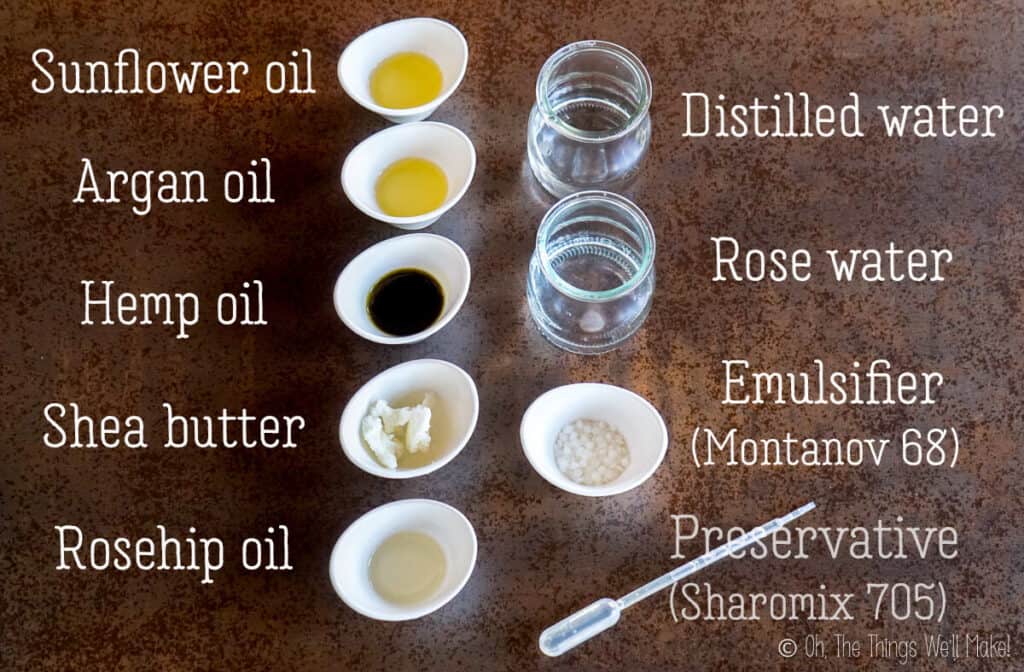
The best oils for oily and acne prone skin
After a bit of research, I realized that not all oils will cause breakouts. Nor will they all make your skin feel oily. In fact, some oils can actually help balance the oils in your skin. That makes them beneficial for someone like me with oily or combination skin.
When making your own homemade moisturizer, it’s important to use the best oils for your skin type! Today, I’ll cover some non-comedogenic oils that I use in my homemade moisturizer.
While you can use my recipe as written, you can use your own combination of oils. (Just make sure to keep the total oil weight the same.)
Hemp seed oil
Hemp seed oil may be my favorite oil for people with oily and/or acne prone skin!
Not only does it have a comedogenic rating of ZERO, but it is known to help balance the oils in your skin. It may also help clear up blackheads and small pimples. It does all of that while helping reduce dry patches, inflammation, redness, and fine lines!
It’s a definite must have in any homemade lotion for oily and acne prone skin.
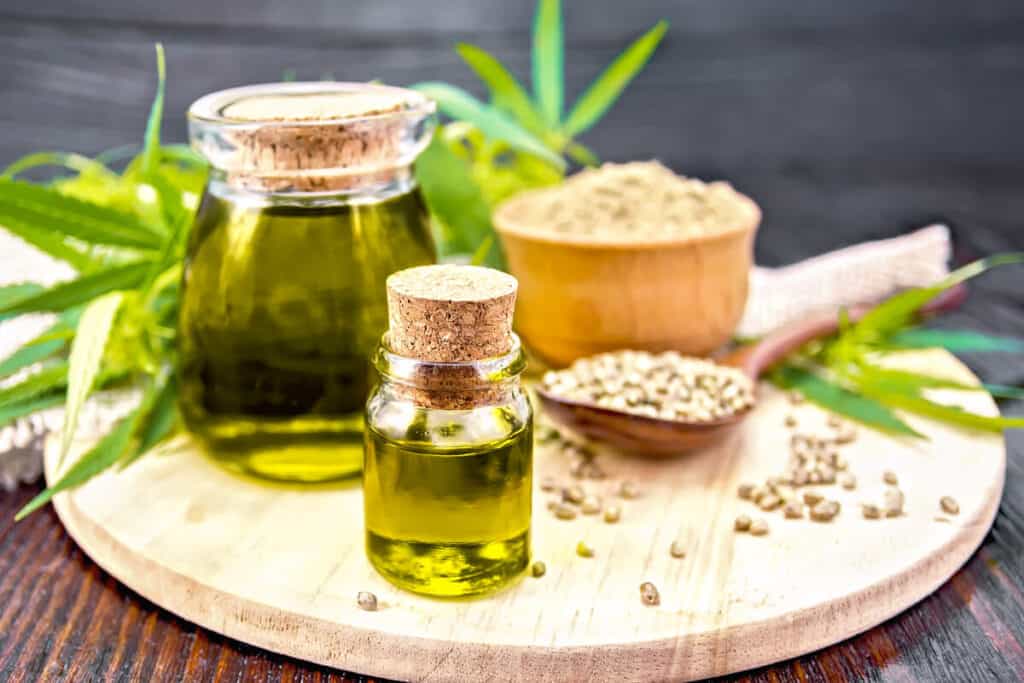
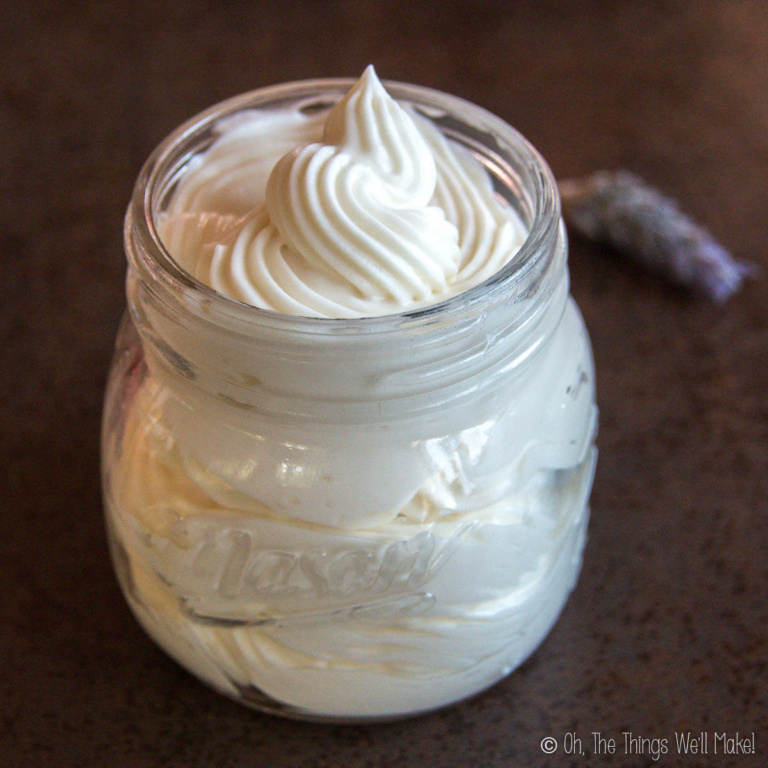
You may notice that in some of my photos, my homemade moisturizer is a bright white color. In others, it’s more of a pale yellow. This is due to using different hemp oils from different suppliers. When using a light-colored hemp oil, the moisturizer is very light in color or even bright white. When using a dark green hemp oil, the moisturizer is darker in color.
Some hemp oils may also add a scent that can be overpowering, so keep that in mind. (Oils with less scent and less color probably make a prettier, more pleasant moisturizer, but either type will work.)
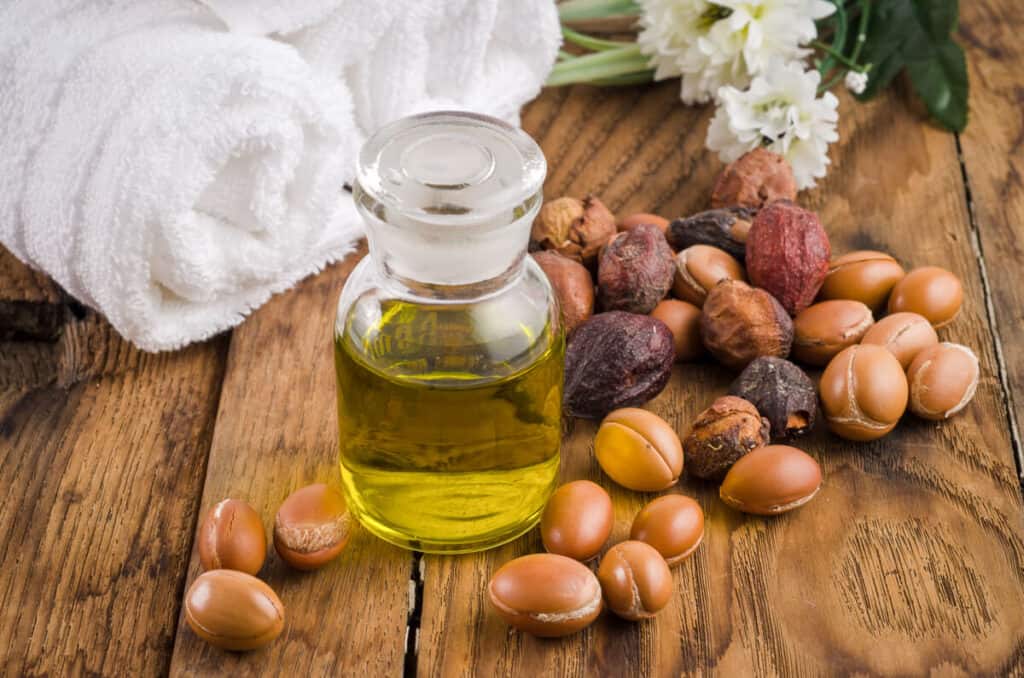
Argan oil
Argan oil was already one of my favorite oils for both skin and hair, but I love it even more knowing that it also has a comedogenic rating of ZERO. In fact, it may even directly inhibit the bacteria that cause acne, making it a possible acne treatment!
The great thing about argan oil is that, because it helps balance the sebum production of the skin, it is a great oil to use on any skin type. It hydrates and works great on flaking or itchy dry skin. It is normally very well tolerated by people with sensitive skin, and it may help eczema, rosacea, or psoriasis.
Because it helps balance the sebum production of your skin, it’s especially great for moisturizing oily or combination skin.
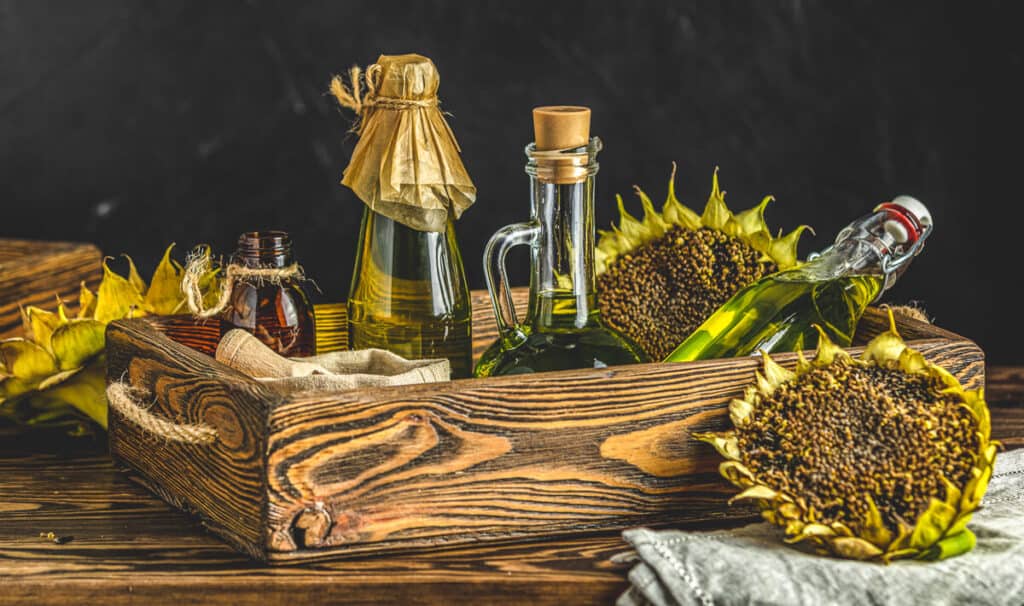
Sunflower oil
I was very surprised to find that sunflower oil is another oil with a comedogenic rating of ZERO!
There is a catch, though. You shouldn’t use sunflower oil with a high oleic content which may clog pores. Sunflower oil that doesn’t specifically say it is high oleic should be fine. (High oleic sunflower oil is made from sunflowers that have been crossbred to be high in oleic acid in an attempt to prolong their shelf life and make them healthier for eating.)
Otherwise, sunflower oil may be the best oil to use on acne-prone skin because it is the highest, of the oils with a comedogenic rating of zero, in linoleic acid. People who are acne-prone tend to have lower levels of linoleic acid in their skin, and it is generally thought that oils high in linoleic acid will help problems with acne.
Sunflower oil has also been shown to hydrate the skin better than olive oil, and it also may provide a barrier against the bacteria that could cause acne and other infections.
Shea butter
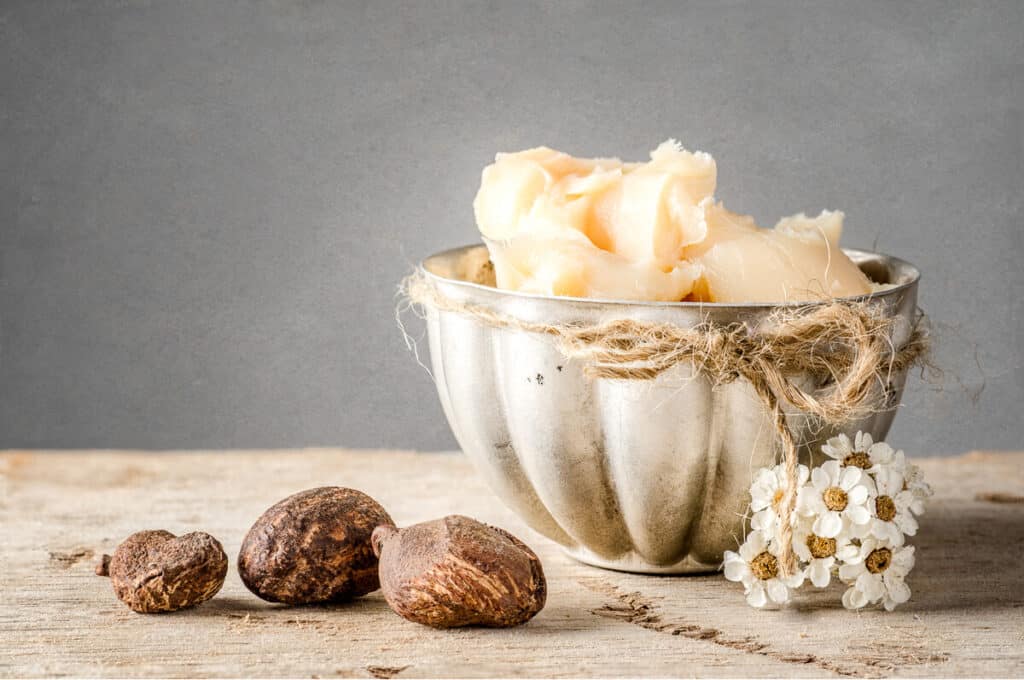
Shea butter is another one of those surprising oils. Because it’s so thick, you’d probably imagine it would cause your skin to break out. Interestingly enough, though, it also has a comedogenic rating of zero!
An amazing emollient, shea butter has demonstrated anti-inflammatory and anti-aging properties. It also naturally blocks some UVB rays, making it a useful addition to day creams.
If your skin is very oily, shea butter may feel slightly heavy for your skin. That’s why I use it in a low concentration. It adds its anti-aging benefits without feeling too heavy.
Unrefined shea butter also has a scent that many people find overpowering and unpleasant. Keep that in mind when choosing which type of shea butter you’d like to use.
Some people (not all) with a latex allergy may also react to shea butter. If you are in doubt, sub out the shea butter for a different oil in the recipe!
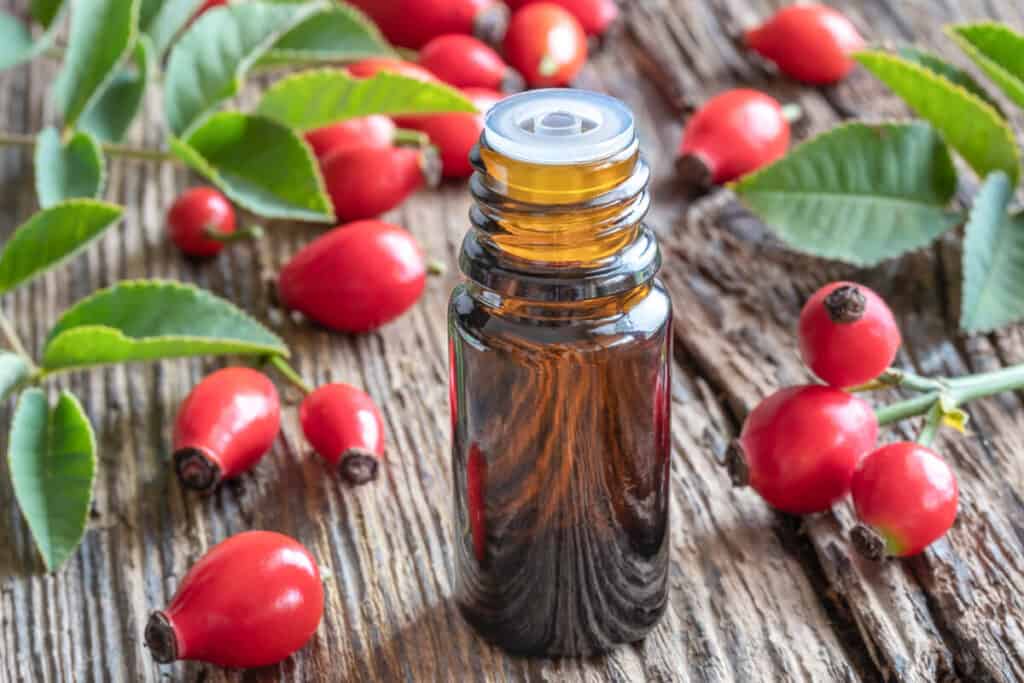
Rosehip oil
Rosehip oil is great for helping combat the redness and inflammation from acne. It has antioxidant qualities and is a good source of phytonutrients.
I was first introduced to rosehip oil when my husband was badly burned in an accident on his fishing boat. During the rehabilitation phase, the doctors prescribed massaging rosehip oil into the scars daily. They told us that rosehip oil and massage could help reduce the thickness of the scars, allowing for mobility in the scarred areas of skin.
It’s not just useful for acne and scars, though. Rosehip oil may help with a variety of skin conditions. It may help reduce fine lines and wrinkles, scarring, and skin discolorations like age spots. It may also help improve eczema, psoriasis, and stretch marks.
With all of its potential benefits, rosehip oil makes a great addition to a homemade moisturizer for acne-prone skin!
Unlike the other oils listed, rosehip oil has a comedogenic rating of 1. That is still a very low rating and most people react well to it.
Some people with acne use rosehip oil on alternate days and find that it helps them when used in that way. I added it in a low percentage to the moisturizer recipe, just in case. It works well for me. If you have issues with rosehip oil, though, sub it out for a different oil!
The water phase
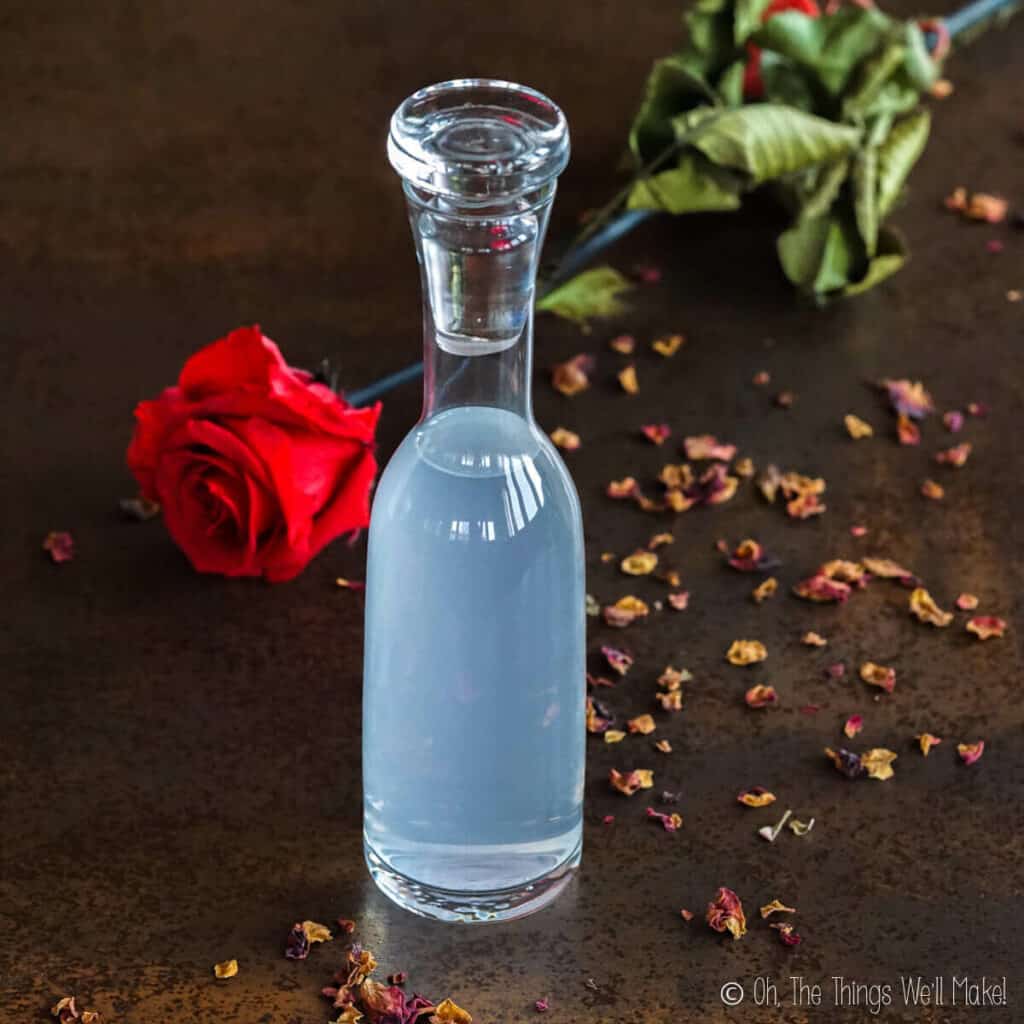
While this moisturizer can be made with only distilled water, I combined the water with rose water. Rose water adds a lovely floral fragrance to the moisturizer, additional moisturizing and anti-aging properties, and it can help fight acne and eczema. Its antioxidant and anti-inflammatory properties may protect cells from damage. It may also help heal wounds and clear up scars!
My homemade rose hydrosol didn’t have as potent of a fragrance as the store-bought rose water sold for use in foods. So, the last time I made this moisturizer, I actually combined the two. I had an abundance of homemade rose hydrosol, so I used that in place of the distilled water. I then used the food grade rose water for the rose water in the recipe below.
While I normally add essential oils to my lotions and creams, the rose water left this facial cream with such a lovely fragrance that I didn’t choose to add any. If you have moderate to more severe acne, though, you may want to consider adding some tea tree essential oil to your cream.
Choosing an emulsifier
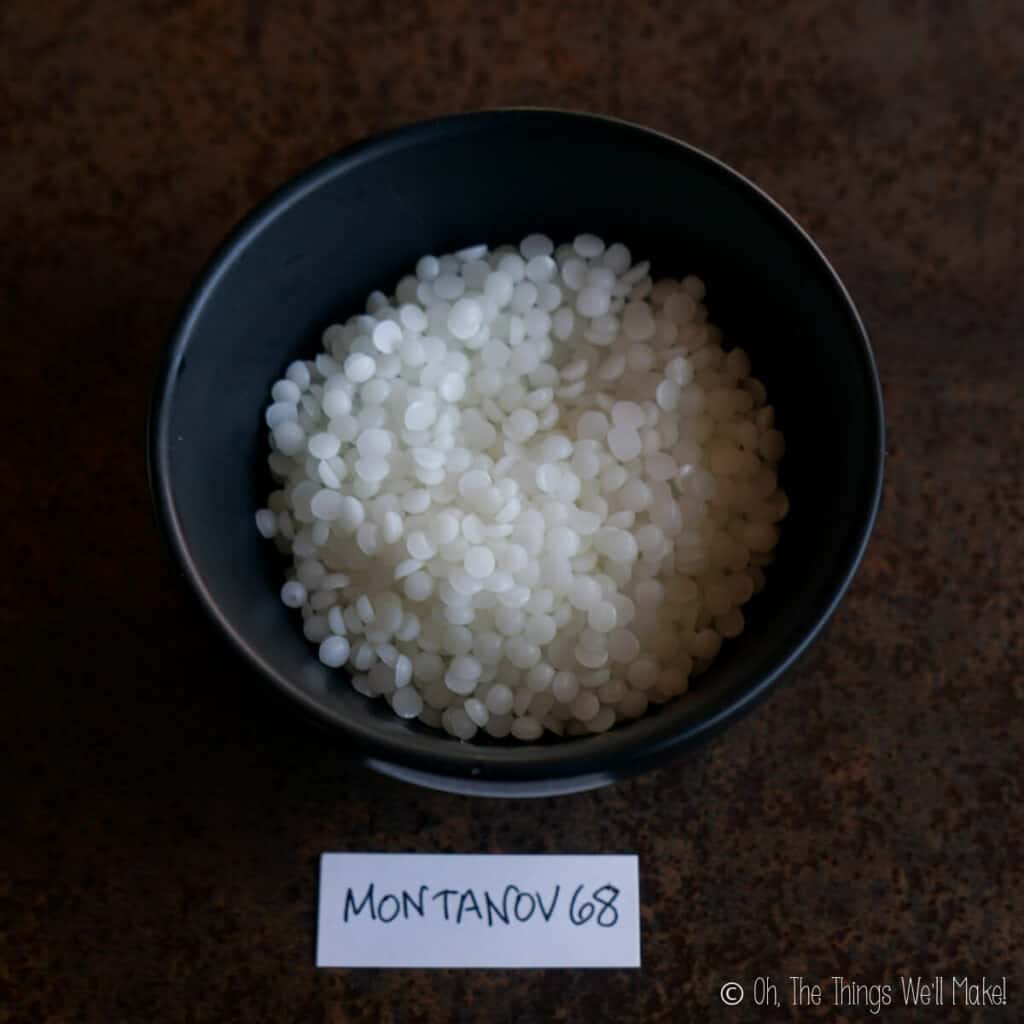
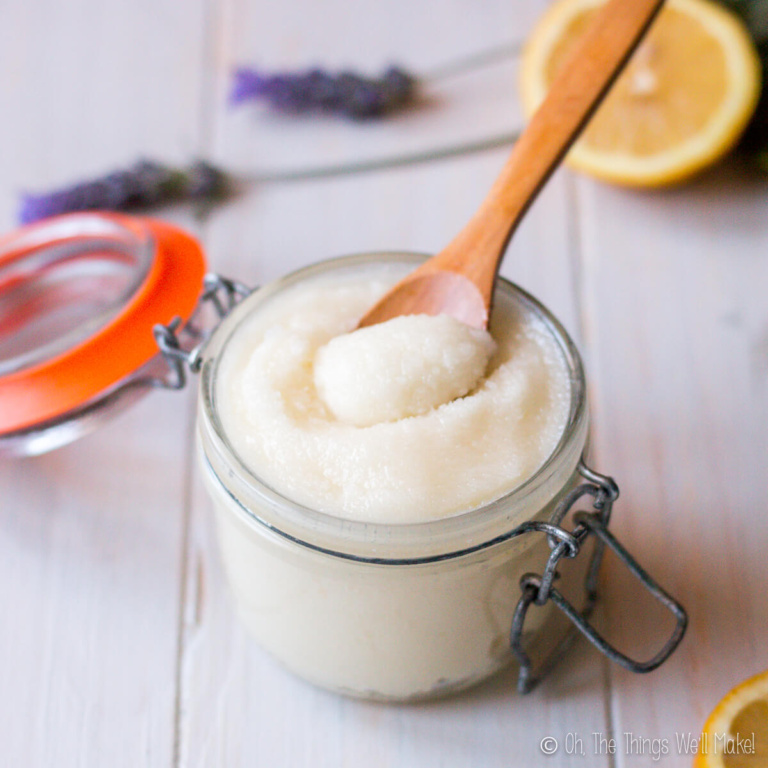
Because this is a recipe for acne-prone skin, I chose to use an emulsifier that is known to be non-comedogenic, Montanov 68. It’s an emulsifier that is made from tapioca and coconut oil. It gave my cream a light, yet thick, texture that goes on wonderfully. It makes my skin feel nice and smooth.
Some readers have commented that it is harder to find Montanov 68 in the United States, so I have researched other emulsifiers. (Check out my guide to cosmetic emulsifiers for more information about the various emulsifiers.)
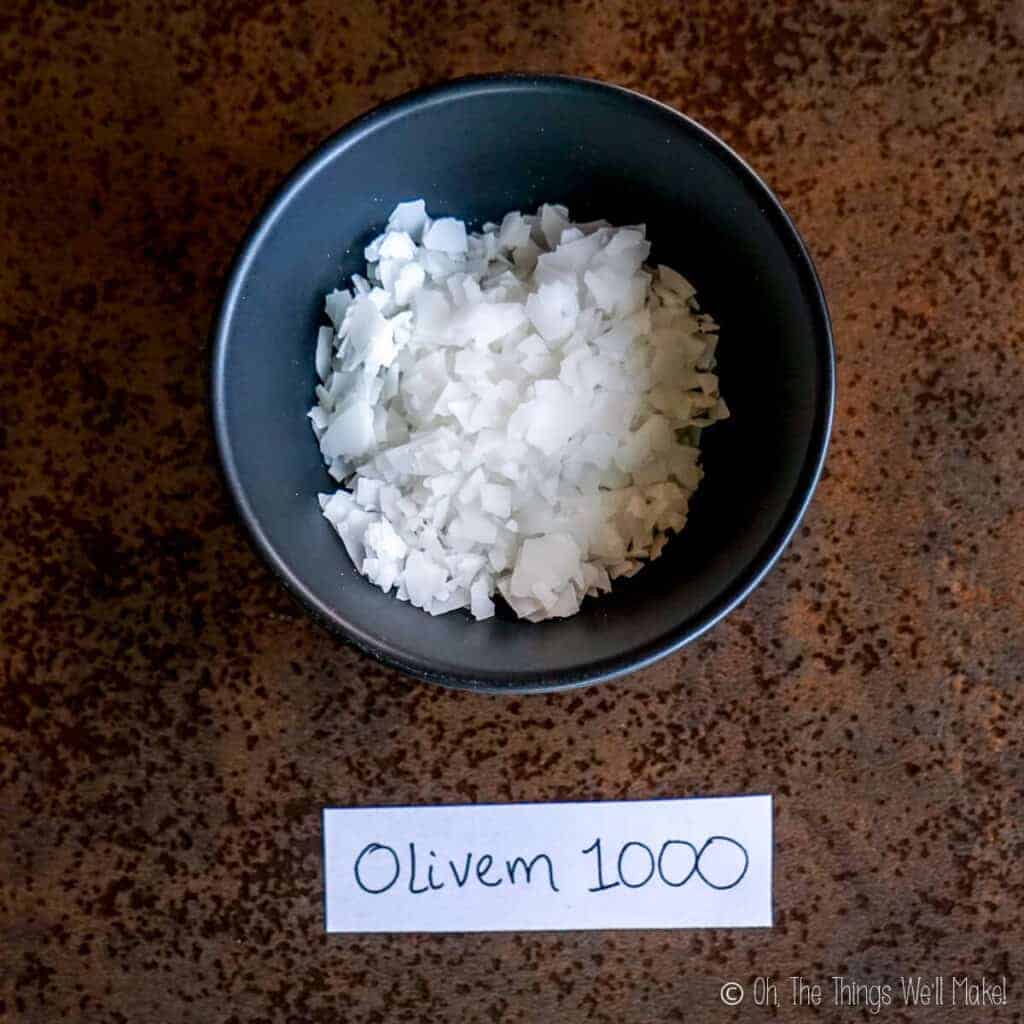
Olivem 1000 is another natural emulsifier that is considered non-comedogenic. It’s an emulsifier derived from the olive plant that also makes a nice creamy lotion. While I haven’t tried it in this specific recipe, I have used in many other homemade lotions like the anti-stress and headache lotion posted on the blog.
Some people say that Olivem is a more difficult emulsifier to use. Others think it has a soapy feel to it in lotions. While I don’t have issues with Olivem, both of those issues can be resolved somewhat by combining it with a co-emulsifier like cetyl alcohol or cetearyl alcohol. (I’ve also read that Olivem may cause problems when over-beaten. If you think you have that issue, either hand-mix it or blend in short bursts during the cooling phase.)
Natural Preservatives
For this recipe, I originally chose Leucidal because it’s a fairly accesible natural preservative both in Spain and in the United States. Leucidal comes from fermenting radishes with a bacteria called Leuconostoc Kimchii. Using it as 3-4% of your recipe by weight allows you to keep your finished lotion for 2-3 months (outside of the fridge) provided that you have made the lotion in hygienic conditions.
I have since switched to using other preservatives instead. Lately, I’ve been making it with either Sharomix 705 or Euxyl® K 903. Both are allowed in natural and organic cosmetics. Most natural preservatives (other than Leucidal) are used at a dosage of around 1% of the recipe, by weight. That means that you’d add 1g of preservative for every 100g of cream (99g other ingredients).
There are several other natural preservatives that you can use. Check out my guide to natural preservatives for more preservatives that can be used and how to safely substitute them in recipes.
I also cover more about preservatives and emulsions in my post about how to make a basic lotion. If you haven’t made lotions or creams before, it’s a good idea to read through that post to give you a better idea of the process. (Don’t worry, it’s easy!)
Using essential oils
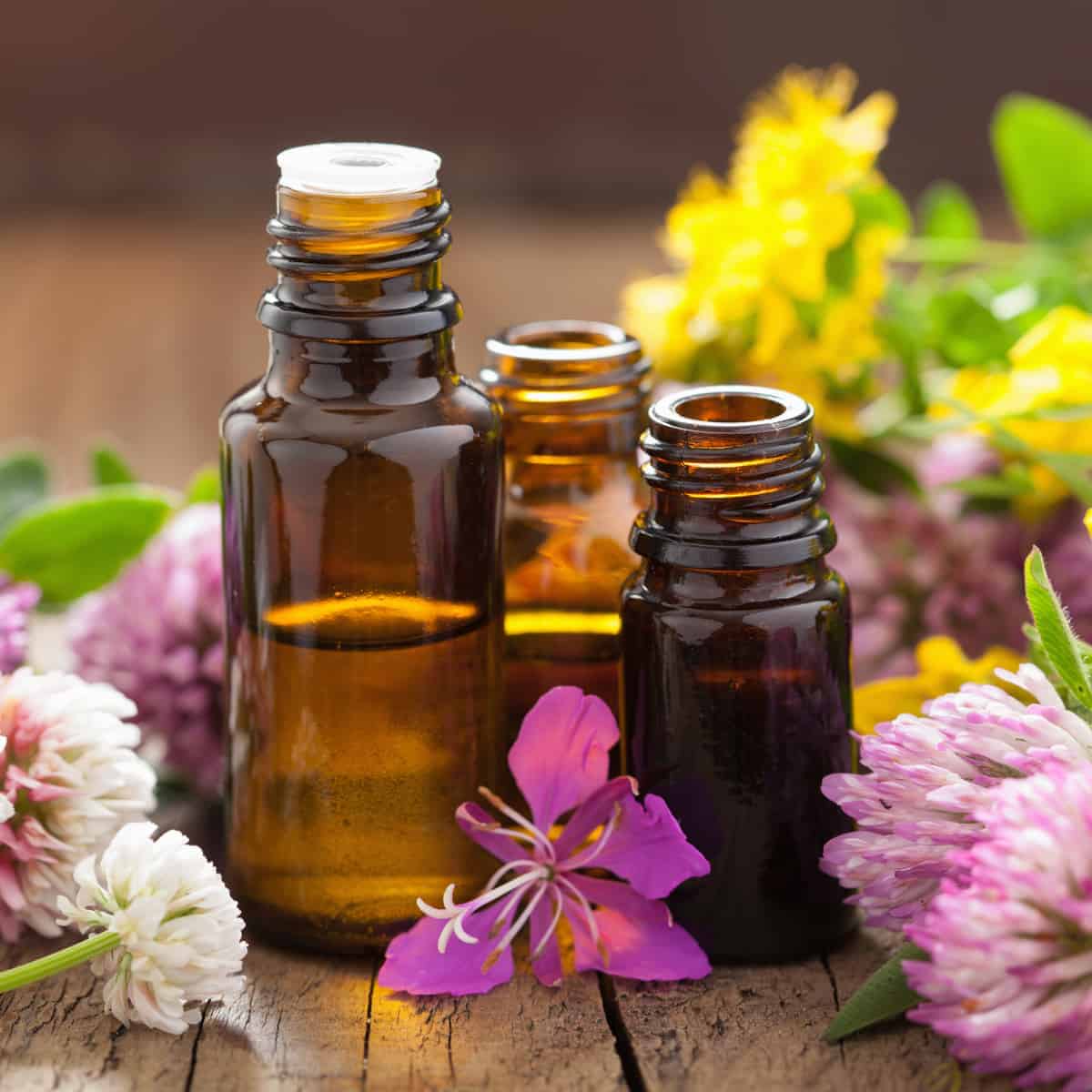
This is one of the few times that I haven’t added essential oils to one of my homemade lotions. That doesn’t mean that you can’t add them, though. I mostly didn’t add them because I loved the rose scent of this lotion obtained from using rose water. (This could be made more potent by adding some rose essential oil!)
If you want to try to help increase the acne-fighting benefits of this homemade moisturizer, though, tea tree oil is probably the best essential oil for treating acne. Not only is it gentle enough to be well tolerated by most people, but it has also been shown to have antimicrobial properties, which may very well help clear up acne.
Lavender essential oil is often used in skin treatments for acne-prone skin and it effectively helps clear up the skin of some people. Plus, it has a lovely fragrance!
Some people may find that they are sensitive to essential oils, and their use may cause redness, making the problem worse. If you have sensitive skin, it may be a good idea to divide your batch of moisturizer and only add essential oils to a small amount to test out before adding them to an entire batch.
When adding essential oils, I normally add them at around 1% of the product, by weight. (So, 1g for every 100g of product.)
How to make the moisturizer
To make the moisturizer, you first need to weigh out the various ingredients. The oil-based ingredients should be combined in a heat-safe container and the water-based ingredients should be combined in a separate heat-safe container.
I find it easiest weigh out all of the oil-based ingredients together and all of the water-based ingredients together. To do so, tare the scale with the empty container on it. Add the first ingredient, up to the correct weight. Tare the scale between ingredients to get the reading back to zero again.
The emulsifier will normally be added to the oil-based ingredients. (Check on the instructions that come with your particular emulsifier to make sure.)
For those who will be making their own soaps and other cosmetics, having at least one scale is essential. You can buy an inexpensive kitchen scale for under $20. A kitchen scale is great for recipes where you don’t need to be super precise. It will give you a reading to the nearest gram.
More precise measurements may be needed for making smaller batches. (For example, when measuring out preservatives or when making a homemade serum.) I use an inexpensive jeweler’s scale for those times.
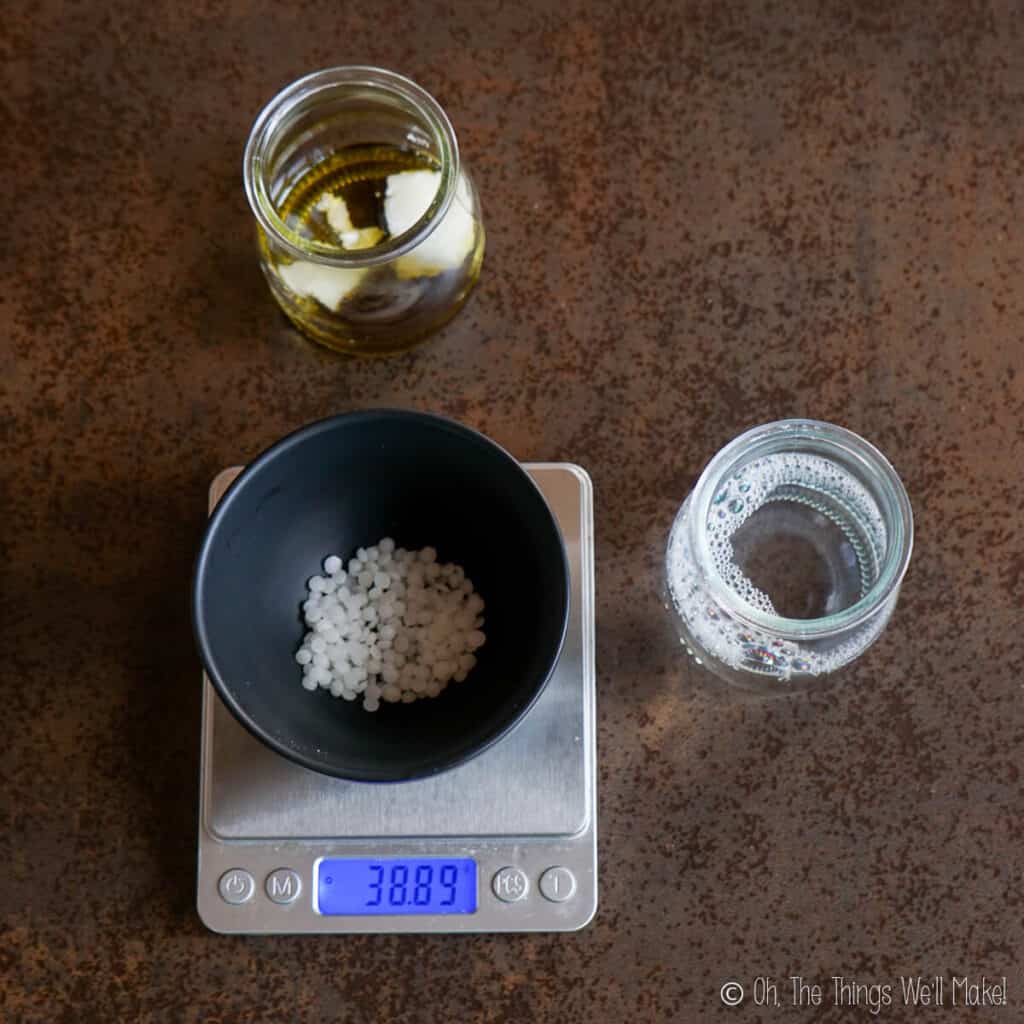
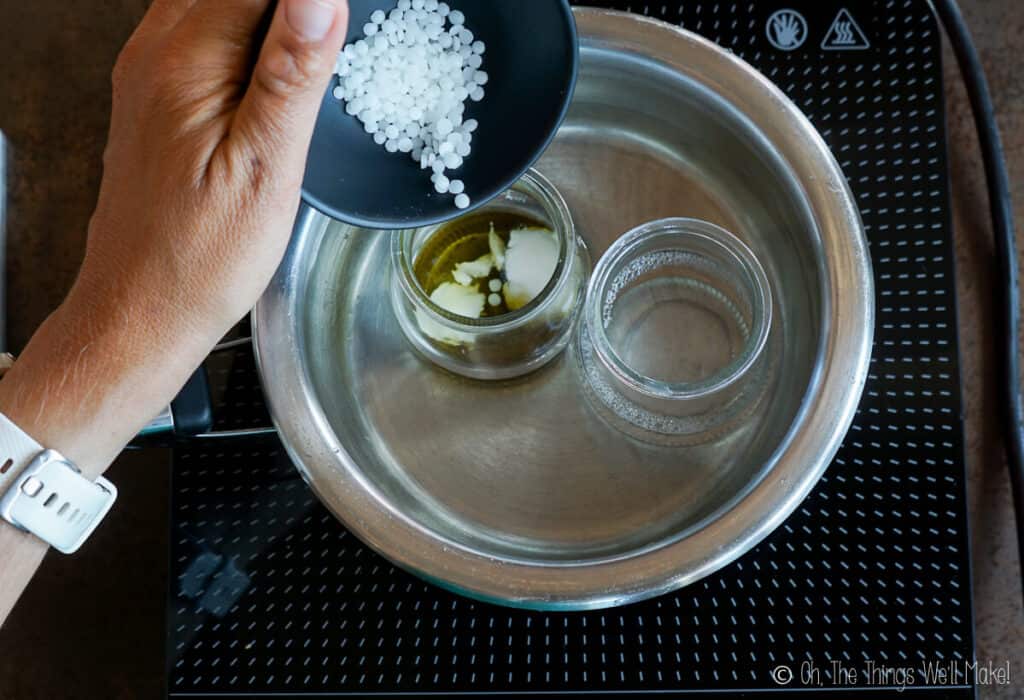
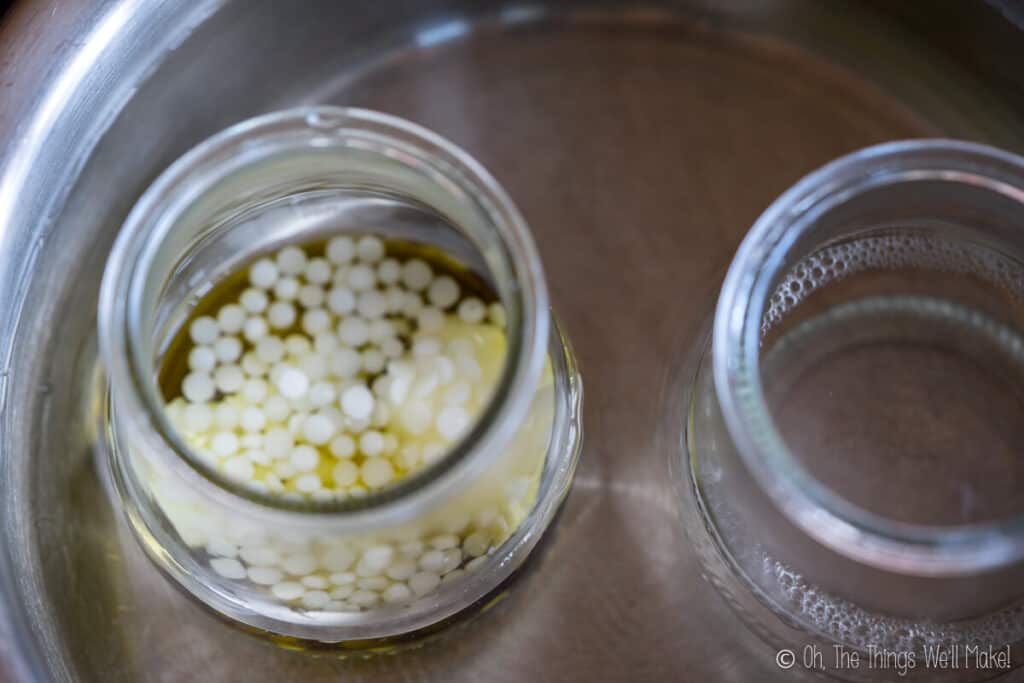
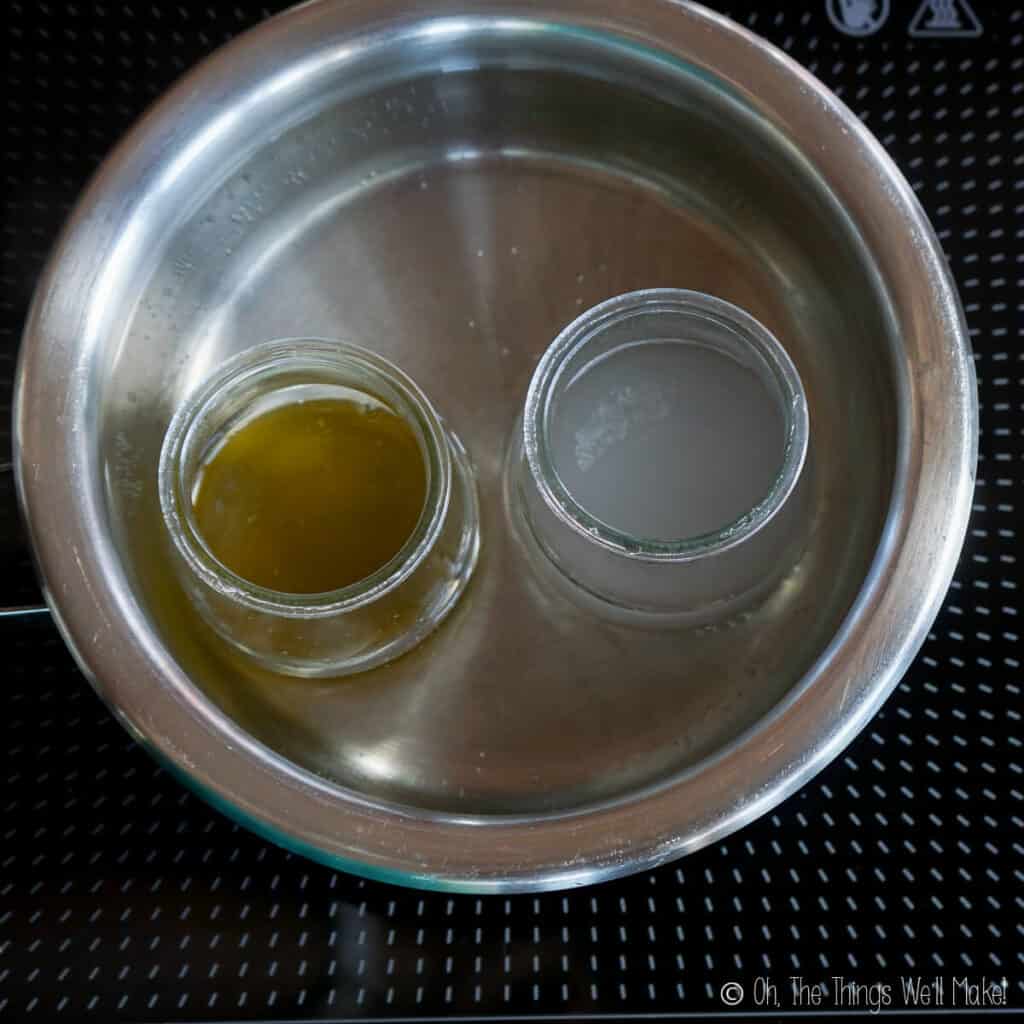
Once you’ve weighed out the various ingredients, heat both the oils and the waters in a water bath until the emulsifier has melted.
Once the emulsifier has melted, remove both containers from the hot water bath. Immediately pour the oil-based ingredients into the water-based ingredients while warm. Ideally, they should both be around 70º-75ºC/160º-170ºF.
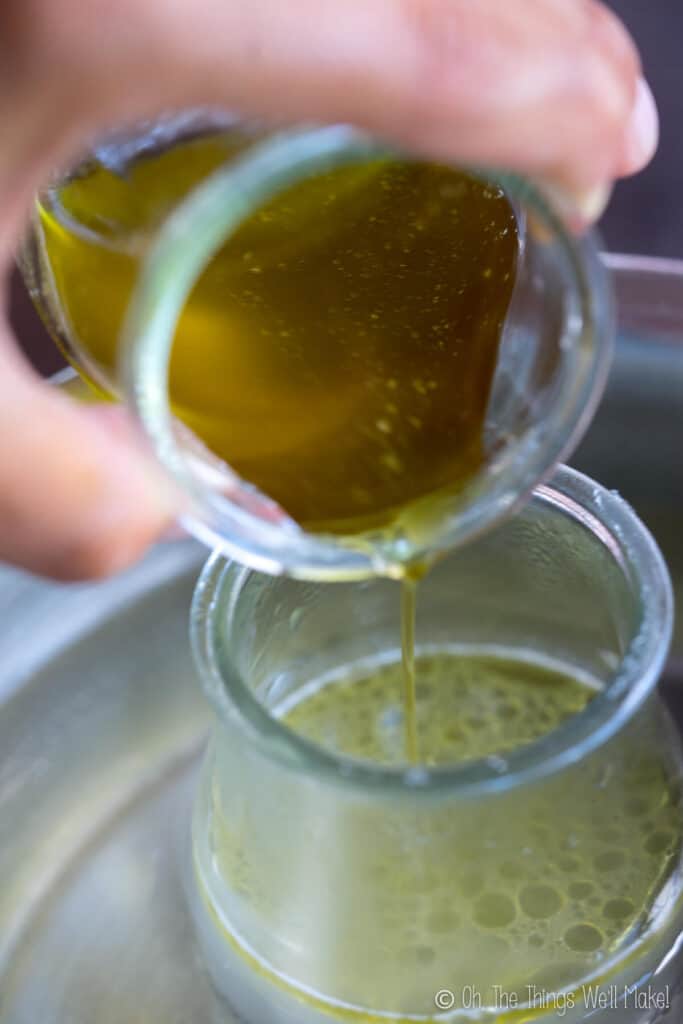
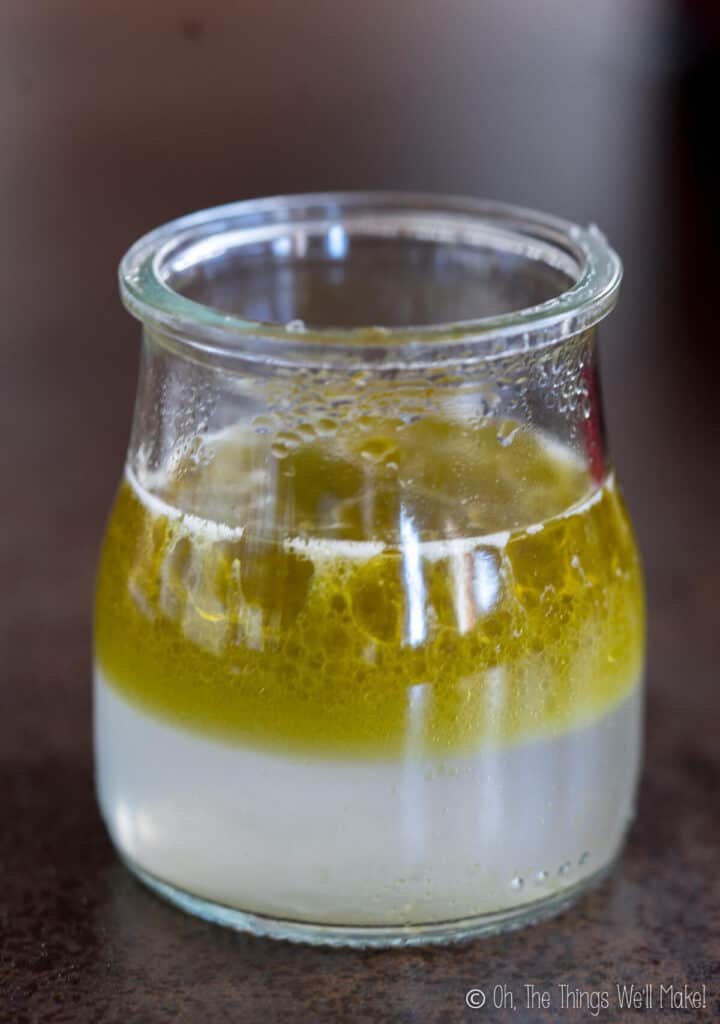
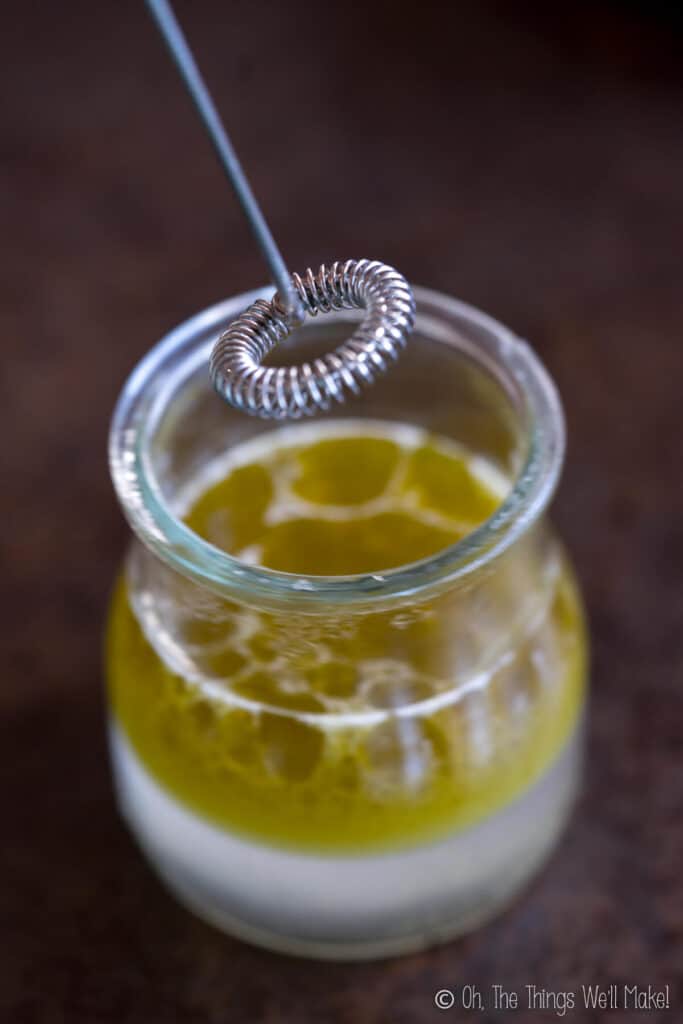
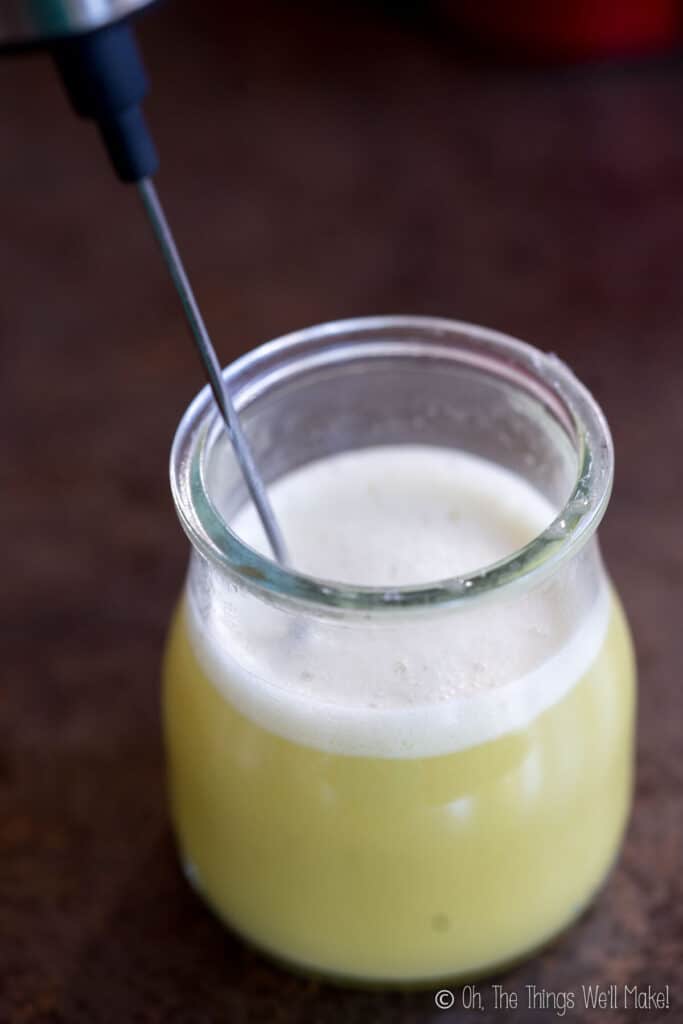
Periodically blend the ingredients together with an immersion blender or a milk frother while the mixture cools. You can also whisk by hand, but an electric mixer can help ensure a more stable emulsion. The moisturizer will thicken as it cools.
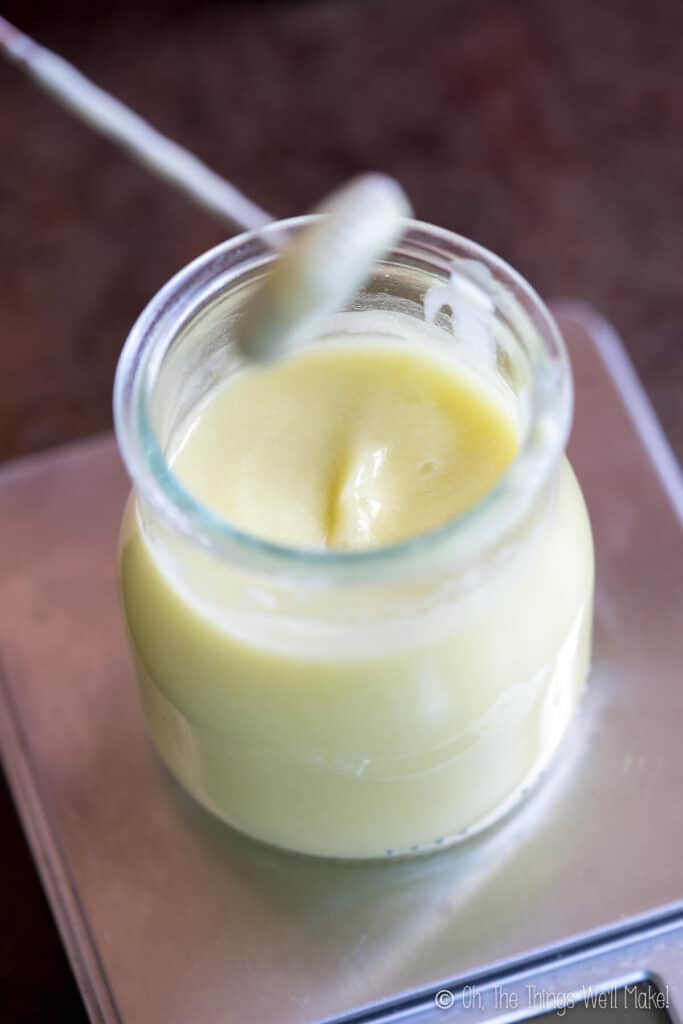
Once the ingredients have cooled enough, add the preservative and any other heat-sensitive ingredients that you may want to add. (This includes essential oils and/or vitamins like b-panthenol.)
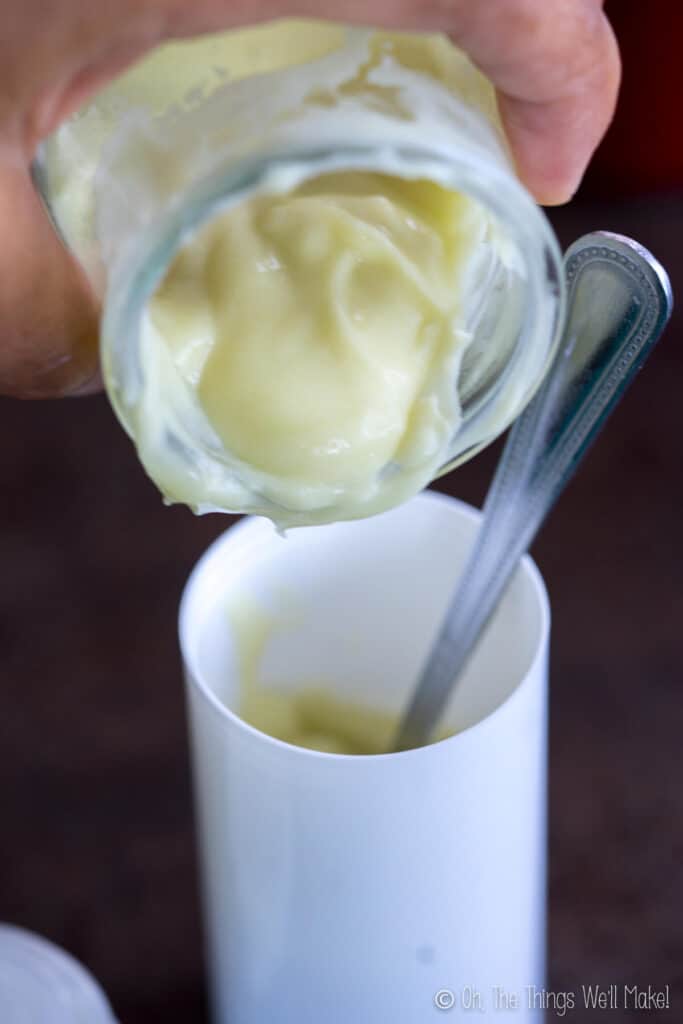
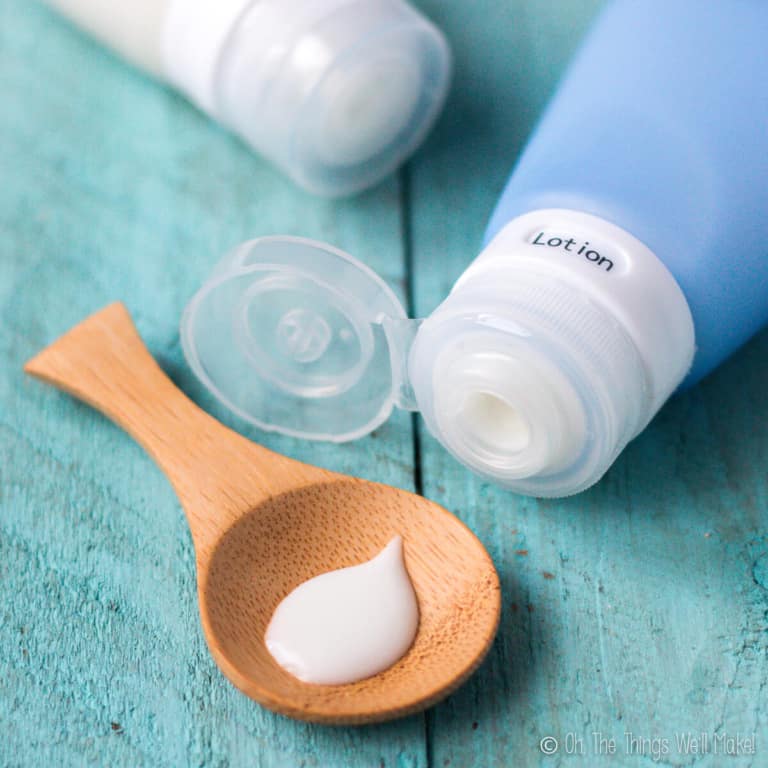
Then, pour the mixture into clean packaging. I like using airless dispensers and silicone travel tubes because they allow you to dispense the moisturizer without contaminating it with your hands.
Day cream or night cream?
This moisturizer works well both day and night. It’s not too heavy and it includes several oils with anti-aging properties.
Normally, the main difference between day and night creams is that night creams often use photosensitive ingredients that can’t be used in day creams. They are also sometimes a bit heavier and greasier than a cream that you would want to wear in the day under your makeup.
This cream doesn’t have any photosensitive ingredients (unless you were to add a citrus essential oil or some other additive that may increase sun sensitivity), so it’s perfectly fine to use both night and day. Perhaps as I get older, though unnecessary, I may try making a separate night cream that is slightly heavier.
Video
Homemade Moisturizer for Oily, Acne Prone Skin
Materials
- 10 g sunflower oil not high oleic
- 5 g argan oil
- 5 g hemp seed oil
- 5 g shea butter
- 5 g rosehip oil
- 40 g distilled water
- 25 g rose water
- 5 g montanov 68 or olivem or other emulsifier
- 1 g natural preservative (follow the recommended dosage for preservative chosen)
Instructions
- Weigh out the distilled water and rose water in a heat-safe container.
- Weigh the oils and emulsifier in a separate heat-safe container.
- Heat both containers in a hot water bath until the emulsifier has melted. (You may also use double boiler inserts for heating the ingredients over the hot water.)
- Combine the hot oils and waters while still hot, stirring until well combined. Ideally, both should be around 70º-75ºC/160º-170ºF when you combine them.
- Periodically whisk the ingredients together while they cool. The mixture will thicken and become more opaque as it cools.
- Once the mixture has cooled to around 30ºC/85ºF, add the preservative and, optionally, essential oils or other heat-sensitive ingredients. Mix together well to incorporate all of the ingredients.
- Test the pH of the lotion. Adjust it down with a few drops of lactic acid, if needed.
- Pour the facial cream into bottles. I love airless dispensers because they allow you to dispense the cream easily without contaminating it with your fingers.
Notes
Customizing oils
You may adjust the amounts and combination of oils used to suit your skin and sensitivities. (Just keep the total weight of the oils the same.Adding fragrance
This moisturizer obtains its subtle floral scent from the rose water. If you want a more pronounced rose scent, you can substitute part of the distilled water for more rose water or add a few drops of rose essential oil. If you prefer, you can also substitute the rose water with another floral water or hydrosol. You can also add an essential oil like lavender or tea tree oil at around 1% of the recipe by weight. Some essential oils may also help prevent and clear up acne.Preservatives
I normally use Sharomix 705 and Euxyl k903 to preserve this moisturizer. If using Leucidal for your preservative, it should be dosed around 3-4% of the recipe by weight (rather than 1%). For more information about preservatives, check out my guide to natural preservatives.Emulsifiers
Different emulsifiers will give different consistencies and textures. You may need to adjust the amount of emulsifier used depending on the one chosen. (Adding more will give a thicker consistency.) For more information about emulsifiers, check out my guide to emulsifiers. I like Montanov 68 and Olivem 1000.Testing the pH
You can use ph test strips to test the pH of the lotion. Test the pH to ensure the lotion falls in a decent range for both your skin (5-6 is ideal) and for the preservative you want to useYield
This recipe makes around 100g of lotion. In volume, it will make slightly less than 100ml. (The oil component of ml to grams isn’t interchangeable in the same way water is.) You can adjust the amount of the recipe to suit whichever container you plan to use.This post was originally published on April 8, 2017. It was rewritten, adding new photos, video, and clearer instructions in April of 2021.
Would I be able to use Jojoba Oil in this recipe? I have read it’s good for acne prone/oily skin.
Hi Seanna,
Yes, of course!
Just switch out jojoba oil for one (or part of one) of the other oils in the recipe.
I didn’t use jojoba oil because it has a comedogenic of two, which is higher than the other oils I used.
Most people can use it well without breaking out, including me. That said, it does cause what is known as a “purge” first in some people, meaning that they may break out at first when they begin to use it. Things should eventually clear up, but I didn’t want to use an oil that would make people’s skin break out when they first started using the moisturizer and that would scare them away from using it.
If you tolerate jojoba oil, by all means use it- it’s a great oil! 🙂
Good day,
Do you have any suggestion for dry skin?
Thank you
Hi Nicole,
It’s definitely on my to-do list. I’ve been working on a good one for aging skin, and I want to get a nice moisturizer together for dry skin. Now that my son is back to school, as of last week, I was hoping for more time for getting to those and getting them up on the blog. It’s definitely a priority- we’re in the middle of planning a kitchen reform in October, though, so I haven’t been able to do as much as I hoped so far this year.
I’ll do my best to get to it sooner rather than later!
HI Tracy Ariza,
The acne skin problem can be eliminate ,if you can use hemp oil daily before the taking of shower bath according to the time period after concerning this kind of problem with the skin specialist of skin and also understand the procedure of applying hemp oil on the body of which is helpful to eliminate the acne disease rapidly and protect your skin from the dryness and cracks appeared due to the working in a sunlight ,My suggestion is to go at a clinic of skin specialist one time in a week for the proper treatment of acne skin disease and also discussed the results comming during the treatment of acne disease ,don’t move in the sun light because the light of sun damaged the upper layer of skin ,So please take care of skin .
Thanks.
Thank for sharing this recipe! I have been on the hunt for an acne safe emulsifier and my research was leading me to try the Montanov 68. (Cetearyl Alcohol (and) Cetearyl Glucoside) so I am excited to see a recipe with it specifically for acne prone skin. I am going to give it a try with some other oils that I know work well for me vs. Shea/Argan. Thanks again!
Hi Brie,
I really love Montanov 68. It’s probably my favorite of all of the emulsifiers I have tried, but I don’t use it a lot in my recipes here because I couldn’t find it as easily in the US for some reason. (I was looking for places to link to for readers to be able to find it.)
I actually have a recipe that worked perfectly with Montanov 68 that I still haven’t posted because it doesn’t work well for me using other emulsifiers. I’m glad to see that it’s now showing up more in other countries because I’d really like to use it more often for my recipes here!
I hope the recipe works well for you. I’ve really loved this moisturizer, and need to make more as I just ran out again.
This time I may add some hyaluronic acid or some other aging skin additive. I need to research a bit more before I decide. 🙂
May I ask your ratio for water and oil?
I have extremely oily skin and am trying to make a moisturizing serum with aloe vera gel (water substitute) and oils. I was thinking of about 70% water & 30% oils and just use 9% glycerin to retain moisture.
What would you suggest? What is your ratio? I do not need preservative, because the aloe vera gel has it in the bottle already. I won’t use an emulsifier either, because I can just shake it in amber dropper and it comes out fine.
Hi Julia,
A 70% to 30% should be about right. If you take a look at my basic lotion recipe, I talk a little bit about customizing your own lotions. In a basic lotion, I usually use around 65% water, 30% oil, and the other 5% is made up by emulsifiers, preservatives, and fragrances or other additives.
A lot depends on the final consistency that you are looking for.
I’ve never mixed a commercial aloe gel with oil before. My guess would be that without an emulsifier, you won’t really end up with a solid product that you can use. It will end up separating all of the time. That is, unless, the aloe gel already has some sort of emulsifier in the product, which wouldn’t completely surprise me. I’m not sure if it would be enough to keep the mix together, though. Also keep in mind that although the aloe gel has a preservative in it, the amount used was based on the weight of that product. You are adding oils and not water, so hopefully the combination won’t add much, if any, potential for pathogen growth, but I’m not really sure. To be on the safe side, I’d probably make small batches and not keep it around for too long.
Good luck!
You are right of course! oil and water do not mix unless I shake it vigorously. Then it turns cloudy. I’m currently mixing small batches 15-30ml. I am wondering, if aloe vera gel seems to be a good substitute for water? When I rub Aloe Vera gel (98%) into my skin it seems to leave my pores quicker than grapeseed oil does. I’m confused about this. Hence I wanted to try glycerin to seal the moisture.
Oh and here are the ingredients of my 8oz Aloe Vera gel bottle:
Cold-Pressed Organic Aloe Vera (99.75%), Citric Acid, Ascorbic Acid, Potassium Sorbate, Xanthan
Hi Julia,
I don’t know enough about it to know for sure how your mix will turn out, or how well it will keep- even with the ingredients. I wish I could be of more help!
Thanks for the recipe. I’m eager to try it but had a couple questions before I begin.
Because of various allergies, the hydrolat isn’t an option. Chamomile hydrolat is the only one I could possibly use and I honestly hate the smell. Can I just use more distilled water, or do it have to be a hydrosol?
And second, can I use coconut oil in place of the shea butter? You mentioned increasing the other oils if there’s a shea butter sensitivity issue, and I can certainly do that, but I love coconut oil and wondered if its inclusion would throw things off.
Thanks again for taking the time to post this!
Hi Jilian,
You’re very welcome. I’m happy to help you out! 🙂
There is no need to add any hydrosols. You can use only distilled water if you prefer. I used the rose water as an experiment in the batch I had made just before posting, and I loved the natural fragrance that it gave the lotion so much that I decided to add it to the recipe. Feel free to switch out for any other hydrosol or just have the whole water component be distilled water- your choice!
As for the oils- yes, you can use coconut oil instead. I didn’t add coconut oil to this recipe because it’s a recipe meant for acne prone skin. Coconut oil is a comedogenic oil (It has a rating of 4!), and causes breakouts for many people. Some people can use it on their faces without any issues, though. So, if it works for you, you can definitely use it instead. I’ve made my homemade lotion with coconut oil many times now, and like it a lot for the rest of my body. I just can’t use it on my face.
Good luck!
Hi tracy am thinking of making a natural lotion with argan,coconut,rosemary & lavender oil.Isnt d oil too mch 4 oily sk
Hi Emdy,
Coconut oil can be problematic for some people. Some people find it works really well on their oily skin. Others find that it makes them break out. The others should be OK.
As long as you keep the proportions the same, you can switch out some of the oils in the recipe, but I’d be careful to try to use a different oil that doesn’t cause breakouts if that’s an issue for you.
I am unable to find Low Oleic Sunflower oil. Would it be ok to use Safflower oil as a substitute?
Hi Alexis,
I was struggling with this issue myself, meaning I spent time trying to figure out which sunflower oil was the best oil to use. I think that I’ve since gathered that “normal” sunflower oil should be OK, and that “high oleic” sunflower oil is marked as such. So, you don’t necessarily have to look for low oleic sunflower oil, but make sure you aren’t using “high oleic sunflower oil.” I should go back and update the post to make it less confusing.
Safflower oil also has a comedogenic rating of zero, but in this case supposedly that is only the “high linoleic” type. I found this brand of safflower oil that specifically mentions that, but I’m not sure if it’s something that is usually on the bottle or not. I’ve never used safflower oil as it isn’t a common oil to find here in Spain.
Can you use measurements in tablespoons, ounces etc?
Hi Shirley.
I used grams because the amounts are so small that grams, a smaller measurement, are the most precise. I also find that people get confused between liquid ounces and regular ounces, so writing in grams prevents confusion for a lot of people.
You can easily toggle the recipe to show up in ounces by changing the units from metric to US imperial. You can find that between the ingredients and the instructions part of the recipe.
In any case, most scales these days will also allow you to switch to either measuring in ounces or grams. I find that very helpful when trying different recipes from different areas of the world.
I hope that helps!
If you have any problems getting it to work, just let me know.
Thanks!
Am the only one though who gets clogged pores from hemp oil?
Hi Inga,
Well, I guess anything is possible. Have you tried using only hemp oil exclusively for awhile to see if it’s really what is aggravating your skin? Are you sure the oil you are using is 100% pure hemp oil?
It is considered a non-pore clogging oil. Other oils with a rating of 1, for example, don’t clog pores for most people, but can for certain people. Some oils can cause bumps/little pimples to form while the skin is regulating it own oils/while your pores purge. Hemp oil, though, has a rating of zero so it’s considered a non-clogging oil, and it isn’t supposed to do that.
I don’t know what to tell you. We all react differently to different ingredients, so even if something is said to not clog pores, I guess that there could be some way that you have some sort of adverse reaction to the oil which, of course, could lead to it clogging them. (And while it’s not the norm, and while I don’t know of anybody else who has had that problem, you probably aren’t the only one. 😉 )
I would suggest that you just switch out the hemp oil for one of the other non-comedogenic oils, and give that a try in this recipe instead. I wish I could be of more help!
Hello, Tracy!
I got here looking for recipes of foundation for oily and acne skin. I thought maybe I could use one of those oils for a foundation recipe, what do you think?
Hi Ohana,
Yes, definitely!
You could make a lotion using those oils and then add pigments to it. I think that would work well.
I’d love to hear how it goes for you!