

Natural preservatives for DIY skincare and cosmetics
If you make homemade skincare or cosmetics, understanding preservatives is essential. This guide explains when you need them, how they work, and which natural preservative systems are the most reliable.
Over the years, I’ve gotten a lot of questions about how to preserve homemade skincare and cosmetic products and which preservatives are actually worth using.
As more people become interested in making their own products, there’s also been growing interest in using gentler, more natural ingredients and avoiding certain preservatives or additives. I’m one of those people too. I enjoy making my own skincare and cosmetics because it gives me more control over the ingredients I use and helps me customize products for my own needs and preferences.
That said, “natural” doesn’t automatically mean safe or self-preserving. Even products made with high-quality ingredients can become contaminated with bacteria, mold, or yeast if they aren’t formulated properly. Understanding when and how to preserve homemade products is an important part of making safe DIY cosmetics.
Why use a preservative?
When people first start making homemade skincare products, they often focus mostly on choosing natural oils, butters, and other active ingredients. Just as important, though, is making sure the final product stays safe to use over time.
Microbes such as bacteria, yeast, and mold can grow in skincare products, especially those that contain water or water-based ingredients. While mold is often easy to spot, bacterial contamination is usually invisible. A product can look, smell, and feel completely normal while still containing microbial growth.
Not all microbes are harmful, but some can cause irritation, spoilage, breakouts, or infections. Contaminated products have been linked to skin issues such as folliculitis, and products used around the eyes or on sensitive or damaged skin need extra care because contamination can pose a real infection risk.
Proper preservation helps slow the growth of unwanted microbes and is an important part of making safe, stable homemade lotions, creams, shampoos, conditioners, and other water-based products.
When do you need a preservative?
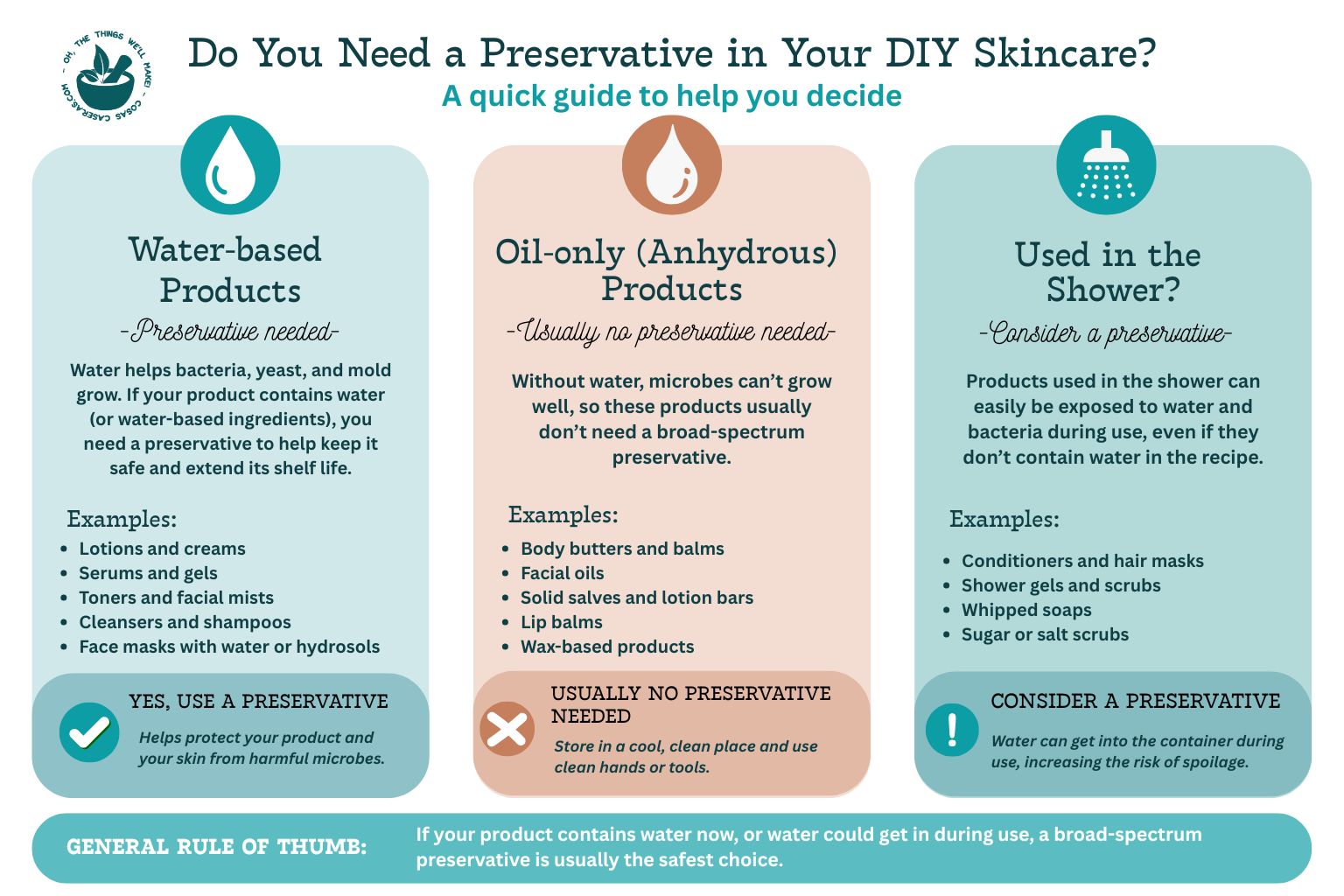
In general, any product that contains water or water-based ingredients needs a broad-spectrum preservative. Water creates an environment where bacteria, yeast, and mold can grow.
Products that usually need a preservative include:
- Lotions and creams
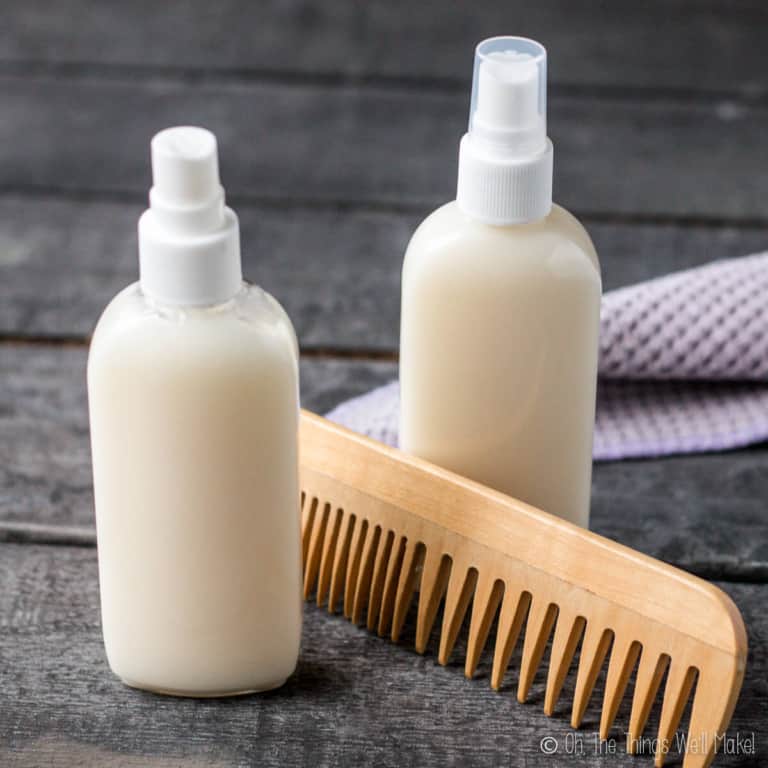
- Shampoos and conditioners
- Facial toners and sprays
- Products made with aloe vera, hydrosols, teas, or herbal infusions
- Emulsions that combine water and oils
Products that usually do NOT need a preservative include:
- Pure oils
- Salves or balms
- Balm bars or lotion bars
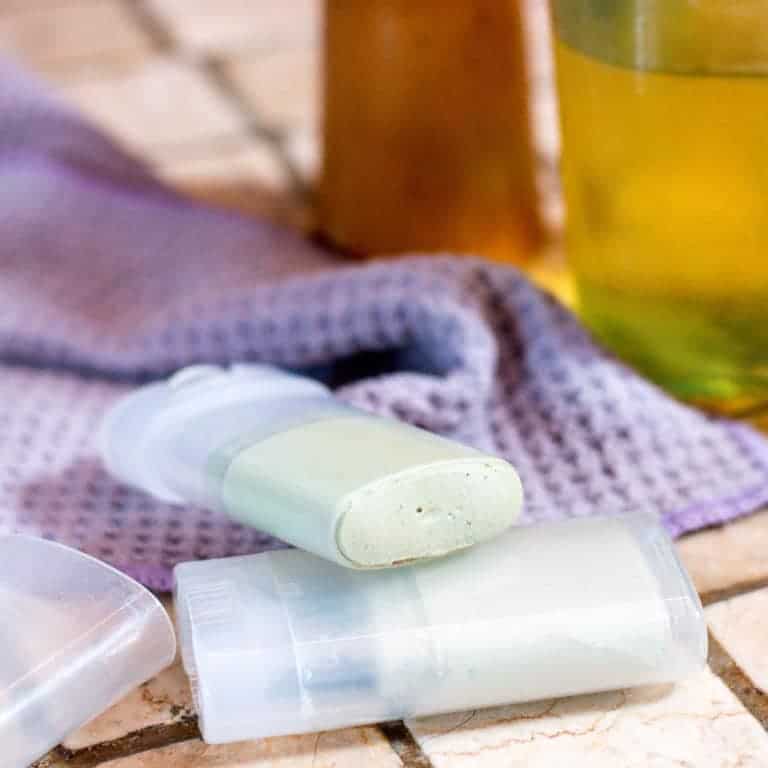
- Anhydrous body butters
- Wax-based products
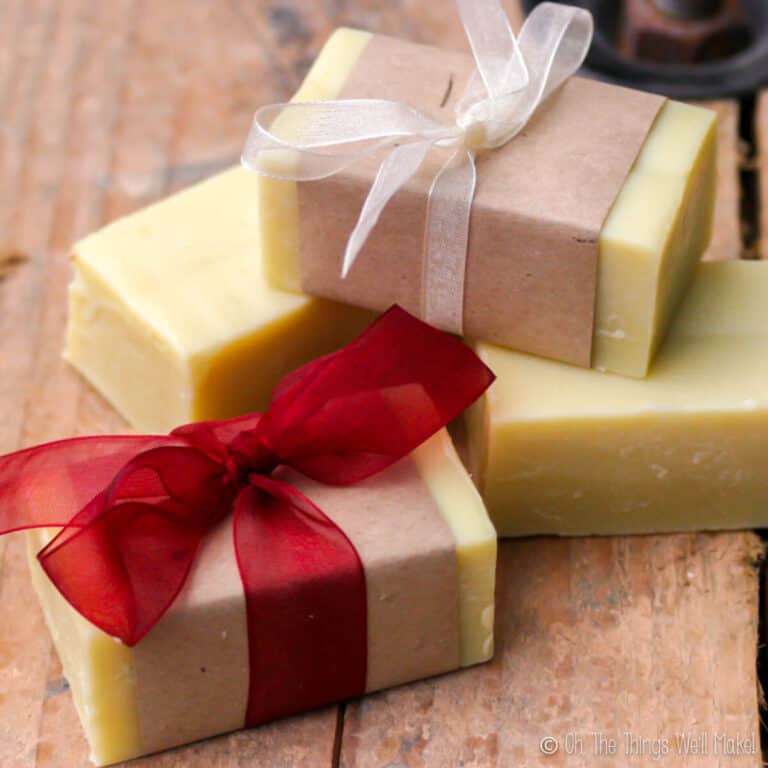
- True soap bars
Products that may still need a preservative
Some products fall somewhere in between. Sugar scrubs, for example, may not contain water initially, but they’re often used in the shower where water can easily contaminate the container. In cases like that, adding a preservative is usually a good idea.
The same can apply to other anhydrous products that are regularly exposed to water or used with wet hands. Once water is introduced into the container, microbial growth becomes much more likely.
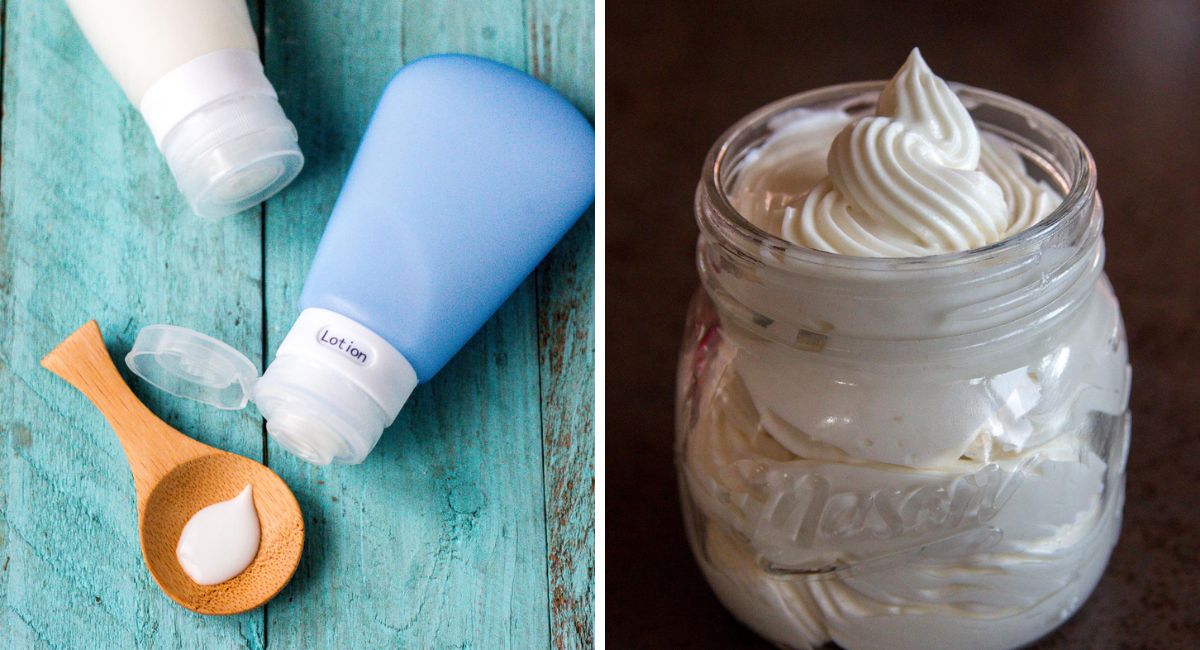
Water-based products
Water-based products are especially prone to microbial growth because bacteria, yeast, and mold thrive in moist environments. Even products that look and smell perfectly normal can become contaminated over time.
This is especially important for emulsions like lotions and creams because they combine water and oils into a stable mixture that can support microbial growth throughout the product.
Ingredients like aloe vera, hydrosols, herbal infusions, milk, and fresh botanical ingredients can make products even more difficult to preserve properly.
Why true soap is different
True soap is somewhat unique because its naturally high pH makes it much less hospitable to microbial growth than most other homemade skincare products.
Traditional bar soaps and liquid soaps made with lye typically have a pH of around 9–10 or higher. At that pH, most bacteria, yeast, and mold struggle to grow, which is why true soap is often considered self-preserving.
That’s one reason properly made soap bars and undiluted liquid soap paste can usually be stored for long periods without needing a broad-spectrum preservative.
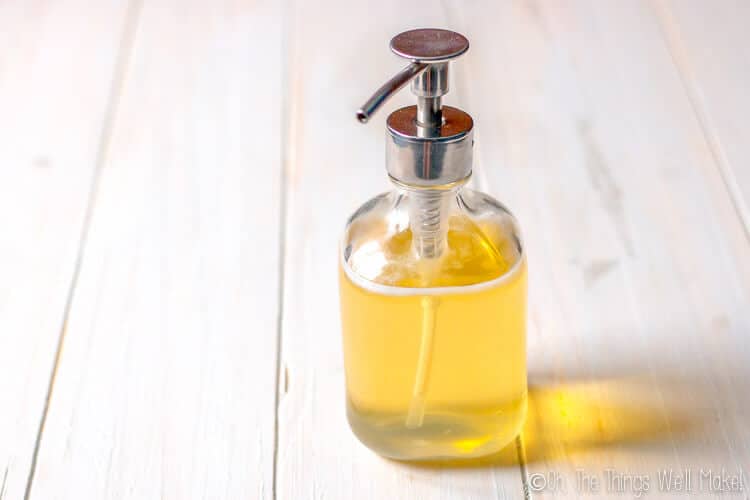
Diluted liquid soap is a bit more debated in DIY circles, but the naturally high pH still makes it far less prone to microbial growth than lotions, creams, or surfactant-based cleansers.
It’s important to note, though, that this only applies to true soap made with lye. Syndet products, such as many homemade shampoos, body washes, and facial cleansers made with surfactants, usually have a lower pH and do require a preservative if they contain water.
Preservatives for liquid soap
One reason liquid soap creates so much confusion is that most preservatives used in skincare products aren’t effective at the high pH of true soap. Many common cosmetic preservatives only work well in products with a pH below 6, while properly made liquid soap usually has a pH closer to 9–10 or higher.
For that reason, many soapmakers rely on the naturally high pH of the soap itself rather than adding a preservative. Properly made liquid soap paste is generally considered very shelf stable and can usually be stored for long periods without issues.
That said, contamination risks can increase if you add ingredients like milk, botanical extracts, fresh aloe, or other difficult-to-preserve additives after dilution. In those cases, preservation becomes much more complicated.
One preservative often mentioned for high-pH products is Suttocide™ A (Sodium Hydroxymethylglycinate), which is marketed as effective in higher-pH formulations like liquid soap. Some formulators also experiment with preservatives like Glydant Plus, although many common cosmetic preservatives are not considered reliable at typical soap pH levels.
Even when working with high-pH soap, good manufacturing practices still matter. Clean equipment, distilled water, and proper storage all help reduce contamination risks.
Anhydrous products
Anhydrous products are products that do not contain water or water-based ingredients. This includes products made only with oils, butters, waxes, and oil-soluble additives.
Because microbes need water to grow, properly formulated anhydrous products are generally much less prone to microbial contamination and usually do not require a broad-spectrum preservative.
Examples include:
- Body butters
- Salves and balms
- Lotion bars
- Facial oils
- Wax-based products
That said, oils can still go rancid over time. Antioxidants like vitamin E or rosemary extract can help slow oxidation and extend shelf life, but they are not broad-spectrum preservatives and do not prevent microbial growth.
Anhydrous products and humidity
Even if a product does not contain water initially, it can still become contaminated during use.
Products used in the shower, such as sugar scrubs, are especially prone to contamination because water can easily enter the container through wet hands, steam, or condensation.
Once water is introduced into an otherwise anhydrous product, microbial growth becomes much more likely. For products that are regularly exposed to moisture, adding a preservative or using packaging that minimizes contamination can be a good idea.
Ingredients that are NOT preservatives
Just because an ingredient has antioxidant or antimicrobial properties doesn’t automatically mean it can safely preserve a homemade cosmetic product. Many ingredients commonly promoted as “natural preservatives” are not considered reliable broad-spectrum preservatives when used alone.
Vitamin E
Vitamin E is one of the most commonly misunderstood ingredients in DIY skincare.
While it’s often referred to as a preservative, vitamin E is actually an antioxidant, not a broad-spectrum preservative. It helps slow the oxidation of oils and can help extend the shelf life of oil-based products by delaying rancidity.
That makes it a great addition to body oils, balms, salves, and body butters, but it does not prevent the growth of bacteria, yeast, or mold in products that contain water.
I add vitamin E to most of my homemade lotions, oils, and butters at around 0.5% of the product by weight to help protect the oils from oxidation, thus extending the shelf life of my products.
Essential oils
Some essential oils, including tea tree, oregano, rosemary, and thyme essential oils, do show antimicrobial properties in studies. That doesn’t mean they can reliably preserve homemade skincare products on their own, though.
To function as true preservatives, essential oils would often need to be used at concentrations that could irritate the skin or increase the risk of sensitization.
While essential oils can add fragrance and may contribute some antimicrobial support, they are not considered reliable broad-spectrum preservatives for homemade lotions, creams, shampoos, or other water-based cosmetics.
While I don’t use them as preservatives, I do often add essential oils at around 1-2% of the recipe by weight to add a natural fragrance and other beneficial properties.
Rosemary extract
Like vitamin E, rosemary extract is primarily used as an antioxidant rather than a preservative.
It can help slow the oxidation of oils and extend the shelf life of oil-based ingredients, making it useful in products like balms, body oils, and salves. It’s commonly used in both cosmetic and food formulations for this purpose.
While rosemary extract can help delay rancidity, it does not provide reliable broad-spectrum protection against bacteria, yeast, or mold.
Rosemary extract can either be added at around 0.15-5% by weight directly to your oils or to the oil phase of a recipe to help extend the shelf life by protecting against oxidation of the fats.
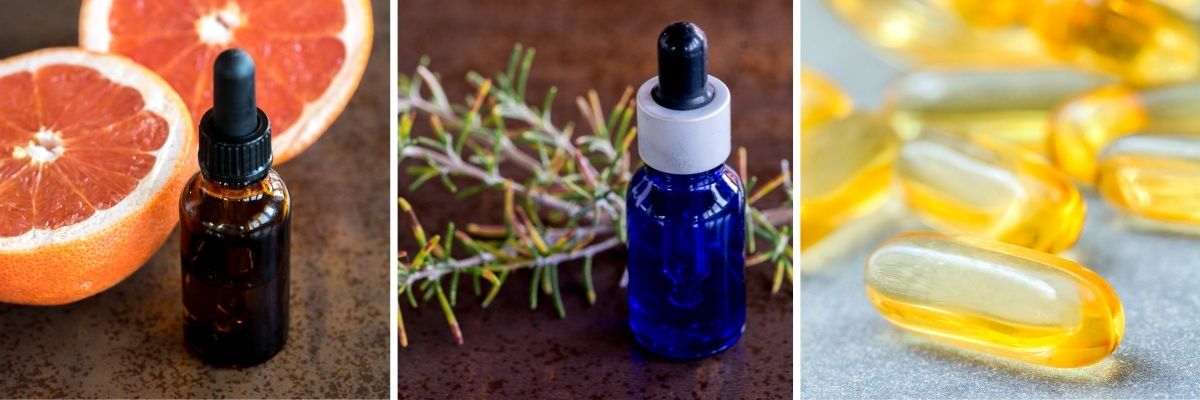
Grapefruit seed extract
Grapefruit seed extract is often marketed as a natural preservative, but it remains highly controversial within the cosmetic formulation world.
Some studies have suggested that the antimicrobial activity found in certain grapefruit seed extract products may come from contamination with synthetic antimicrobial compounds rather than from the grapefruit extract itself.
In addition, grapefruit seed extract varies widely from supplier to supplier and is not generally considered a reliable broad-spectrum preservative for homemade cosmetics.
Because of the inconsistency and lack of reliable evidence supporting its effectiveness, I don’t recommend relying on grapefruit seed extract alone to preserve homemade skincare products.
Alternative preservation methods
Some ingredients can help preserve certain types of homemade products when used at high enough concentrations. While they aren’t usually used like standard broad-spectrum preservatives, they can still work well in certain situations.
Alcohol
Alcohol can help prevent microbial growth when used at sufficiently high concentrations. It also helps solubilize essential oils, making it especially useful in products like room sprays, linen sprays, and tinctures.
For preserving and extracting botanical ingredients, an alcohol content of at least 40% is typically recommended. That’s why many tinctures and extracts use vodka or stronger alcohols as their base. I use alcohol-based extraction methods in recipes like my homemade vanilla extract and homemade bitters.
In sprays and similar products, many formulators aim for roughly 20–30% alcohol in the final product to help reduce the risk of microbial growth.
Alcohol usually isn’t the best option for lotions, creams, or other emulsified skincare products, though, because the amount needed can feel drying or irritating on the skin.
Glycerin
Glycerin can also help preserve products when used at very high concentrations. It’s commonly used to make glycerites, which are botanical extracts made with glycerin instead of alcohol.
To reliably help prevent microbial growth, glycerin generally needs to make up more than half of the product, often around 55% or higher.
I’ve used glycerin-based extraction methods in recipes like my cucumber extract and non-alcohol vanilla extract.
While glycerin is an excellent humectant in smaller amounts, products with very high concentrations of glycerin tend to feel sticky or tacky on the skin. Because of that, glycerin usually isn’t used as the main way to preserve lotions, creams, or most other homemade skincare products.
Common natural broad-spectrum preservatives
No preservative is perfect for every recipe. Different preservatives work best at different pH ranges and in different types of products. Always check the recommended usage rate and effective pH range for the preservative you choose.
This section focuses mainly on preservatives commonly used in natural or ECOcert-style formulations, since those are the ones I’m asked about most often.
| Preservative | Effective pH range | Typical usage rate | ECOcert/COSMOS approved | Notes |
|---|---|---|---|---|
| Geogard ECT / Preservative ECO | 3–8 | ~0.6–1% | Yes | Broad-spectrum preservative with a somewhat noticeable scent |
| Geogard 221 / Cosgard | 2–6 | ~0.2–1% | Yes | Popular and easy to use in many emulsions |
| Sharomix 705 | Below 5.5–6 | ~0.6–1.2% | Yes | Works well in lower-pH formulations |
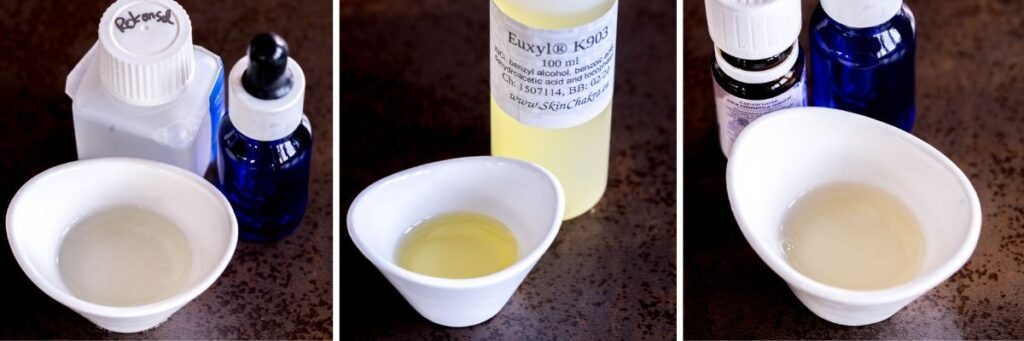
| Rokonsal BSB-N | Below 5.5 | ~0.2–1% | Yes | Mild preservative commonly used in natural formulations |
| Euxyl K903 | 3–6 | ~0.2–1% | Yes | Gentle preservative often used in baby or eye-area products |
| Dermorganics 1388 | 5–5.5 | ~2–4% | Yes | Works in a narrow pH range |
| Leucidal Liquid SF | Best below 6 | ~2–4% | Yes | Popular natural preservative, but somewhat controversial |
Geogard ECT / Preservative ECO
Geogard ECT (also sold as Preservative ECO) is a broad-spectrum preservative commonly used in natural skincare products. It works well in many lotions, creams, shampoos, and emulsions.
One downside is that it does have a somewhat noticeable scent that some people dislike, although fragrances or essential oils can often help mask it.
INCI: Benzyl Alcohol, Salicylic Acid, Glycerin, Sorbic Acid
Typical usage rate: Around 0.6–1%
Effective pH range: 3–8
Because it contains salicylic acid, it’s generally not recommended for leave-on products intended for babies.
Geogard 221 / Cosgard
Geogard 221, also known as Cosgard in some regions, is another popular preservative for natural formulations. It’s relatively easy to work with and is commonly used in lotions, creams, shampoos, and conditioners.
INCI: Benzyl Alcohol, Dehydroacetic Acid
Typical usage rate: 0.2–1%
Effective pH range: 2–6
It tends to work best in products with a pH below about 5.5.
Sharomix 705
Sharomix 705 is one of the natural broad-spectrum preservatives I’ve personally used the most over the years. It works best in products with a lower pH and is commonly used in emulsions and surfactant-based products.
INCI: Benzoic Acid, Sorbic Acid, Dehydroacetic Acid, Benzyl Alcohol
Typical usage rate: 0.6–1.2%
Effective pH range: Below 5.5–6
It’s generally considered heat stable, although prolonged exposure to high heat should still be avoided.
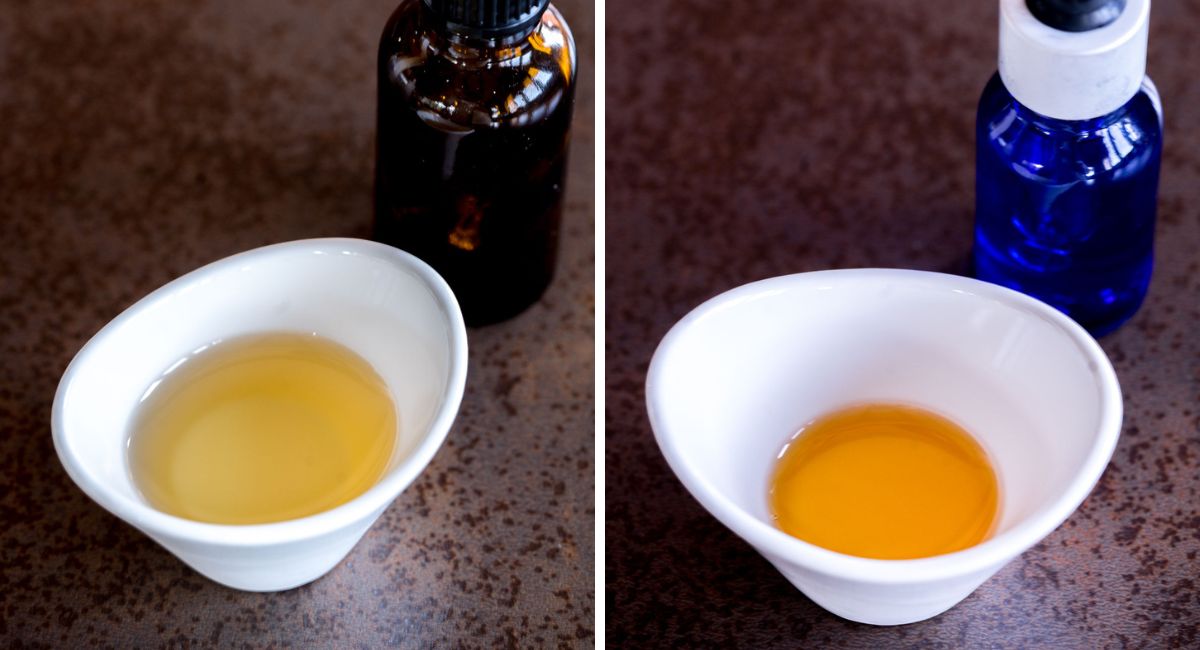
Rokonsal BSB-N
Rokonsal BSB-N is a mild broad-spectrum preservative commonly used in natural and organic cosmetic formulations.
INCI: Benzyl Alcohol, Glycerin, Benzoic Acid, Sorbic Acid
Typical usage rate: 0.2–1%
Effective pH range: Below 5.5
It’s often used in lotions, creams, and other lower-pH skincare products.
Euxyl K903
Euxyl K903 is considered a particularly gentle preservative and is often used in products designed for sensitive skin or the eye area.
INCI: Benzyl Alcohol, Benzoic Acid, Dehydroacetic Acid, Tocopherol
Typical usage rate: 0.2–1%
Effective pH range: 3–6
It tends to work especially well in lower-pH formulations.
Dermorganics 1388
Dermorganics 1388 works in a fairly narrow pH range, so checking the final pH of your product is especially important when using it.
INCI: Glycerin, Aqua, Sodium Levulinate, Sodium Anisate
Typical usage rate: 2–4%
Effective pH range: 5–5.5
Because it needs to be used at a higher percentage than many other preservatives, it can sometimes affect the final feel of a product.
Leucidal® Liquid SF
Leucidal is a radish root ferment preservative that became very popular in natural skincare because it appears to be a much more natural alternative to many conventional preservatives.
The antimicrobial peptides are derived from Leuconostoc kimchii, the same type of lactic acid bacteria used in making kimchi, a Korean fermented cabbage. Honestly, that was one of the things that originally made it sound so interesting to me.
When I first started making lotions and creams, I used Leucidal myself because I knew many readers were looking for more natural preservative options. I also liked the idea of using a ferment-derived preservative system instead of some of the harsher preservatives people were trying to avoid.
At first, I didn’t really notice any problems with it. The biggest downside for me was that it needed to be used at a much higher percentage than many other preservatives.
Over time, though, I started coming across more discussions questioning how reliable it really was as a broad-spectrum preservative, especially against mold. Then I found a study suggesting that the antimicrobial activity in some samples may not have actually been coming from the radish ferment itself, but instead from compounds like salicylic acid and quaternary ammonium compounds found in the samples tested.
“In summary, the antimicrobial activity of commercial Leuconostoc/radish root ferment filtrates (LRRFF) are attributed to salicylic acid and didecyldimethylammonium salts… We were unable to detect antimicrobial peptides in any sample of fermented radish root filtrate.”
J. Agric. Food Chem. 2015, 63, 11, 3053-305
INCI: Leuconostoc/Radish Root Ferment Filtrate
Typical usage rate: 2–4%
Effective pH range: Best below pH 6
That made me personally less comfortable relying on it as my main preservative system, especially for products with a longer shelf life.
That said, many people still use Leucidal successfully, and you’re welcome to experiment with it yourself if it fits your goals and comfort level.
What about Optiphen and Germall Plus?
If you search for preservatives online, especially on Amazon, you’ll probably also come across preservatives like Optiphen, Optiphen Plus, and Liquid Germall Plus. People ask me about those a lot too.
Unlike many of the preservatives discussed above, these aren’t usually considered “natural” preservatives and generally aren’t ECOcert or COSMOS approved. That said, a lot of DIYers and small businesses still use them successfully.
One reason they’re so popular is that they tend to be easier to work with than some natural preservative systems. Some also work over a wider pH range, which can make formulation a little less finicky.
I focused mainly on preservatives commonly used in more natural-style formulations because that’s what most of my readers are looking for. But that doesn’t mean preservatives like Optiphen or Germall Plus are automatically bad or unsafe.
Liquid Germall Plus
Liquid Germall Plus is probably one of the most commonly used preservatives in DIY skincare. It’s a broad-spectrum preservative used in products like lotions, creams, shampoos, and conditioners.
A lot of people like it because it’s effective at very low percentages and is generally considered easy to use.
Optiphen and Optiphen Plus
Optiphen preservatives are also very common in DIY skincare and cosmetic recipes. They’re often marketed as paraben-free alternatives and are commonly used in lotions and emulsified products.
Optiphen Plus tends to work better in products with a lower pH.
As with any preservative, it’s still important to check the manufacturer’s recommendations for things like pH range and suggested usage rates.
How to choose the right preservative
Choosing a preservative isn’t just about picking one labeled “natural” or swapping one preservative for another. Different preservatives work best in different types of products and under different conditions.
Using the correct dosage
When substituting one preservative for another, don’t automatically use the same percentage called for in the original recipe.
Always check the manufacturer’s recommended usage rate for the preservative you’re using. Some preservatives work well at very low percentages, while others, like Leucidal or Dermorganics 1388, need to be used at much higher amounts to be effective.
Using more preservative than recommended isn’t necessarily better, either. In some cases, higher percentages can affect the texture, scent, or feel of the final product.
Checking the pH range
Every preservative has a pH range where it works best. If the pH of your product falls outside that range, the preservative may not work effectively.
Most homemade skincare and haircare products are formulated somewhere around pH 4.5–5.5, which works well for both skin and many natural preservatives. True soap is one of the major exceptions because its naturally high pH changes how preservation works.
It’s also important to remember that some preservatives can slightly shift the pH of a product after they’re added. If you’re formulating a pH-sensitive product, it’s a good idea to check the pH again after adding your preservative.
Water-soluble vs. oil-soluble preservatives
Some preservatives work best in water-based products, while others can also be used in anhydrous products like sugar scrubs or body butters.
Most broad-spectrum preservatives used in homemade skincare work well in emulsions that combine water and oils, but it’s still important to check the supplier’s recommendations for compatibility and usage guidelines.
When in doubt, always check the documentation provided by the manufacturer or supplier.
Difficult-to-preserve ingredients
Some ingredients make products much more difficult to preserve safely, even when using a broad-spectrum preservative.
Fresh aloe vera, milk, fruit purees, honey, herbal infusions, and other food-like ingredients can increase the risk of microbial growth. Clays and fresh botanical ingredients can also complicate preservation.
That doesn’t mean you can never use those ingredients, but it does mean preservation becomes more challenging and less predictable.
For products with a longer intended shelf life, I usually prefer using ingredients that have already been commercially processed and preserved rather than adding fresh plant materials directly to homemade formulations.
Good manufacturing practices
Even the best preservative system can’t compensate for poor hygiene or heavily contaminated ingredients and equipment.
When making homemade skincare products, clean working conditions help reduce the number of microbes introduced into the product from the beginning, making preservation much easier and more reliable.
A few simple habits can make a big difference:
- Wash your hands well or wear gloves
- Sanitize work surfaces, tools, and containers
- Use distilled water when possible
- Avoid reusing containers that can’t be cleaned thoroughly
- Keep water out of anhydrous products whenever possible
- Store products in clean, airtight containers
Preservatives help slow microbial growth, but they don’t make a poorly handled product indestructible. Good formulation practices and proper storage are still important parts of making safe homemade skincare products.
Shelf life and realistic expectations
When large cosmetic companies develop products, they often perform microbial testing and preservative challenge testing to help verify that a product remains safe and stable over time.
Most home formulators are not doing that kind of testing, so shelf life estimates for homemade products are always somewhat approximate.
Even when using a broad-spectrum preservative, I usually recommend making relatively small batches of homemade skincare products and using them within a few months.
Products made with fresh ingredients, herbal infusions, milk, aloe vera, fruit purees, or other difficult-to-preserve ingredients may have a shorter shelf life and higher contamination risk.
Watch for signs of spoilage such as:
- changes in smell
- separation
- color changes
- mold growth
- gas buildup
- texture changes
While microbial contamination isn’t always visible, any noticeable change in smell, texture, appearance, or performance is a good reason to discard a product.
Conclusion
A lot of people start making their own skincare because they want more control over the ingredients they use. I’m the same way. But avoiding preservatives entirely doesn’t automatically make a product safer.
Once a product contains water, bacteria, yeast, and mold can become a real concern if it isn’t properly preserved. The good news is that there are several preservatives approved for natural and organic formulations, so it’s possible to make products that feel more natural while still helping protect against microbial growth.
Once you understand how water, pH, and different preservative systems work, choosing a preservative becomes much less intimidating.
FAQs
No. Vitamin E is an antioxidant, not a broad-spectrum preservative. It can help slow the oxidation of oils and delay rancidity, but it does not prevent the growth of bacteria, yeast, or mold in water-based products.
Usually, no. Products made only with oils, butters, and waxes generally don’t need a broad-spectrum preservative because microbes need water to grow.
That said, products used in the shower or with wet hands can still become contaminated over time if water gets into the container.
True liquid soap made with lye is generally considered self-preserving because of its naturally high pH. Most bacteria and mold struggle to grow well in that environment.
That said, things become more complicated if you add ingredients like milk, botanical extracts, aloe vera, or other difficult-to-preserve ingredients after dilution.
Essential oils may have some antimicrobial properties, but they are not considered reliable broad-spectrum preservatives for homemade skincare products.
In many cases, the amount needed to effectively preserve a product could irritate the skin or increase the risk of sensitization.
There isn’t one perfect preservative for every recipe, but preservatives like Geogard ECT, Geogard 221/Cosgard, or Sharomix 705 are commonly used in beginner-friendly natural skincare formulations.
The best choice depends on the type of product you’re making, its pH, and the ingredients you’re using.
Some preservatives are considered gentler than others, but it’s important to carefully check manufacturer recommendations and ingredient restrictions. For example, some preservatives containing salicylic acid are not generally recommended for leave-on baby products.
That depends on the ingredients, formulation, storage conditions, and preservative system used. Unlike commercial cosmetic companies, most home formulators are not performing microbial testing or preservative challenge testing, so it’s impossible to know the exact shelf life of a homemade product with certainty.
Even when using a broad-spectrum preservative, I usually prefer making relatively small batches and using them within a few months. One of my ingredient suppliers often recommends around 3 months as a reasonable estimate for many homemade products, even though some products may last longer under good conditions.
Products made with fresh ingredients, homemade infusions, milk, aloe vera, or fruit purees are often much more difficult to preserve and may have a shorter and less predictable shelf life.
Using more preservative than recommended doesn’t necessarily make a product safer. In some cases, it can affect the texture, scent, stability, or feel of the product and may increase the risk of irritation.
Always follow the manufacturer’s recommended usage rates.
Usually, yes, if the product contains water.
Refrigeration may help slow microbial growth, but it does not reliably prevent contamination in water-based skincare products. I like to compare it to food: refrigeration can help things last longer, but it doesn’t keep them safe indefinitely.
For very simple homemade products without a preservative, refrigeration may help them stay usable for a few days or possibly around a week, depending on the ingredients used. Beyond that, though, microbial growth becomes much more of a concern.
Preservatives help reduce the risk of microbial growth, but they are not magic. Mold can still form if:
– the preservative wasn’t used at the correct percentage
– the product’s pH was outside the preservative’s effective range
– difficult-to-preserve ingredients were used
– the product became heavily contaminated during use
– the preservative system wasn’t broad-spectrum or compatible with the formula
That’s why formulation, pH, packaging, and good manufacturing practices all matter too.
Originally published November 12, 2019. Updated and expanded in May 2026 with additional information, updated graphics, and expanded FAQs.
Hi, I am completely new to the whole soap making thing…I grew an abundance of gorgous, huge loofah sponges and would like to give a nice soap with them…I personally love whipped soap and am also a fan of “Halfway Homemade” gifts…I found a whipped soap base, I would like to add some dried ground loofah to, and maybe a couple different oils to help in moisturizing…Would I still need to add a preservative as an extra measure of safety to melt and pour soaps, or pre-made whipped soap base..Thanks for any info you can give me..
Hi Teresa,
I personally don’t use preservatives with my soaps as I mentioned in the article. I’m not really convinced that the preservatives suggested for soaps really help much anyway because of the pH issue.
If you are only adding oils and oil-based ingredients, I wouldn’t be too concerned.
Adding too many botanicals- like teas with plants, or water-based ingredients- especially ones like fresh aloe, that could be more problematic. I’d probably want to check the pH of the final product in those cases and then, maybe, look into trying one of the preservatives if the pH were too low (in the optimal range for microbial growth- 4-9).
This is really great information! Thanks soo much for sharing!
Hey Tracy, great content. Thanks for sharing. I am looking into making DIY products for my kids and myself, which is DIY soaps and body butter. What preservative would you recommend ? Thanks.
Hi Whitney,
As I wrote in the post, I don’t generally use preservatives for my soaps. You could try one of the ones mentioned in the post if you really want to use one.
For body butters, it isn’t thoroughly necessary either, but you could add one just in case someone uses the body butter in the shower and keeps contaminating it with water.
Euxyl® K903 would be an ideal one for body butters as it’s oil soluble.
Hi, Tracy!
Congratulations on your blog and for this amazing post about preservatives. I would like to know what happens if you pour a bit too much in your final product? I have added Sharomix 705 to a face lotion batch I’ve just made and the final product smell to sharomix. I needed to add 1% but that bottle is terrible and I ended up pouring a bit more. Not too much, though. I’ve tested the product on my skin and it feels ok but just wandering if it could be toxic, specially since I wanna make an eye cream too.
Thank you again
Hi Aleina,
If you aren’t having skin irritation, you’re probably fine. I have similar issues sometimes. If it’s too much, I have been known to just make a bigger batch by mixing up more of the other ingredients and mixing both batches together. If you don’t notice any issues, though, you’re probably fine. Just try to be careful in the future. (I try to be patient enough to use pipettes these days to make dosing easier.) 😉
Hi…Thank you for sharing such an informative article. Please help me with some information. I am trying to make liquid eye liner..the problem is that after a few days (around 2 weeks) some green color-like mold appears floating on the liquid. I am using two preservatives phenoxyethanol (0.6%) and DMDM hydantoin (0.2%). Do I need to replace the preservative with some other. Which is the best preservative for liquid eyeliners? Thanks
I’m not sure. Without more information about the formulation, I can’t even begin to guess what the problem is.
Thank you so much!! This is so thorough and well explained! I really appreciate it. If I choose to use preservatives that are eco cert can I still hold my “all natural” claim?
Hi Leyda,
Yes, I think so.
“Natural” isn’t really regulated in most countries, so the term really allows for more than what an Ecocert or COSMOS approval would.
For example, BTMS (A cationic emulsifier used in making conditioners and lotions) is considered “natural” by some because it’s obtained from rapeseed. It’s not Ecocert approved, though, so while some still call their products with BTMS “natural,” others don’t.
It can’t be given any type of organic certification, though, because the ingredients are Ecocert approved.
I hope that makes sense. 😉
Thanks, Tracy! I really appreciate your response.
Can’t wait to see what else you add to the blog 🙂
Hi! Thanks so much for sharing your knowledge 🙂
In looking into creating my own skin/hair care (I inherited ridiculously sensitive skin), I just wanted to make sure that I correctly understood when to use Euxyl. Even though it isn’t supposed to be used w/ anhydrous solutions, it is safe for things like shampoo, conditioner, face cleanser/micellar water, face cream, etc…right?
Also, I was looking at a hydrosol/fruit essence/distillate that says it’s preserved with Leucidal. Would there be any problem with using that in something like shampoo but then adding Euxyl as my preservative?
Thanks again!
Hi Carolynn,
Yes, Euxyl can be used in all of those applications- they all are either water-based or contain some water. If you were to have a layered product, like my sea salt spray, with oils in one layer and water-based products in the other layer, I’m assuming that only the water-based layer would be protected.
It should be perfect for water-based gels and shampoos, though, as well as for emulsified lotions and creams.
You wouldn’t choose it for extra protection in a body butter, though. (Although it might actually work if the product had an emulsifier, like my emulsified sugar scrub. I’m not 100% about that, though.) Does that make sense?
As for your second question- I don’t see any problem with that. Most distillates will arrive with one preservative or another to keep them clean until you are able to use them. When you add them to your product, though, you’ll need to add your own preservative for the final product.
Hi! I’m new to making my own cosmetic and I absolutely love your diy conditioner recipe but my first batch I used Luicidal SF complete which you say not to use in this post (I should have read more of your posts first!) I’m Canada and I can’t seem to find most the preservatives you mentioned and the few I can find seem to have very high shipping costs to me. I was wondering if you know anything about Optiphen Plus and if that was a sufficient or useful preservative in conditioner? It seems to be the one I can purchase locally.
Thank you so much!
Hi Lisa,
Yes, that seems to be quite popular in the Americas. I’ve never seen it here, so I’ve never used it personally.
That should be fine.
Also, I never personally had issues with Leucidal, but was basing my comments on what I’ve read since. You can definitely use up what you bought and just consider trying something else in the future.
Hi there,
Thank you for these recipes. Your xantham gum gel recipe is a lifesaver. I love the flaxseed gel but am allergic to nickel which apparently flax seeds are high in.
I have a question about natural preservatives. In Australia we have a preservative available called Optiphen. Just wondering if you have heard of it and if it would be ok to use?
Thanks,
Lei-an
Hi Lei-an,
That’s interesting. I wasn’t aware of that!
Yes, I’ve heard of Optiphen, but have never used it. It seems to be popular in the Americas too, but I haven’t really seen it at the places I buy from locally. It should be fine to use, though.