

Easy Emulsified Sugar Scrub
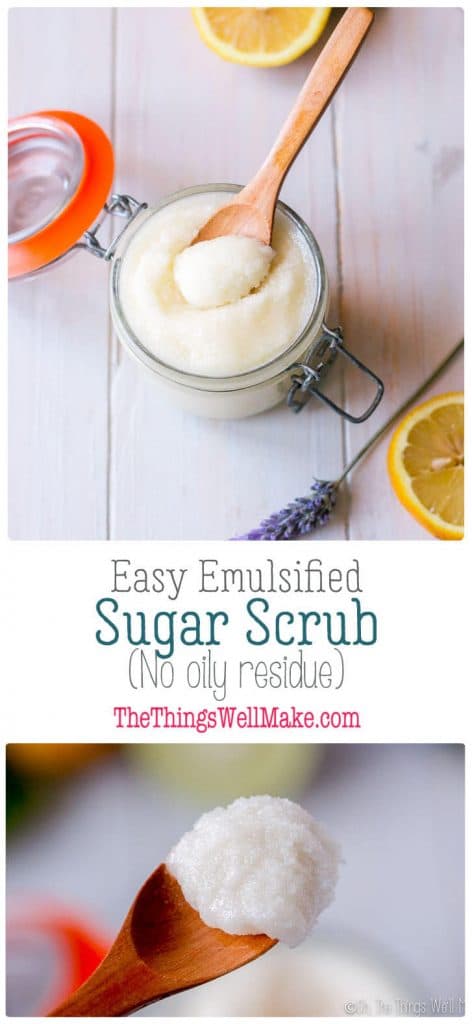
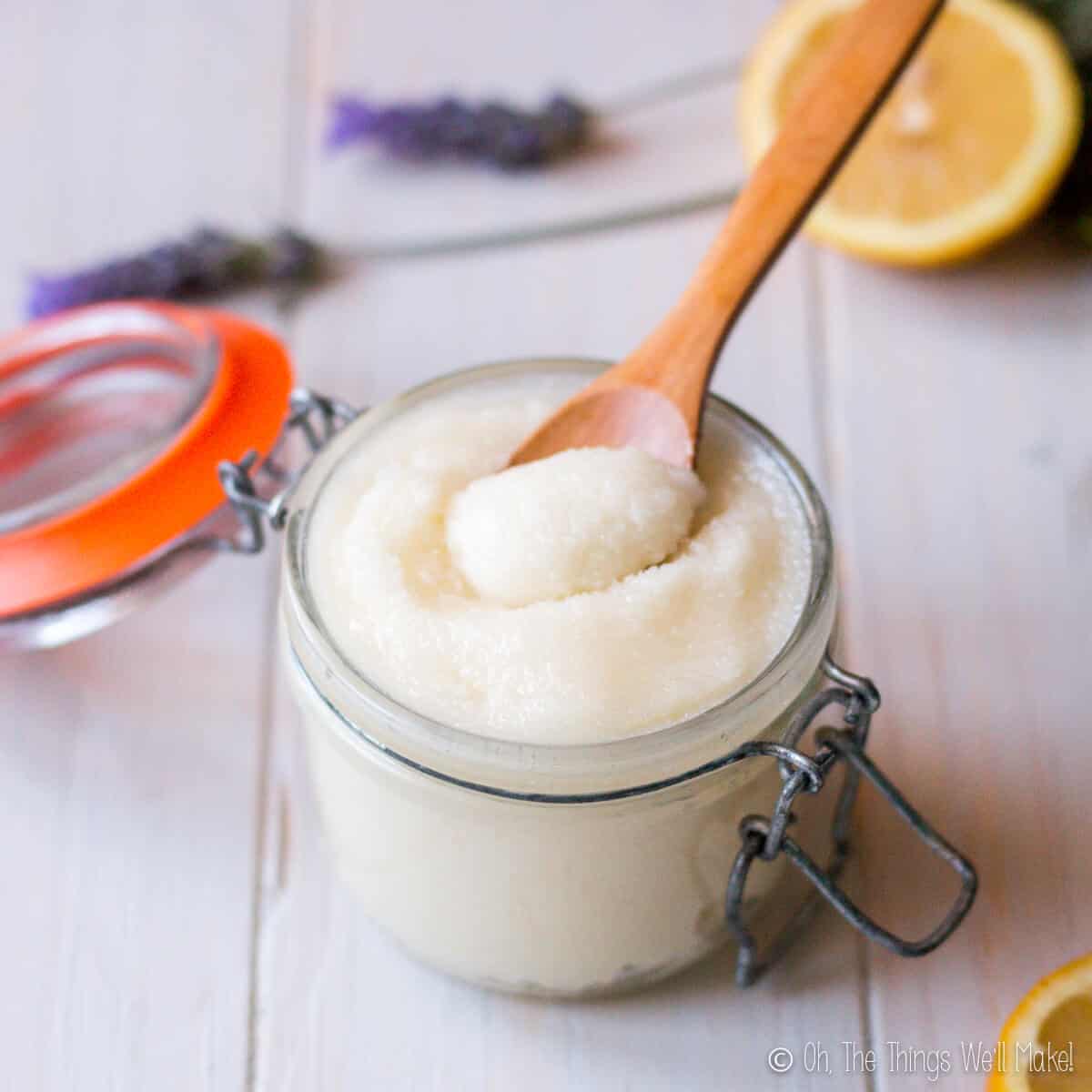
Unlike sugar scrubs made with only oils and sugar, emulsified sugar scrubs become a creamy exfoliating lotion upon contact with water, leaving no oily residue, but only soft, supple skin behind.
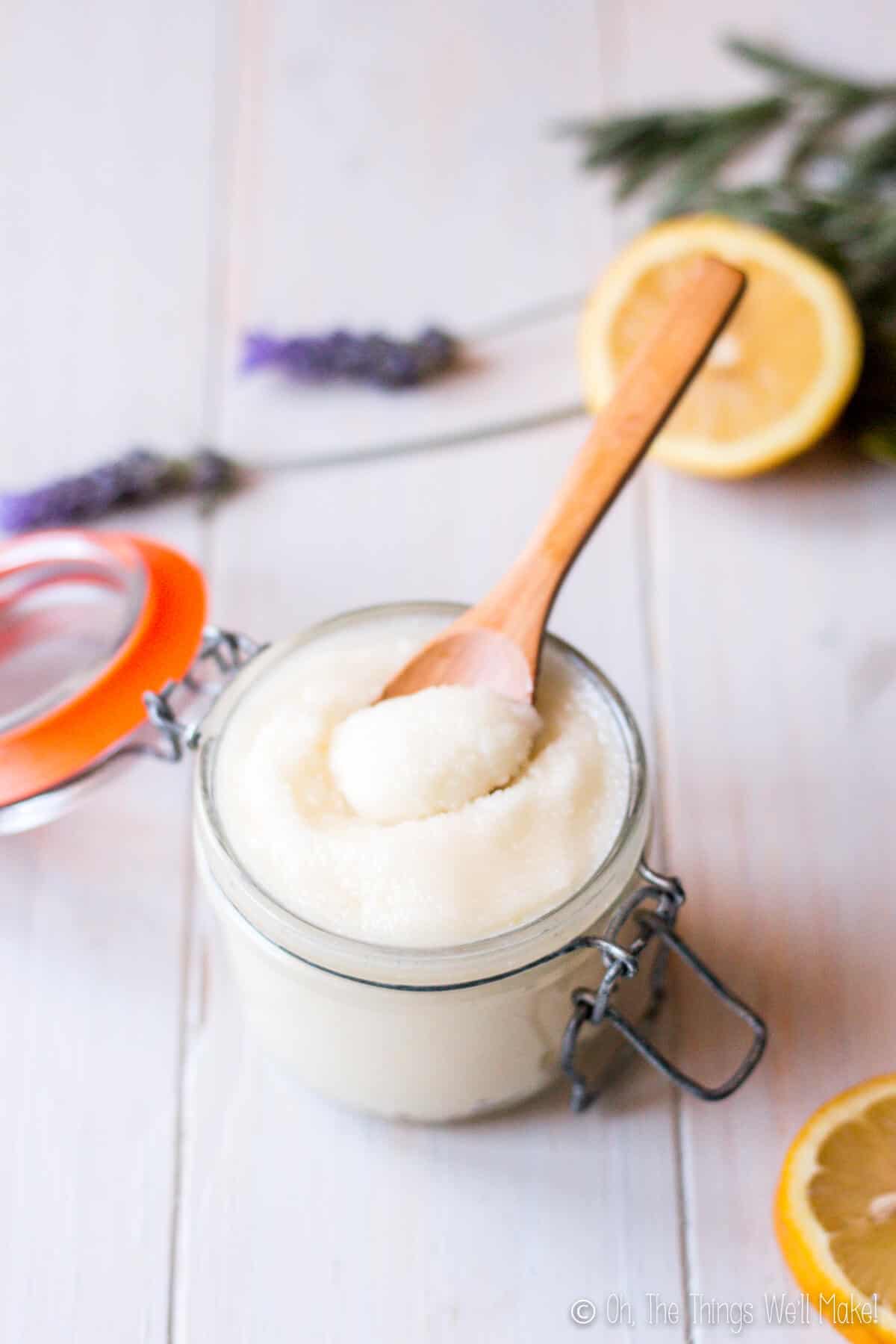
One of the most common DIY beauty products that can be found online is sugar and salt scrubs. Perhaps the main reason that these products are so popular is that they are very easy to make. Basically, you take some oil and mix it together with either sugar and salt, and you’re essentially done. Sure, you can customize your recipe with different oils, sugar types, essential oils, and/or add in other exfoliants or colorants, but most of these recipes are essentially the same.
I’m not going to criticize these recipes. In fact, one of the first DIY recipes on my blog was a brown sugar lip scrub. As you may have guessed, I mostly used it to exfoliate my lips, but also tried using it in the shower to exfoliate my skin.
The benefit of emulsified sugar scrubs
The problem with regular sugar scrubs is that they tend to be messy to use. The oil doesn’t provide a lot of structure for your product, so it’s usually hard to scoop into your hands to use in the shower. Sure, you can use coconut oil to give it more body, but as soon as the weather warms up, you’re back to a more liquid product.
You could, of course, add some butters and/or waxes to the scrub to thicken it, but we’re still left with the main problem with sugar scrubs, the oily residue. Because it’s an oil-based product, you usually end up with oil all over your hands, and body, and shower, as well as the container you’re using for your sugar scrub. I liked the smooth feeling of my legs and arms after exfoliating with my homemade sugar scrub but didn’t like the feel of the oily residue all over my body.
Emulsified sugar scrubs don’t leave that sort of oily residue behind. Because they include an emulsifier as one of their ingredients, when the oils and waxes of the product come in contact with water, they basically form an emulsion, or a lotion, on your skin while you are exfoliating away. In the end, emulsified sugar scrubs are like exfoliants and lotions in one product. You’re essentially making an exfoliating creamy cleanser right on your skin as you scrub away.
If you’re lazy like I am, and don’t like having to exfoliate, rinse, and then use lotion once out of the shower, this emulsified sugar scrub is the perfect solution. It leaves your skin clean, smooth, and lotioned up. (Is that a word?)
Watch me make this easy, emulsified sugar scrub:
Should you add a preservative to your sugar scrub?
Because this is still an oil-based product, without any water in it, you technically don’t have to add a preservative to it. The problem with not using a preservative, though, is that you use this product in a very wet environment and likely scoop it out of the jar with wet hands. The likelihood of moisture contaminating your product is very, very high.
That’s why preservatives are usually added to these types of products, and why you have to be very, very careful using it if you choose not to add a preservative. You could even consider adding less sugar and less wax to the scrub so that you end up with a thinner product that you could more easily dispense from a silicone travel tube dispenser or another type of flip cap dispenser. That would allow you to dispense the product without touching it and would help keep water from contaminating your product.
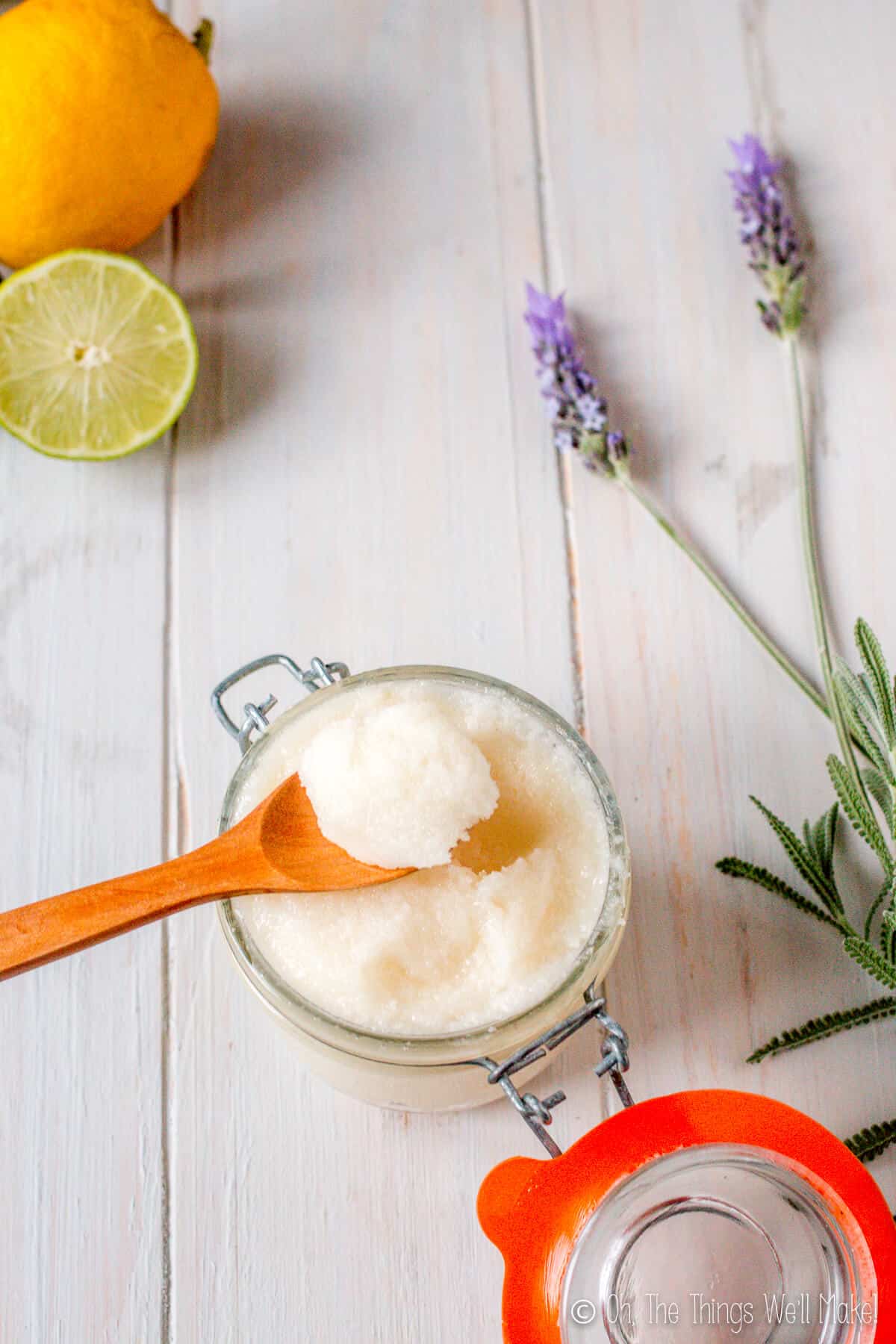
Customizing the emulsified sugar scrub
There are several ways that you can customize this recipe to better suit your taste.
Changing the exfoliant: Salt, sugar, or brown sugar?
While I made this a sugar scrub, you could just as easily add salt to the recipe instead. Salt tends to be a bit more abrasive because the granules aren’t as round and it takes longer for the salt to dissolve, but it really depends on the coarseness of whatever you choose to use. Brown sugar usually has smaller granules and tends to be a lot less abrasive, making it a great option for exfoliating your face.
How much sugar should I use?
When I first made the recipe, I used 120g of sugar and found it to be a nice texture. The next time I made it, I decided I would add more sugar, around 30g more, thinking I’d end up with a thicker scrub (and more of it). In the end, I think it may be a bit on the thick side (as you can see at the end of my video when I’m applying the scrub). It still works well, especially if you are applying it to wet skin, but is a bit harder to apply if it isn’t thinned out with a bit of water. I think somewhere between 120g-150g is a good guideline, and you can adjust the amount to achieve the consistency you prefer.
Customizing the fragrance
I used a combination of lavender, rosemary, and lemon essential oils because I tend to favor citrus herbal scents. You can change the essential oils, though, to suit your tastes. I like lavender because it is calming and soothing for relaxing after a busy day. Lemon can be both soothing or invigorating depending on what you mix it with and when you use it. I don’t normally measure out my essential oils, but use my nose to help decide how much to add.
Which emulsifying wax should you use?
You can use any emulsifying wax that you may happen to have on hand. If you make your own homemade lotions, you should already have one or two of them at home.
If you are very concerned about making a very natural emulsified sugar scrub, consider using an emulsifying wax like olivem. Olivem is a vegetable based emulsifier that is derived from olives. It is allowed in natural, organic products that use the ECO-CERT certification. Olivem is a great option for an emulsifying scrub, too, because some people say that it has a bit of a soap feel to it. In the case of a cleanser, that is more of an advantage than a disadvantage.
Basic, Easy Emulsified Sugar Scrub
Emulsified Sugar Scrub
Ingredients
- 50 g oil I used sweet almond oil
- 10 g cocoa butter
- 10 g shea butter
- 10 g beeswax or candelilla wax
- 15 g emulsifying wax Olivem is a great choice for this!
- 1 g essential oil (I used lavender, rosemary, and lemon)
- 1 g cosgard or other natural preservative used at the recommended dose
- 150 g sugar (Use less for a slightly thinner product)
Instructions
- Weigh out ad mix together the first 5 ingredients: the oil (but not essential oils), butters, and waxes.
- Melt the oils, butters, and waxes over a double boiler (or in the microwave, if you prefer).
- Once melted, remove from the heat, and stir occasionally as the mixture cools. You can use a mixer to help blend everything together and make a creamy mixture, but it’s not essential.
- Once your mixture has cooled down quite a bit (ideally below 45ºC/115ºF), you can begin to add the essential oils and preservative.
- Make sure the essential oils and preservative are well incorporated into your oils and then begin to add the sugar. Add slowly, and stir constantly, so you can gauge the consistency of the product. Add as much sugar as you like to achieve the desired consistency. (I like it somewhere between 120-150g.)
- To use your sugar scrub, scoop out a small amount in your hands and begin to rub over your wet arms and legs (or any areas you want to exfoliate and hydrate) in a circular motion. As the mixture comes into contact with the water, a lotion will be formed, and the sugar will begin to dissolve, making the product smoother and less abrasive. Rinse any remaining sugar crystals off, and pat your skin dry. Your skin should now feel smooth and hydrated.
Ok so what if i wanted my emulsified sugar scrub to foam too . What should i add. I have stephensons base lying around and it does have a preservative in . How do you think i should incorporate that into it.
Hello,
I haven’t tried incorporating any sort of cleansing surfactant into the scrub.
You’d probably have to add water if it’s some sort of cleansing base. (I looked up Stephensons, and they have a wide variety of mostly detergent based solid products.) You’d then need to heat and emulsify it with the oils.
Keep in mind that just because a product has a preservative in it doesn’t mean that you wouldn’t have to preserve your new product that has been made with it. As you add water and other ingredients, you end up with a greater quantity of product, so you’d need more preservative to preserve the new quantity made.
Again, I haven’t attempted what you’re asking for, but I think you’d have to experiment with adding the “soap”-base (in quotes because most of their soaps aren’t true soaps) to water and then emulsify everything as you would when you make lotion. I’m not sure what you’d end up with as a final product.
If you give it a shot, I’d love to hear how it goes. 🙂
Hello!
I’m so excited to have found this recipe! Thanks so much for posting! 😀
If I were to skip the preservatives (mostly because I’m new and still learning), but wanted to add some vitamin e oil as my preservative, how much would I use without changing the consistency?
Would it be best to calculate this ingredient into the initial 50 g oil suggested above?
On a separate note, I was planning to make use a couple different hydrating oils in this recipe, what combinations do you like to use and why?
I should mention my ultimate goal was to gift a DIY scrub that wont cause slipping in the tub/shower.
New and learning,
Thanks bunch!
Hi Gena,
Vitamin E is not a preservative. It’s an antioxidant that can help prevent rancidity, extending the shelf life of oils.
You can’t use it to prevent mold and bacterial growth, which is the purpose of the preservative here. Vitamin E is usually used at around 0.5% of the recipe by weight.
If you are insistent about making this without a preservative, you’ll want to look for a way to keep water out of it. You could use a spoon to scoop a small amount out of your jar and then bring only the small amount, meant for one use, into the shower with you. If you were to do that, you’d prevent water from getting in and contaminating the product.
I can’t promise that this won’t cause slipping. It will emulsify into a lotion-like consistency on your skin. While it’s not oily- it does feel like a lotion so it can make things slick.
I just made this! Added some activated charcoal and bentonite clay to the sugar before adding in. It ended up being a bit waxy, noticeable because the charcoal really stuck around, haha. If I had to guess, I would bet I had too much candelilla wax. I’ve read that I should use half the amount of wax called for if using candelilla was instead of beeswax, but of course, I didn’t do that. 😛 I didn’t want to toss the batch, so I ended up adding 1/4 c liquid coconut oil soap (made per your recipe!), and that totally cut the waxy feel and still left plenty of moisture. Next time, I’ll try with beeswax (or tinker with the amount of emulsifying wax, since I didn’t use the e wax you called for). Or just keep making a soap scrub! 😉
Hello, I love this recipe, however, my emulsifying wax isn’t 100 melting, any thought? Thank you!
Hi Bonnie,
I’ve never had that happen or heard of that happening.
What emulsifying wax are you using?
Hi, thank you for the informative article! I am wondering, how do I emulsify my scrubs without thickening them? Or, if I don’t want them to be “soapy” or “lotion-y”? Thank you so much.
Hi Laura,
I’m not sure you really can. The emulsifying process makes it thicker.
It will end up emulsifying into something like a lotion. I’m not quite sure what you are trying to achieve.
can we use geogurd ultra or bht in sugar scrub
Geogard Ultra should be fine. I’m not familiar with bht.
What about just using an amount of salt as a purifier in your sugar scrub to combat the microbes or growth of bacteria?!
Im trying to make a large batch for 10-15 people, but it will be separated into 4 or 6oz containers, & I don’t want a gift to go bad or become gross if they take a bit to use it?!?!
Hi Sandy,
This, in and of itself shouldn’t go bad. It doesn’t have water in it, so it’s just like any other sugar or salt scrub made with just oils and sugar or salt. Yes, the sugar and salt can help combat the problem of microbial growth, and the preservative is optional.
That said, it was recommended in a cosmetic formulation class I took that you add a preservative to this sort of thing anyway just because people tend to get water in them. You probably would never actually see the microbes forming because the bacteria can grow without you being able to see them. It’s likely you’d be completely fine making this without a preservative, it’s just a suggestion to be extra safe. 😉
Salt does tend to be more abrasive than sugar, so keep that in mind. They both should help against microbial formation to an extent too. 😉
I noticed you didn’t use stearic acid, any reason for that?
Hi Valerie,
I try to keep my recipes as simple and as “natural” as they can be because that is what most of my readers are looking for. Stearic acid is usually derived from palm and many of my readers take issue with that. It can be derived from animal fats, but that is harder to find, and other people still oppose that.
If it were necessary for the recipe, I’d use it anyway, but I don’t really see why you’d need it in a recipe like this one. I had a harder time formulating my shave soap recipe without stearic acid, and will likely provide an alternative, more advanced recipe for those who want a soap with a more stable and abundant lather. 😉
Hi Tracy
Thank you for sharing this
I made it yesterday
It worked fine with the 120 sugar and 30 coffee
I made the same recipe today with dried herbs and sugar
But I used the hand mixer to make it look fluffy
Unfortunately the scrub didn’t turn to be lotioney after I used it on a wet skin it turned to be so fatty when I washed my hands
I had to use a towel to take off the grease out of me
What did I do wrong
Thank you
Hi Maaza,
Sounds like you had good ideas for personalizing the recipe!
If it’s not emulsifying well on your skin, it’s probably your emulsifier.
Which one did you use?
You may need to adjust the amount used, depending upon the emulsifier.
what type of preservative do you recommend?
i also wondered if there’s a reason you recommend weighting the ingredients instead of measuring by volume. i don’t have a scale at home, and was wondering if the measurements could be reasonably converted to volume instead of mass…
thank you!
Hi Mary,
All cosmetic formulations should be done by mass. This helps to ensure you are using the right amount each time. Beeswax can come in a number of formats, and the volume will differ by the size beads (or other shape/format) used. Even with a butter, it’s very hard to measure accurately. For this sort of recipe, it’s not that big of a deal because if the amount is off, it will only change the texture of your product. With recipes with water, though, it makes a big difference. You need to be accurate when adding preservatives and such. In mine, I used a preservative known as Sharomix 705, but there are lots of different natural preservatives that you can use. (Preservative ECO, Cosgard/Geogard…) I’m planning on writing up a post about some of the available ones soon.
Small digital scales are very affordable, and if you plan on making things yourself, they are definitely something you should invest in. (All good soap and lotion recipes, for example, will be done by weight.)
Hi there! I came across this post while looking for a sugar scrub that wont make me slip and slide all over the tub! Forgive me if it is written in the questions above, but does this indeed cut down or eliminate all the slipping and sliding? I’m going to purchase the ingredients needed and just wanted to make sure before I bought the butters and emulsifier. I would like to put this in silicone tubes to eliminate the need of a preservative!
Thanks for the post.
Hi Chris,
Yes, it should cut down on that, at least. It still may lead to a bit of slippage because it does turn into a lotion like consistency and may leave some residue when you rinse it. We have a marble tiled floor in our bathroom and I haven’t noticed it leaving a slippery floor, but I do feel like my arms and leg (or face 😉 ) have lotion left on them. I have found that I don’t like “normal” sugar scrubs much, though, and those do leave an oily residue everywhere!
If you’re going to use a silicone tube, I’d suggest making the mixture a bit more liquidy so that you can more easily dispense it from the tube. You can do that by either adding a bit more oil, or reducing the amount of solid ingredients (waxes, butters, or even the amount of sugar you add) slightly. You may have to experiment a bit. (You could start out testing with just using a bit less sugar.)
Hello ma’am, my question is if it’s possible for me to skip the use of bees wax?
Probably- it should just make a bit thinner product, but so many people are content making sugar scrubs just using oil and sugar, so it should be fine. 😉
It will just change the texture somewhat. If you are opposed to beeswax but want to keep the texture of mine, candelilla wax is a good substitute.
Thanks so much! can’t wait to make this : )