

Easy Emulsified Sugar Scrub
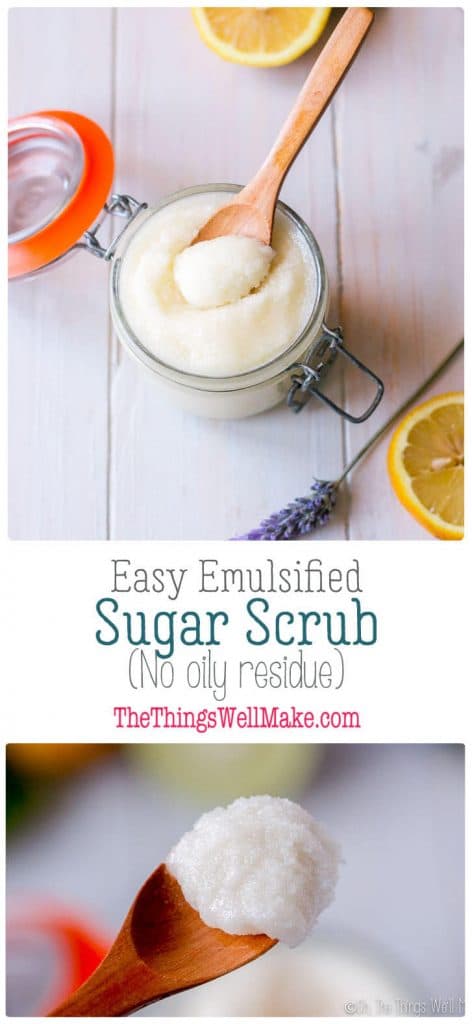
Unlike sugar scrubs made with only oils and sugar, emulsified sugar scrubs become a creamy exfoliating lotion upon contact with water, leaving no oily residue, but only soft, supple skin behind.
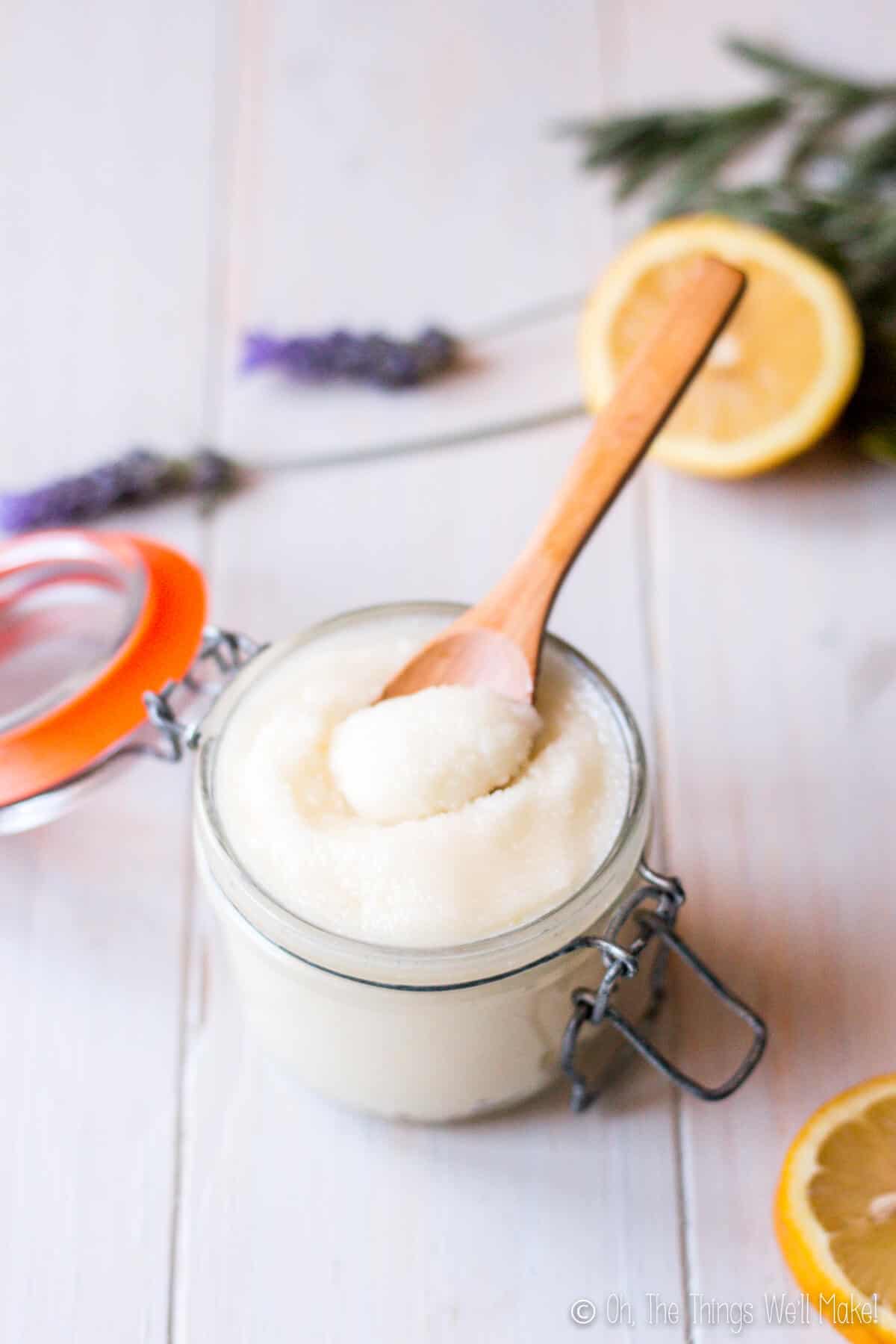
One of the most common DIY beauty products that can be found online is sugar and salt scrubs. Perhaps the main reason that these products are so popular is that they are very easy to make. Basically, you take some oil and mix it together with either sugar and salt, and you’re essentially done. Sure, you can customize your recipe with different oils, sugar types, essential oils, and/or add in other exfoliants or colorants, but most of these recipes are essentially the same.
I’m not going to criticize these recipes. In fact, one of the first DIY recipes on my blog was a brown sugar lip scrub. As you may have guessed, I mostly used it to exfoliate my lips, but also tried using it in the shower to exfoliate my skin.
The benefit of emulsified sugar scrubs
The problem with regular sugar scrubs is that they tend to be messy to use. The oil doesn’t provide a lot of structure for your product, so it’s usually hard to scoop into your hands to use in the shower. Sure, you can use coconut oil to give it more body, but as soon as the weather warms up, you’re back to a more liquid product.
You could, of course, add some butters and/or waxes to the scrub to thicken it, but we’re still left with the main problem with sugar scrubs, the oily residue. Because it’s an oil-based product, you usually end up with oil all over your hands, and body, and shower, as well as the container you’re using for your sugar scrub. I liked the smooth feeling of my legs and arms after exfoliating with my homemade sugar scrub but didn’t like the feel of the oily residue all over my body.
Emulsified sugar scrubs don’t leave that sort of oily residue behind. Because they include an emulsifier as one of their ingredients, when the oils and waxes of the product come in contact with water, they basically form an emulsion, or a lotion, on your skin while you are exfoliating away. In the end, emulsified sugar scrubs are like exfoliants and lotions in one product. You’re essentially making an exfoliating creamy cleanser right on your skin as you scrub away.
If you’re lazy like I am, and don’t like having to exfoliate, rinse, and then use lotion once out of the shower, this emulsified sugar scrub is the perfect solution. It leaves your skin clean, smooth, and lotioned up. (Is that a word?)
Watch me make this easy, emulsified sugar scrub:
Should you add a preservative to your sugar scrub?
Because this is still an oil-based product, without any water in it, you technically don’t have to add a preservative to it. The problem with not using a preservative, though, is that you use this product in a very wet environment and likely scoop it out of the jar with wet hands. The likelihood of moisture contaminating your product is very, very high.
That’s why preservatives are usually added to these types of products, and why you have to be very, very careful using it if you choose not to add a preservative. You could even consider adding less sugar and less wax to the scrub so that you end up with a thinner product that you could more easily dispense from a silicone travel tube dispenser or another type of flip cap dispenser. That would allow you to dispense the product without touching it and would help keep water from contaminating your product.
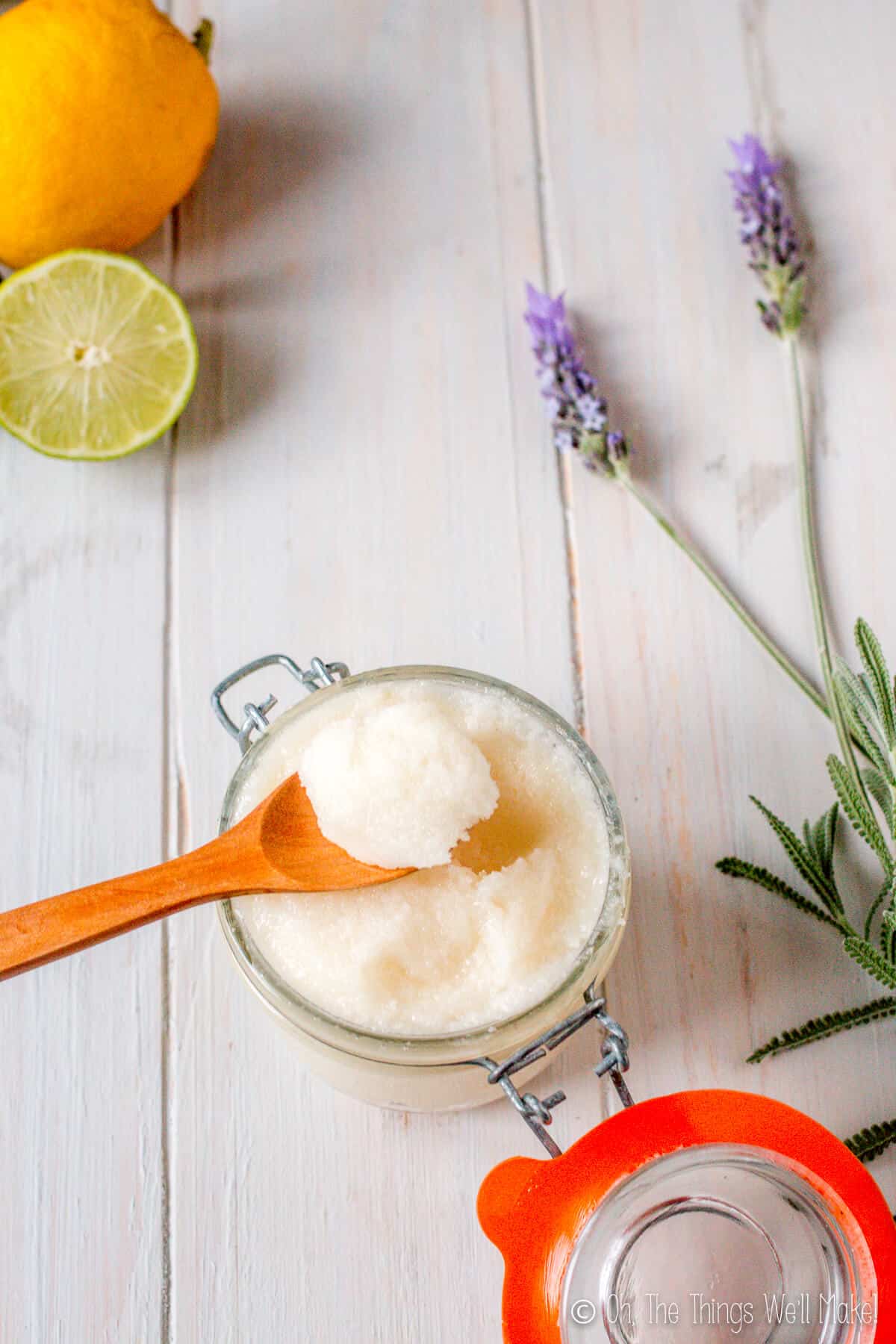
Customizing the emulsified sugar scrub
There are several ways that you can customize this recipe to better suit your taste.
Changing the exfoliant: Salt, sugar, or brown sugar?
While I made this a sugar scrub, you could just as easily add salt to the recipe instead. Salt tends to be a bit more abrasive because the granules aren’t as round and it takes longer for the salt to dissolve, but it really depends on the coarseness of whatever you choose to use. Brown sugar usually has smaller granules and tends to be a lot less abrasive, making it a great option for exfoliating your face.
How much sugar should I use?
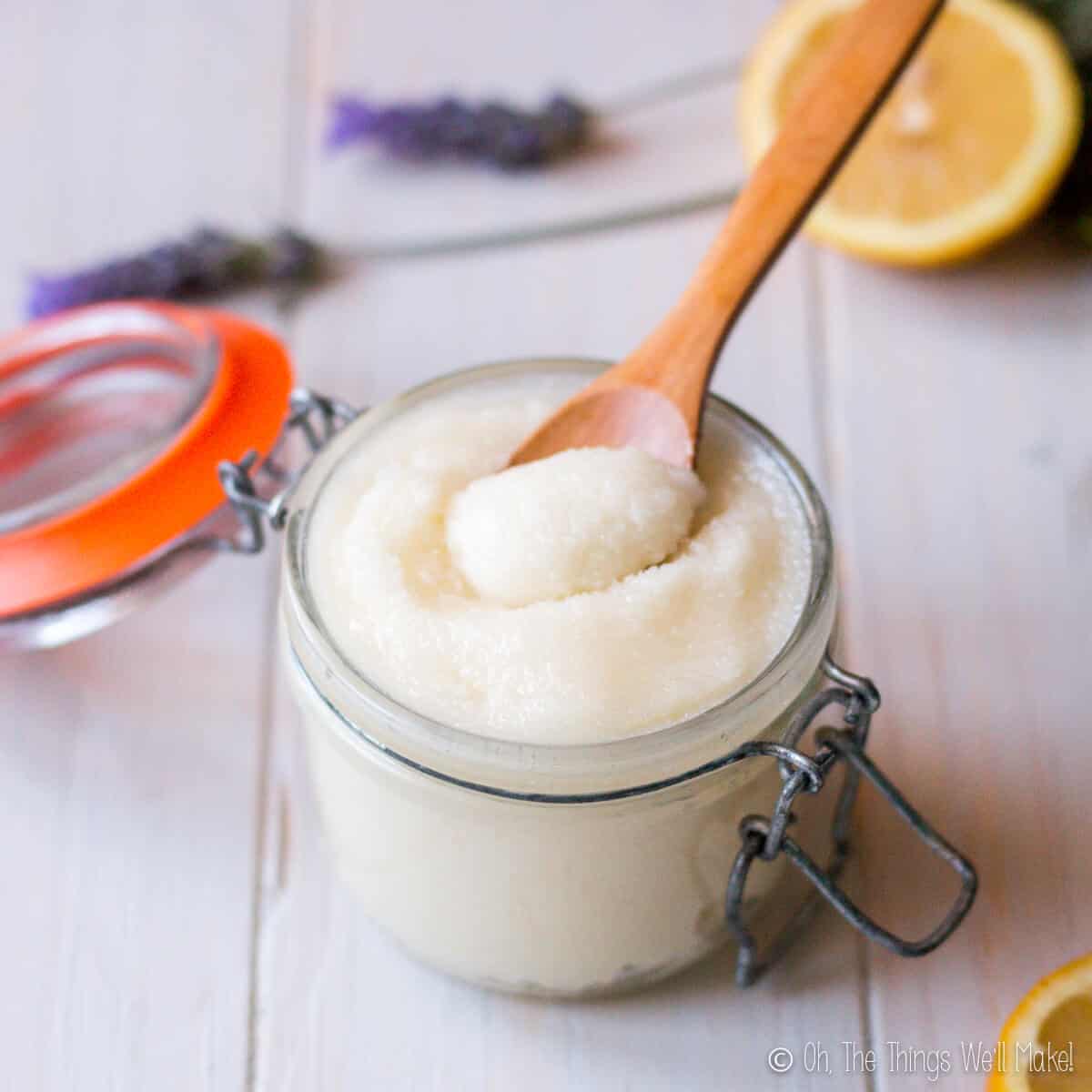
When I first made the recipe, I used 120g of sugar and found it to be a nice texture. The next time I made it, I decided I would add more sugar, around 30g more, thinking I’d end up with a thicker scrub (and more of it). In the end, I think it may be a bit on the thick side (as you can see at the end of my video when I’m applying the scrub). It still works well, especially if you are applying it to wet skin, but is a bit harder to apply if it isn’t thinned out with a bit of water. I think somewhere between 120g-150g is a good guideline, and you can adjust the amount to achieve the consistency you prefer.
Customizing the fragrance
I used a combination of lavender, rosemary, and lemon essential oils because I tend to favor citrus herbal scents. You can change the essential oils, though, to suit your tastes. I like lavender because it is calming and soothing for relaxing after a busy day. Lemon can be both soothing or invigorating depending on what you mix it with and when you use it. I don’t normally measure out my essential oils, but use my nose to help decide how much to add.
Which emulsifying wax should you use?
You can use any emulsifying wax that you may happen to have on hand. If you make your own homemade lotions, you should already have one or two of them at home.
If you are very concerned about making a very natural emulsified sugar scrub, consider using an emulsifying wax like olivem. Olivem is a vegetable based emulsifier that is derived from olives. It is allowed in natural, organic products that use the ECO-CERT certification. Olivem is a great option for an emulsifying scrub, too, because some people say that it has a bit of a soap feel to it. In the case of a cleanser, that is more of an advantage than a disadvantage.
Basic, Easy Emulsified Sugar Scrub
Emulsified Sugar Scrub
Ingredients
- 50 g oil I used sweet almond oil
- 10 g cocoa butter
- 10 g shea butter
- 10 g beeswax or candelilla wax
- 15 g emulsifying wax Olivem is a great choice for this!
- 1 g essential oil (I used lavender, rosemary, and lemon)
- 1 g cosgard or other natural preservative used at the recommended dose
- 150 g sugar (Use less for a slightly thinner product)
Instructions
- Weigh out ad mix together the first 5 ingredients: the oil (but not essential oils), butters, and waxes.
- Melt the oils, butters, and waxes over a double boiler (or in the microwave, if you prefer).
- Once melted, remove from the heat, and stir occasionally as the mixture cools. You can use a mixer to help blend everything together and make a creamy mixture, but it’s not essential.
- Once your mixture has cooled down quite a bit (ideally below 45ºC/115ºF), you can begin to add the essential oils and preservative.
- Make sure the essential oils and preservative are well incorporated into your oils and then begin to add the sugar. Add slowly, and stir constantly, so you can gauge the consistency of the product. Add as much sugar as you like to achieve the desired consistency. (I like it somewhere between 120-150g.)
- To use your sugar scrub, scoop out a small amount in your hands and begin to rub over your wet arms and legs (or any areas you want to exfoliate and hydrate) in a circular motion. As the mixture comes into contact with the water, a lotion will be formed, and the sugar will begin to dissolve, making the product smoother and less abrasive. Rinse any remaining sugar crystals off, and pat your skin dry. Your skin should now feel smooth and hydrated.
Thank you for this wonderful recipe! I’m going to make this for my husband who has very dry winter skin. Can you please share the formula for making the scrub consistency to be used in a squeeze bottle/tube dispenser? Thank you so much!
Hi Laura,
I haven’t tried this yet, but if you want to dispense it from a tube, you’d want to lower the amount added of the more solid ingredients. Even by lowering the amount of sugar you add should help! You could either lower the amount of wax or increase the oil amount slightly.
I can try to make a more liquidy version next time to update with an alternative for those who want to use the tube dispensers, but for now, I haven’t personally done it so I can’t tell you a precise ratio.
I was wondering: if I made your recipe as directed, and was going to give it as a gift, do you know how long of a shelf life the scrub would have? It sounds like it would be a great product and fun gift to give.
Hi Julie,
It would be a wonderful gift!
The shelf life should be around the same as the ingredients you are using (the oils and butters).
Of course if the person using it were to get lots of water into the container, the shelf life would be reduced. (But, that’s why I suggest adding the preservative. While it’s not strictly necessary, it is a good idea because this can be contaminated with water.)
Tracy, thanks for getting back to me so quickly, I appreciate your hlep! I’m excited to try and make a batch!
Can i replace the beeswax with soy?? And is it ok if I use only cocoa butter if tats what I have on hand :):) can I add crushed rose petals to this ? Sorry for asking so many questions ! First time making this ?
Hi Devi,
Yes, you can make these sorts of substitutions, but they may change the texture somewhat. So, I’m not sure about how soy and beeswax compare in hardness, but if you’re adding in a harder substance you may want to either add less of it or add more liquid oil to make up for that change. The same goes for the cocoa butter. Cocoa butter is quite hard- much harder than something like shea butter, so you’d need to account for that difference if you don’t want to make a mixture that ends up being too solid. You can add a bit more liquid oil to compensate for that.
As for the crushed rose petals, yes, you could add something like that. You’d probably want to add dried petals because fresh ones will add moisture to the product. If you were to add fresh petals, you’d need to add a preservative for sure! Keep in mind that either way, the rose petals can be a source of bacteria or mold formation. I’d make sure you used a preservative either way when using them, and trying to keep water out of your scrub.
I accidentally purchased shea butter glycerin soap….can I still use this in place of the shea butter?
Hi Melanie,
No, I’m sorry. Shea butter and shea butter soap have completely different consistencies and properties. You could exchange it for another butter, though, like mango butter or illipe butter. (Cocoa butter could also work, but as it’s a much harder butter, you’d want to use less and use more liquid oil so that the scrub isn’t too hard.)
How much does this make?
Hi Jane,
It really depends on how much sugar you add to it.
You end up with around 100g of the emulsified oils. That will be slightly over 100ml.
Then, depending on how much sugar you add, you’ll get more or less scrub.
Hi,
was wondering if I could add Castile soap to this recipe to add a bit of foam ,
and if so how much would I add?
Thanks
Hi Diana,
I haven’t tried anything like that and am not quite sure what would happen, especially with this being such an oily product.
Usually oils will lower the effectiveness of the soap, but, of course, you aren’t looking for the soap cleansing to be the main action.
I guess it’s all about experimentation. Adding the soap will probably start the emulsification because it has water. I’m really not sure what the result would be.
I’d love to hear how it goes if you do try it.
Do you have any recipes for a non greasy body butter?
Hi Charlene,
I do have a couple I’ve been experimenting with. I haven’t posted any yet, though.
I’ve found that adding a bit of arrowroot powder or some other starch will greatly help with the greasy texture. Of course, the least greasy option is to make a lotion instead, but, of course, that means needing an emulsifier and preservative again.
If you stick with me, I will be posting one soon. 😉
Hi ,I want to start to sell body scrubs and body Butters. How to keep them natural without adding chemical preservatives
Hi Imago,
Products that don’t have water in them don’t necessarily need a preservative. I don’t use a preservative in body butters.
In this case, you don’t “need” to use one, but you have to keep in mind that most people will be using them in the shower and they will likely contaminate the product with water by dipping their wet hands into it. This allows for microbes to grow.
That’s why it is recommended that you add preservatives to sugar scrubs.
If you can find a way to dispense the product without contaminating it with water (Like a silicone tube or something like that), then you could get away without using the preservative. If it’s in a jar, though, I think it’s best to add the preservative.
There are many natural preservatives available on the market these days. Just because you are using a preservative doesn’t mean your product is no longer “natural.” I’d say, though, that safe should trump “natural” always!
Hi! How much scrub does this recipe produce? Thanks!
Hi Shannon,
It depends on how much sugar you add, but I was able to fit most of mine into a 200ml glass jar (the one in the pictures). I think I did use a little of it first- for trying it out and making the video, and the jar was pretty full so if you add a lot of sugar, you may not be able to fit it into a 200ml recipient.
What does the bees wax do? Is it a must?
Hi Amy,
The beeswax gives the oils a bit more consistency, but no, it’s definitely not a must, especially if you are using a lot of sugar.
In any case, the basic sugar scrubs that don’t use emulsifying wax, only use oils, so they aren’t as thick either. It’s all a matter of preference. 🙂
Some of the ingredients in the emulsifying wax you recommended are known to cause cancer. I wouldn’t suggest making this recipe at least with that wax
Hi Marina,
You can make this recipe with any emulsifying wax that you choose.
I had studied the linked to emulsifying wax at the time of linking to it long ago. (While the recipe is new, all of the same ingredients of my various recipes link to the same place. So, if I had linked to “emulsifying wax” in another recipe a long time ago, and I now use emulsifying wax again, they will link to the same wax I chose long ago.)
When I chose that wax, I had chosen it because it was vegetable based, didn’t have GMO’s and none of the ingredients had a rating higher than 3 on the EWG Skin Deep database. That said, I have become a bit more strict about what I use myself, too, and try to avoid products with polysorbates and PEG’s whenever possible. That is much easier said than done, though, and you’ll find that a lot of the emulsifying waxes will have them, but they will be hidden, even from their ingredient list.
I have switched the link out to Olivem because I think that Olivem would work wonderfully in this recipe. It’s an emulsifier that some say gives a bit of a soapy feel, which makes it a great emulsifying wax for cleansers of all types.
I should add to that that none of the ingredients in that emulsifying wax have been shown to cause cancer and the EWG doesn’t have them listed as a cancer risk. I am very careful about the products that I link to. I am aware, though, that some people are going to be pickier than others. That’s why I usually explain why I’ve used the ingredients that I have used, so you will understand better how to switch the ingredients and personalize the recipe. The whole beauty of making something yourself is that you control the ingredients.