
Natural DIY Clarifying Shampoo
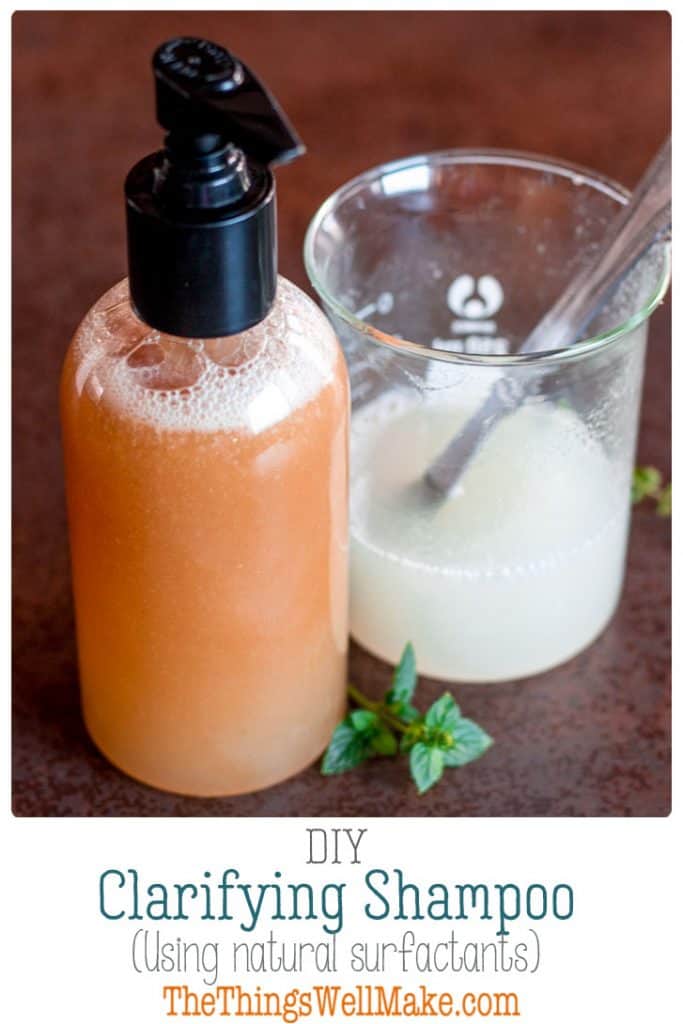
Cleanse your hair gently with this DIY clarifying shampoo that uses natural surfactants to remove dirt and leave your hair clean and soft.
Because many of you have found me through my soap recipes (like my liquid Castile soap or my easy beginner soap), I often get requests for a soap-based shampoo. While I love making soap, I never use soap for my hair because it leaves my hair dry and unmanageable. Some people are able to cleanse their hair with Castile soap and are quite happy with it, but I’m not one of those people.
Why not use liquid Castile soap?
I’m not alone, though. Castile soap isn’t an ideal shampoo for hair because the pH of soap is high yet our hair and scalp have a more acidic pH. Not only can an alkaline shampoo increase the negative charge in the hair making the hair more prone to friction and damage, but it can also be irritating to your scalp.
In an attempt to remedy this issue, most people who wash their hair with soap or soap-based “shampoos” will follow it up with a vinegar rinse to lower the pH again. Not everybody reacts well to vinegar rinses either. I, again, am one of those people and I don’t like the feel of my hair after a vinegar rinse.
Choose natural surfactants
You want a “natural” alternative, but soap may not be the best option. So what’s left?
Natural surfactants, of course!
Surfactants have a bit of a bad rap. It’s partly because harsher surfactants like SLS Sodium Lauryl Sulfate and Sodium Laureth Sulfate can be found in just about every conventional product at the supermarket. It can be found in everything from household cleaners to shampoos, shower gels, and even toothpaste! (You can make your own toothpaste sans SLS, too!)
I’m actually not even an SLS hater, to be honest. (Shocked?) I use it in my homemade version of Dr. Bronner’s Sal Suds just like they do (I’ll share my recipe soon!), but I reserve it for general cleaning around the house. For my skin and hair, I choose milder, more natural surfactants instead!
With time, more natural surfactants are being developed to meet consumer demands! I wrote more about them and shared a list of some of my favorites in my post about working with natural surfactants! (If you aren’t familiar with natural surfactants, I recommend reading that post as a great starting point for making your own homemade products!)
Who is this shampoo best for?
Because this is a fairly gentle shampoo, it should work well with most, if not all, hair types.
Those who follow the curly girl method for developing waves or curls and keeping their hair hydrated can use this shampoo as a “low poo” alternative. (No, I didn’t come up with that term.) It makes a good starting point for beginning the process and for occasional washings when normally using co-wash.
You can use it as often as works best for your hair. I have been developing my natural waviness over the last few years by rarely using shampoos and sticking to very gentle ones when I do. I usually use this shampoo around once a week and for my other “washing,” I either co-wash with my homemade conditioner or I use a DIY conditioning shampoo. (Yet another recipe that I’ll be sharing with you shortly!)
Why make your own clarifying shampoo?
It’s very difficult these days to find shampoos free of harsher surfactants like SLS. When you make your own shampoo, you can control which surfactants you use.
Many shampoos also have other ingredients that may not be right for your hair. They may contain non-water soluble silicones, harsh preservatives, and artificial fragrances.
Customizing your DIY clarifying shampoo
What it comes down to, though, is that when you make a product, you can control the ingredients and customize the recipe to suit your needs. While most of us aren’t that in tune to our hair and will use just about any shampoo that doesn’t have harmful ingredients, those that are doing processes like the curly girl method to maintain perfectly hydrated curls and waves are often very in tune to what their hair needs in terms of vitamins and proteins. Your hair may show more need for protein, for example, so you can adjust the amount you add to your hair care products. Looking for a shampoo without protein, you can make it without too! Making your own shampoo allows you to fine tune it to perfectly suit your hair from batch to batch.
Vitamins and Proteins
In this shampoo, I chose to use d-panthenol (provitamin B5) to help nourish the hair, but you could also add some hydrolyzed wheat protein or silk protein to give your hair extra nutrients. (Just use the suggested range for each particular ingredients, as suggested by the supplier, and exchange any water-soluble additions for part of the water in the recipe.)
Distilled water or floral waters
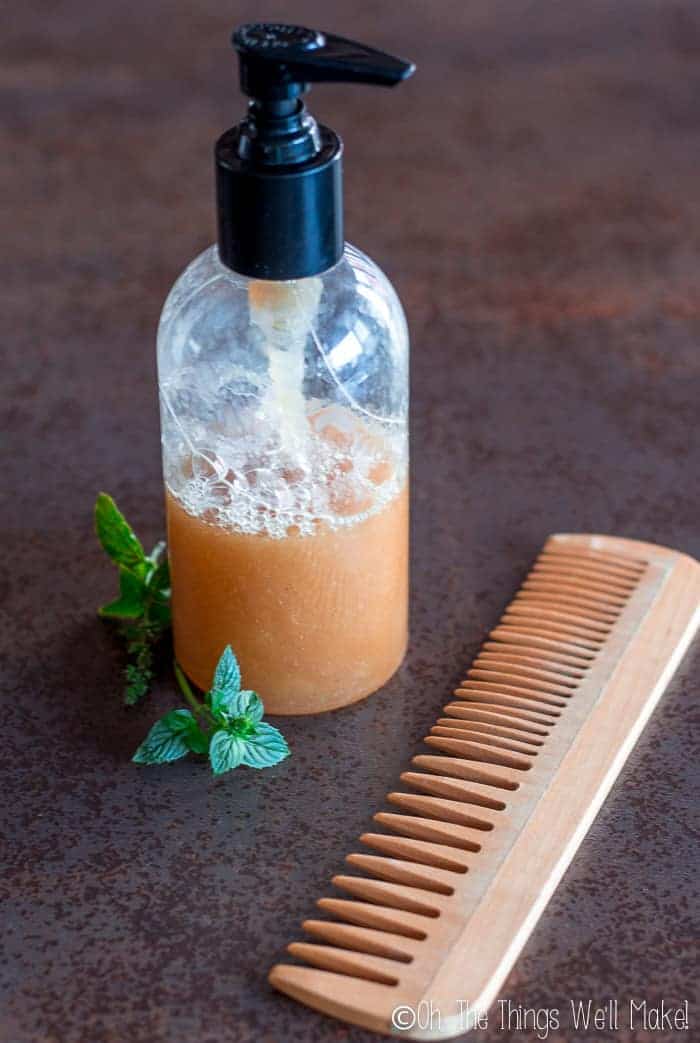
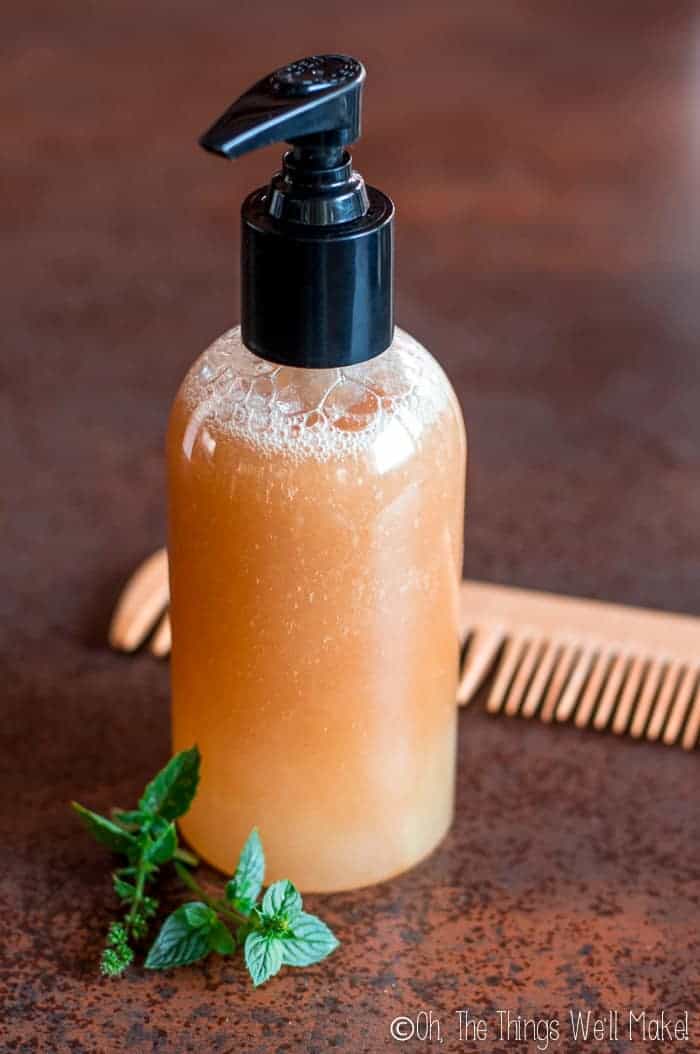
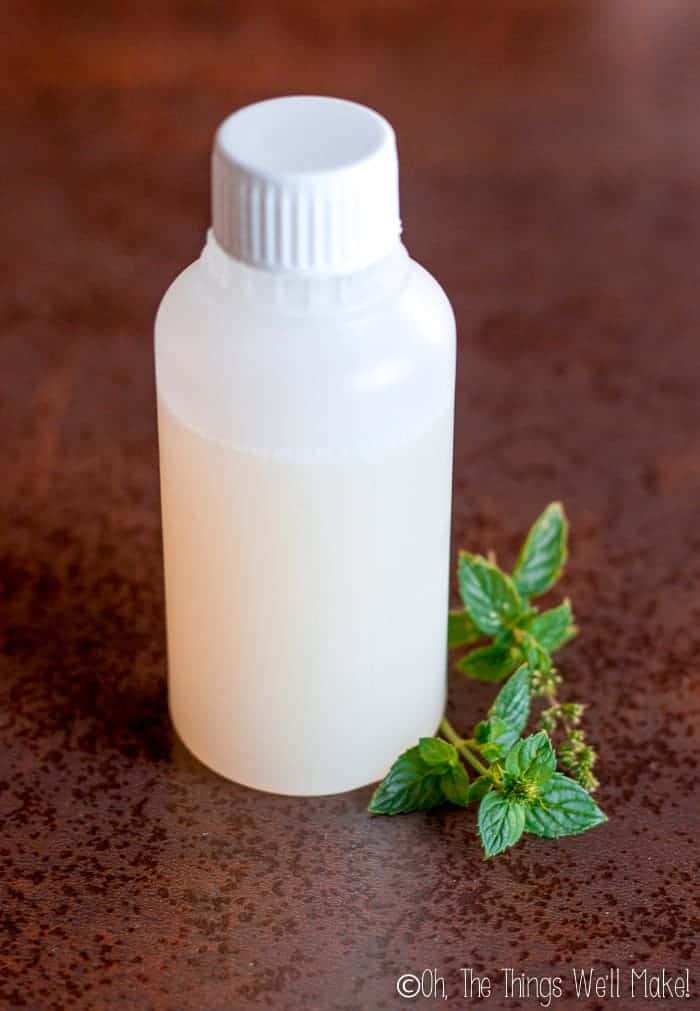
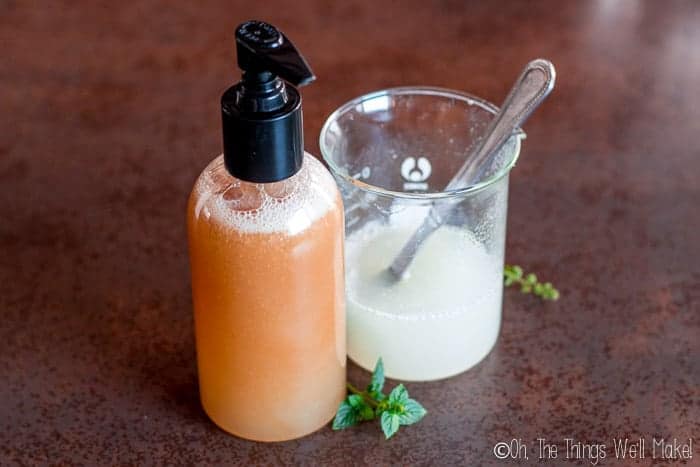
In the shampoo in the photos, I actually used an infusion of peppermint leaves in distilled water as the water component of the recipe. I like mint for shampoos because it leaves your scalp feeling nice and refreshed, and just feels clean to me. That refreshing feeling is said to help stimulate the circulation in the scalp and may help stimulate hair growth.
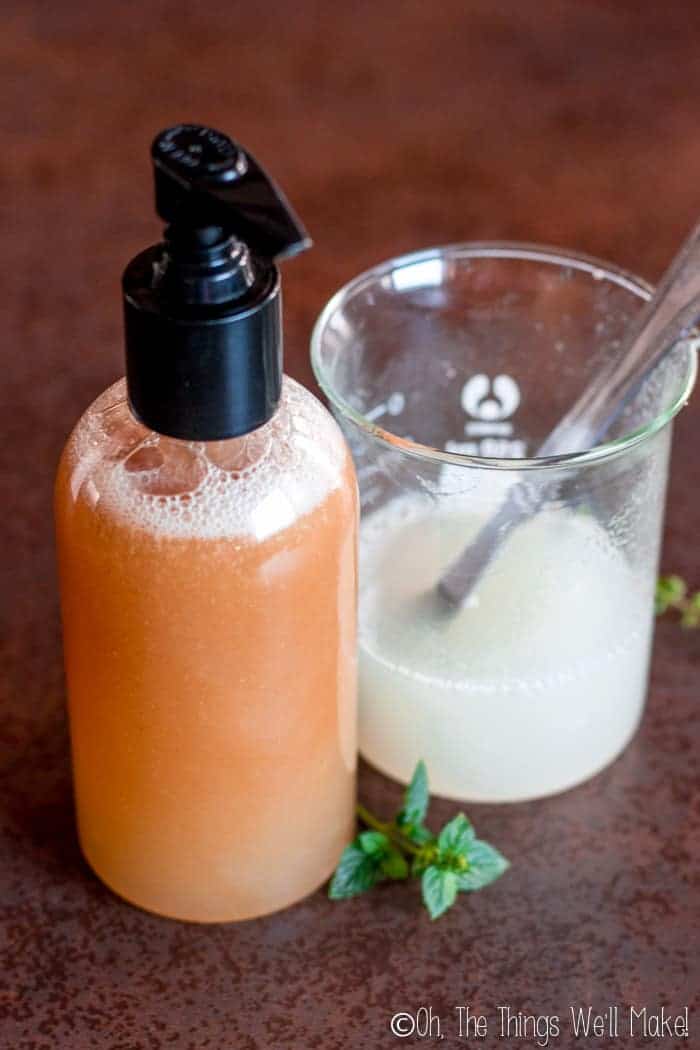
Prefer to use a floral water or some other infusion? Go for it. It’s your shampoo. Nettle tea would also make a good base as nettle is also said to be great to help fight hair loss. You could have the best of both worlds by using a nettle infusion and some peppermint essential oils.
The surfactants
You can experiment by changing up some of the surfactants in this shampoo. I used a mix of non-ionic surfactants (coco glucoside and decyl glucoside) as well as an amphoteric surfactant (coco betaine) to help boost the foaming. Because my husband likes a lot of lather to his shampoo, and I’m not using any of the harsher anionic surfactants like SLS, I’m using a relatively high percentage of surfactants in this recipe. You can reduce the percentage of surfactants added to make for an even gentler shampoo, but you will probably find that it will also lather a bit less.
Natural DIY Clarifying Shampoo
DIY Clarifying Shampoo
Materials
- 88 g distilled water (or infusion, or floral water)
- 40 g coco betaine
- 25 g coco glucoside
- 25 g decyl glucoside
- 10 g glycerin
- 2 g xanthan gum
- 4 g d-panthenol
- 2 g peppermint essential oil or other essential oils of choice
- 2 g preservative (use the recommended amount for your preservative)
Instructions
- Mix the xanthan gum into the glycerin until fully incorporated. This helps prevent clumping later on when it’s added to the rest of the shampoo.
- Once the xanthan gum is fully incorporated, begin adding the remaining ingredients, stirring gently as you go. Avoid mixing too vigorously, as this can create excess foam and make the shampoo harder to work with.
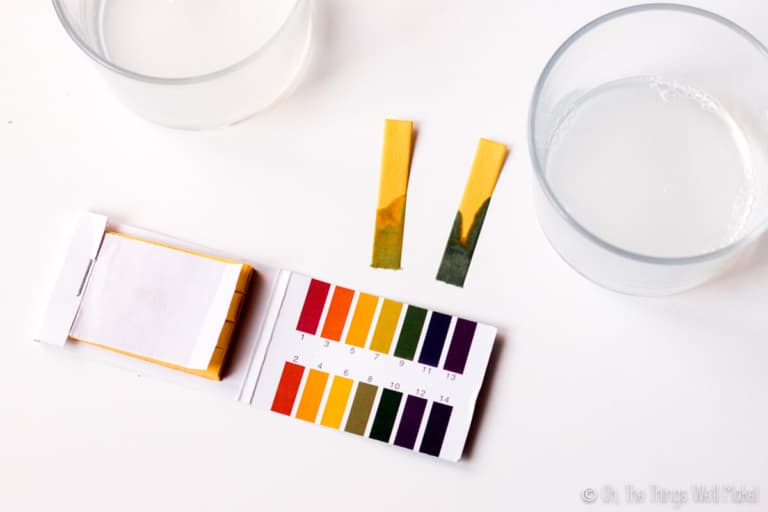
- Once everything is fully mixed, check the pH using a test strip. You want it to fall within a slightly acidic range, ideally around pH 4–5.5, and to be compatible with the preservative you’re using.
- If needed, adjust the pH with a few drops of lactic acid to lower it, or a small amount of baking soda or sodium hydroxide (lye) to raise it. Once it’s where you want it, the shampoo is ready to bottle and use.
hi~ thank you for amazing recipe. what is a substitute for xanthan gum and coco glucoside? they are so hard to find.
Hi Nauhie,
If you can’t find xanthan gum, you’ll want to try to find some other thickener like guar gum or something similar. That will work to thicken the shampoo so that it can be more easily applied.
As for the coco glucoside, it can be substituted with another glucoside like lauryl glucoside or decyl glucoside.
What is the shelf life for this product? How would I extend shelf life? What preservatives would I use and where would I find them?
Hi Taylor,
The shelf life will depend upon the preservative used, but I always recommend making only enough to use it up within 3 months. Professional formulators have their products tested for microbes and are usually very careful about hygiene to extend the life of their products.
Because we won’t normally be testing our homemade products, it’s best to err on the side of caution and only make a few months worth.
I have more information about preservatives in my Beginner’s Guide to Natural Preservatives.
Hi Tracy!
Thank you very much for this DIY shampoo!
I do not have decyl glucoside, I only have Coco betaine, coco glucoside, SCI, SCS and SLsa. Do you think I can make some liquid shampoo with these ingredients?
Homemade clarifying shampoos are best to leave hair soft, supple, and moisturized, without negative effects on hair color and this is why I love them. Thank you for sharing the DIY shampoo tips.
This looks amazing!
I wanted to ask: what can I change to formulate it more as an anti-dandruff shampoo (or anti-fungal)?
I’m trying to minimize my waste by making my own products, but shampoos are harder with skin conditions… (also changing the shampoo bar to be anti-dandruff can work for me).
Thank you so much!
Your blog has been super helpful 😀
Hi Nimrod,
I’d have to do more investigation. I know there are some essential oils that can help prevent dandruff. There may be other additives like adding zinc somehow, but I’d really have to look into how it could be done. I’m not really sure.
Hi Tracy, thanks so much for your generosity in sharing this recipe! Is there any reason I shouldn’t substitute the coco glucoside with caprylyl/capryl glucoside surfactant? Also, should I add polysorbate 80 for the essential oils? Much appreciated!
Hi Bronwyn,
I’ve never seen or tried capryl glucoside, but it looks to be very similar to coco glucoside, so it should work! If you give it a shot, I’d love to hear how it goes!
Great article! Another new recipe/ingredients for homemade shampoo, I never tried this surfactant, and I’m not familiar with it. Can it be purchased over the counter? I use Castile soap together with the other ingredients which I found here https://juvetress.com/shampoo-recipes/ it’s a safe combination with the other essential oils, and it works to me, I want to explore the other suggests ingredients so I can recommend it with my friends too. Anyway, thank you for sharing your article.
Hi Angel,
Yes, you can find the various surfactants pretty easily online. It’s harder to find them in local shops.
I recently started washing my hair with a recipe of 1 tablespoon baking soda in 1 cup water. And a conditioner of 1 teaspoon apple cider vinegar to 1 cup water.
It seems to do a great job. Is there any problem with using simple recipes like this for the hair & scalp?
Hi Charles,
If it works well for you, feel free to continue with it.
The problem is that the high pH of baking soda will damage most people’s hair. If your hair is short or thick, you may never notice the problem even if you have it. If you were to want to grow out your hair or if you have fine hair, eventually you would probably notice that your hair becomes brittle and dry.
I was never able to use either baking soda nor vinegar on my hair. It left my hair feeling strange. I did better only washing with water, which I did try for a while.
Nowadays, I feel my hair is the healthiest it’s ever been using my homemade shampoos and conditioners.
How do you figure out how much preservative you need?
Are you asking Charles about the vinegar or baking soda? They have extreme pH’s and don’t really need a preservative. (You can read a lot more about preservatives in general in my beginner’s guide to natural preservatives.)
It is very harsh with time on your hair vinger and baking soda too tough
Hi,Tracy
i NEVER comment on blogs but just when i was about to give up, i found this recipe! you are a life saver and look forward to letting you know how it went! quick question is this possible to convert this recipe for a shampoo bar? i know the bars call for SCI and im aware of its mildness but im so in love withi this im hoping you wil say yes. bless you truly.
Hello!
Thank you! ?
The problem is that you need to use solid surfactants to make a solid shampoo bar. I have a recipe up for a shampoo bar, but, of course, it also calls for SCI. I used the SCI in conjunction with SLSA, another solid surfactant. Both are mild, but they are different than the liquid surfactants.
I just don’t know of any way to use liquid surfactants to make a shampoo bar.
Have you tried one of the bars? I actually quite like them, and I’m pretty picky about what I use for my hair. I don’t use it very often- like once a week- and then clean my hair with only a conditioner between shampoos.
I was reading about Sharomix, it doesnt look good. Can you please tell me if this is a safe, non toxic preservative?
Thanks.
Joy
It’s ECOCERT/Cosmos approved for natural products. It’s one of my favorites. That said, I have a post about natural preservatives you can consult if you’d like to try a different one.
Hi,
This recipe is sls and paraben free?
Hi Kinjal,
Yes, of course!
It uses milder surfactants and more natural preservatives!