

Natural DIY Clarifying Shampoo
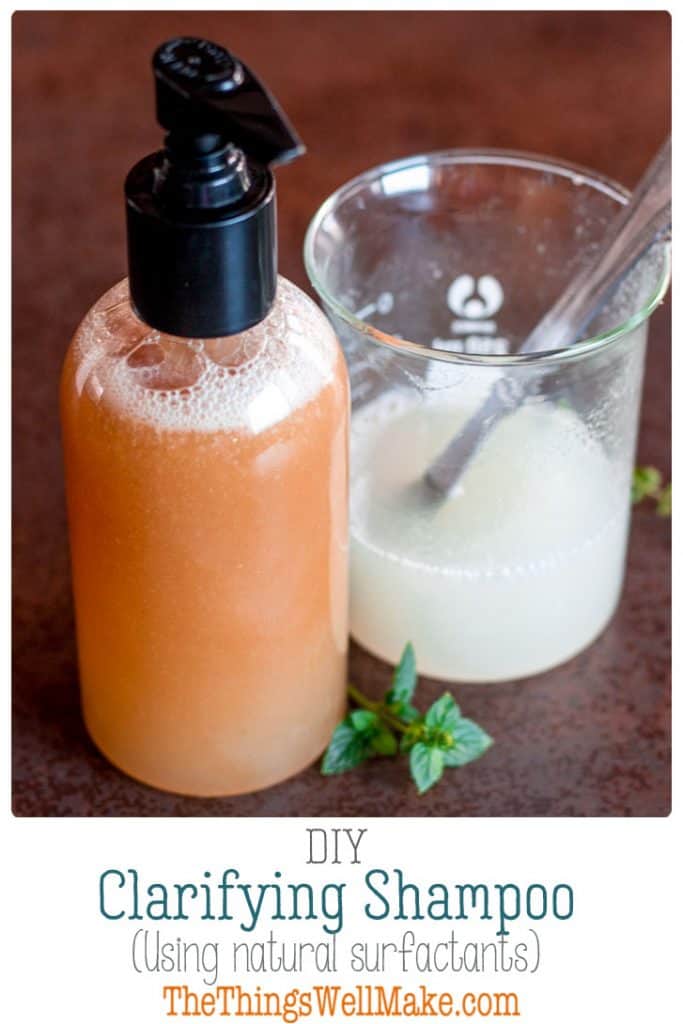
Cleanse your hair gently with this DIY clarifying shampoo that uses natural surfactants to remove dirt and leave your hair clean and soft.
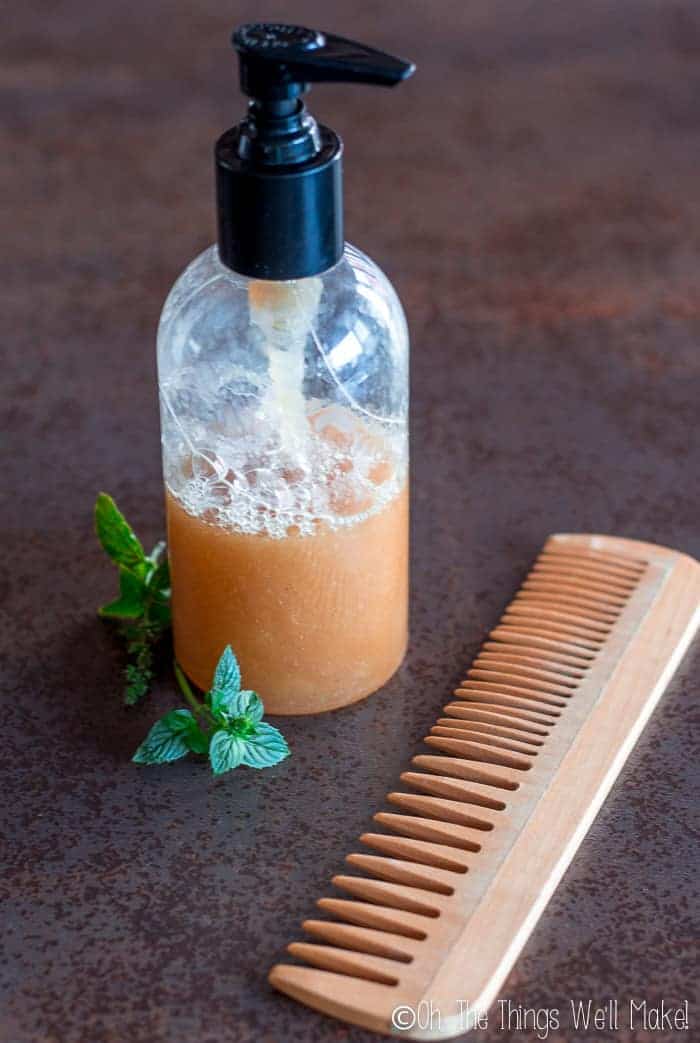
Because many of you have found me through my soap recipes (like my liquid Castile soap or my easy beginner soap), I often get requests for a soap-based shampoo. While I love making soap, I never use soap for my hair because it leaves my hair dry and unmanageable. Some people are able to cleanse their hair with Castile soap and are quite happy with it, but I’m not one of those people.
Why not use liquid Castile soap?
I’m not alone, though. Castile soap isn’t an ideal shampoo for hair because the pH of soap is high yet our hair and scalp have a more acidic pH. Not only can an alkaline shampoo increase the negative charge in the hair making the hair more prone to friction and damage, but it can also be irritating to your scalp.
In an attempt to remedy this issue, most people who wash their hair with soap or soap-based “shampoos” will follow it up with a vinegar rinse to lower the pH again. Not everybody reacts well to vinegar rinses either. I, again, am one of those people and I don’t like the feel of my hair after a vinegar rinse.
Choose natural surfactants
You want a “natural” alternative, but soap may not be the best option. So what’s left?
Natural surfactants, of course!
Surfactants have a bit of a bad rap. It’s partly because harsher surfactants like SLS Sodium Lauryl Sulfate and Sodium Laureth Sulfate can be found in just about every conventional product at the supermarket. It can be found in everything from household cleaners to shampoos, shower gels, and even toothpaste! (You can make your own toothpaste sans SLS, too!)
I’m actually not even an SLS hater, to be honest. (Shocked?) I use it in my homemade version of Dr. Bronner’s Sal Suds just like they do (I’ll share my recipe soon!), but I reserve it for general cleaning around the house. For my skin and hair, I choose milder, more natural surfactants instead!
With time, more natural surfactants are being developed to meet consumer demands! I wrote more about them and shared a list of some of my favorites in my post about working with natural surfactants! (If you aren’t familiar with natural surfactants, I recommend reading that post as a great starting point for making your own homemade products!)
Who is this shampoo best for?
Because this is a fairly gentle shampoo, it should work well with most, if not all, hair types.
Those who follow the curly girl method for developing waves or curls and keeping their hair hydrated can use this shampoo as a “low poo” alternative. (No, I didn’t come up with that term.) It makes a good starting point for beginning the process and for occasional washings when normally using co-wash.
You can use it as often as works best for your hair. I have been developing my natural waviness over the last few years by rarely using shampoos and sticking to very gentle ones when I do. I usually use this shampoo around once a week and for my other “washing,” I either co-wash with my homemade conditioner or I use a DIY conditioning shampoo. (Yet another recipe that I’ll be sharing with you shortly!)
Why make your own clarifying shampoo?
It’s very difficult these days to find shampoos free of harsher surfactants like SLS. When you make your own shampoo, you can control which surfactants you use.
Many shampoos also have other ingredients that may not be right for your hair. They may contain non-water soluble silicones, harsh preservatives, and artificial fragrances.
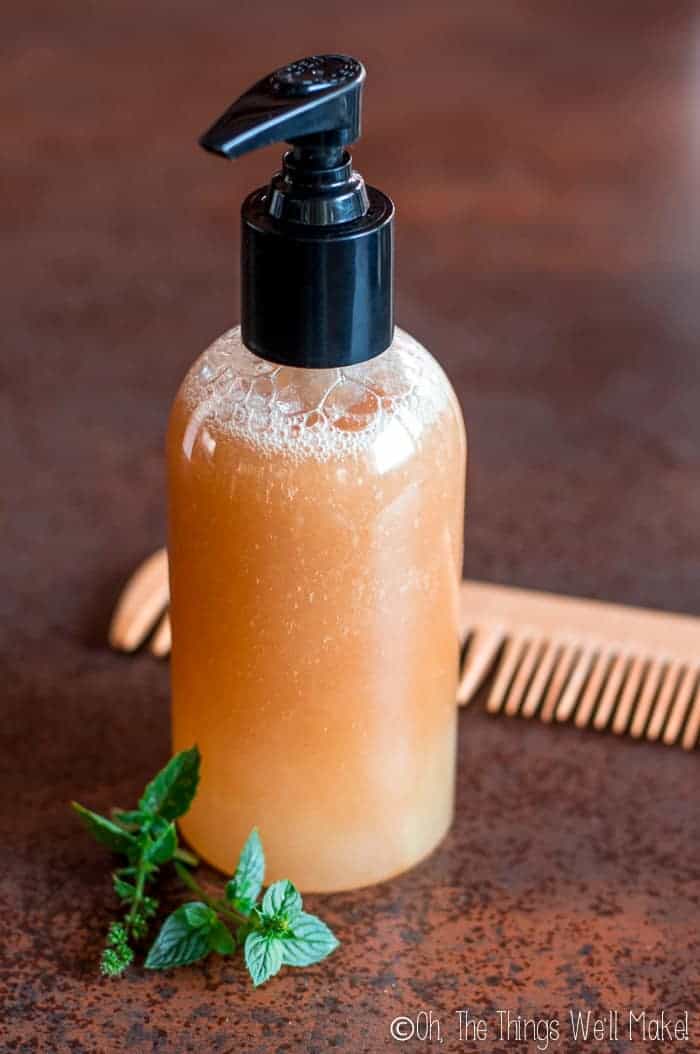
Customizing your DIY clarifying shampoo
What it comes down to, though, is that when you make a product, you can control the ingredients and customize the recipe to suit your needs. While most of us aren’t that in tune to our hair and will use just about any shampoo that doesn’t have harmful ingredients, those that are doing processes like the curly girl method to maintain perfectly hydrated curls and waves are often very in tune to what their hair needs in terms of vitamins and proteins. Your hair may show more need for protein, for example, so you can adjust the amount you add to your hair care products. Looking for a shampoo without protein, you can make it without too! Making your own shampoo allows you to fine tune it to perfectly suit your hair from batch to batch.
Vitamins and Proteins
In this shampoo, I chose to use d-panthenol (provitamin B5) to help nourish the hair, but you could also add some hydrolyzed wheat protein or silk protein to give your hair extra nutrients. (Just use the suggested range for each particular ingredients, as suggested by the supplier, and exchange any water-soluble additions for part of the water in the recipe.)
Distilled water or floral waters
In the shampoo in the photos, I actually used an infusion of peppermint leaves in distilled water as the water component of the recipe. I like mint for shampoos because it leaves your scalp feeling nice and refreshed, and just feels clean to me. That refreshing feeling is said to help stimulate the circulation in the scalp and may help stimulate hair growth.
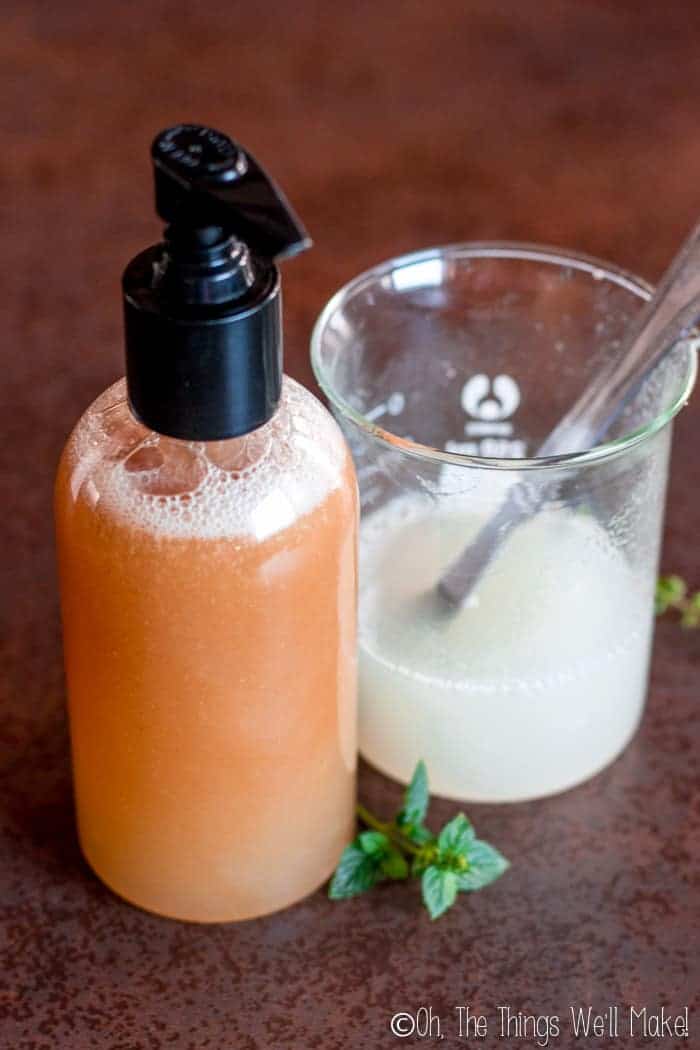
Prefer to use a floral water or some other infusion? Go for it. It’s your shampoo. Nettle tea would also make a good base as nettle is also said to be great to help fight hair loss. You could have the best of both worlds by using a nettle infusion and some peppermint essential oils.
The surfactants
You can experiment by changing up some of the surfactants in this shampoo. I used a mix of non-ionic surfactants (coco glucoside and decyl glucoside) as well as an amphoteric surfactant (coco betaine) to help boost the foaming. Because my husband likes a lot of lather to his shampoo, and I’m not using any of the harsher anionic surfactants like SLS, I’m using a relatively high percentage of surfactants in this recipe. You can reduce the percentage of surfactants added to make for an even gentler shampoo, but you will probably find that it will also lather a bit less.
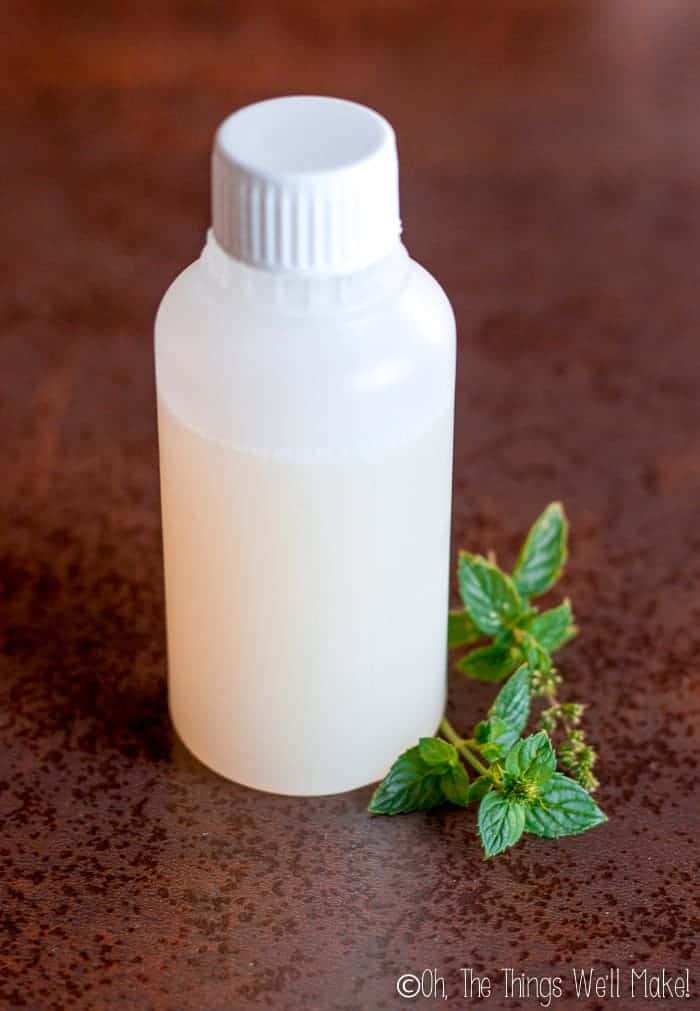
Natural DIY Clarifying Shampoo
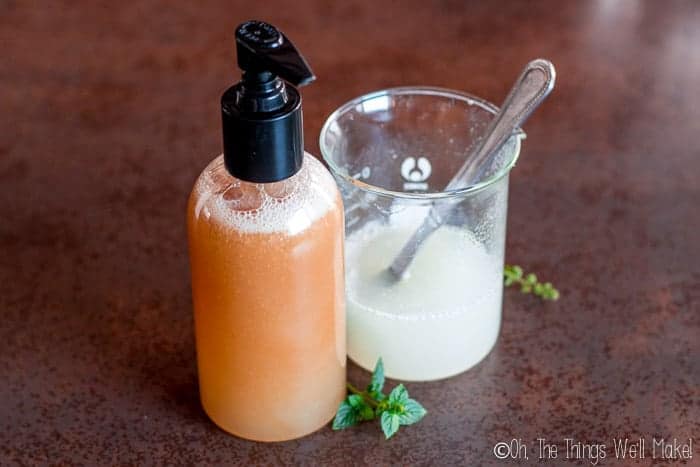
DIY Clarifying Shampoo
Materials
- 88 g distilled water (or infusion, or floral water)
- 40 g coco betaine
- 25 g coco glucoside
- 25 g decyl glucoside
- 10 g glycerin
- 2 g xanthan gum
- 4 g d-panthenol
- 2 g peppermint essential oil or other essential oils of choice
- 2 g preservative (use the recommended amount for your preservative)
Instructions
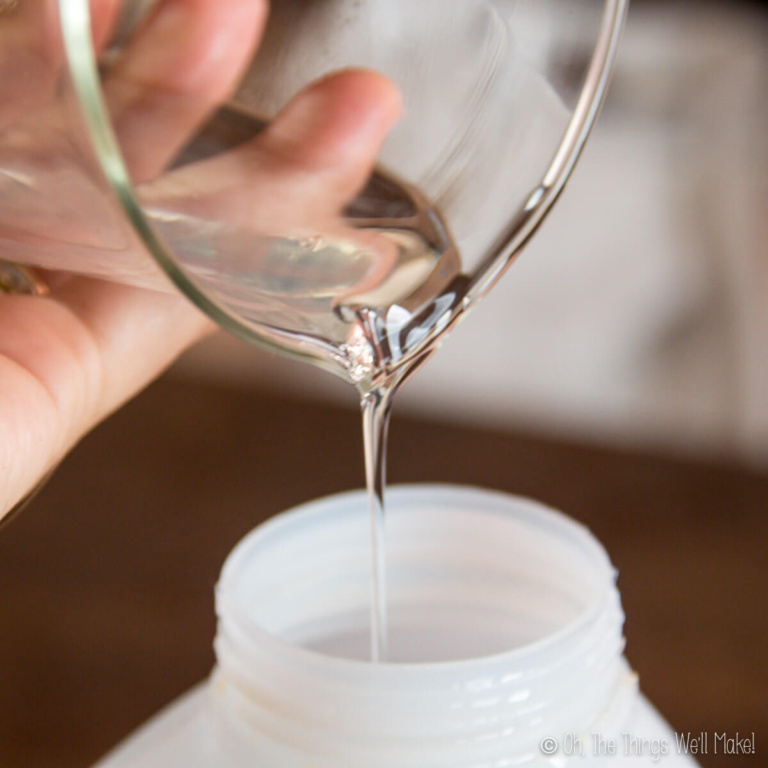
- Mix the xanthan gum into the glycerin until fully incorporated. This helps prevent clumping later on when it’s added to the rest of the shampoo.
- Once the xanthan gum is fully incorporated, begin adding the remaining ingredients, stirring gently as you go. Avoid mixing too vigorously, as this can create excess foam and make the shampoo harder to work with.
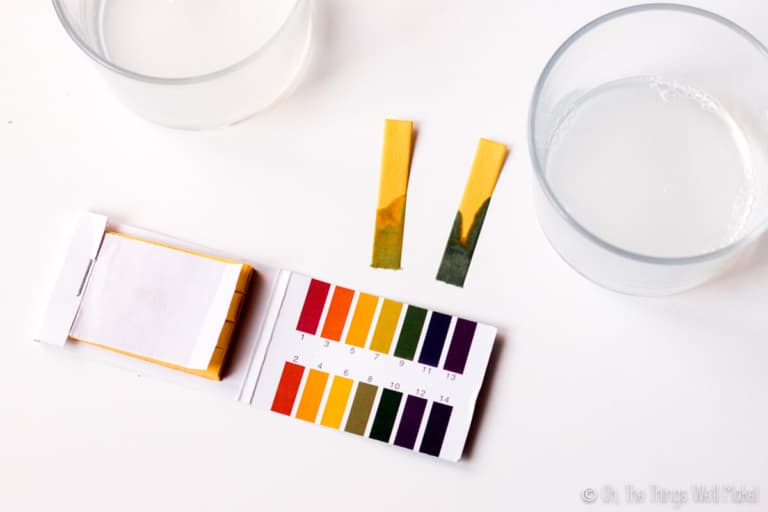
- Once everything is fully mixed, check the pH using a test strip. You want it to fall within a slightly acidic range, ideally around pH 4–5.5, and to be compatible with the preservative you’re using.
- If needed, adjust the pH with a few drops of lactic acid to lower it, or a small amount of baking soda or sodium hydroxide (lye) to raise it. Once it’s where you want it, the shampoo is ready to bottle and use.
Hi Tracy
What are the ingredients in this recipe that lower the pH if some of the surfactants like coco glucoside and decyl glucoside have a very high pH? If lactic acid is used to lower the pH, will it not just react with the alkaline ingredients to create a salt and water or do the two ingredients remain in the shampoo unaltered? I know that you cannot lower the pH of soap by adding an acidic ingredient as the two just react together. Is it different with these type of surfactants? Thank you
Hi Jane,
Yes, it’s different with surfactants. You can lower the pH with something like lactic acid without issues. Soap’s pH can’t be lowered in the same way without causing the soap to break down. A pH of around 5.5 is ideal for hair care products. 😉
Hi! Have you already posted recipee for shampoo bar using natural surfactants? Been waiting for it:)
Hi Tami,
I actually have been working on it today. It’s my next post to go out- so look for it. With the holiday and having my son home for spring break, I can’t promise a date, but my goal is for this week. 😉
Hallo Tracy, what a wonderful recipe! I made it and I am delighted with the result. My hair feels very good, much better than with other “natural” things I tried. This time I used lavender hydrosol, and some essential oil of patchouli and geranium. It is nice to try different ingredients at different times and see what effect it has on the hair. Great, I am looking forwards to more recipes of you. Thanks a lot!
Hi Janny,
That sounds like a wonderful blend. I love lavender for my hair too! 🙂
I’m so happy that it worked for you. I hope to give you many more very soon!
Fantastic, this recipe sounds amazing! May I just ask what works as am emulsifier in this recipe? For the essential oils to mix with the water base?
Hi Kal,
You aren’t using very much oil, so the surfactants themselves are enough to keep the oils incorporated into the mixture.
Hello! Looking forward to trying this (and your conditioner) soon! I’m working on accumulating the ingredients I don’t have yet. Coco glucoside is the trickiest to find, though I can also only find one place that sources coco-betaine. Are there any substitutions that could work for either of those? Thank you!
Hi Hannah,
Well, you can try some of the other natural surfactants that I list in my guide to natural surfactants, but keep in mind that they are all slightly different. So, if you use a different one, it may change the way the shampoo feels, cleans, etc.
I like testing my recipes out for several batches before posting them on my blog. In this case, I really like this combination. That doesn’t mean another combination won’t work, though.
Keep in mind, that once you buy for shampoo, you can use for all sorts of other things too- like body washes, facial washes, cleaning around the house, etc.
Little by little, I’ll be posting more recipes using these surfactants, so you can use them for more than just this recipe.
Aah, thank you. That is helpful on both fronts – referring me to your blog about surfactants, as well as reminder that they can be used in other products.
Your link to coco-betaine is the only brand I’ve found so far, but on the manufacturer’s website they list it as cocamidopropyl betaine (https://www.makingcosmetics.com/Coco-Betaine_p_273.html)… so I’m on the hunt for another brand. Crazy how hard it is to find in the US!
Hi Hannah,
I’m sorry I missed this before.
I buy here in Spain. For the post, I linked to the only one I could find in a reputable source that I recognized online to help readers out.
I buy from here. They have a nice one and do send internationally, but I’m going to guess that the shipping charges would make it unreasonable to buy from them. Maybe I’m wrong?
https://www.cremas-caseras.es/tensioactivos/137-betaina.html
Hi again Tracey,
Thanks again for the recipe. I added more distilled water in mine. My sons agreed to test it for me.
Next time I will try with the infused moringa tea.
Thanks again…
love from Jakarta
Sounds great!
Just make sure you use the preservative in a proper quality for the amount of water you add. 😉
I hope they (and you) enjoy it! Merry Christmas too!
I did, I used liquid germall plus.
Was going to tag you on FB to show you the pic but was not able to do it. Thank you again… xoxo
Hmmm I wonder why you weren’t able to tag me.
It should be fine, then.
You could join the Facebook group and post in there if you want to show me something. You can find it here, if you’re interested. 😉
https://www.facebook.com/groups/968125513310515/
Hello,
Thank you for your recipes! Where do I buy “sharomix” and what type should I use?
Hi Kelly,
I buy locally here in Spain. It will really depend on where you live.
You don’t have to use Sharomix.
There are many natural preservatives that you can use instead.
I’m currently working on a post about them and hope to get it up soon!
I believe coco betain should be reduced if you completely want to be organic although many people are unaware. Just a thought.
Are you maybe talking about Cocamidopropyl betaine? (They are different!)
https://realizebeauty.wordpress.com/2015/10/18/yes-coco-betaine-and-cocamidopropyl-betaine-are-different-chemicals/
Tracy, could this also be used as a body wash? If not, could there be some minor additions or subtractions to turn it into a body wash? I’m totally new to formulating and have read that shampoos can be used for body washes, but not the other way around.
Cheers,
Hi Kathy,
Yes, it could be used as a body wash. I’d probably reduce the amount of surfactant because you probably don’t need as much for your body, but it is also fine to use as is. It’s basically using most of the same surfactants, so yes. Some body washes will have a pH that isn’t very good for your hair, so that may be the reason for what you read. 😉
Your skin is a lot more resilient to those sorts of things. I can use soap well for body, but my hair hates it!
I’ll be posting some body washes in the (hopefully) near future– just trying to get caught up on getting my new posts out on the blog! The holidays are a busy season.
Hello! I live in Spain, I am American and followingthe CGM. I really want to make my own natural non-toxic products but struggle with time at the moment with 2 toddlers. I also lack patience too unfortunately. I absolutely love your page and what you do! Do you ever sell your lovely concoctions? You got a buyer right here. 🙂
Hi Rocio,
That’s awesome! We have a lot in common. Do you mind my asking where you are? (You can email me at [email protected] if you don’t feel comfortable sharing that information here. 😉 )
Legally, I can’t sell homemade products here in Spain. I could, but I’d have to make them in a local outside of my house and do a lot of paperwork to be able to do so. Then, it would have to follow European regulations, meaning I’d need to pay for microbial testing, etc.
I’d also need some sort of insurance.
In the end, it’s just not something I can fathom doing. As it is, I also struggle with time. (And I only have one 8 year old, albeit one that refuses to do his homework. Ha!)
The US is a lot more lenient, and I’d be able to sell pretty much anything with no issues. (That’s also why there are a lot of more dangerous products out there, though.)
Can I change the preservatives into Euxyl K 903
Inci :: Benzyl Alcohol, Benzoic Acid, Dehydroacetic Acid, Tocopherol
Hi Tami,
Yes, definitely!
I just ordered some myself and will be experimenting with it soon! 🙂