

How to Make a Multipurpose Liquid Castile Soap: Dr. Bronner’s Copycat Recipe
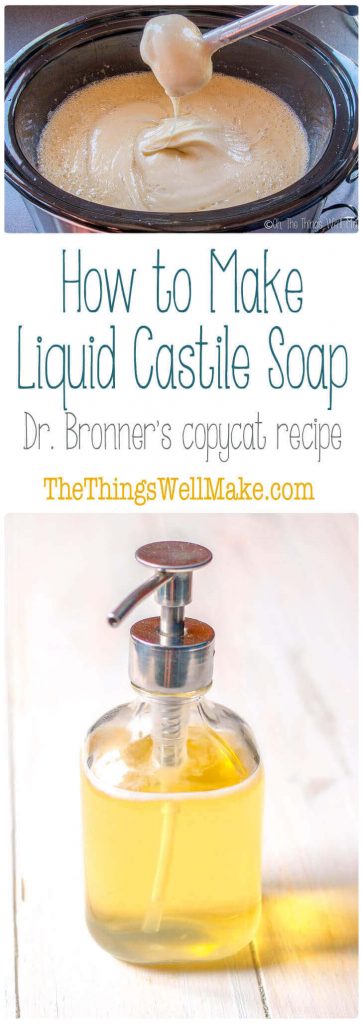
Dr. Bronner’s soap is a versatile, all purpose cleaner that is a great addition to any household. But let’s face it, it’s can be quite expensive. Learn how to make a multipurpose liquid Castile soap at home. It’s easy, frugal, and very rewarding.
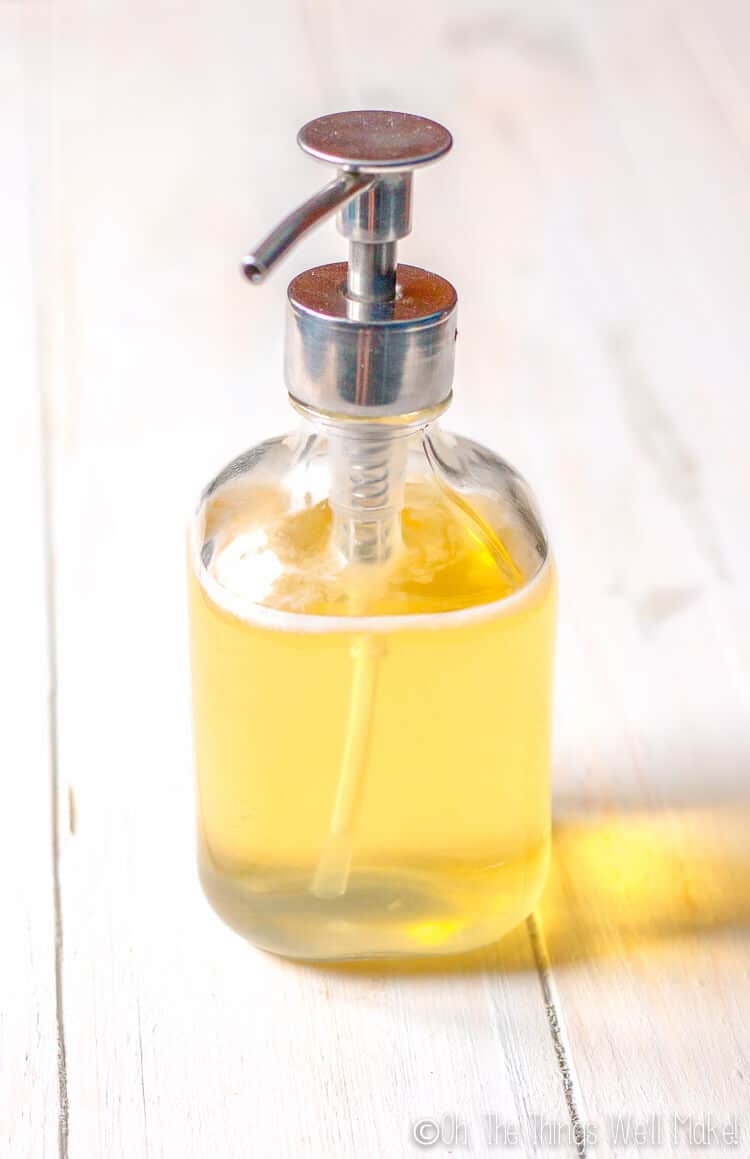
If you’ve been following my blog for a while, you know by now that I love making soap.
Making bars of soap is a lot of fun, and you can experiment with all sorts of ingredients, colors, and other additives to customize your soap exactly as you like. If you’ve never made a bar soap before, take a look at my easy, beginner soap recipe, which shows you exactly how to start making bar soaps and also gives you ideas for customizing the soap to suit your needs. That beginner soap recipe is a modified Castile soap recipe, just like this one.
What is Castile soap?
I call this recipe a modified liquid castile soap recipe because it uses a variety of vegetable oils. Pure Castile soap normally refers to a soap made with only olive oil.
Over the years, the definition of “Castile soap” has been extended to include other soaps made with not only olive oil, but that also add in other vegetable oils. Other vegetable oils are added to change the properties of the soap, normally to give it more lather and make it more cleansing.
Soaps made with only olive oil are on the conditioning side, meaning that they are mild, and not stripping, when used on skin. On the other hand, they don’t form as much lather and aren’t considered highly cleansing soaps.
Coconut oil in soap makes a nice lather and is very cleansing, but it can be drying on the skin when used alone.
Combining a variety of oils allows you to add the beneficial properties of each oil in the soap, making a soap that can be ideal for a number of uses.
Why make your own liquid soap?
While it is fun to make bar soaps, I find it more rewarding to make liquid soaps at home.
Let’s face it, Dr. Bronner’s Liquid Castile soap is a very handy soap to have on hand, but it can be pretty pricey. By making your own liquid Castile soap at home, you can save yourself a lot of money. (And it’s actually pretty easy to do too!)
What’s in Dr. Bronner’s Liquid Castile Soap?

Despite the fact that they call it a “pure Castile soap,” it isn’t a soap made only with olive oil. In fact, coconut oil is the main ingredient of the Dr. Bronner’s soap that I tried to copycat (and of all the Dr. Bronner’s soaps that I can find here.)
I chose to try to make a soap similar to the Dr. Bronner’s 18-in-one Hemp Baby Unscented Pure Castile Soap. One of the reasons I chose that particular soap is that it is unscented, and it allows for me to see if my homemade liquid Castile soap has a similar natural scent. (I’ve noticed that my homemade liquid coconut oil soap and my homemade pure liquid Castile soap don’t have the same scent. Both have a mild natural soap scent, but my coconut oil soap smells a lot more like the Dr. Bronner’s soap than my soap made with olive oil.
Interestingly enough, I’m seeing that the version sold on Amazon in the US appears to be different from the bottle I bought at a local shop here in Spain.
Here in Spain palm kernel oil wasn’t listed at all, but in the US it is the oil that is used in the highest concentration after the coconut oil.
In the US, the soap has this ingredient list: Water, Organic Coconut Oil, Potassium Hydroxide, Organic Palm Kernel Oil, Organic Olive Oil, Organic Hemp Oil, Organic Jojoba Oil, Citric Acid, Tocopherol
You’ll notice that the main oil used is coconut oil, and that all of the other oils are used in a lesser quantity than even the lye itself. (In the case of liquid soaps, potassium hydroxide is the lye used.)
When I made my copycat liquid Castile soap, I didn’t use palm kernel oil because I was trying to copy the bottle of soap that I had at home. I had no idea that they made different formulations of their soap here in Europe.
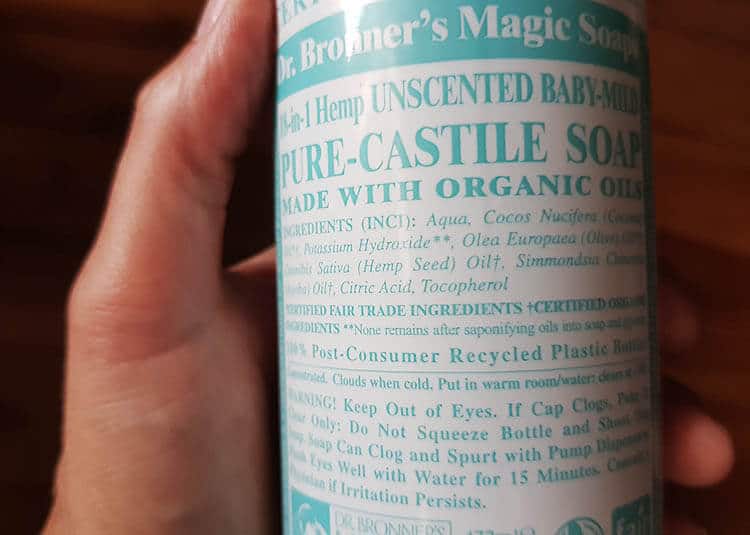
I tried to make my recipe as similar to theirs as possible, so I used coconut oil as the base oil for my liquid Castile soap recipe, and used the other oils in descending order, using a smaller amount of those oils than the potassium hydroxide just like theirs.
The last two ingredients in Dr. Bronner’s soap are citric acid and tocopherol. Citric acid is likely used to neutralize the soap to keep it on the mild side. (You can read more about that in the section below about superfatting.)
Tocopherol is a form of vitamin E. It is often added to soaps to help extend the life of the soaps as it can help keep any excess oils from going rancid. In the case of liquid soaps that aren’t normally superfatted, it probably doesn’t help as much in this way, but it still may somehow help extend the shelf life somewhat. (Keep in mind that while the antioxidant properties of vitamin E can help extend an oil’s shelf life, Vitamin E is NOT a preservative, and won’t prevent bacterial or mold growth.) Still, vitamin E is a nice addition to any beauty product that will be used on face and body as it helps add moisture and can help soothe skin. You can most definitely add a few drops of vitamin E to your homemade liquid soap when you dilute it to help gain some of its positive benefits when using your liquid soap.
Differences between oils in liquid soap
When I first started making liquid Castile soap, I made the pure Castile soap with only olive oil as often as I made a liquid soap using coconut oil. I figured that for face and body use, the pure liquid Castile soap would be a lot better to use because soaps made with olive oil are milder and more conditioning than soaps made with coconut oil.
I wanted versatility, though, so I was making batches of both types of liquid soap to later combine them dependent on each particular use. The nice thing about liquid soaps is that you can combine the soaps after having made them. I used a mixture of different liquid soaps, using mostly olive oil soap for general bathing and mostly coconut oil for cleaning around the house.
Since then, though, I’ve found that I use my homemade liquid soap made with coconut oil much more than I use the liquid Castile soap made with only olive oil. I even occasionally use it 100% in the shower, and don’t find it to be drying on the skin. I think part of that may have to do with me using the glycerin method of liquid soap making. I use glycerin as part of the water component of the soap. I do it to help make an easier to use soap, but I think the extra glycerin (all soaps have glycerin in them that is made during the soap making process) likely helps prevent drying and makes a more conditioning soap.
Despite its popularity here on the blog (more than twice as many people check out the olive oil liquid Castile soap recipe over the coconut oil liquid soap), I have to admit that I rarely make that recipe anymore. I find myself often making double batches of the liquid coconut oil soap, though. I think people are so used to seeing “liquid Castile soap” for sale, and assume that the olive oil soap, being called “Castile soap,” will be closest to what they would normally buy.
That’s part of the reason that I decided to come up with another recipe that would be a nice, versatile, all-purpose cleanser like Dr. Bronner’s liquid Castile soap. This new recipe would combine coconut oil and olive oil, along with a couple of other oils, to make one batch of all-purpose liquid Castile soap. Some people had no desire to make two different batches of liquid soap, and I totally understand! Don’t get me wrong; either of the other recipes is pretty multi-purpose as well, but this one allows you to make just one batch and use it for pretty much anywhere you’d want to use liquid soap.
This soap compare vs. Dr. Bronner’s Unscented Baby Mild Liquid Castile soap
Scent comparison
While this soap had a similar scent, Dr. Bronner’s has a natural fragrance somewhere between this soap and that of my coconut oil liquid soap. I think my soap smells a bit more like hemp oil than Dr. Bronner’s version, which makes me think that I used higher concentrations of hemp and jojoba oils than Dr. Bronner’s does. (This, of course, is all guesswork on my part!)
Seeing as how hemp oil and jojoba oils are the more expensive oils in those recipe, that would make a lot of sense. To save even more money, you could definitely reduce those oils in this recipe, but you’d have to run the new formula through a lye calculator first to make sure that you use the right amount of potassium hydroxide. When formulating liquid soap recipes, I usually use the Summer Bee Meadow lye calculator, as I’ve often read that it’s the best calculator for liquid soap making. Not only does it take into account the water component in KOH vs. NaOH, but it also allows for calculating in glycerin and alcohol should you choose to use them.
Color comparison
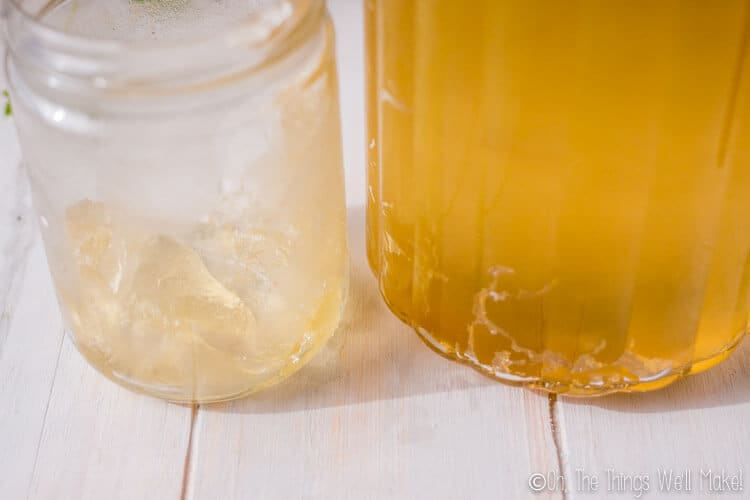
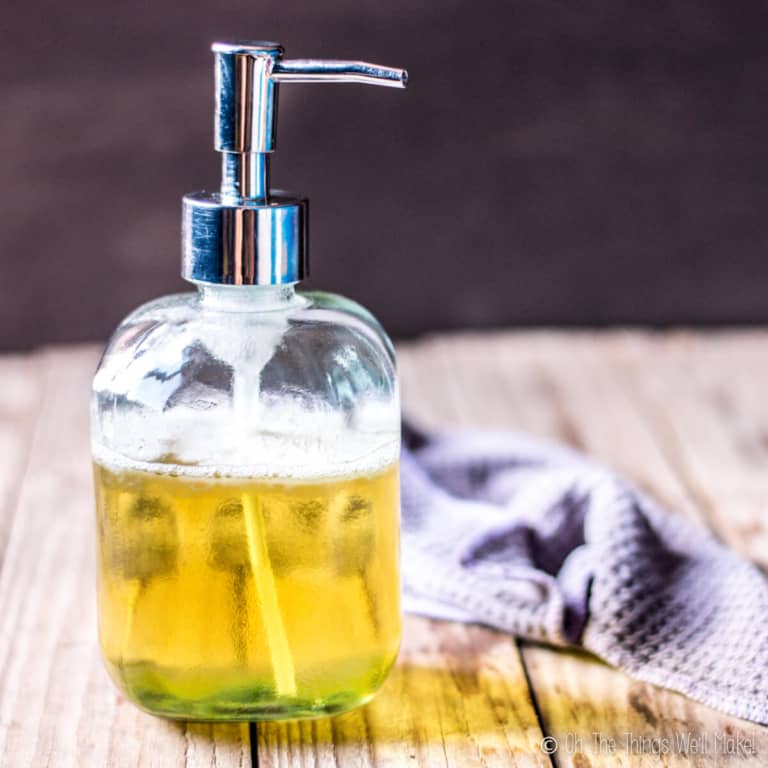
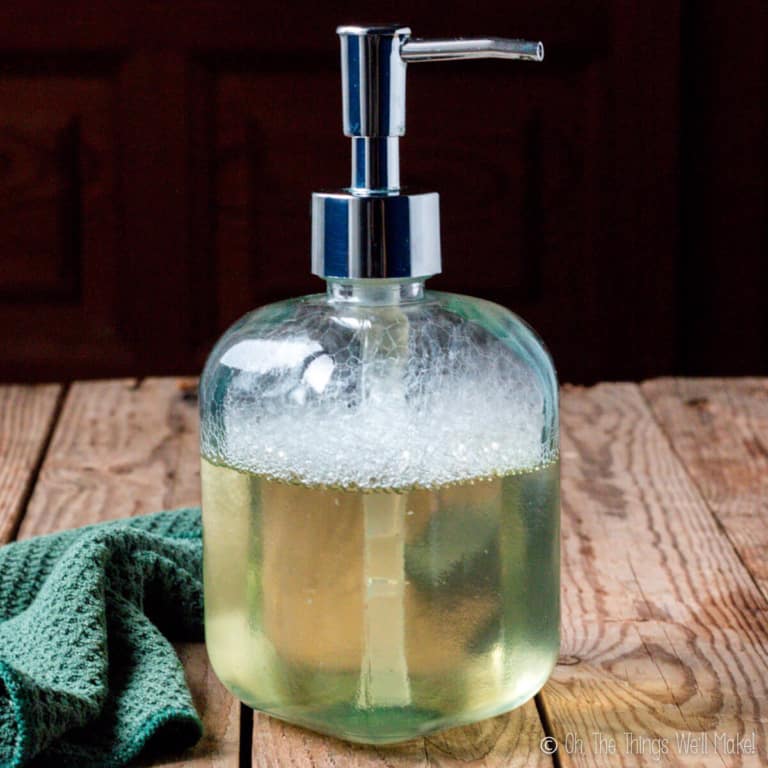
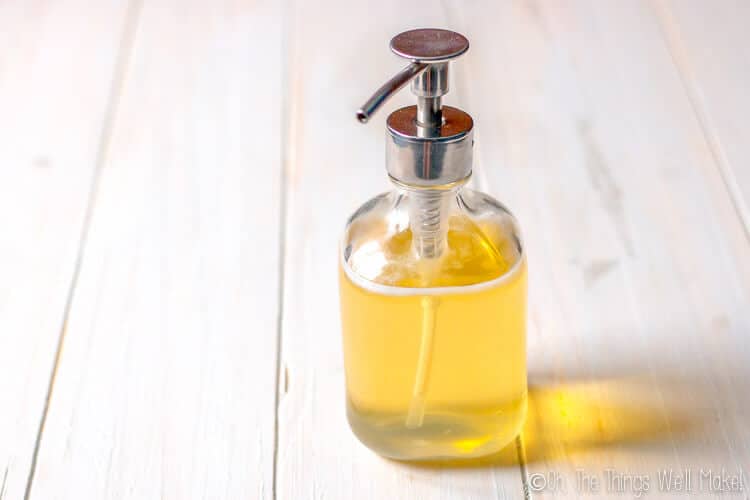
My diluted soap is slightly lighter in color than my bottle of Dr. Bronner’s. Dr. Bronner’s soap is closer in color to my liquid soap paste. That likely means that their soap is a bit more concentrated than the soap I diluted to use as a hand soap. That makes sense when you consider that Dr. Bronner’s soap is marketed as being very concentrated, and most people dilute it further before using it. If I were to dilute my liquid soap paste with less water, I’d likely be able to make a liquid soap of the same color as theirs.
I would like to say that I’ve also had the bottle of Dr. Bronner’s soap for longer than my homemade liquid Castile soap. I’ve found that my liquid soap pastes tend to get slightly darker with time, so that could be another factor that affects the difference in color.
Use comparison
When using them, both soaps lather up nicely, and neither is drying on the skin. I don’t really notice any differences while using them.
Why use Glycerin (When Dr. Bronner’s doesn’t list it)?
Adding glycerin does add to the cost of making your own liquid Castile soap, but it does have several added benefits.
When I first started developing liquid soap recipes, I remember reading about people who replaced all of the water in the recipe with glycerin. The idea was that it makes the process more fool proof and speeds up the process of making a clear liquid soap.
I wanted to make the process of making liquid soap at home the easiest I could, so I chose to substitute part of the water component for glycerin. I’ve found that not only does it help move the process along quickly, converting the soap quickly into a liquid soap paste, but it also seems to make a very nice, mild liquid soap, even when only using coconut oil. When you take into consideration that liquid soaps aren’t normally superfatted, that’s saying a lot.
When making a homemade glycerin bar soap, I learned how glycerin can be a solvent of sorts that helps make a more transparent soap. My guess is that the addition of glycerin to my liquid soap helps to make it a bit more transparent even when I don’t use excess lye in the recipe.
I also think that the addition of glycerin helps make a liquid soap paste that easily dissolves in water. I’ve read horror stories from people who have a difficult time trying to dilute their soap paste in water. On the other hand, I’ve always easily dissolved mine just by adding some water to it and leaving it alone for a few hours.
What is superfatting?
Superfatting is the process of adding more oils to a soap than what are needed to react with all of the lye used. The idea is that not only will all of the lye be safely converted into soap, but that leftover oils also remain in the soap to help leave the skin conditioned and soft.
While most bar soaps are superfatted, especially those meant for face and body, leftover oils in a liquid soap can cause cloudiness. Because most people are aiming to make a transparent liquid soap like the ones sold in stores, liquid soaps aren’t normally superfatted. In fact, they are normally made with a lye excess and later “neutralized” to bring down the pH from the unreacted lye. You can read more about how to check the pH of soap and how to neutralize liquid soaps here. (The term neutralizing is a bit misleading as it will only bring the pH down slightly to a non-irritating range. You won’t be bringing the soap to a neutral pH. It will still be alkaline.)
You’ll notice that Dr. Bronner’s liquid soap lists citric acid as one of the ingredients. My best guess is that they are using the citric acid to help neutralize their soap so that the pH isn’t too high and doesn’t irritate your skin, all while allowing for a nice, clear, transparent soap.
To simplify things, I’ve calculated all of my liquid soap recipes to be 0% superfatted. Basically that means that if the recipe is followed precisely, you shouldn’t have any unreacted oil or any unreacted lye left.That said, it’s very possible that even if you follow the recipe precisely with a well calibrated scale, that you may have the tiniest bit of one or the other leftover, but it shouldn’t be enough to throw things far enough in either direction to make a big difference. If the soap is slightly cloudy, you may have some unreacted oils, but that will also make for a more conditioning soap. I personally don’t have a problem with cloudy liquid soap, but if it bothers you, you can try making with a lye excess and neutralize the soap later. Or you could go the easy route and use an opaque soap dispenser. (There are some beautiful stainless steel and ceramic ones available.) 😉
If you do end up with some unreacted lye, as long as it isn’t enough to bring the pH high enough so that it irritates the skin, it shouldn’t be a problem. If you find the soap irritating to your skin, though, you can check the pH and try neutralizing the soap. Up until now, I’ve never had an issue with any of my homemade liquid soaps using the recipes I’ve shared with you.
Video
Dr. Bronner’s Unscented Baby-Mild Copycat (Updated Recipe)
When I originally posted this recipe, I used larger quantities of the hemp and jojoba oils. Not only does this make the recipe more expensive to make, but I also found that it made for a cloudier soap.
I had a reader comment to me that she had made all of my liquid soap recipes, and that while the others were crystal clear, this one stayed cloudy for her. Mine was cloudy at first, but then an opaque layer settled out and fell to the bottom of the jar. Neither of us found it to affect the quality of the soap, but I didn’t really find it to improve the soap either. I decided to give you an updated version of the soap, with reduced quantities of the more expensive oils. I’ve found this updated version to much clearer, and I think it behaves similarly to the soap I bought in the store.
For those who want a soap without the hemp and jojoba oils, try the last recipe on this page. I’m guessing it’s perfectly clear and cheaper to make. I’m not convinced that the hemp and jojoba oils are providing any benefit in this soap anyway. (They are likely added for label appeal.)
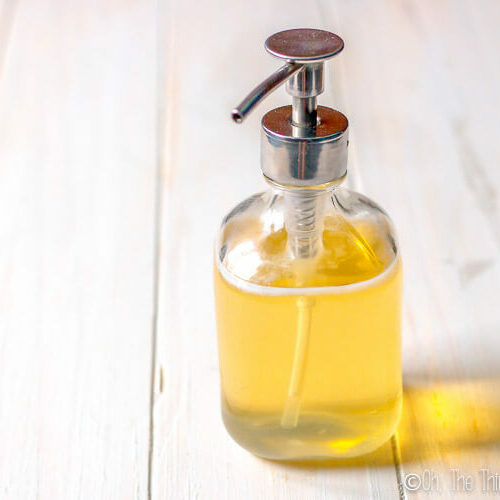
Dr. Bronner’s Unscented Baby-Mild Copycat (Updated)
Materials
- 28 oz. coconut oil
- 8 oz olive oil
- 1 oz hemp oil
- .5 oz jojoba oil
- 9.4 oz KOH
- 20.2 oz distilled water
- 8 oz glycerin
Instructions
- Weigh out all of the oils and add them to a slow cooker on low heat.
- Weigh out and mix together the distilled water and glycerin.
- Dissolve the Potassium hydroxide (KOH) in the distilled water and glycerin mixture in a well ventilated area. Add the KOH to the water and not the other way around. Use gloves and safety goggles when working with potassium hydroxide. the mixture will heat up and get hot. Avoid inhaling the fumes.
- Add the potassium hydroxide solution to the oils in the slow cooker and begin to slowly mix them together.
- Use an immersion blender to blend the oils and potassium hydroxide solution together. At first it will get opaque and thicken slightly, then it will look curdled. Keep blending!
- Continue blending until it gets more opaque and begins to get too thick to blend with the immersion blender. I stopped blending as soon as I felt too much resistance so as not to burn out the blender, and my soap paste turned more solid almost immediately after I stopped.
- Continue to heat the paste, stirring as best you can with a spatula or spoon every half an hour or so. You want to continue to cook the soap paste until it becomes translucent. A good way to check what your final soap should look like is to dissolve a small amount in some distilled water and see if it dissolves clear. If not, continue to process a little longer. You’ll probably end up cooking the paste for a few hours.
- Once processed, you can store the soap paste in glass jars in a cool, dark place until you are ready to dilute it to make your liquid Castile soap.
- Depending upon how concentrated you want your soap, dissolve the soap paste in distilled water. I usually use somewhere between 2-4 parts water for every 1 part of soap paste. I dissolve small amounts at a time and leave the rest as a soap paste until I need to use it. The soap paste will keep for longer than diluted liquid soap.
- You can now add in any essential oils that you want to use to add a fragrance to your soap, or you can keep in unscented. You can also add in a few drops of tocopherol (vitamin E) at this time.
- Enjoy using your homemade liquid Castile soap.
Notes
- This recipe makes 4-4.5 lbs. of soap paste which can be diluted to 10-20 lbs. of liquid soap, or 1-2 gallons, depending on your dilution rate.
- Keep in mind that liquid soap is not as thick as commercial gels and surfactants. You’ll find that this soap, like Dr. Bronner’s, doesn’t need to look thick to be a concentrated, effective cleanser.
- Find more information about diluting your liquid soap paste here.
- Read more about checking the pH and neutralizing liquid soap here.
Dr. Bronner’s Copycat soap recipe (Original version)
This was my original recipe for this post
Version 1: Dr. Bronner’s Copycat
Ingredients
- 25 oz. coconut oil
- 8 oz olive oil
- 5 oz hemp oil
- 3 oz jojoba oil
- 9.68 oz KOH
- 21.05 oz distilled water
- 8 oz glycerin
Instructions
- Weigh out all of the oils and add them to a slow cooker on low heat.
- Weigh out and mix together the distilled water and glycerin.
- Dissolve the Potassium hydroxide (KOH) in the distilled water and glycerin mixture in a well ventilated area. Add the KOH to the water and not the other way around. Use gloves and safety goggles when working with potassium hydroxide. the mixture will heat up and get hot. Avoid inhaling the fumes.
- Add the potassium hydroxide solution to the oils in the slow cooker and begin to slowly mix them together.
- Use an immersion blender to blend the oils and potassium hydroxide solution together. At first it will get opaque and thicken slightly, then it will look curdled. Keep blending!
- Continue blending until it gets more opaque and begins to get too thick to blend with the immersion blender. I stopped blending as soon as I felt too much resistance so as not to burn out the blender, and my soap paste turned more solid almost immediately after I stopped.
- Continue to heat the paste, stirring as best you can with a spatula or spoon every half an hour or so. You want to continue to cook the soap paste until it becomes translucent. A good way to check what your final soap should look like is to dissolve a small amount in some distilled water and see if it dissolves clear. If not, continue to process a little longer. You’ll probably end up cooking the paste for a few hours.
- Once processed, you can store the soap paste in glass jars in a cool, dark place until you are ready to dilute it to make your liquid Castile soap.
- Depending upon how concentrated you want your soap, dissolve the soap paste in distilled water. I usually use somewhere between 2-4 parts water for every 1 part of soap paste. I dissolve small amounts at a time and leave the rest as a soap paste until I need to use it. The soap paste will keep for longer than diluted liquid soap.
- You can now add in any essential oils that you want to use to add a fragrance to your soap, or you can keep in unscented. You can also add in a few drops of tocopherol (vitamin E) at this time.
- Enjoy using your homemade liquid Castile soap.
Notes
- This recipe makes 4-4.5 lbs. of soap paste which can be diluted to 10-20 lbs. of liquid soap, or 1-2 gallons, depending on your dilution rate.
- Keep in mind that liquid soap is not as thick as commercial gels and surfactants. You’ll find that this soap, like Dr. Bronner’s, doesn’t need to look thick to be a concentrated, effective cleanser.
- Find more information about diluting your liquid soap paste here.
- Read more about checking the pH and neutralizing liquid soap here.
Don’t want to use hemp and jojoba oils at all?…
Multipurpose Liquid Castile Soap (Coconut + Olive Oil)
Some people have been asking me for a soap without hemp and jojoba, so I decided to calculate it out for you. I haven’t personally tried this recipe myself yet, but I imagine it would make a wonderful soap.
Multipurpose Liquid Castile Soap
Ingredients
- 28 oz. coconut oil
- 8 oz olive oil
- 9.15 oz KOH
- 19.44 oz distilled water
- 8 oz glycerin
Instructions
- Weigh out all of the oils and add them to a slow cooker on low heat.
- Weigh out and mix together the distilled water and glycerin.
- Dissolve the Potassium hydroxide (KOH) in the distilled water and glycerin mixture in a well ventilated area. Add the KOH to the water and not the other way around. Use gloves and safety goggles when working with potassium hydroxide. the mixture will heat up and get hot. Avoid inhaling the fumes.
- Add the potassium hydroxide solution to the oils in the slow cooker and begin to slowly mix them together.
- Use an immersion blender to blend the oils and potassium hydroxide solution together. At first it will get opaque and thicken slightly, then it will look curdled. Keep blending!
- Continue blending until it gets more opaque and begins to get too thick to blend with the immersion blender. I stopped blending as soon as I felt too much resistance so as not to burn out the blender, and my soap paste turned more solid almost immediately after I stopped.
- Continue to heat the paste, stirring as best you can with a spatula or spoon every half an hour or so. You want to continue to cook the soap paste until it becomes translucent. A good way to check what your final soap should look like is to dissolve a small amount in some distilled water and see if it dissolves clear. If not, continue to process a little longer. You’ll probably end up cooking the paste for a few hours.
- Once processed, you can store the soap paste in glass jars in a cool, dark place until you are ready to dilute it to make your liquid Castile soap.
- Depending upon how concentrated you want your soap, dissolve the soap paste in distilled water. I usually use somewhere between 2-4 parts water for every 1 part of soap paste. I dissolve small amounts at a time and leave the rest as a soap paste until I need to use it. The soap paste will keep for longer than diluted liquid soap.
- You can now add in any essential oils that you want to use to add a fragrance to your soap, or you can keep in unscented. You can also add in a few drops of tocopherol (vitamin E) at this time.
- Enjoy using your homemade liquid Castile soap.
Notes
- This recipe makes around 5.5 lbs. of soap paste which can be diluted to 12-25 lbs. of liquid soap, or around 2 gallons, depending on your dilution rate.
- Keep in mind that liquid soap is not as thick as commercial gels and surfactants. You’ll find that this soap, like Dr. Bronner’s, doesn’t need to look thick to be a concentrated, effective cleanser.
- Find more information about diluting your liquid soap paste here.
- Read more about checking the pH and neutralizing liquid soap here.
Regarding glycerin in your soap
, please read: http://goldenphae.com/blog/68-7-myths-about-glycerin-in-skin-care
Hi Bob,
You don’t need to add glycerin to the recipe if you don’t want to add it. I’m only explaining my reasons for adding it to this recipe based on my experimentation.
I find that it makes the recipe more foolproof for those who’ve never made liquid soap before, and it makes for an easy-to-dissolve soap paste. If you don’t add it, glycerin is still a by-product of the soap making process so you’ll still end up with glycerin in your final product. So, I guess if you want to completely avoid glycerin based on that article, you should avoid all soaps.
Honestly, the sources of the article don’t even really back up what they say. Glycerin is a humectant which can draw moisture out of the air in the right conditions, but it can also work the other way around (just as mentioned in the article used as a source in the one you linked to.)
They also linked to the EWG database that gives it a good safety rating.
Anyway- be it as it may, you can switch out the glycerin for water if you prefer. 😉
Hi! Does it requires a curing period also before you can use the liquid soap? Thanks
Hi RJ,
No, it isn’t really necessary. The paste may improve somewhat with time, but you can use it right away if you like. 🙂
Hi Tracy, I am new to your blog and I enjoy very much on what you share. Will keep on following your blog.
Thank you, C.F.!
I really appreciate your comment!
I am so happy to have found your site! I found that I react to (of all things) citric acid. ☹️ The home-made foaming liquid soap recipe I use calls for liquid Castile soap. I only knew of Dr. Bronner’s, which has citric acid. I made your liquid Castile soap today, and it works great! I have also made your easy beginner soap too. I am hooked, and I can’t wait until my first batch cures. I am so excited to use them! Thanks so much for all of your work—and for sharing it!
Wow, Jennifer!
I hadn’t heard of a citric acid reaction before. Does that mean you have to avoid citrus fruits too? (Just general curiosity) 😉
I’m so happy I was able to help you. I guess we can look at the bright side and say that your little problem pushed you into finding a fun new hobby that should save you a lot of money! 🙂
For general cleaning and most uses, I’d try out the liquid coconut oil soap too. It’s actually my favorite because it’s the most cost efficient one, and I don’t really notice a huge difference when using the different liquid soaps. (I notice a much bigger difference in the different oils in bar soap.) After using this one for awhile, and comparing, I think Dr. Bronner’s uses more coconut oil and less of the other more expensive oils. So I think I’ll be experimenting with a new combination for this one- and will update the post with a 2nd recipe and my thoughts after trying out both for awhile.
I had a blood test that revealed food and food additive sensitivities, and I was told that my blood was moderately reacting to citric acid, meaning my blood had created antibodies to the citric acid. It stems from leaky gut syndrome. I am on an elimination diet now, so hopefully it won’t be forever. Funny thing—the only citrus fruit I reacted to was lime.
I am happy that it led me to a more economical hobby! I will try out the liquid coconut oil recipe next. Thanks again for sharing your information!
Wow- That’s interesting- and sad. I hope you are able to heal things!
(I’ve been there, done that. Not the citric acid part, but the elimination diets.)
Hi Jennifer – I thought I was the only one! Citric acid seems to be in just about everything, although I have just ‘discovered’ Udderly Smooth Hand Cream which will make a nice change from using straight coconut oil. I’ve only recently found that Apple Cider Vinegar is also prohibited, along with pineapple – which (on my extremely restricted diet) I am sorely missing…
Sorry to hear that, Rob!
I can definitely help you make yourself a nice cream without harmful ingredients. Let me know if you’re looking for something specific!
I’d really miss pineapple myself. I love it. 🙁
Thanks for sharing the cream. It is definitely hard to find things without citric acid in it! I unfortunately also reacted to pineapple, so I’m restricting it for awhile, then I’ll try it again to see what happens. I feel your pain!
Hi Tracy,
It’s my first time on your blog.
1) For use as “baby soap”, which ingredient would you add/remove and at what percentage?
2) “Skin whitening soap” is popular in Asia. What is the added ingredient, and at what percentage?
Muchas gracias!
Hello Ireneo,
Welcome, then! 🙂
1)For a baby, I might choose my pure liquid Castile soap made with olive oil. Olive oil is a very conditioning oil in soaps. Coconut oil is more drying to the skin. That said, I haven’t noticed as much of a difference in that sense in my liquid soaps as I have in bar soaps. I find all of these soaps to be pretty mild as they are (I think the added glycerin helps quite a bit), but soaps in general have a relatively high pH, and that may be drying to a baby’s skin. There is the possibility to add some citric acid or something to the soap to bring the pH down slightly. You have to be careful not to bring the pH down too far, though, because soap can never really be in the neutral or acidic ranges. It would fall apart.
Adding something like citric acid can make the soap start to get cloudy. I have more information about all of this in my post about neutralizing liquid soap. I actually want to update that post soon with some of my more recent thoughts on the subject.
I will say that I was using these soaps on my son, who had horrible atopic dermatitis several years back. (He still has skin issues, but they have since improved by quite a bit.) I really only use soaps to clean what is really dirty, though. I think with babies and anybody with sensitive skin especially, that you don’t want to overdo soap or any cleanser for that matter. Only use them when and where you need to.
2) I wasn’t familiar with the skin whitening soaps. They look very interesting. I just looked it up online, and it appears that they are usually bar soaps with ingredients like glutathione, kojic acid, arbutin, and placenta as the active ingredients. I can definitely look into trying to make something like that for the blog. I think it could be sort of a fun experiment, but for now, I’m sorry to say that I don’t know enough about the subject to give you a good recommendation.
Hi Tracy, is it hemp oil or hemp seed oil? I am finding it difficult to know which one. I am hoping it is Hemp seed oil because it is cheaper.
Hi Colin,
Yes, hemp seed oil. Here they call it hemp oil, but, yes, it’s the hemp seed oil and not some other extract from other parts of the plant.
All of that said, even that oil is relatively expensive. I’ve been considering making a new version of this soap with lesser amounts of the jojoba and hemp and adding it as an alternative to this recipe. Over the last months, I’ve talked with a few other people that have made this recipe, along with the other liquid Castile soap recipes on the blog, and we aren’t sure that we see any real benefit to adding the more expensive oils. Don’t get me wrong, this still makes a great liquid soap, it’s just not necessarily better than the much cheaper coconut oil liquid soap. I think that Dr. Bronner’s soap probably has less of those oils, too, because it smells a lot like the liquid soap made with coconut oil.
Another thing we’ve found is that this one, with time, forms a bit of a layer that falls to the bottom of the container. It doesn’t do anything bad, it’s just a cosmetic concern.
I guess all of that to say that if you’re concerned about the cost factor, I’d probably make the coconut oil liquid soap. It’s the cheapest to make, and probably my favorite. I use it for multipurpose cleaning, but haven’t found it harsh for using on skin. I make it most of the time, and rarely even make the liquid Castile soap with olive oil anymore because I don’t feel like the coconut one is harsh in any way. I hope that helps.
hello, if I want to use this liquid soap as an all-purpose cleaner around my home, how much essential oil should I add to it to make a nice and very fragrant scent? i.e. what percentage of essential oils should be added to 1 ounce of soap for cleaning homes? 3%, 4% 5% or much higher? I read somewhere that the more essential oil you add may not increase the stregth of the scent. There is a tipping point.
Hi Heidi,
That’s actually probably true- which is also why I don’t usually measure out the oils for the scent. I just start adding in a few drops at a time and sniff to get to the right concentration.
If you’re mostly going to use for cleaning, I’d actually recommend the coconut oil liquid soap. It’s my favorite of the liquid soap, and while you can also use it for body, it’s probably the best one for cleaning.
I actually want to update this recipe post with a second recipe for an all purpose with lesser amounts of the more expensive oils. After using this soap for awhile, not only have I found them to make the soap separate a bit giving a more opaque, foamy layer, at least in the winter time, but it just increases the price of the soap unnecessarily in my opinion. I’m pretty sure that they use lesser amounts of those oils than I did- and I’d really like to perfect the recipe to get an inexpensive all purpose soap. Don’t get me wrong. This soap is just fine, but I’ve been talking with a couple of readers who have also tried this soap. We all like it fine, but none of us think that you need to use the more expensive oils in such a high concentration. I won’t be deleting this recipe, but plan to give a new, second recipe here- with the explanation- very soon.
I recalculated lye and water with the calculator from the soapcalculator.com web site. The amount of water and lye is different.
Coconut Oil, 76 deg 25.0 61
Olive Oil 8.0 20
Hemp Oil 5.0 12
Jojoba Oil (jojoba wax ester) 3.0 7
Water 15.6
Lye (NaOH) 6.5
Hello,
I use the Summer Bee Meadow lye calculator for my liquid soap recipes because it is supposed to be the most accurate when it comes to liquid soaps. Plus, it allows for the glycerine method of liquid soaps by having that be one of the things you can input into the equation. I often use soapcalc.net for my bar soap recipes. I’m not familiar with the soapcalculator.com.
The water amount shouldn’t make much of a difference.
You appear to have calculated a bar soap recipe, as I see you have used NaOH and not KOH. Sodium hydroxide will make a bar soap. If you want to make a liquid soap, you need to use potassium hydroxide.
Hi, i live in South Africa. Some of the ingredients are very difficult to find and expensive if you do find them. Can I substitute the hemp and jojoba oil with more olive or coconut oil?
Hi Mariska,
If I were you, I’d just make either my liquid coconut oil soap or my liquid castile soap with only olive oil.
I really want to update this post with my thoughts about these liquid soaps. I formulated this recipe because people wanted an all-in-one liquid soap, but I find that there isn’t really much of a difference between the different homemade liquid soaps. I really think that the oils make a much bigger difference in bar soaps.
In the end, I pretty much always make the liquid soap made with only coconut oil. I find that it’s completely multi-purpose, and it’s even very mild in the shower. I don’t find it at all drying on my skin. I think Dr. Bronner’s probably uses even less of those oils than I did, and find their soap to be very much like the coconut oil soap.
Maybe I should give an alternative recipe here that only uses coconut oil and olive oil.
I’m about to head out the door, but I’ll try to put up a recipe alternative in the next couple of days if you’re interested.
Thank you for this recipe. Could it also be used for the basis of washing liquid recipes that call for 1 cup of ‘liquid castle soap’?
Hi Kate!
You’re welcome. 🙂
Of course! You can use it as you would any store bought liquid Castile soap! 🙂