

Homemade Liquid Coconut Oil Soap
Making your own homemade liquid coconut oil soap is simple, thrifty, and very rewarding. Coconut oil soap provides lots of lather and cleaning power for all-purpose cleaning.
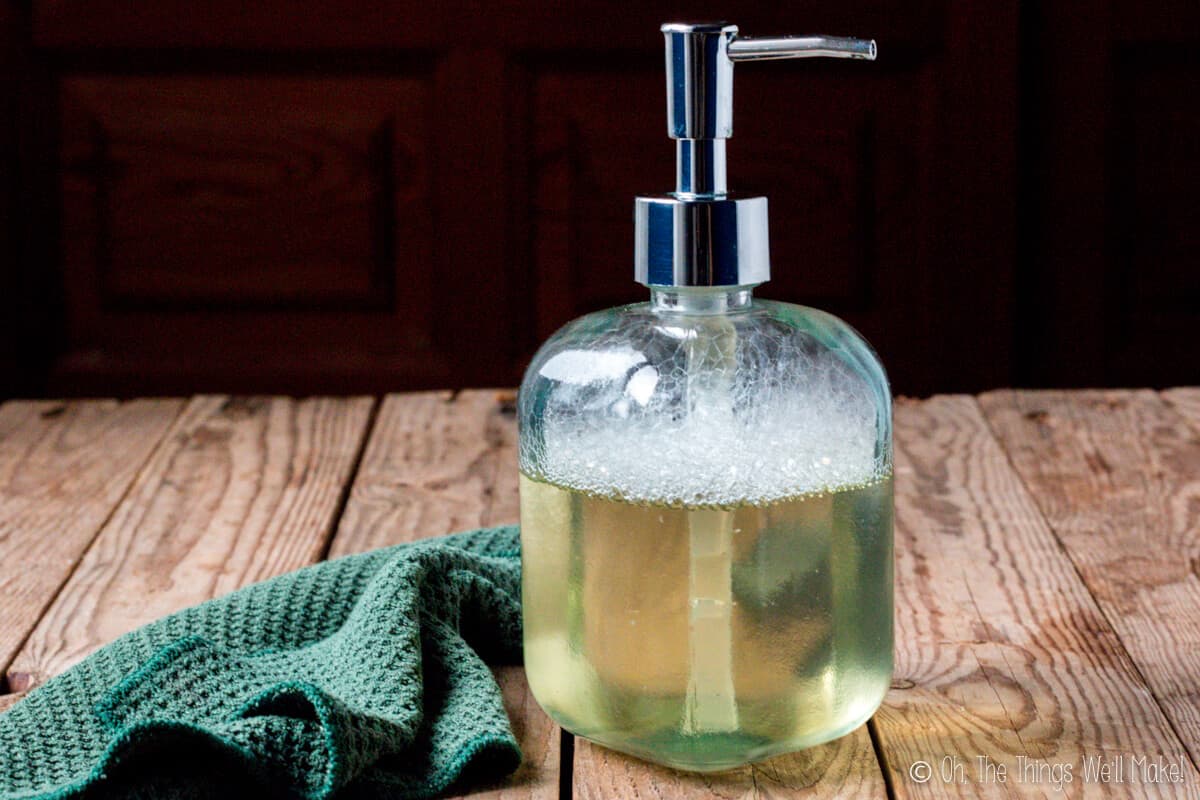
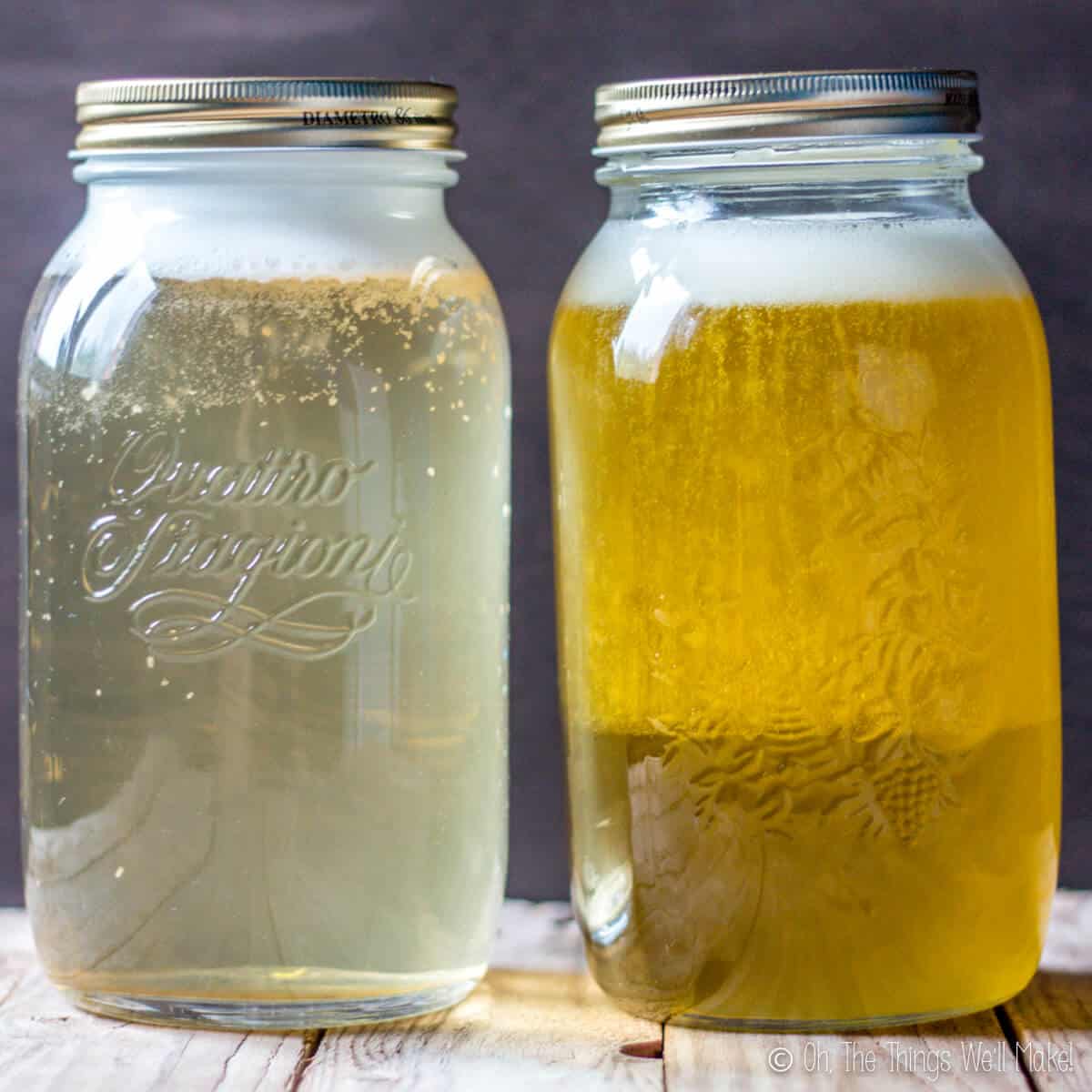
When I first made this soap, I had a great idea. I made a pure liquid Castile soap (made with only olive oil) and this liquid soap made with only coconut oil. My idea was that I would combine them, as needed, for different purposes around the house.
Oils in soapmaking
I had my reasons. Each oil in soap making brings different properties to soap (different from the properties they’d bring to a homemade lotion, for example). In a bar soap, there is a HUGE difference between a pure Castile soap made with only olive oil and soap made with only coconut oil.
Soaps made with olive oil are more conditioning. Olive oil is great for soaps meant for the face and body for that reason. On the other hand, soaps made with only olive oil don’t make much lather and they aren’t as “cleansing” as soaps made with coconut oil. Some people find them “slimy.”
Soaps made with coconut oil are cleansing and they provide a nice bubbly lather, but they can be drying to the skin when used alone.
Most people prefer using a soap with a combination. They want a soap that isn’t too drying, but that has some lather and cleansing ability. That’s why I used a combination of the two oils in my easy beginner soap recipe. I wanted a conditioning soap that provided some lather. If you haven’t tried making soap yet, you may want to begin with that recipe to get your confidence up before moving on to liquid soaps.
Read my post about the best oils in soap making for more information.
Oils in liquid soap making
Now that I’ve made these liquid soaps several times now, I have to admit that I don’t notice as much of a difference between the liquid soap made with olive oil and this liquid soap as I thought I would. In fact, I generally make this soap most often.
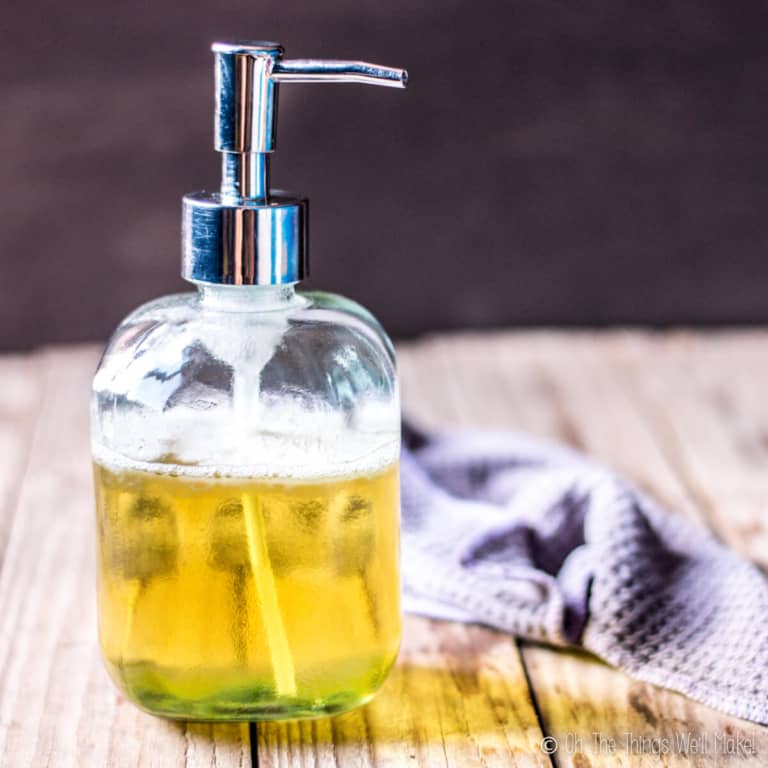
The biggest differences are cosmetic. This soap is much lighter in color while the liquid Castile soap is more golden in color. They also have a different scent. (If you add essential oils or fragrance oils when you dilute your liquid soap, though, you probably won’t notice a difference.)
I’ve found that both of these soaps provide a lot of lather. This one makes a slightly more abundant and bubbly lather. Neither one is excessively drying, although the one made with olive oil is slightly more conditioning.
My husband prefers my homemade liquid soaps for use in the shower to gels made with other surfactants because he likes the amount of lather they provide. (Yes, even the one made with only olive oil provides a lot of lather.)
Refined coconut oil, sold for soap making, generally is very inexpensive, so I like using it to make soap. I haven’t noticed a difference when using refined coconut oil vs. virgin coconut oil (which I used to use before I could find the more inexpensive coconut oil locally). (I used to make soap with olive oil more often because here in Spain it was the least expensive oil.)
Those with coconut allergies will be happy to learn that pure Castile liquid soap is also a great multi-purpose soap.
Why Make this soap?
Making your own liquid soap makes a lot of sense financially. It’s a bit intimidating, but once you’ve successfully made it, you’ll see it’s not that difficult. Liquid Castile soap is surprisingly expensive. Not only can you save a lot of money by making it yourself, but you are able to control which ingredients you use. This is especially helpful for people with allergies and skin sensitivities.
It’s also more sustainable. You can keep using the same containers and dispensers over and over again, meaning much less waste! One big batch of soap will keep for a very long time.
Before making this soap, you may want to read my post about how to make a liquid soap with general information about the process. It may also help you choose which soap you’d like to make.
Ingredients
This recipe uses only a few simple ingredients.
Coconut oil
Obviously, you will need coconut oil. You can use refined coconut oil or virgin coconut oil. It doesn’t really matter which you choose. Avoid using fractionated coconut oils or coconut oils that have been modified to melt at a different temperature. (If you want to use them, you’d have to run the recipe through a lye calculator and adjust the amount of lye used. Read more about using a lye calculator here.)
Lye (KOH)
Apart from the coconut oil, you will also need lye. In the case of liquid soap, you will need a different type of lye than the one used in bar soaps. For liquid soap, we will be using KOH, potassium hydroxide. (Bar soaps use NaOH, sodium hydroxide). All true soaps use lye. (For more information about lye and why it is needed in soap, read my post about why soap needs lye.)
Do not use NaOH, sodium hydroxide, to try to make liquid soap!
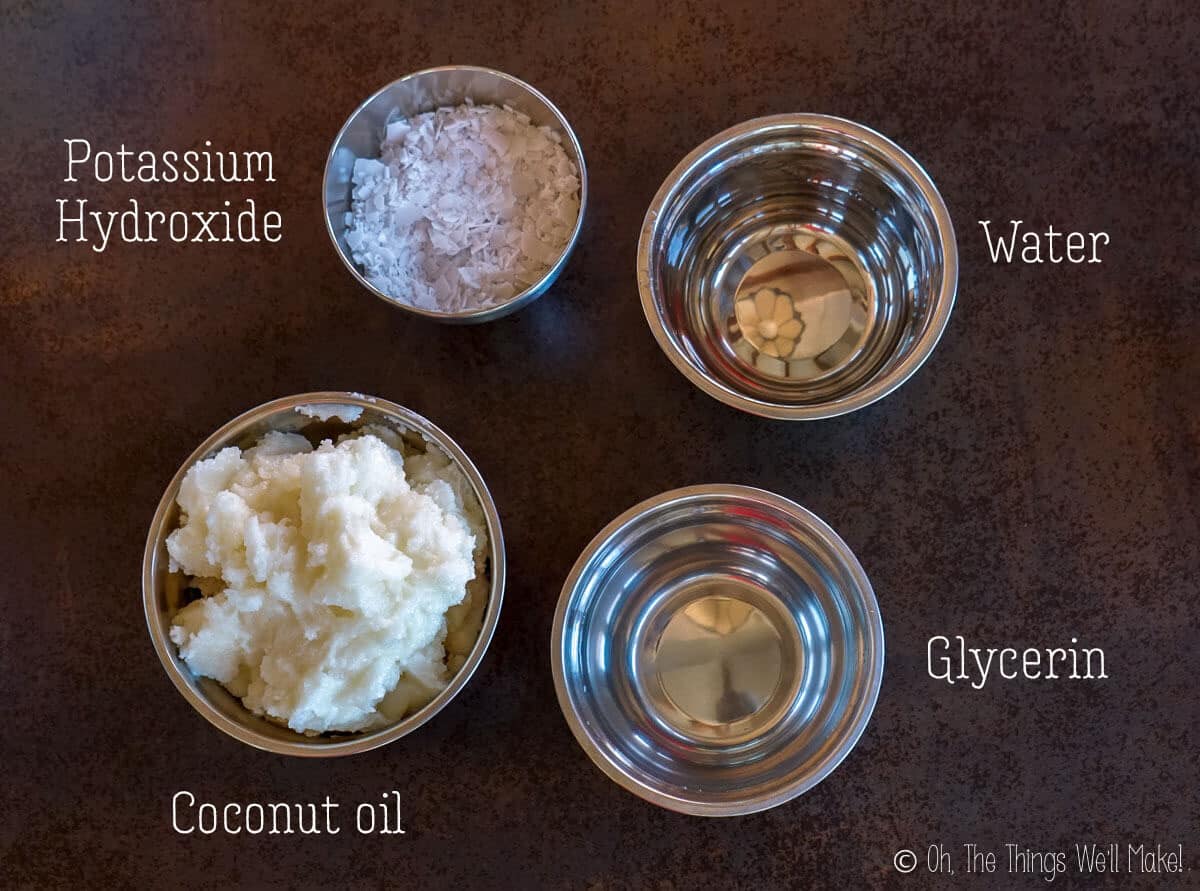
Glycerin
I use glycerin when making liquid soap for several reasons. Glycerin is normally a by-product of the soap making process. Adding more glycerin makes the process of liquid soap making easier and more fool-proof.
Not only is it said to move the process along more quickly, making the process quicker and easier, it also has other advantages. Soap pastes made with glycerin tend to be easier to dilute in water. They also may be more transparent and conditioning to the skin. (Glycerin is a humectant which can draw moisture into your skin.)
If you don’t want to use glycerin, you can just sub it out for more water. Just know that it may take longer to make and your resulting soap may be slightly different from mine.
Water
We’ll also be using water in our lye solution. I recommend using distilled water to avoid adding impurities and minerals that could result in a cloudy soap.
Procedure
Making liquid soap is very similar to making bar soap. Most people hot process their liquid soap, though. That means that they will cook it in some way or another to help finish the process of saponification. (Someday I will write about my experiments in trying to cold process liquid soap.)
In the past, I have recommended making this soap in a slow cooker. Over the years, though, I’ve had many questions about how to make this if you don’t have one. I made my last batch of this soap in the oven, and it worked quite well and was very easy to do too.
So, if you are using a slow cooker, you can add the weighed out coconut oil to the slow cooker and allow it to melt in there. If not, I’d suggest melting the coconut oil in a large bowl.
Making the lye solution
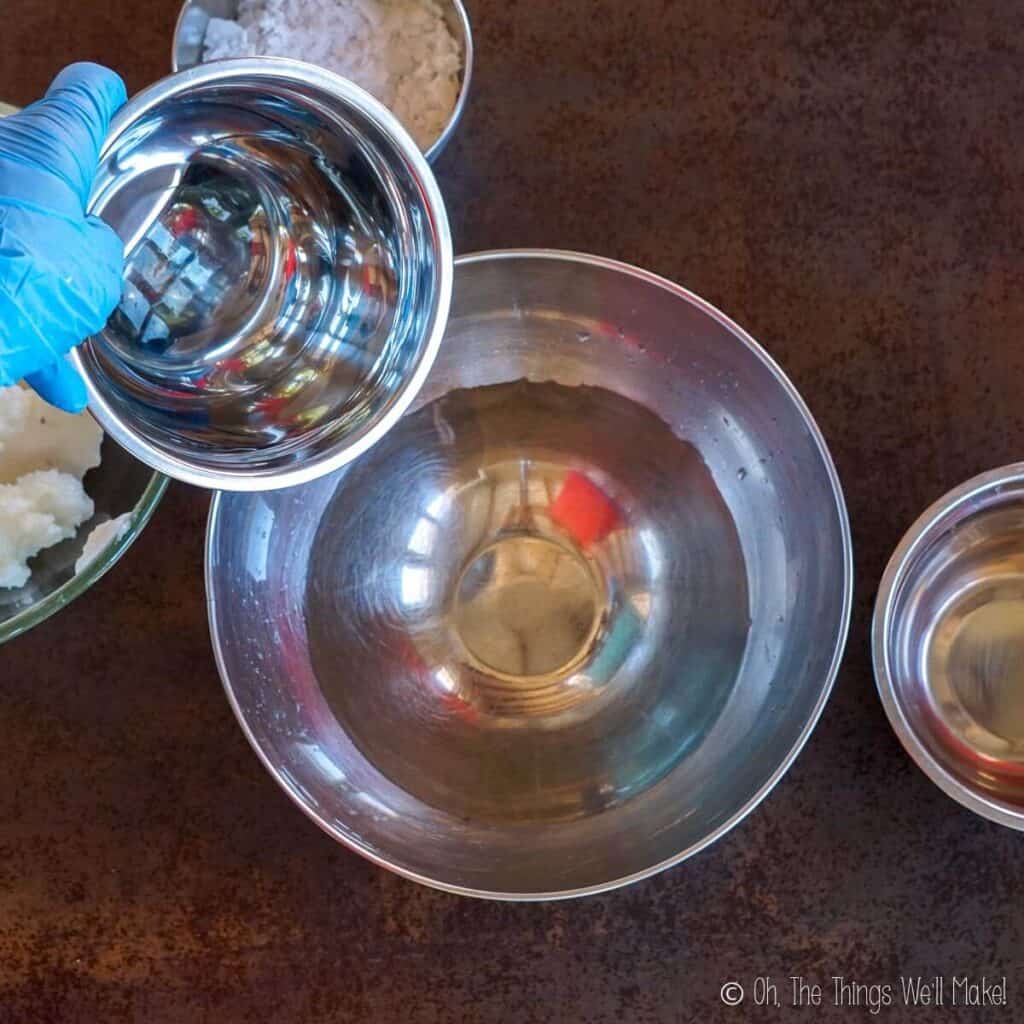
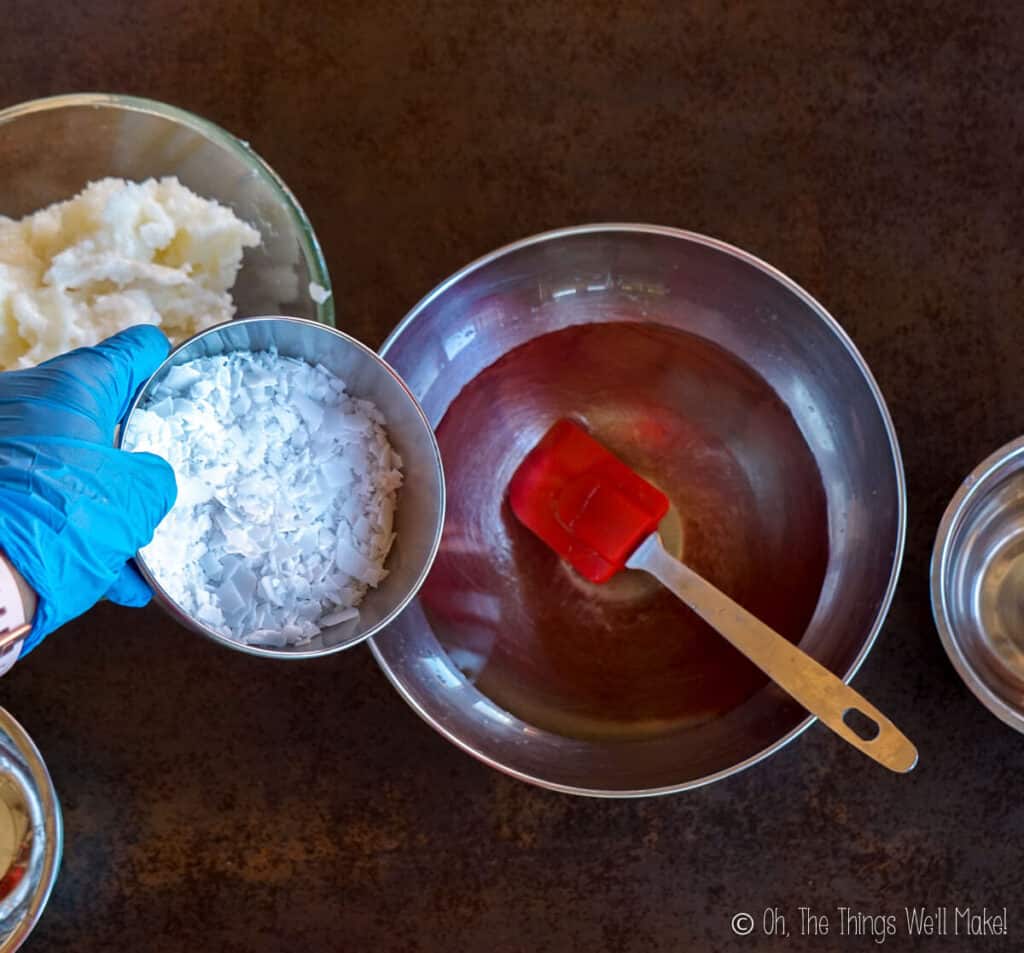
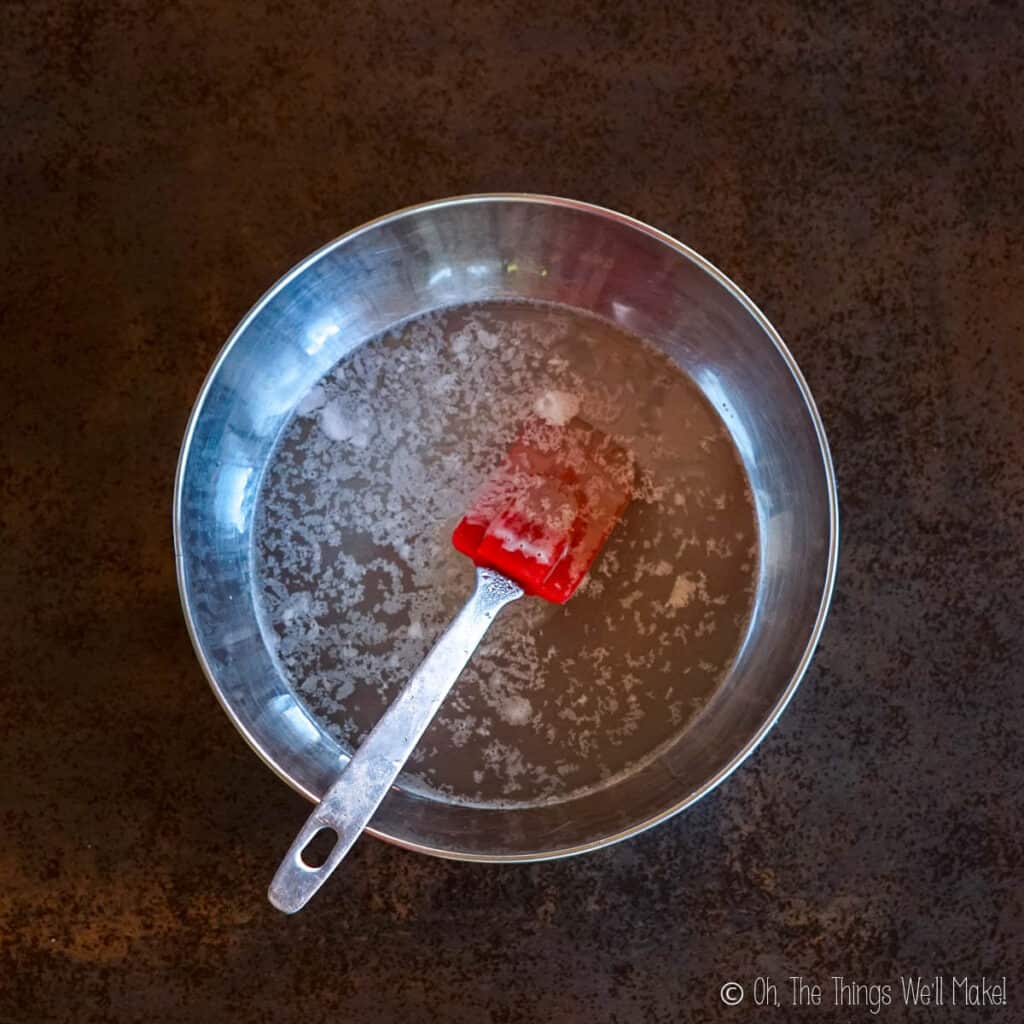
In a separate medium-sized bowl, mix together the water and glycerin. In a separate smaller bowl, weigh out the potassium hydroxide (KOH).
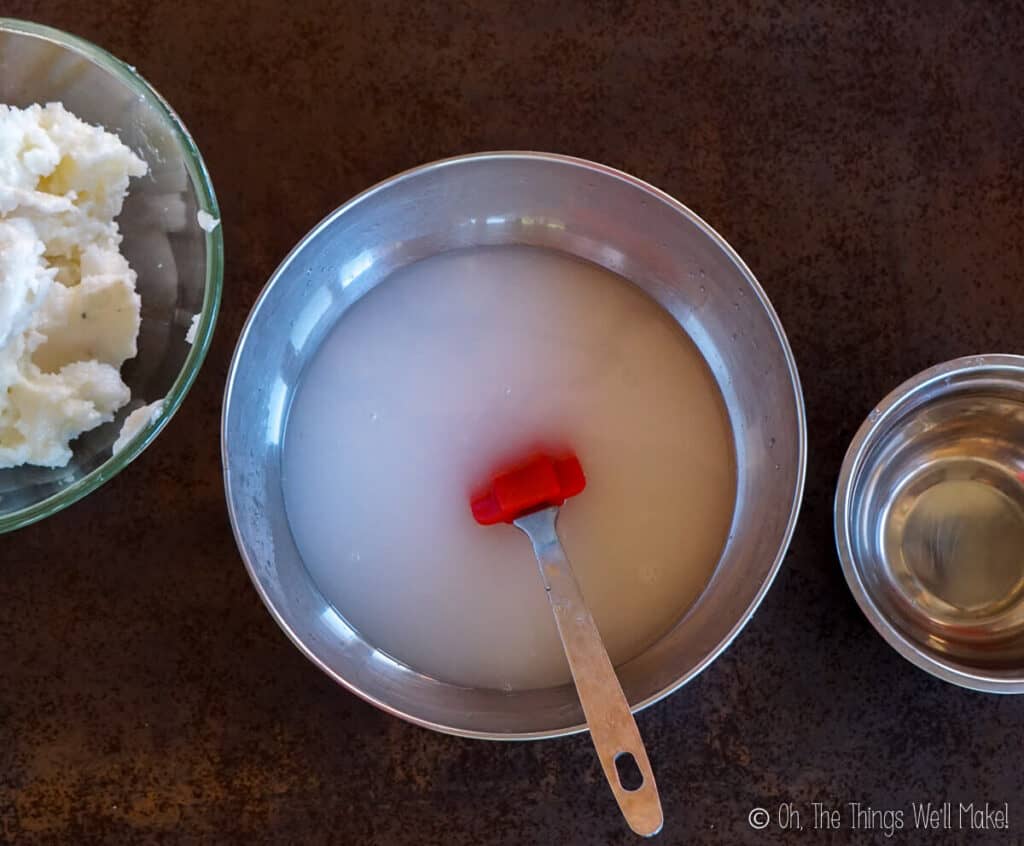
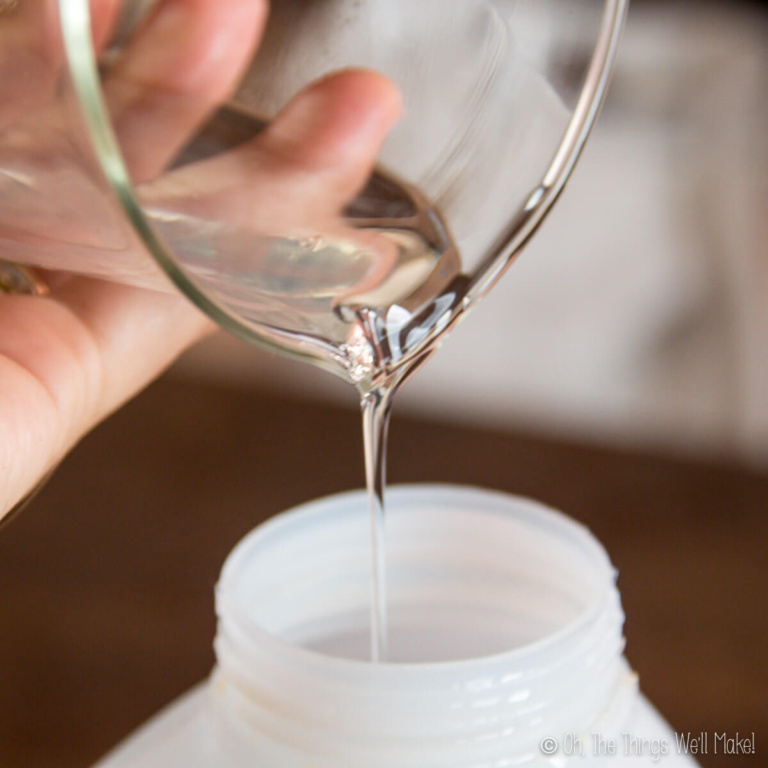
Pour the KOH into the water and glycerine mixture. Mix them together until the KOH is fully dissolved into the water and glycerine mixture. It will be cloudy at first but will clear up. It will also get very warm.
Making the soap paste
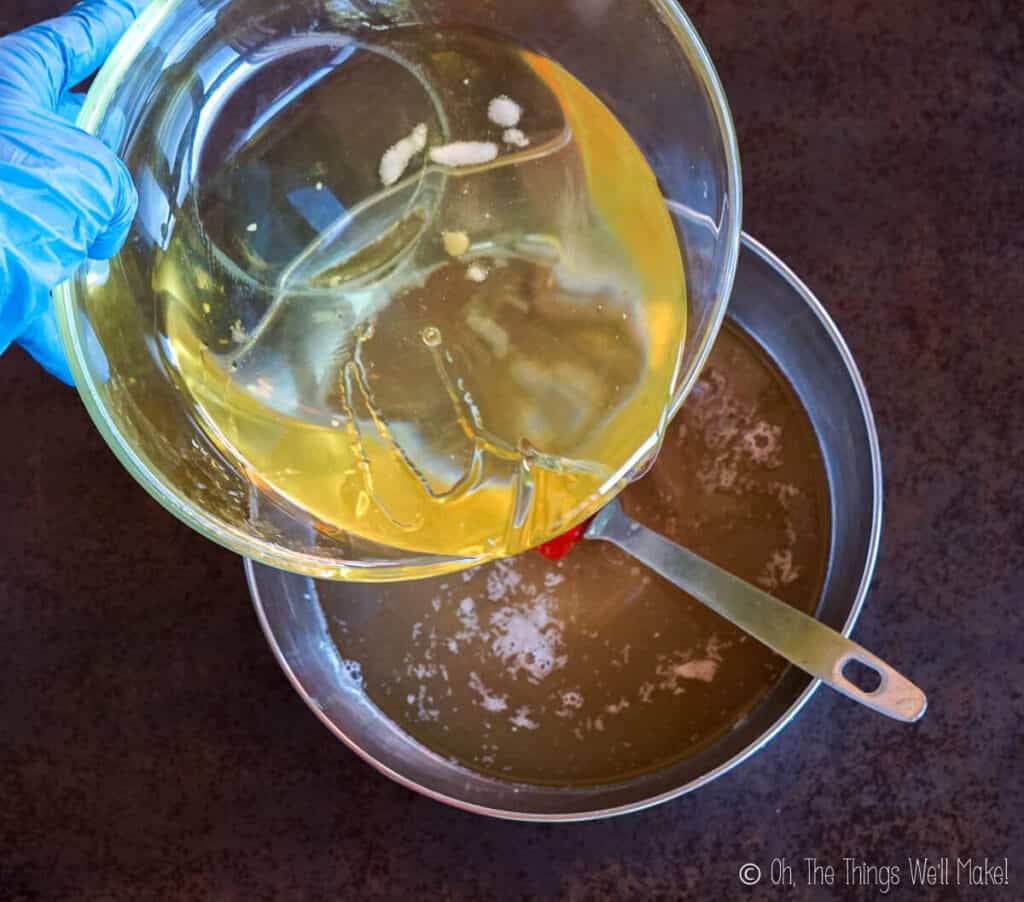
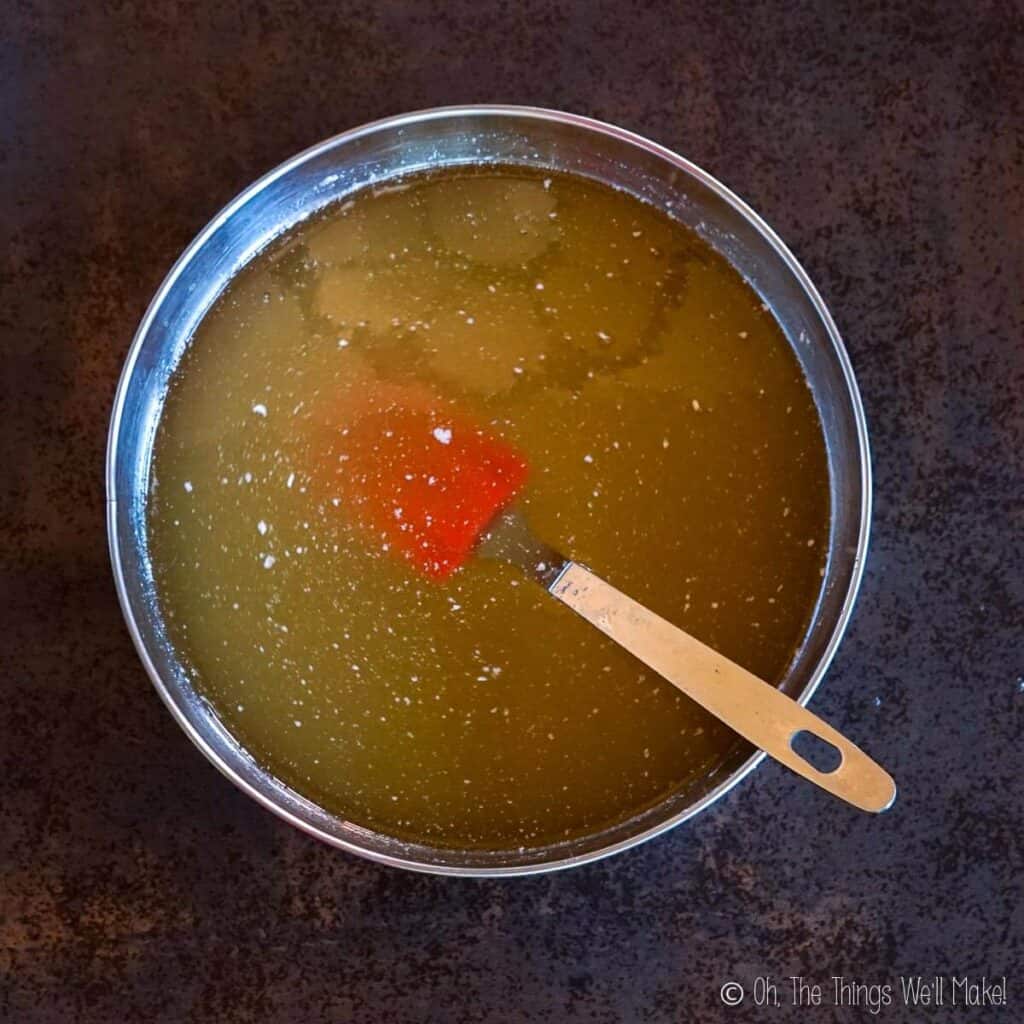
Carefully pour the KOH mixture into the warm coconut oil, and slowly mix them together. This can either be done right in the slow cooker crock or in a large bowl.
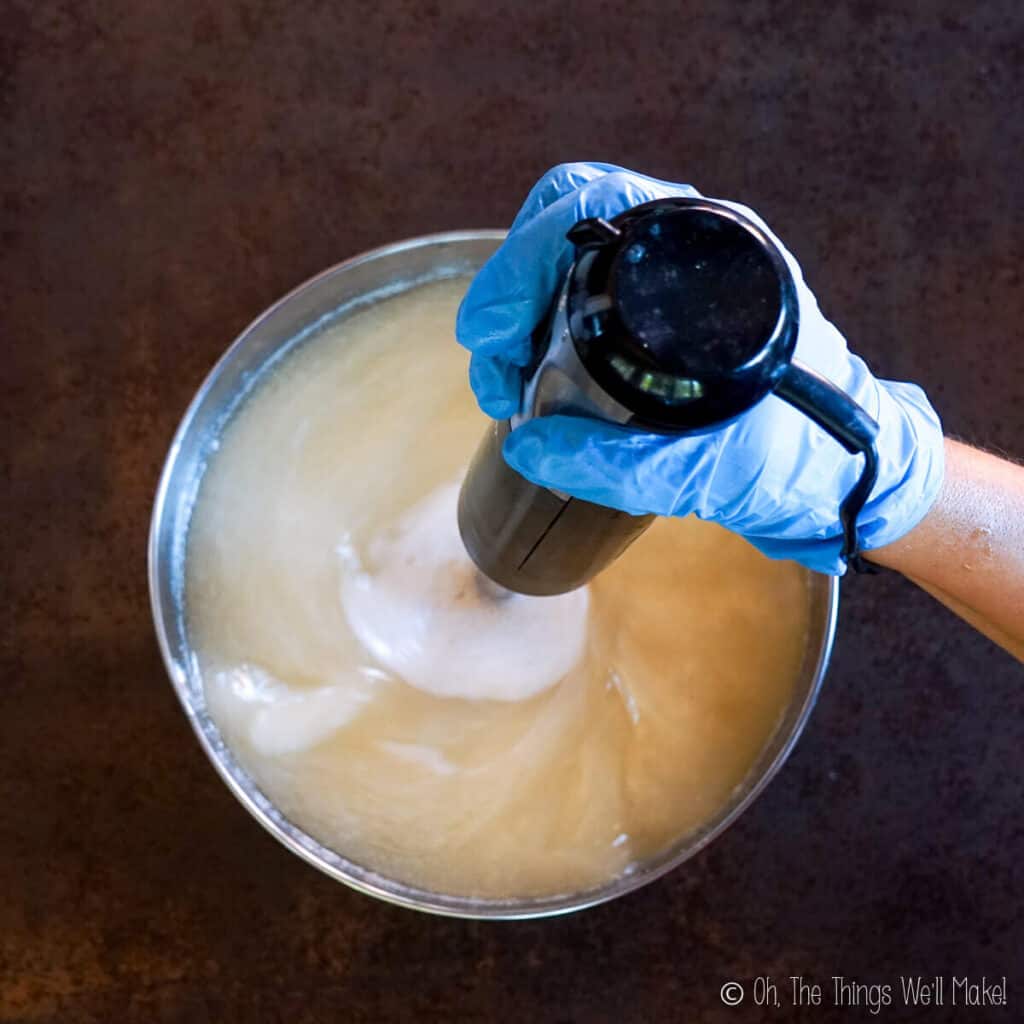
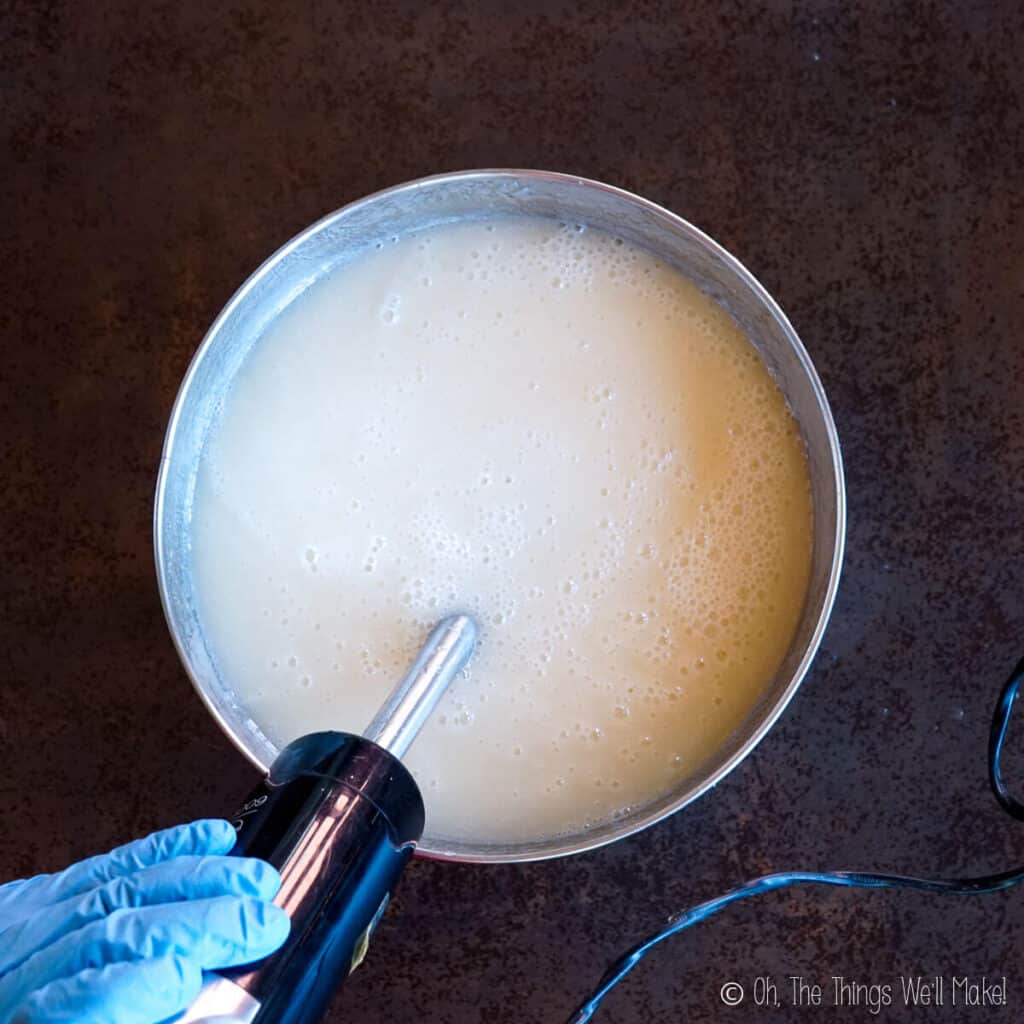
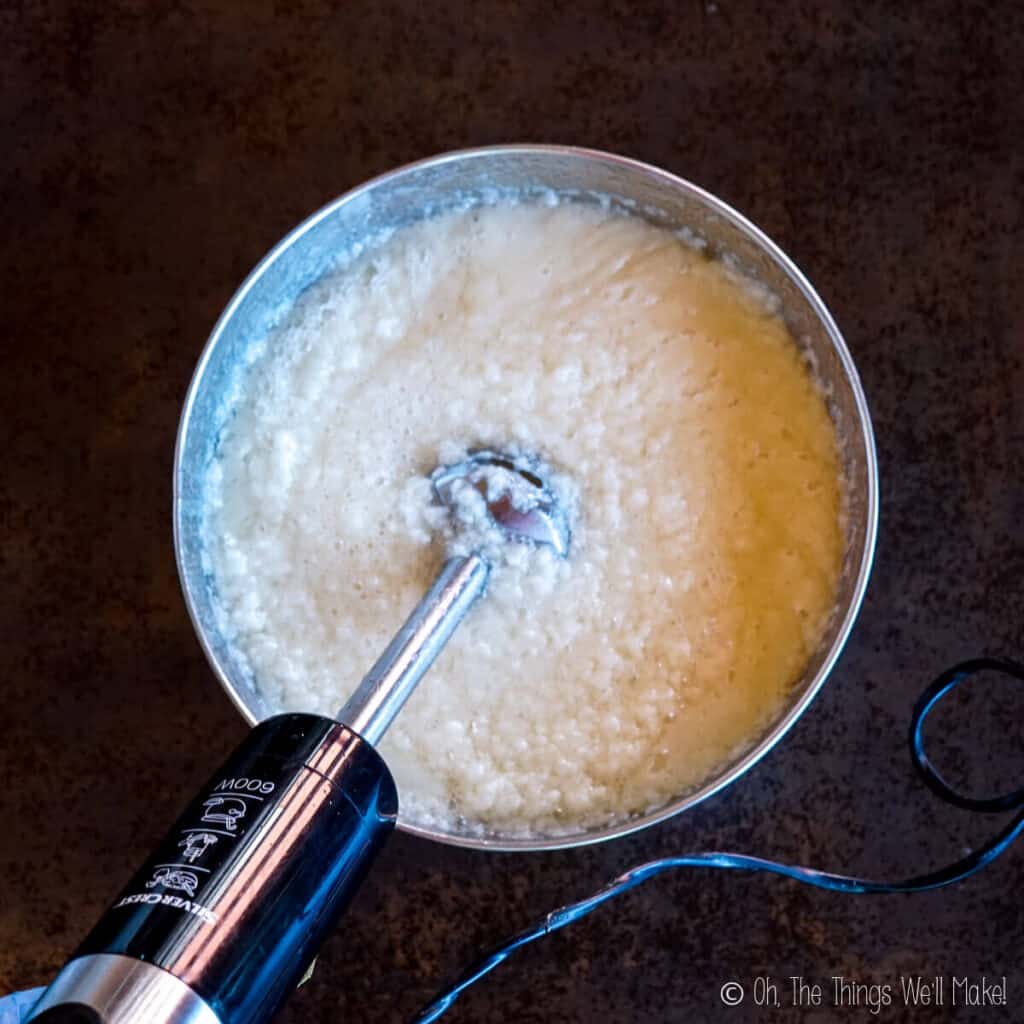
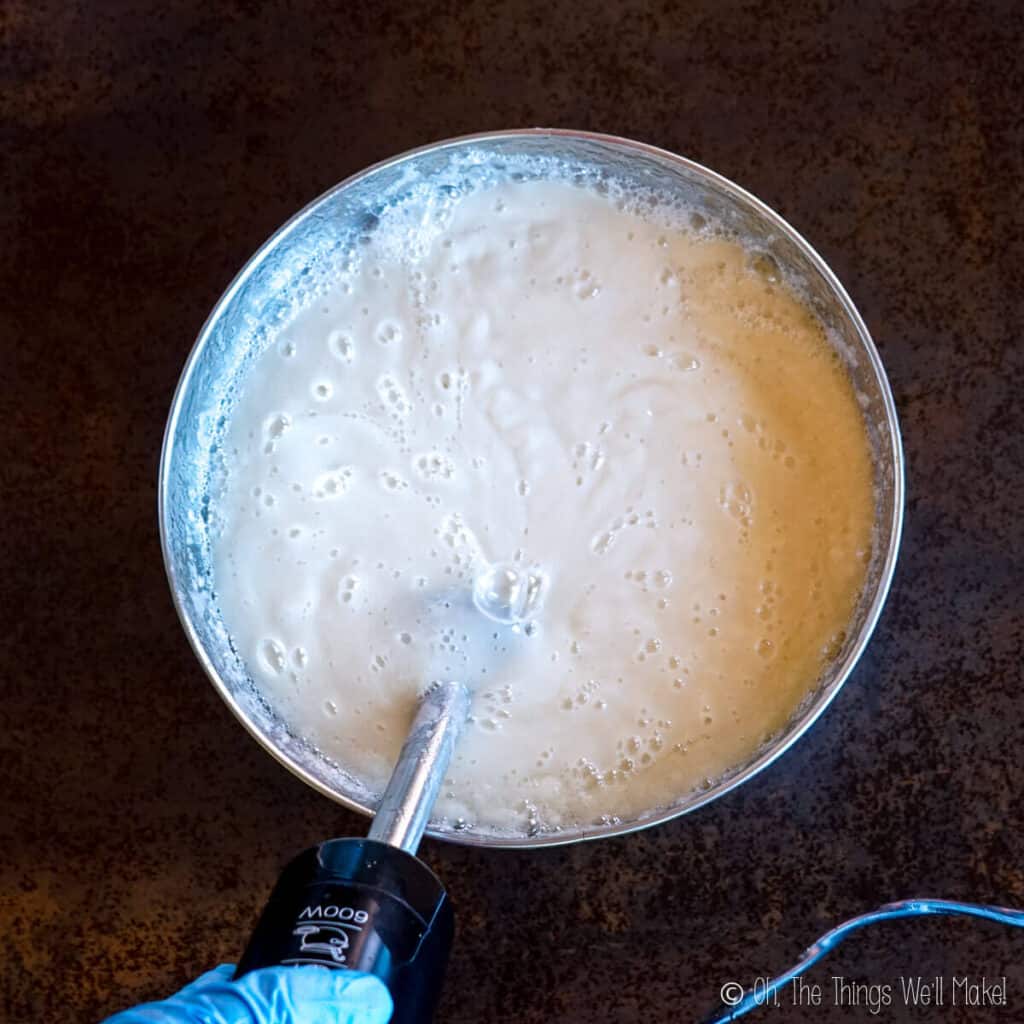
Using an immersions blender, blend the ingredients together. The mixture will begin to thicken after a few minutes. A couple of minutes later, the mixture will probably begin to look grainy. Continue to blend. (You can take breaks to give your blender time to rest. This helps prevent burning out the motor.)
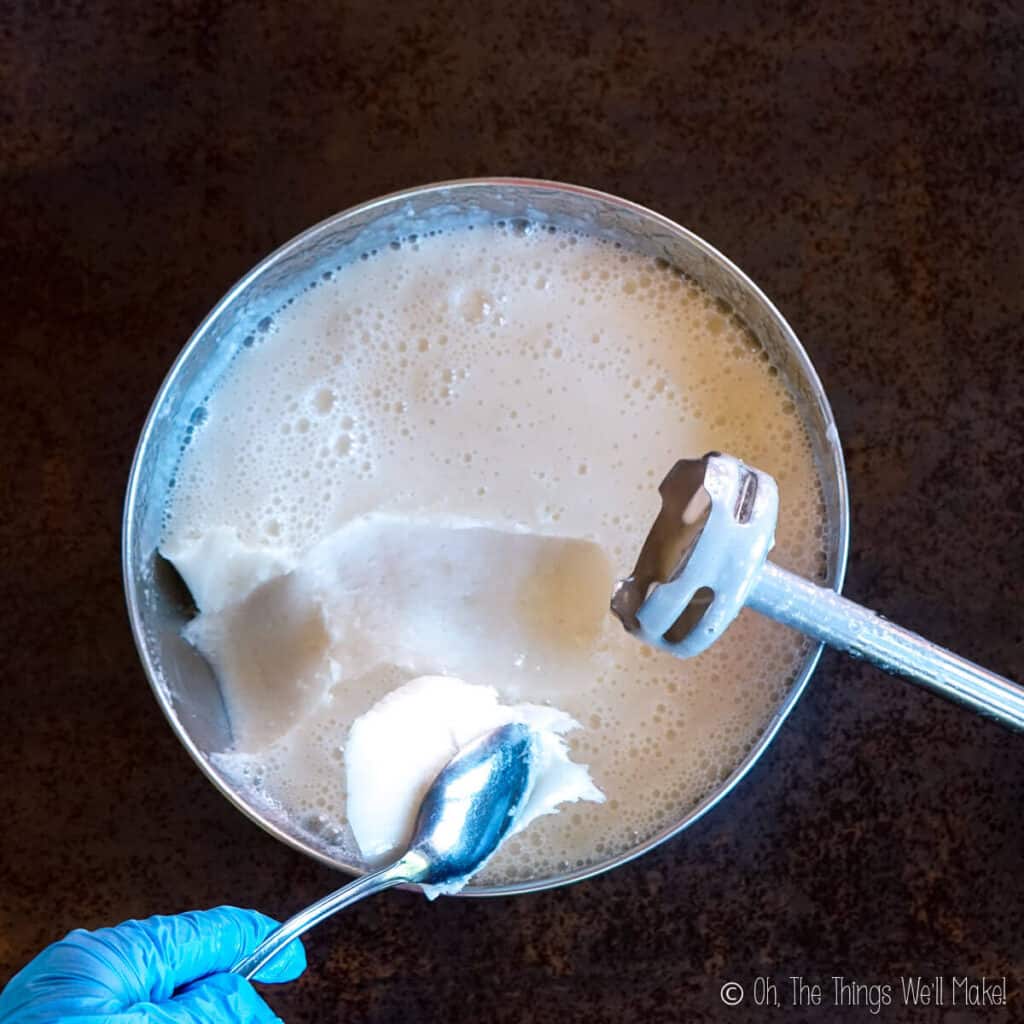
Soon after the mixture gets smooth again, it will start to thicken. At that point, you may want to remove the immersion blender as the mixture turns into a paste pretty suddenly. (You don’t want to burn out the motor of the blender or get it stuck in the soap paste.)
Cooking the soap paste
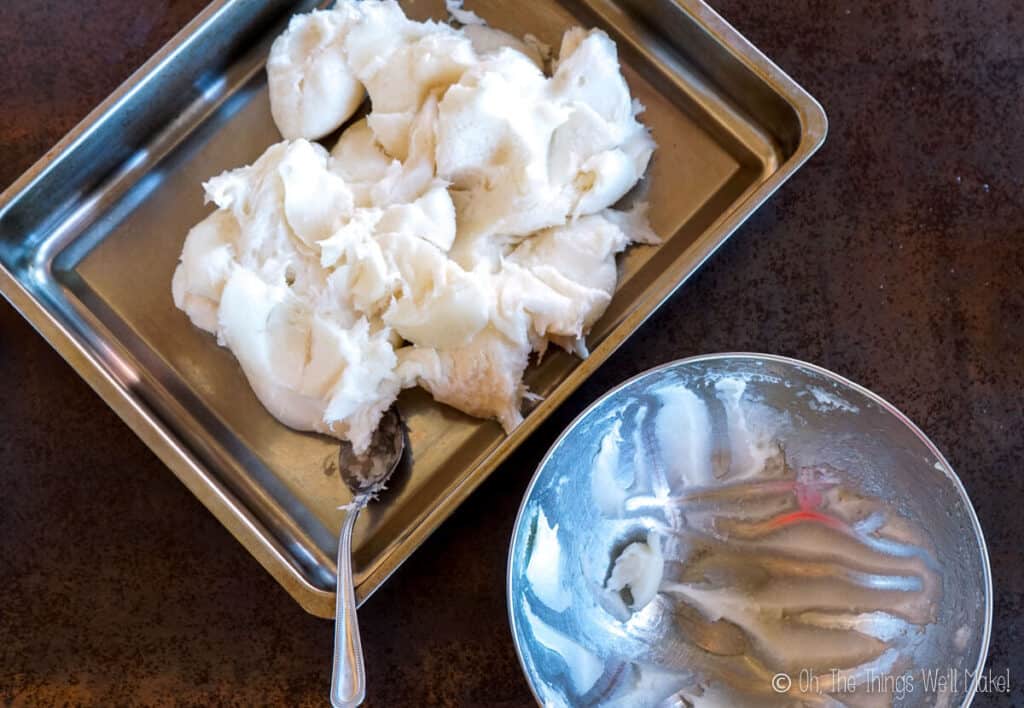
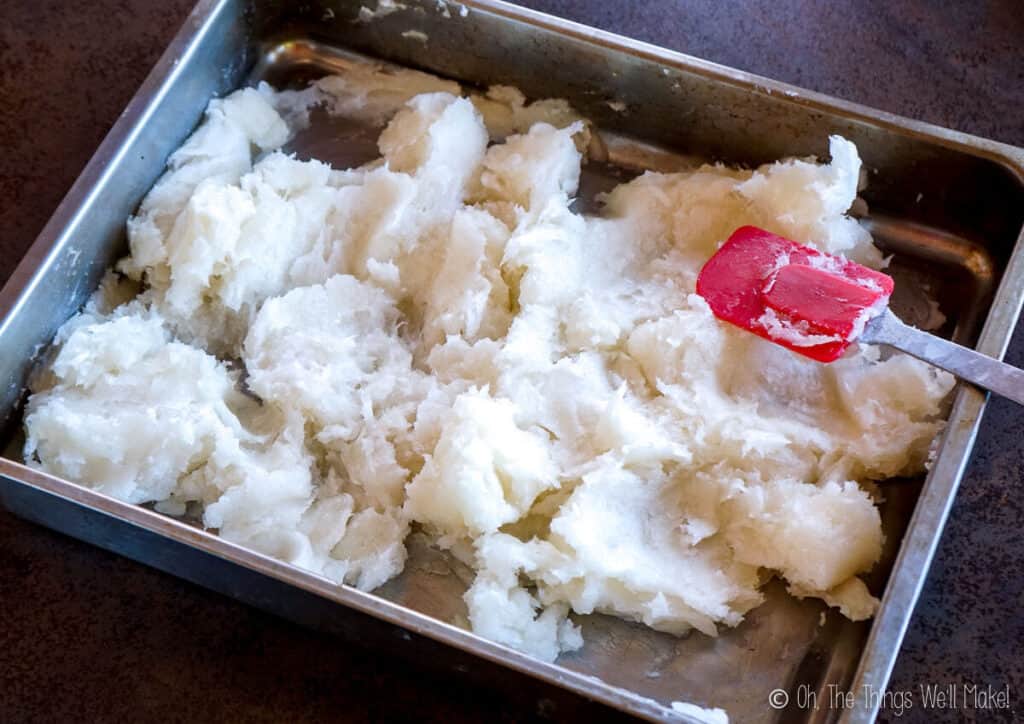
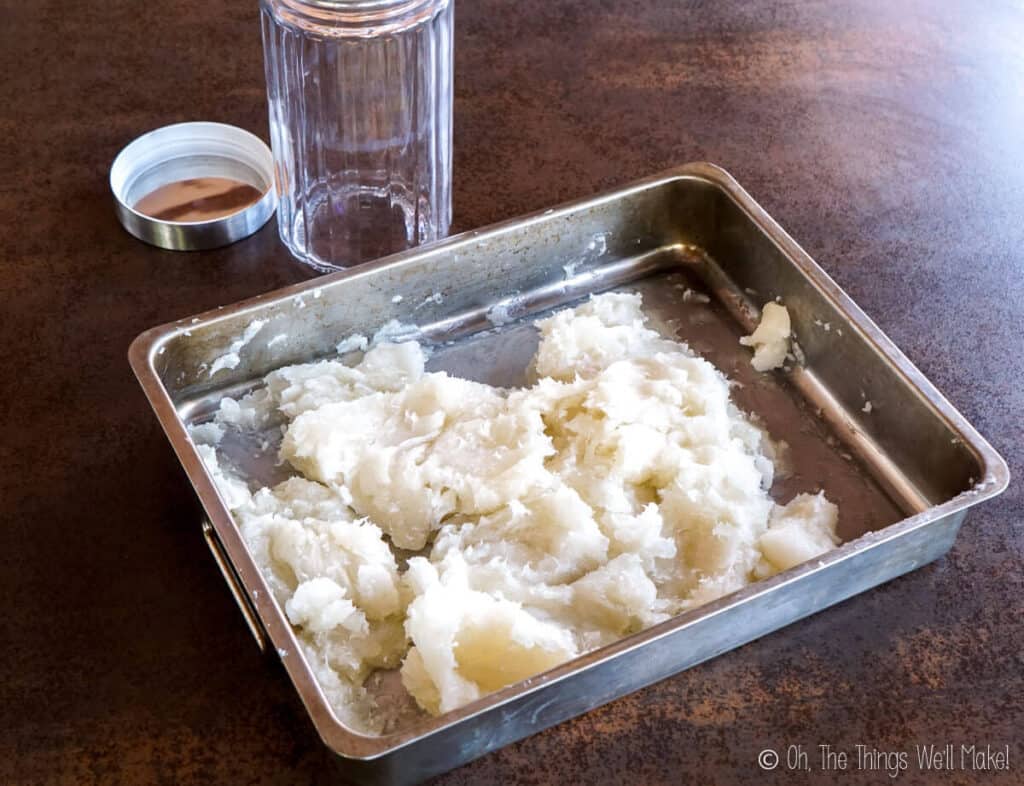
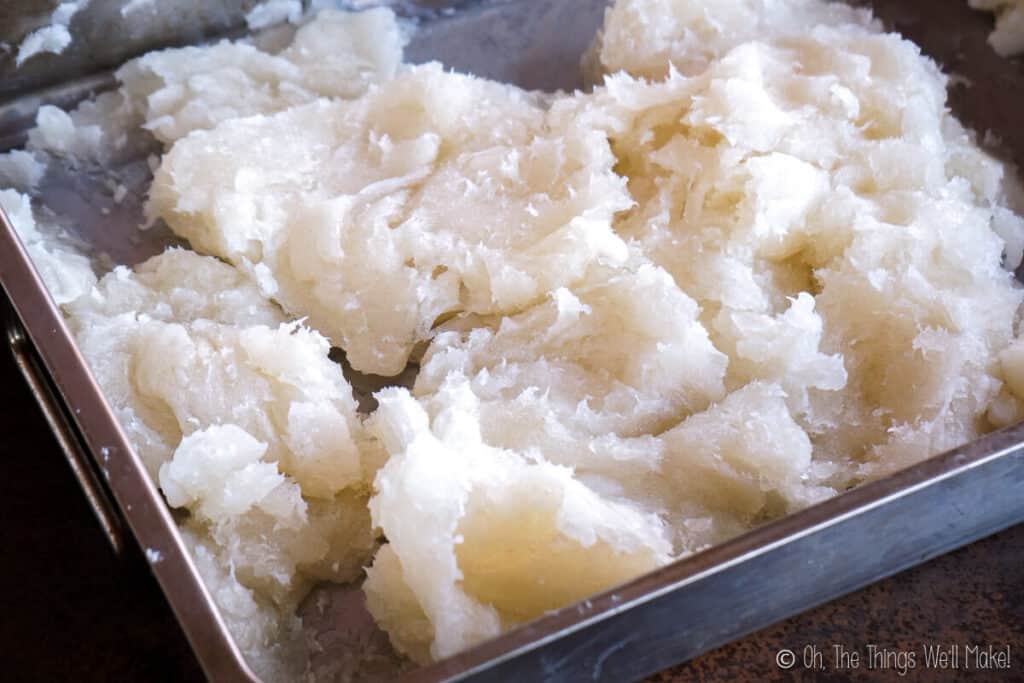
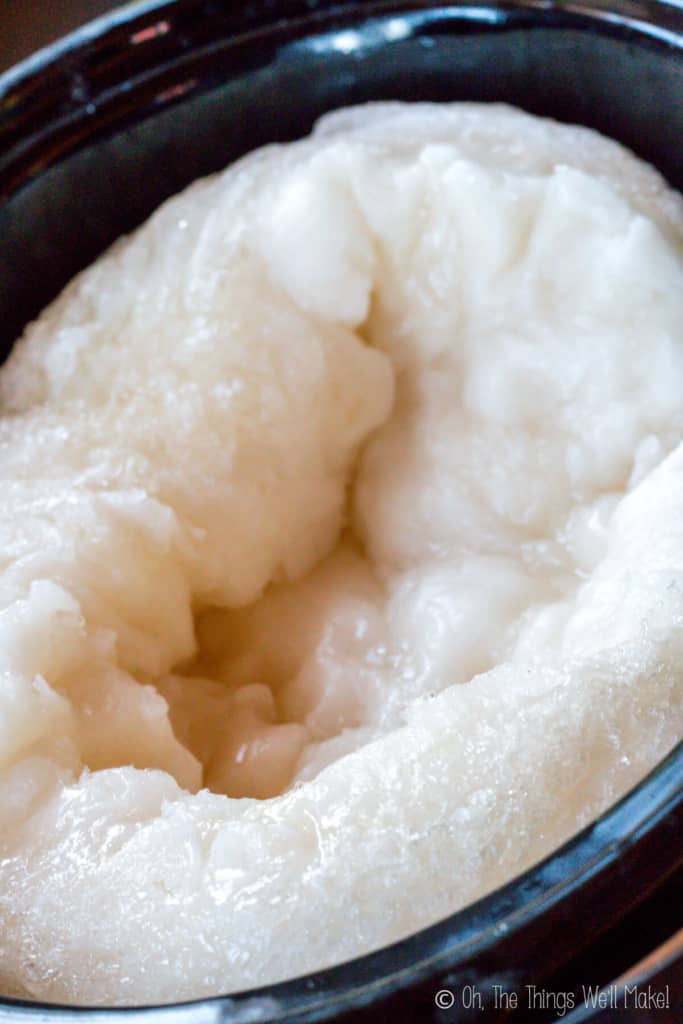
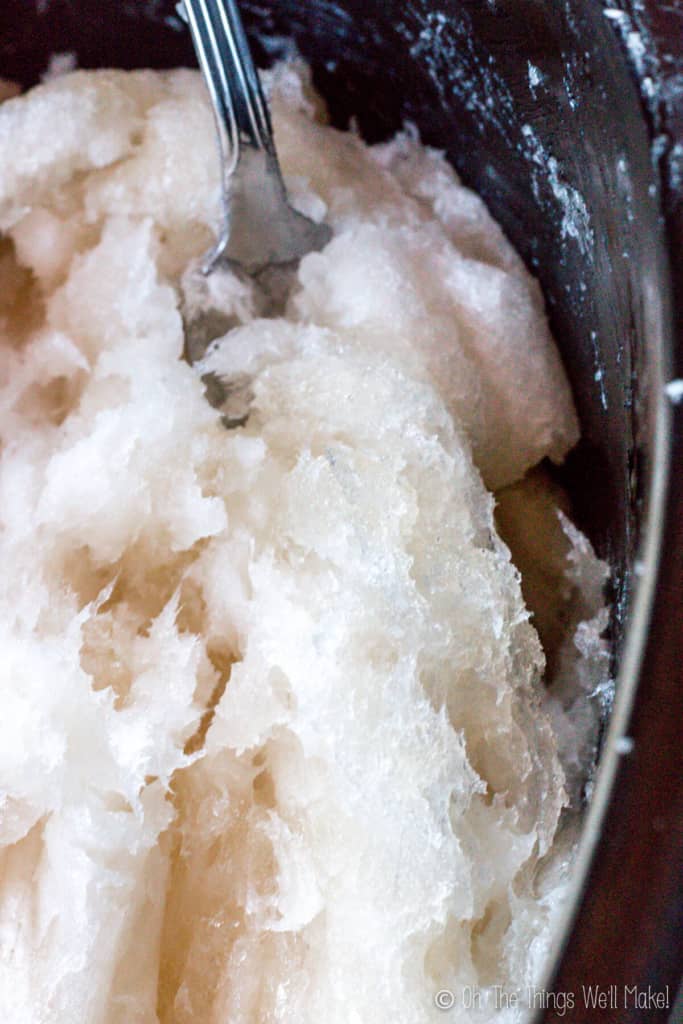
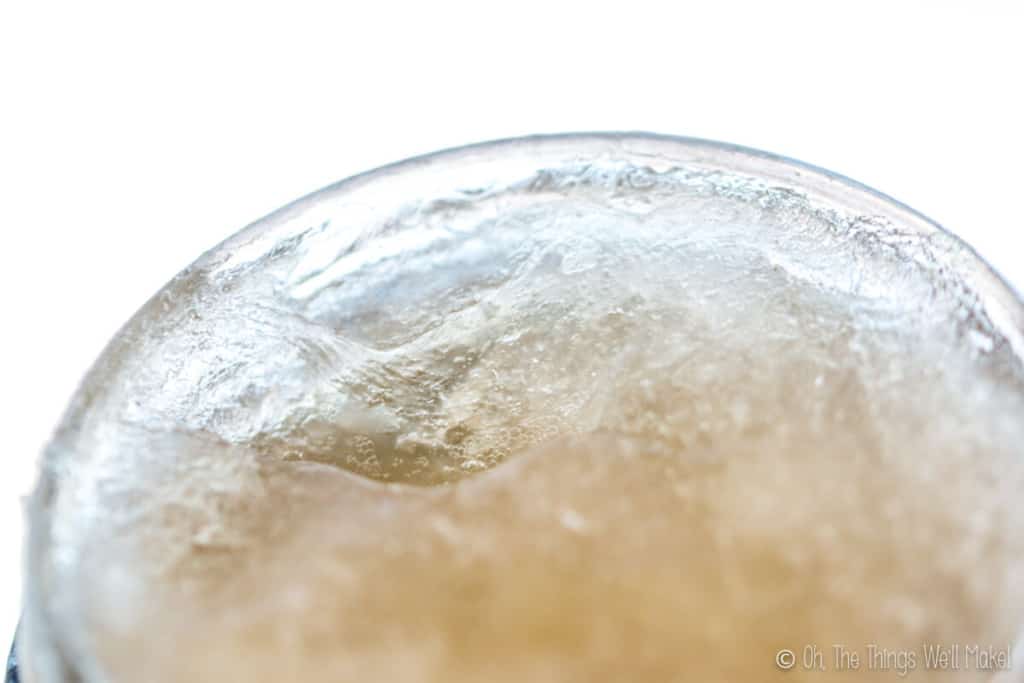
Once the paste has formed, it should be cooked to help finish the saponification process and make a translucent soap. (I’ve tried skipping this step and the paste stayed opaque and the finish soap was on the cloudy side. Even cooking for a short time, though, was enough to get the paste to the point where it could finish the process on its own, with time.)
Cooking in the slow cooker is the best option, if you have one. If you’re using a slow cooker, cover the soap and cook it on low for several hours.
If you don’t have a slow cooker, the paste can be spread out on a baking sheet and baked in the oven at around 70ºC/160ºF. (Ideally, cover the soap paste so that it doesn’t dry out too much.)
I tried cooking my last batch in the oven and my soap paste didn’t get as translucent as it does in the slow cooker. Perhaps, it would have had I cooked it longer and covered it. It may have also helped to increase the temperature slightly. In any case, the saponification process did complete and the soap is safe to use, but it was slightly cloudier than the soap I make in the slow cooker. (See my video!) I’ve found that soap pastes that haven’t gone fully translucent generally improve with time.
Every half hour or so, try to mix the soap paste as best you can. You can flip it over to expose different parts of the soap paste to cook the paste evenly. As it cooks, the mixture will become more translucent. The process will take 3-4 hours.
Check for doneness
There are several ways to test for “doneness.”
One method is to dissolve a small amount of the paste into distilled water, checking to see if dissolves into a clear soap. If the liquid is cloudy, you can continue to cook the soap in the slow cooker for another half an hour before checking on it again. If it dissolves clear, you are finished making the soap paste.
Another method is to use the zap test.
The zap test
To check for safety of the soap, many soap makers rely on what is called the zap test. To zap test a liquid soap paste, run your wet finger over the surface of the paste and then touch your soap-covered finger to your tongue. If the soap is caustic, it gives a zapping sensation. (This has nothing to do with flavor.)
If the soap doesn’t zap (if you can’t tell, it doesn’t), then it doesn’t have any more active lye, and should be safe to use.
If the paste passes the zap test, but is still cloudy, it’s your call whether or not to continue cooking. Cloudiness is generally only a cosmetic issue and may be caused by a number of factors (including minerals in your water). Often, soap paste that isn’t translucent after cooking for a while will eventually get more translucent on its own.
(I once removed part of a soap paste before it was fully cooked to see what would happen, and after a few weeks, it looked just like the rest of the batch that had been fully cooked.)
Once ready, the soap paste can be stored or dissolved into liquid soap as needed.
Storage
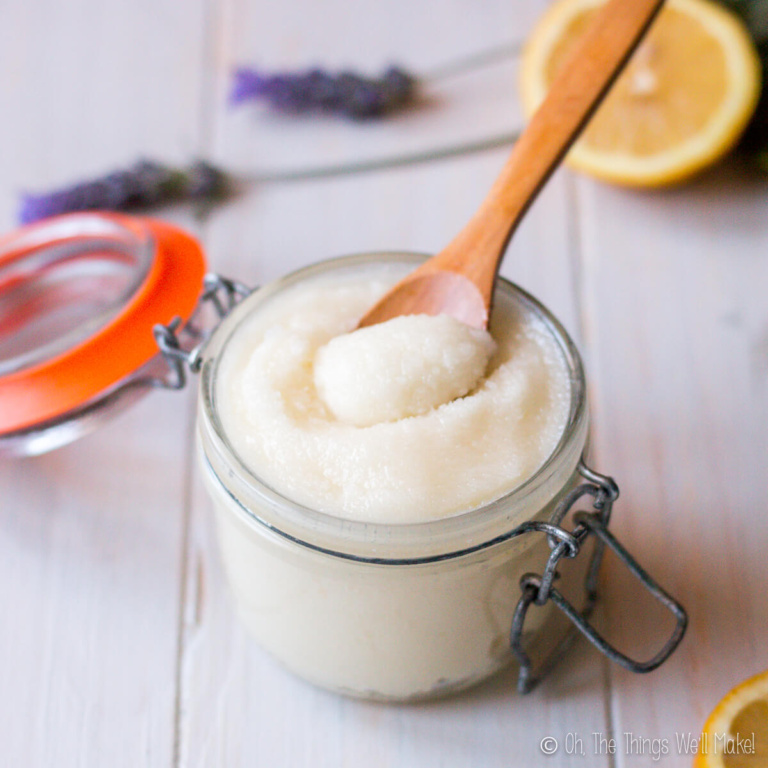
To store liquid soap paste, scoop it into a covered glass or plastic container or in Ziplock type plastic bags. The soap paste can be kept in a cool, dark place for a very long time. (I’ve had soap pastes stored for years without issues.)
Avoid storing in metal containers and avoid contact with metal as certain metals can react with the soap paste and shorten its lifespan. (Don’t ask how I know that. 😏)
Diluting the soap paste
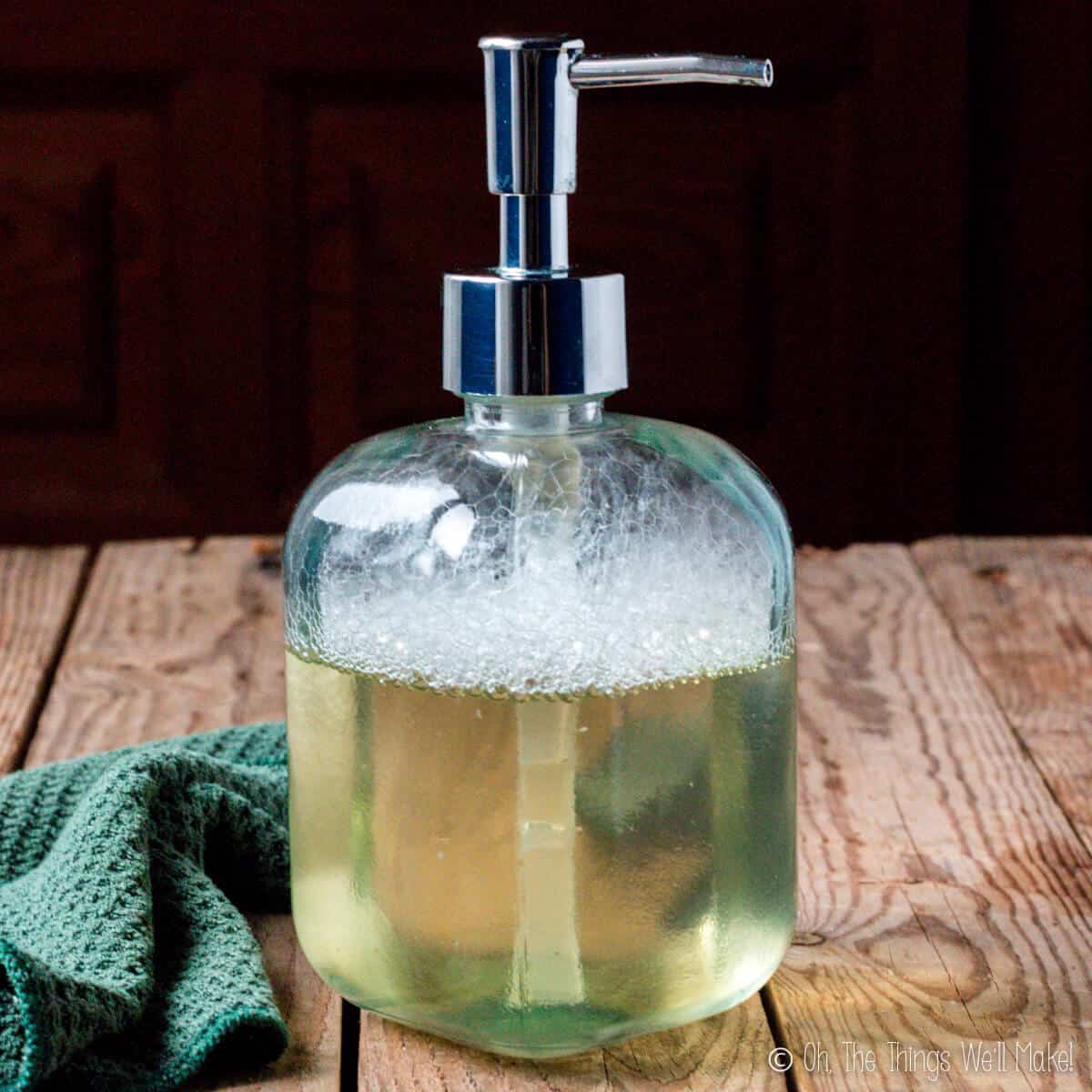
To use the soap paste, it will need to be diluted in water. I suggest using distilled water to ensure a transparent soap. You can add more or less water, depending on the desired concentration. I generally 1 part soap paste to 1-3 parts water.
For fragrance, I also often add a few drops of essential oils to my liquid soap at the time of dilution.
For more information about diluting the soap paste, read my post on diluting soap pastes.
Troubleshooting
Over the years, I’ve had many people writing me with various problems. One of the most common is that the soap isn’t transparent or that the paste doesn’t get clear no matter how long they cook it. There are several reasons that your soap may not be as transparent as you’d like.
Keep in mind that cloudy soap is generally safe to use, it just isn’t as pretty as clear soap. If your soap paste passes the zap test, it should be completely safe to use.
Temperature
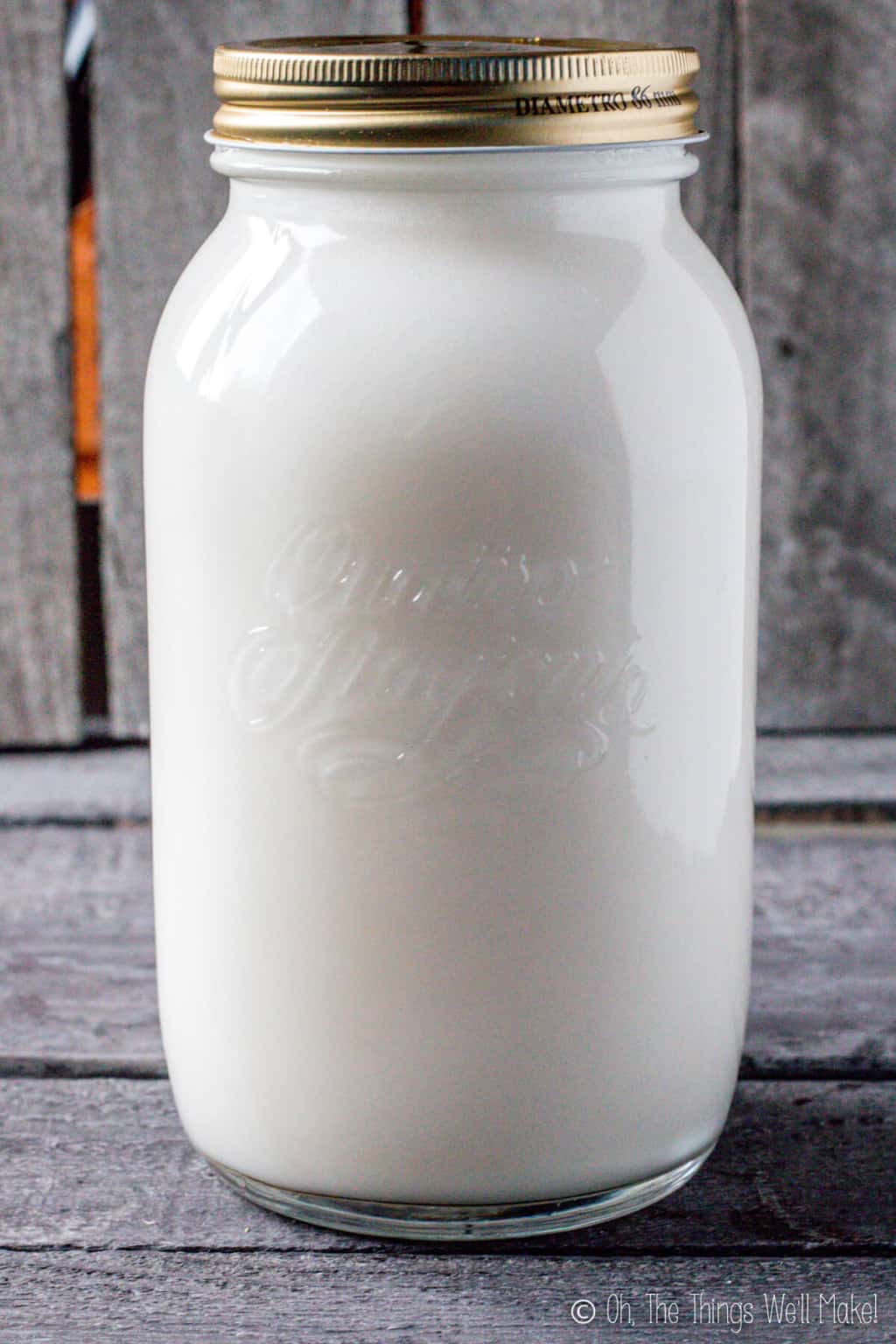
Just as coconut oil turns solid and opaque in cold temperatures, so does this liquid soap, to a certain extent.
My partially diluted liquid coconut oil soap turned an opaque white and thickened up in the winter. When the weather warmed up again, the soap cleared up. This is only a cosmetic issue, but you can dilute it more in the winter than you would in the summer if you want it to be clear.
amzn_assoc_placement = “adunit0”;
amzn_assoc_search_bar = “true”;
amzn_assoc_tracking_id = “nativeads0f-20”;
amzn_assoc_ad_mode = “manual”;
amzn_assoc_ad_type = “smart”;
amzn_assoc_marketplace = “amazon”;
amzn_assoc_region = “US”;
amzn_assoc_title = “My Amazon Picks”;
amzn_assoc_linkid = “79ececd6ba76b6700c7f1df1a7973f22”;
amzn_assoc_asins = “B00H4BZM9M,B001EDK0WK,B00TJTASYG,B004O07LRC”;
Water used
The other most common issue is having used tap water to make the soap. Tap water has minerals and can have impurities that often make the soap look either cloudy or even opalescent.
For other problems, read my post about troubleshooting liquid soap problems.
Video
Homemade liquid coconut oil soap
Materials
- 32 oz. coconut oil
- 8.59 oz. KOH Not the lye (NaOH) used in bar soap.
- 17.77 oz. water
- 8 oz. glycerine
Instructions
Making the soap paste
- Melt the coconut oil. You can do this in a slow cooker or in a large bowl.
- In a large bowl, mix together the water and glycerin. In a separate, smaller bowl, weigh out the potassium hydroxide (KOH).
- Carefully pour the KOH into the water and glycerin mixture (not the other way around). Stir until fully dissolved. It will heat up and go from cloudy to clear.
- Pour the lye solution into the warm coconut oil and begin mixing.
- Use an immersion blender to blend the mixture. It will begin to thicken and may go through a grainy stage. Keep blending until it becomes smooth again and then thickens into a paste.
- Once the mixture reaches a thick, putty-like consistency, stop blending.
Cooking the soap paste
- Cook the soap paste to help finish saponification. If using a slow cooker, cover and cook on low for several hours. If using an oven, spread it on a baking sheet and bake at about 70ºC/160ºF
- Stir or flip the paste every 30 minutes or so to help it cook evenly.
- The paste is ready when a small amount dissolves into clear soap in distilled water.
Dissolving the liquid soap paste
- To make liquid soap, dissolve the paste in water. Start with about 1 part soap paste to 1–3 parts water and adjust as needed.
- Let it sit to dissolve, or use gentle heat and stirring to speed up the process.
Notes
This post was originally published on October 21, 2016. It was rewritten in May of 2021, adding clearer instructions, new photos, and video.
Hi Tracy, can you help please? I made this today and I’m not sure what I did wrong, the only thing I can think of is that I added the KOH maybe not dissolved properly? OR when it was still too hot to the coconut oil which wasn’t hot enough. I am going to remake it as the soap will not dissolve clear and I did the “zap” test and there’s still a sting, I was wondering if the failed soap would be of use for just cleaning or if it’s just to the bin? Thank you.
Hmmmm… I’m going to guess that it’s OK for cleaning. Does it get sudsy?
Ideally, you could check the pH to get more of an idea of what is going on, so you’d have a better idea about if it’s useable for body use.
You can read my post about pH and neutralizing to get more of an idea about my thoughts on the matter.
Hi, thanks for always replying! Yes it does get sudsy waiting for ph strips and will read the other post. Remaking today pretty sure now I didn’t let the KOH dissolve properly also I was also I think I didn’t mix properly because it’s so hard. Will let you know how I go today regards Gina
Hello Tracy, I’m on to your third recipe! Yay. I wanted to ask, I would like to make a half batch of this I don’t expect to use it as much as the Castile, and I haven’t braved the soap calculators yet, do you think I can just half the indredients? ?
Yay!
I’m so glad they’re working out well for you!
Yes, I ran it through a lye calculator, just to be sure, and that is fine.
That said, I thought I’d use them pretty equally, and really use a lot more of the coconut oil soap!
Think about it, for most cleaning purposes, coconut oil soap is the better choice. The only place that the castile soap is the better choice is for body washing, but even there, I end up using almost a 50%/50% mix sometimes. (My husband likes the bubbles and clean feeling that the coconut oil soap adds.) I do tend to use a bit more of the castile soap for body, but not by a lot.
I guess if you only plan on using it for body washing, then halving this recipe is fine, but think about how you’ll be using it first. Once you do the work, you may as well get a decent batch, if you think you’ll use it all. 😉 (Dr. Bronner’s lists coconut il first, which makes me think that it uses more coconut oil soap than olive oil.)
You are right 🙂 I didn’t think it through I intend to use most for the body but if it’s approx 50/50 then I may as well go the whole hog. Thank you for always replying so quickly and your brilliant tutorials!
Oh and I’ll add a quick note, I added the pure Castile soap from your other recipe to a foaming pump and it’s amazing!
Oh, that’s a wonderful idea. I need to find one of those to try it out!
I started out using a lot more of the castile than that, but per my hubby, it has gotten a lot closer to the 50/50 ratio. For me personally, I’d be fine using more of the olive oil soap. I guess it’s all about preference. That said, I find the coconut oil soap is really handy for general cleaning, and plan to make a new batch soon and experiment with using it for more things like laundry & perhaps even the dishwasher.
Thanks so much for posting the liquid soap recipes. I have been fearful of diving in but will now go in with both feet. One question regarding the coconut oil–are you using refined or unrefined coconut oil?
Cheers,
Hi Sojourner,
I can’t remember which one I used with my liquid coconut oil, to be honest. I use both types interchangeably in soap recipes, and don’t see much of a difference, if any between using one or the other. In the past I was only using organic virgin coconut oil (unrefined, I guess), but the only reason is because that’s what is most readily available here in Spain. I’m just now finding refined coconut oil that is slightly cheaper than the virgin coconut oil, and have bought and used it for soaps and lotions.
I’d say use whichever is least expensive wherever you are because in soap, you aren’t really going to notice which one was used.
I do try to use organic ingredients whenever I can, but refined vs. unrefined isn’t a big deal to me either way.
Tracy, thanks so much for the info. I always have the refined on hand so will use that. I also want to say that after an extensive internet search I find that you are one of just a handful of people that use KOH in lieu of the “other” lye for liquid soap–check out all the videos on You Tube for example. Cheers,
You’re welcome! I hope it goes well for you!
Really? That’s so weird.
When I was experimenting, I tried using the “other lye,” and it totally doesn’t work for liquid soap making. You end up with a diluted solid soap! Hmmm
I’ll have to surf the Tube someday when I get a chance. I like to do my thing, and I’m rarely looking to see what others are doing because I’m so busy with all of my projects. hahahaha
I love this recipe. Can the liquid coconut soap be used as Potassium Cocoate for hair shampoo?
Hi Mayra,
That’s a fascinating question.
I know that potassium cocoate is said to be the potassium salt from reacting coconut oil with lye, which in the case of potassium cocoate must be potassium hydroxide. So, my immediate thought was yes, but I had a doubt because many places that sell it call it a salt that is similar to soap!?! If it’s reacted with lye, isn’t it just soap?!?
I did find this discussion in a soap making forum which talks about making potassium cocoate, and they do believe it to be the same thing. So, I’m going to go with my gut feeling and say that, yes, I think it is probably the same thing, but I wouldn’t bet everything I own on it. 😉
I’ve been curious to add some of these liquid soaps to a homemade shampoo of sorts. Coconut oil soap can be drying, so I’m guessing it’s used in small amounts in the recipe? (I guess you’ve piqued my curiosity as to what sort of recipe you’re trying out.)
Hi Tracy
Well after my first attempt at making the olive oil castile soap and then having to rebatch it since I used lye instead of KOH; I finally got around to making the castile soap with the coconut oil.
Everything went just as you outlined…my only issue is that after 6 hours of ‘cooking’ in the crockpot later, my soap is still not dissolving into a clear liquid.
It is very cloudy albeit very sudsy! ?
Even though I brought it into the warm(er) house from the garage and left it near the oven as I was baking all day and used warm water to dilute it…the soap is very cloudy.
Do you think that it has to do with the cold weather? Or should I continue to cook it longer?
Theresa
Update:
Hi Tracy
Well I took it out of the crockpot after 9 hours as it was getting pretty hard to stir. The color of the base paste is as beautifully translucent as your picture if I do say so myself ?. All due to your great tutorial!!
I’ve diluted some and it is staying nice and clear! I have to say I’ve never been so excited about soap before! I will be making the olive oil castile soap tomorrow so I can begin my experiments on mixing ratios.
Thank you so much for your great posts! You’ve made everything so easy to follow and your responses to questions are so very helpful!! Keep up the good fight and know that you’ve got someone in San Diego that appreciates you and all you do!
Oh and btw – I made a 3 serving batch of your recipe (I have a small crockpot) and that yielded just over 2 pounds (32.9 oz/1161 g) of the base soap paste.
Theresa
You caught me in the middle of the night here, so I couldn’t get back to you right away!
I’m so glad to hear that in the end it turned out well!
It may just take a little bit longer to get the process to work in the winter. I had planned on making the castile soap again myself this week so I could make a video of the process, and so I could get a feel for the process again to better answer any questions, but we’ve had pretty bad weather, and I have everybody home with me, so I haven’t had much time for blogging!
Thank you so much for your kind words and for letting me know how much soap paste you ended up getting, too. That should really help other people out. That was one of the other reasons that I wanted to make another batch soon. 🙂
I realized the time stamp when I posted and wanted to give you updates to save you some time answering my questions/dilemma.
I read and reread your blogs often and saw that several people have asked about the quantity of soap paste this recipe produces. I just wanted to offer this tidbit of info as the least I can do when you have already provided such great tutorials!
A quick add for your research notes for making this soap during the winter is that I used a small crockpot (4 quarts) and had it set to the low temperature setting the entire cooking process.
Thank you so much again Tracy for your great tutorials…I’m off to make the pure olive oil castile liquid soap now!
All the best from San Diego!
Theresa
I have been making body wash by mixing Dr Bronner’s with coconut oil, shea and cocoa butter and at first, I had problems with solidifying, but then found out via making lotions with coconut oil, that adding liquid vitamin E, Jojoba, and Sweet Almond or Grapeseed oils keeps the coconut more liquid. Even if kept refrigerated, it never goes completely solid so long as you mix well. I want to try making my own body wash from scratch so I can say I made it all myself, and these seem like the perfect start. I will likely attempt to make both then mix them and add in all my extra goodies that have found are a dream in the shower (and for shaving.. SMOOOTH!) FYI, this will be my first ever from-scratch attemps as soon as I can restore my ingredients list (christmas did me in with lots and lots and lots of lotions, soaps (from melt/pour base) and chapsticks) Thanks for sharing!
Hi Elizabeth,
Interesting. I have never tried mixing this with more oils for a body wash. I guess it was because they always warn not to add new oils in because you’ll end up with a cloudy soap, etc., but I guess it doesn’t really matter when you want to make something like a body wash.
I love making all of those types of products at home, too- it’s lots of fun, and I also love being able to say that I made everything from scratch.
I hope it goes well for you! Good luck, and I’d love to hear how it goes!
Hi Tracy, before I rush out to buy an immersion blender, may I know if the blender is really necessary for making liquid soap (both coconut and olive oils ones)? Tia !
Hi Magdalene,
While it isn’t really “necessary” per se, I’ve always heard horror stories about how long it takes to reach trace without one. I’ve personally never tried it, though. You are braver than I am. 🙂
That said, I feel like the heat used in the liquid soaps would help you get to trace more quickly, so it may be possible without too much hassle. The coconut oil liquid soap got to a very thick mixture more quickly than the olive oil one, so if I were going to try one without an immersion blender, I’d start with that one first.
If you do try it, I’d love to hear how it goes.
Hi!
It worked! I got the correct ingredients, and now I have a crock pot full of lovely soap paste! Next I am going to make the castille soap.
Thank you for being so generous and sharing your recipes. I love being able to do these projects with my children, to teach them about self-sufficiency, and to provide them (and my family and friends)health and beauty products that are chemical free.
Warmly,
~Annmarie
Hi Annmarie,
Yay!
I’m so happy to hear that! I think that’s a great message for your kids. I always try to be as chemical free and self sufficient as I can (without going crazy) too. 😉
Hi! I tried your basic CP soap recipe a couple of weeks ago, and I think I made soap! This time…no so much, I think.
When I mixed the lye/water/glycerine into the melted coconut oil, all was progressing as you describe. After the oil/lye mixture became super thick, I let it sit (uncovered) for about 20 minutes. There was trace on the sides when I checked it, but when I stirred it, the top was dry and the bottom liquid. I stirred it together and it became crumbly (I put the lid on now). It’s been an hour – still crumbly. I added a couple splashes of distilled water.
Can the batch be saved or is it ruined?
Hi Annmarie,
I’m sorry you are having issues.
Are you using the same lye as you were using with the cold process soap? That’s my guess as to what your issue is form your comment, but I could be misunderstanding.
For liquid soap, you need to use KOH or you will end up with a solid bar of soap instead of a soap paste for liquid soap. I can try running it through a lye calculator to see what sort of bar soap you’d end up with if that’s what happened.
If we can pinpoint the issue, you should be able to use the soap no matter what happened. I can try to help you out so that you’ll have something useful.
You may not end up with a normal liquid soap, but we should be able to get you a soap that is usable for basic cleaning around the house (laundry soap, household cleaning, etc.).
If you do end up with a solid soap, by dissolving it in water, you’ll also end up with a useable “liquid soap” that is like dissolving a solid bar in water. Other ideas are grating it and using it in a homemade laundry soap.
It’s never fun to have a soap batch go wrong, but if you’re going to have one go wrong, this is the best one. Coconut oil soap is so useful for household cleaning.
I need to get around to making a post about re-batching soaps when things go wrong. I’ve been able to save several mistake batches that way. Meanwhile, I’ll try to help you out however I can. OK?
Hi Tracy,
Thanks for the feedback! I wound up tossing out the batch. It was getting gooey when hot, rock-solid when cooled. Wouldn’t dissolve, nor did it produce bubbles. The PH was 14. I added water, then some fractionated coconut oil. Still wouldn’t melt.
I used the same KOH both times. I think the problem happened early on. My glycerine/water/KOH mix never completely cleared. And the coconut oil wasn’t completely melted. I’m not sure if either conditions really matter, I’m pretty much guessing.
Your thoughts?
(I’m still going to try to make the castille soap tomorrow.)
I used sodium hydroxide!! Drat! That’s why it turned to stone.
Thanks for the feedback! When you mentioned the KOH, I realized I never checked what I had.
Will try again once I have the correct chemicals.
Now that this happened to you, I’m glad you let me know because it makes me aware that I haven’t made it clear that there is a difference between what is used between liquid and solid bar soaps.
I have a pretty busy day today, but I’ll try to remember to look over the post and better explain that tomorrow.
It’s too bad that you threw it out. It would have probably made a good household cleaner so that your ingredients wouldn’t go to waste, but I completely understand the not wanting to keep a batch that is a gloopy mess. I’m not sure why your mix didn’t produce bubbles. I’ll try running the recipe through a lye calculator tomorrow and see what happens to the recipe when NaOH is used instead of KOH. It may need more of one thing or another to get a useful soap, but usually when you find out the source of the problem, you can rebatch the soap and add in the things that you need to fix it. It doesn’t turn out as perfectly as a soap made the right way from the get go, but you can at least save yourself from having to throw out ingredients.
If you have any questions or problems along the way, I will try my very best to help you out.
Thank you so much! This is incredibly helpful.
Ha! I couldn’t sleep without checking it out.
So, for the amount of olive oil, you would have needed 4.33oz of lye (NaOH) to neutralize the oil exactly.
You, of course, used more (6.5 ounces) if you followed the recipe. So, your soap will be lye heavy, with unreacted lye, and would be really irritating to skin, but it may or may not be useful for some cleaning applications as is.
You can rebatch it, though, to give you a more useful soap that can be used for body too.
To rebatch it, you’d need to warm it up again. You’ll also need to add some water to get it to a mixable consistency (how much you need depends on the consistency you have now). To get an ideal bar soap for the amount of lye you used, you’d want to use 51 ounces total of olive oil. You used 32 ounces, so you would need 19 more ounces of olive oil.
You’ll want to mix the oilve oil with the soap you already made as evenly as possible, with a hand blender if possible, and then pour the new soap into soap molds and allow it to set until hard. You’ll end up with a bar soap that will be a bit more rustic looking than if you had tried making bar soap from the beginning, but it will be useable. I hope that helps you!
How much heat is given to melt oil and also while continue cooking the paste ?
We should add lye when the oil is in the heating process right? Or we should take out the oil from the heat and we have to stir the lye in oil ?
Hi Prabanjan,
I use the lowest heat setting of my slow cooker throughout the process. There is no need to remove the oils from the heat source when you add the lye. Just do so carefully. If you were to add any delicate ingredients that could scald, like milk or something like that, you definitely wouldn’t want to mix them together over the heat source, but if you make the recipe as written, it’s fine.
The low setting on my crock pot is around 190ºF/87ºC. If you aren’t using a crock pot, then I probably would remove the oils form your heat source when adding the lye- not because it’s necessary, but it’s probably easier to carefully do it that way. Other methods include using a double boiler or baking the paste in the oven at a very low heat setting. In either of those scenarios, it’s just easier to remove the bowl with the oils to add the lye. I hope that makes sense.
Thank you so much…
Hello …
How to turn this liquid to thick liquid soap??
Great post Tracy! Thanks for sharing 🙂