

Natural Homemade Deodorant for Sensitive Skin
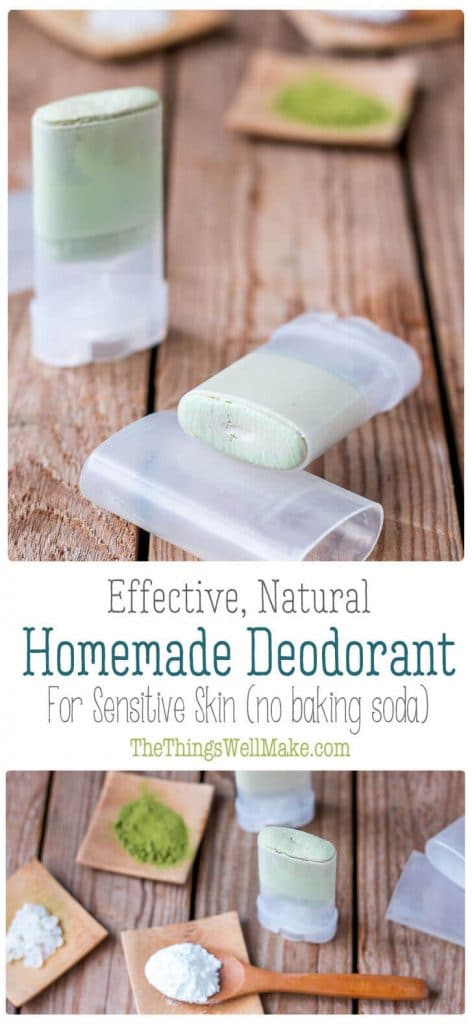
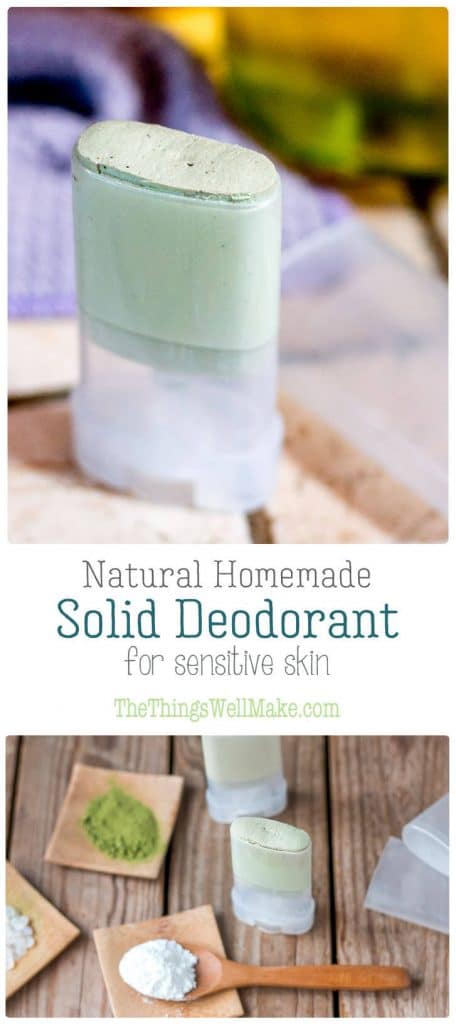
Soothing, yet effective, this natural homemade deodorant stick works without baking soda nor coconut oil and uses zinc to help combat odors for those with sensitive skin.
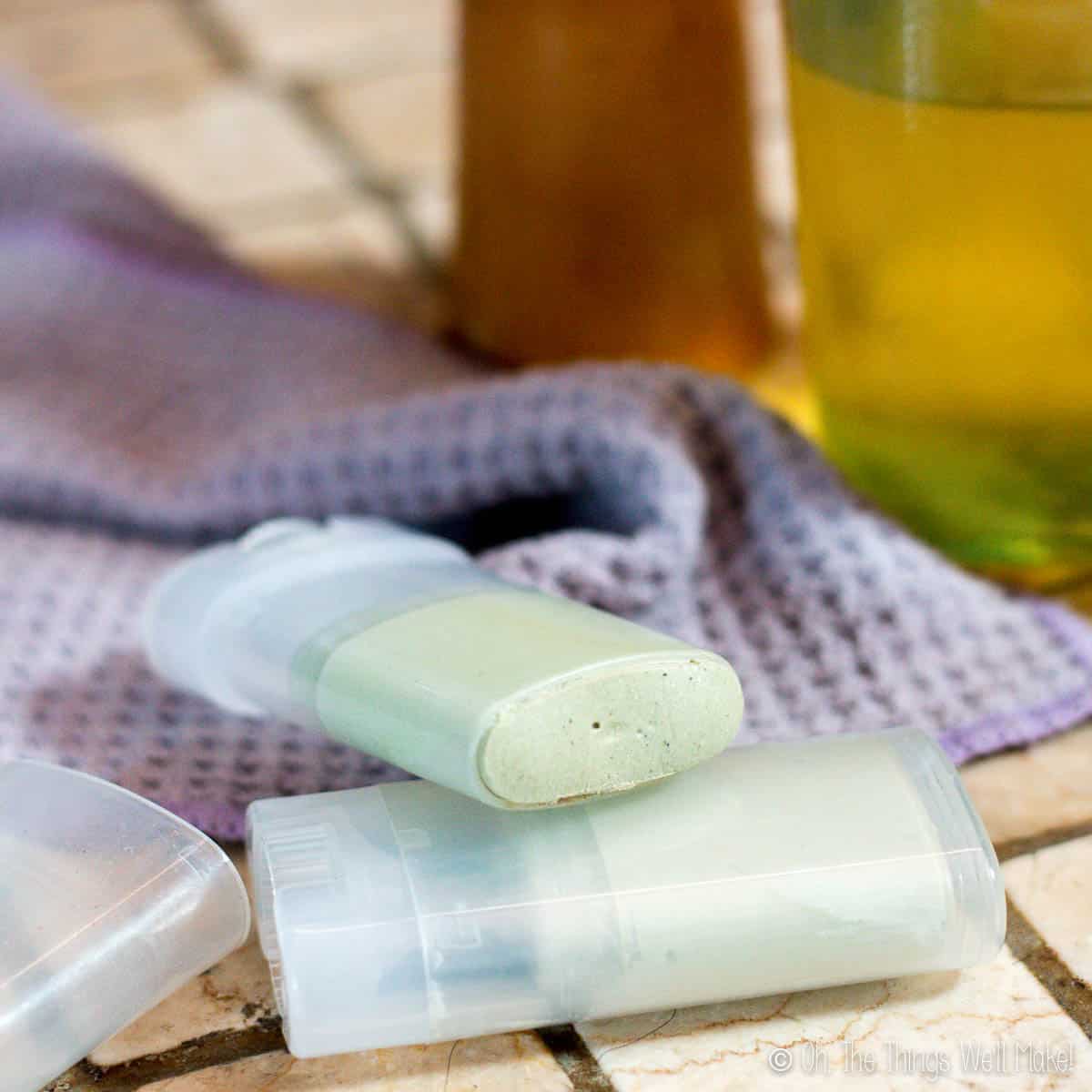
I’m so excited to finally be able to share with you a natural, homemade deodorant for sensitive skin that actually works!
(Before I tell you about my homemade solid deodorant, I wanted to let you know that I also have a roll-on deodorant recipe! My husband loved that one. This one, though, this continues to be my favorite.)
Over the years, I’ve tried so many different natural homemade deodorant recipes, but all of them were either ineffective, irritating to my skin, or just plain too messy to use daily for the rest of my life.
Can you relate?
Natural homemade deodorants that didn’t work (for me)
I’ve been on the search for a decent natural homemade deodorant for years now. Long before I started living a more natural lifestyle, I even had issues with a lot of “normal” deodorants not working for me.
I tried everything. I tried detoxing and eating mostly fruits and veggies after hearing that body odor is often diet-related. I tried supplementation, but that didn’t seem to help either.
For a while, I even used a strange deodorant that I found here in Spain. It was a conventional deodorant, meant to last 2-3 days without needing to reapply, but I was using it daily. That, of course, concerned me a bit.
Crystal deodorants
I wanted something more natural, so I turned to those weird crystal deodorants that you have to get wet with water and then apply under your arms.


Unfortunately, not only did I find them messy, and not 100% effective, but I ditched the idea when I learned that the active ingredient was an aluminum salt. The main reason I wanted to ditch conventional deodorants was to avoid toxins like aluminum.
Many will call me irrational and argue that they are perfectly safe, but why take the risk, especially when I have cancer and Alzheimer’s running in my family?
Coconut oil + baking soda
In the search for something that was aluminum-free, I turned to what seems to be the most popular DIY deodorant: coconut oil and baking soda.
At first, it seemed to work well. After a while, though, the baking soda started to really irritate my skin. That was especially true when exercising or even at certain times of my cycle. I’d end up with very red and sore, chaffed armpits.
If I ditched the baking soda and just used coconut oil (whose antibacterial properties were supposedly enough to work as a deodorant alone), it was as if I hadn’t applied anything at all. Coconut oil did absolutely nothing for me other than leave me feeling a bit oily.
Baking soda-free deodorants
Because baking soda irritated my skin, I tried deodorant recipes that were baking soda-free.
Most of the recipes used coconut oil and replaced the baking soda with clays (like bentonite clay), essential oil mixtures, or both.
The clays were chosen to help absorb the moisture, something that I wasn’t as worried about. The essential oils provided antibacterial qualities that were supposed to help combat body odor. While they did help somewhat, they definitely weren’t enough to keep odors away. (My husband confirmed my suspicions and let me know how ineffective they really were!) 🙊
At one point, I even spent a small fortune buying the ingredients for a natural homemade deodorant that used neem oil. It was supposed to be extra effective. Unfortunately, it smelled so bad that it smelled worse than the body odor that I was trying to avoid! Plus, it didn’t work!
The mixture of neem oil and body odor was nauseating enough that I couldn’t sleep well the first night I applied it.
Back to the drawing board…
What did work (kind of)?
Baking soda is an effective deodorant because it alters the pH under your arms, making it a hostile environment for bacteria to form. In the case of baking soda, a base, the pH is raised enough to help combat body odor.
Baking soda & water
Baking soda was irritating to my skin, but it did work for me, so I decided to try again.
I thought that it was probably the abrasive nature of the baking soda that caused me problems. So, I filled a roll-on deodorant container with baking soda, dissolved in water, with a few drops of essential oil, and tried using that.
It actually worked pretty well and, most of the time, it wasn’t even irritating to my skin! I did have an occasional flare-up, but usually, months would pass between them.
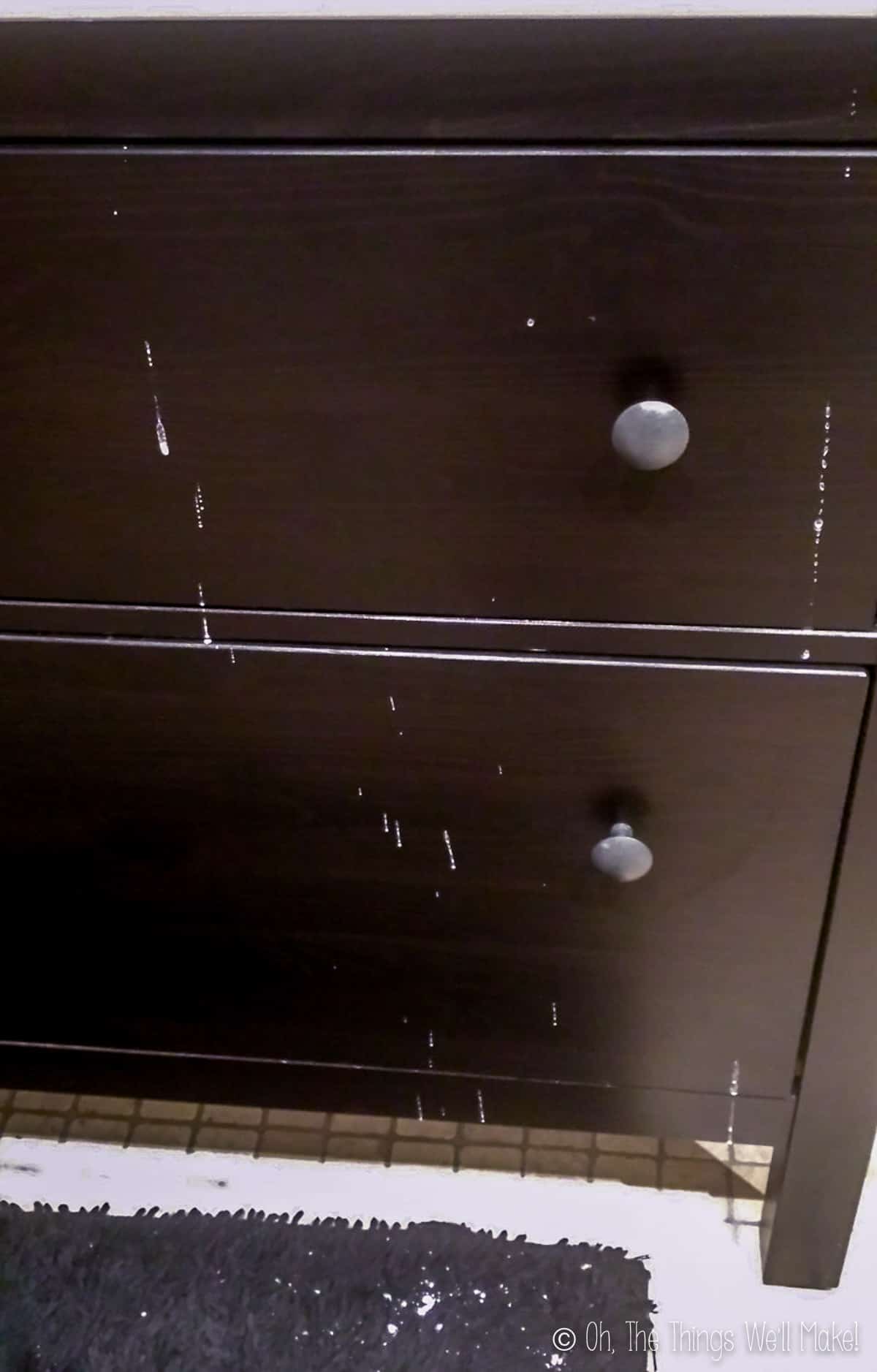
It wasn’t this messy every day, but I often found white drips like this in my bathroom after using baking soda and water! 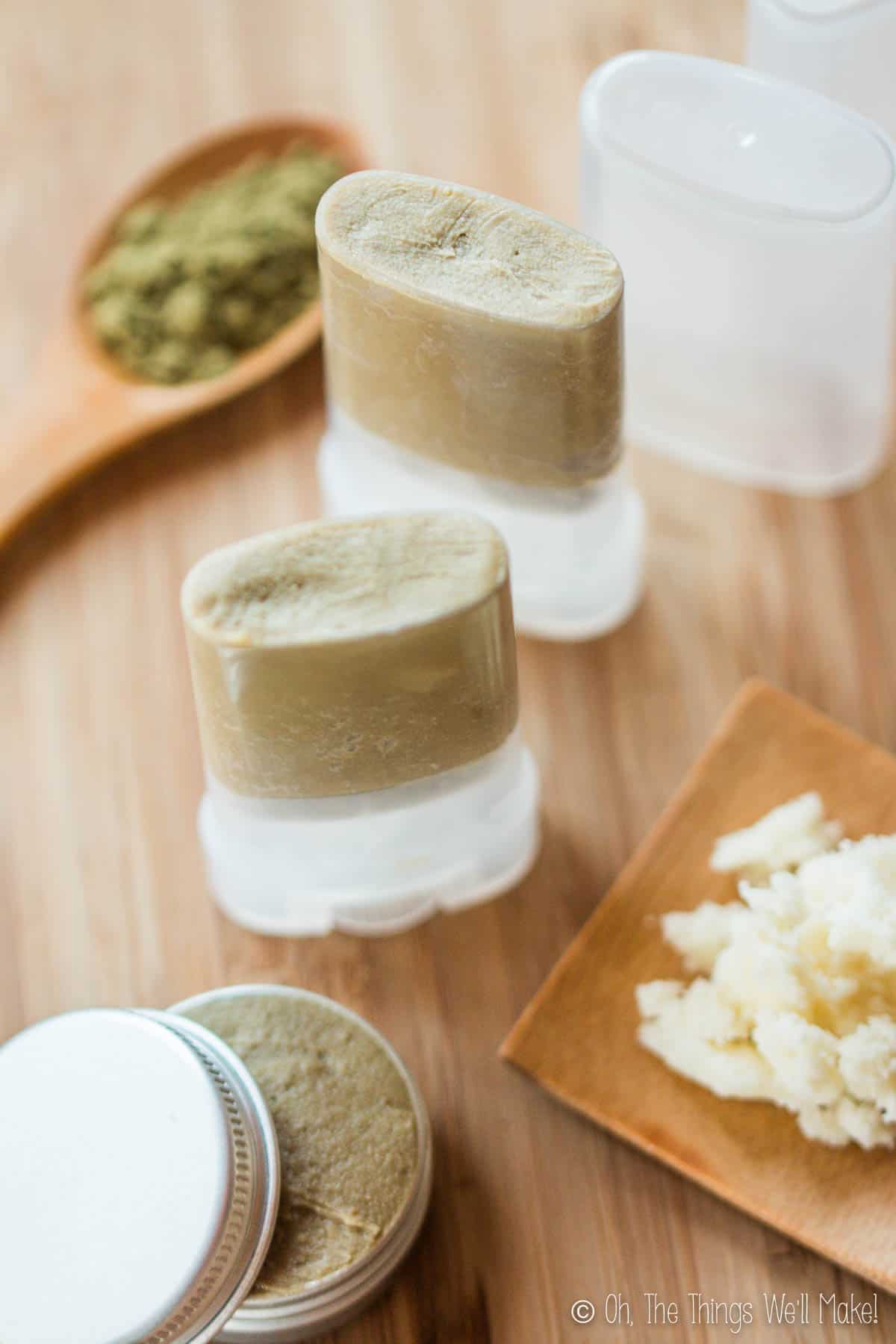
This was a homemade baking soda deodorant that I used for a while.
The real problem, though, was that it was very messy to apply.
The baking soda solution was completely liquid, so it usually ended up all over the place. It dried leaving a white powdered mess behind.
I got sick of always having to clean up afterward, and my husband started to complain about the white stains I unwittingly left behind all of the time. It also left white marks on my clothes like spilled toothpaste. They were easy enough to clean, but I, too, got sick of the mess everywhere.
Acids as deodorants
Lowering the pH is another great way to prevent body odor. That’s why vinegar also works as a natural deodorant. I, too, effectively used it for months.
There were several problems with using vinegar as a deodorant, though.
First, I had to apply it when my husband wasn’t around because he can’t stand the smell of vinegar. Fortunately, the scent goes away when it dries, so it doesn’t smell bad while used.
Unfortunately, although it normally worked, there were days that midway through the day, it no longer did. I reapplied, when I was able. Sometimes that wasn’t convenient, though. Plus, when I applied it too often, I ended up with sore, red armpits again.
I tried using lemons but didn’t like “wasting them” as a deodorant. Plus I had the same issue with lemons as I did with vinegar.
For a while, I dissolved citric acid in water and used that as my favorite natural deodorant. Again, though, it was hard to find a concentration that would be effective without irritating my skin.
See, I tried a lot of different natural homemade deodorants before I shared my favorite!
Luckily, I found something that did work without irritation by accident one day…
The best homemade deodorant: zinc!
One day I applied a homemade sunscreen attempt, made with zinc oxide, to my red, irritated armpits because I didn’t have any other creams or lotions on hand.
Not only did it help calm my irritated skin, but I was surprised to find that I had no unpleasant body odor while using it. It alone was enough to work as a deodorant.
Unlike aluminum, zinc is an essential trace element that your body needs to maintain health. Instead of irritating the skin, it can actually help with wound healing. Zinc in topical formulas may help combat acne, eczema, and psoriasis. (Just think of how zinc oxide is used in many diaper creams.)
I decided to get to work and formulate a solid deodorant that I could comfortably apply and use daily. I planned to use zinc oxide, but wanted to boost the deodorant properties. So, I did some further investigation.
Ingredients
My natural homemade deodorant uses a base of an oil, a butter, and a wax to give a creamy solid bar that can glide over your skin. I chose to use sweet almond oil, shea butter, and beeswax. You may want to use a different combination. (See the substitutions section below.)
For their deodorizing properties, I’ve used two types of zinc, zinc oxide and zinc ricinoleate. Zinc oxide is a white powder and zinc ricinoleate is generally found as a waxy pellet.
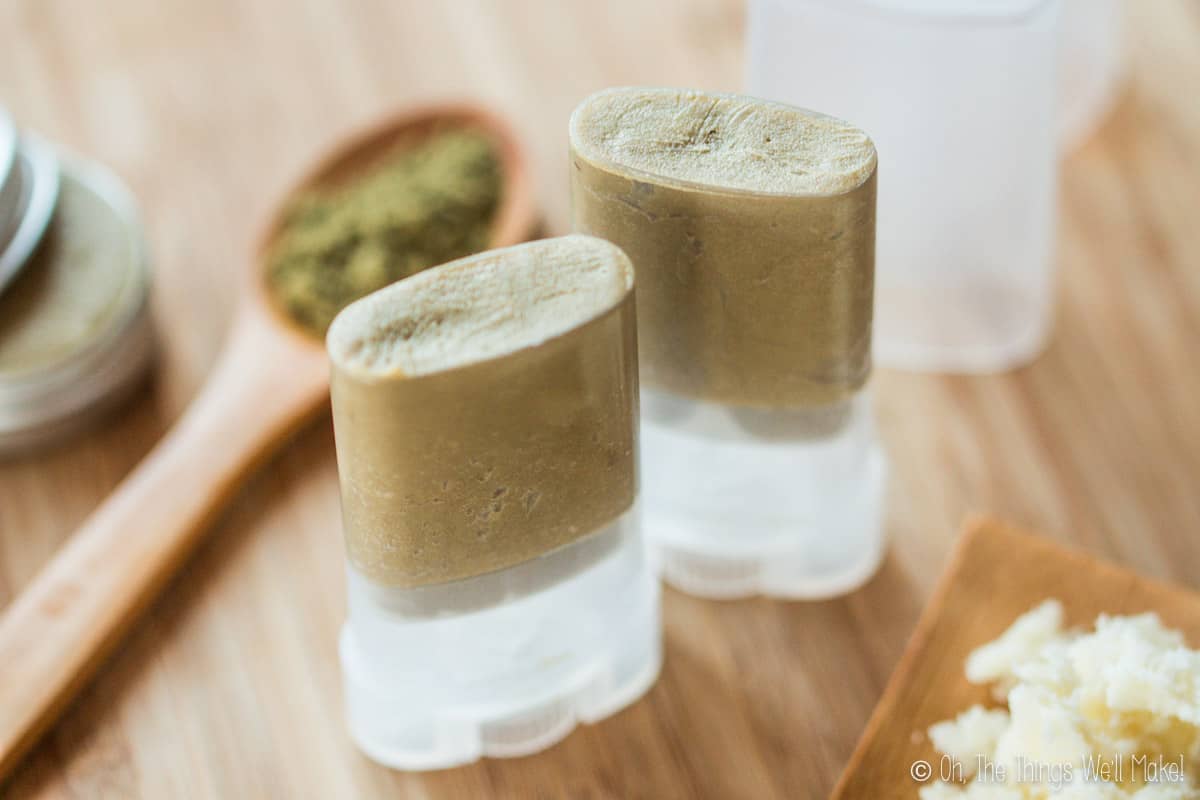
To add a bit of color (so the deodorant isn’t bright white) and some anti-inflammatory properties, I added a bit of matcha powder. I drink matcha almost daily, so I always have it on hand. It’s a totally optional ingredient, though.
For scent, I added a mix of lavender and tea tree essential oils. They may also have some anti-microbial properties that help keep odor away.
Lastly, I added 0.5% of vitamin E (tocopherol) to the deodorant because it’s an antioxidant that helps prolong the shelf life of the deodorant. Plus, it may help with skin nurturing.
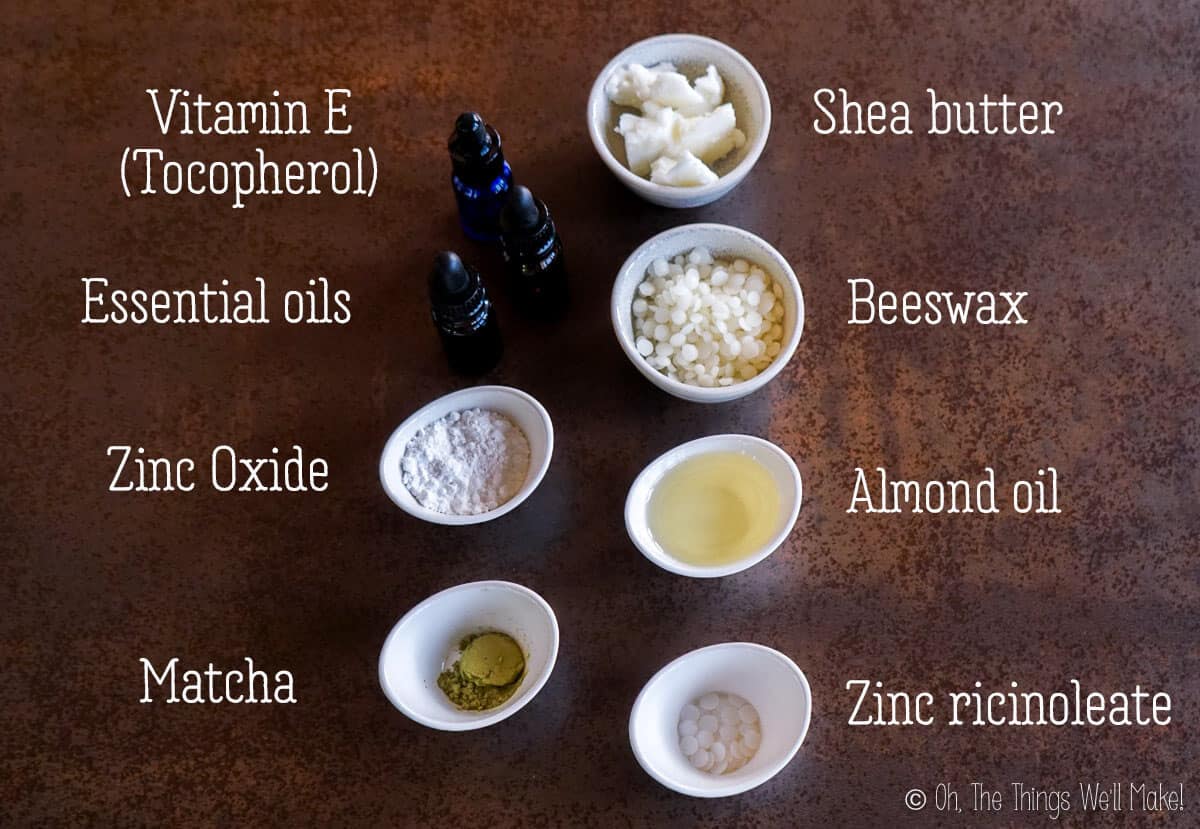
Zinc oxide
Zinc oxide has antibacterial qualities. In fact, it works against both gram-positive and gram-negative bacteria. If you have no idea what that means, don’t worry. It just means that it’s effective over a wide spectrum of bacteria, so no matter what bacteria is causing your odor issues, you should be covered.
As I mentioned before, body odor comes from perspiration combining with the bacteria on your skin, so if you can create a hostile environment for the bacteria by either altering the pH (baking soda, vinegar), or by using something with antibacterial properties (essential oils, zinc oxide), you can prevent body odor from developing.
For the safest zinc oxide, I’d recommend choosing non-nano zinc. Non-nano zinc has larger particles that won’t be absorbed by your skin and enter your bloodstream. So, it’s safer.
The downside to zinc oxide is that it’s very, very white! One of the reasons I added the matcha is that I wanted the deodorant to be a shade that wasn’t quite to bright.
Zinc Ricinoleate as a deodorant
When researching zinc for deodorants, I came across zinc ricinoleate, a zinc salt that is sold as both a deodorant additive and also as an aid in preventing acne. Zinc ricinoleate comes from ricinoleic acid, a fatty acid found in castor seed oil.
If you saw “ricin” in the name and were concerned about it, you’ll be happy to know that although they come from the same place, castor oil and ricin don’t mix. Ricin is water-soluble, so it doesn’t get mixed into the castor oil. Any leftover ricin that may enter the castor oil when it is extracted will no longer be an issue because the proteins in ricin are deactivated by the heat used in the process of castor oil extraction.
The mechanism for zinc ricinoleate working as a deodorant isn’t exactly known, but it is thought to absorb the odors somehow without inhibiting natural perspiration.
When I received my package of zinc ricinoleate, it stated on the package that zinc ricinoleate (I’m translating from Spanish, here, so I’m not sure I’m using the perfect translation, but…) “covers the bad odors that are caused by the bacterial decomposition of sweat so that they aren’t perceived as unpleasant.” I’ve tried to research the exact mechanism of “covering” the odor, but it seems like it isn’t well understood. Most places that talk about it just say that it has a way of “absorbing” the bad odors.
Procedure
Once you’ve obtained the ingredients, making this deodorant is simple! It’s pretty much as easy as melting everything together and pouring it into a deodorant tube. That said, I can give you some tips and tricks to make it perfectly!
Begin by weighing out the ingredients and then melting together the shea butter, almond oil, beeswax, and zinc ricinoleate in a double boiler insert until the wax and zinc ricinoleate melt. Once it’s completely liquid, remove the mixture from the heat source.
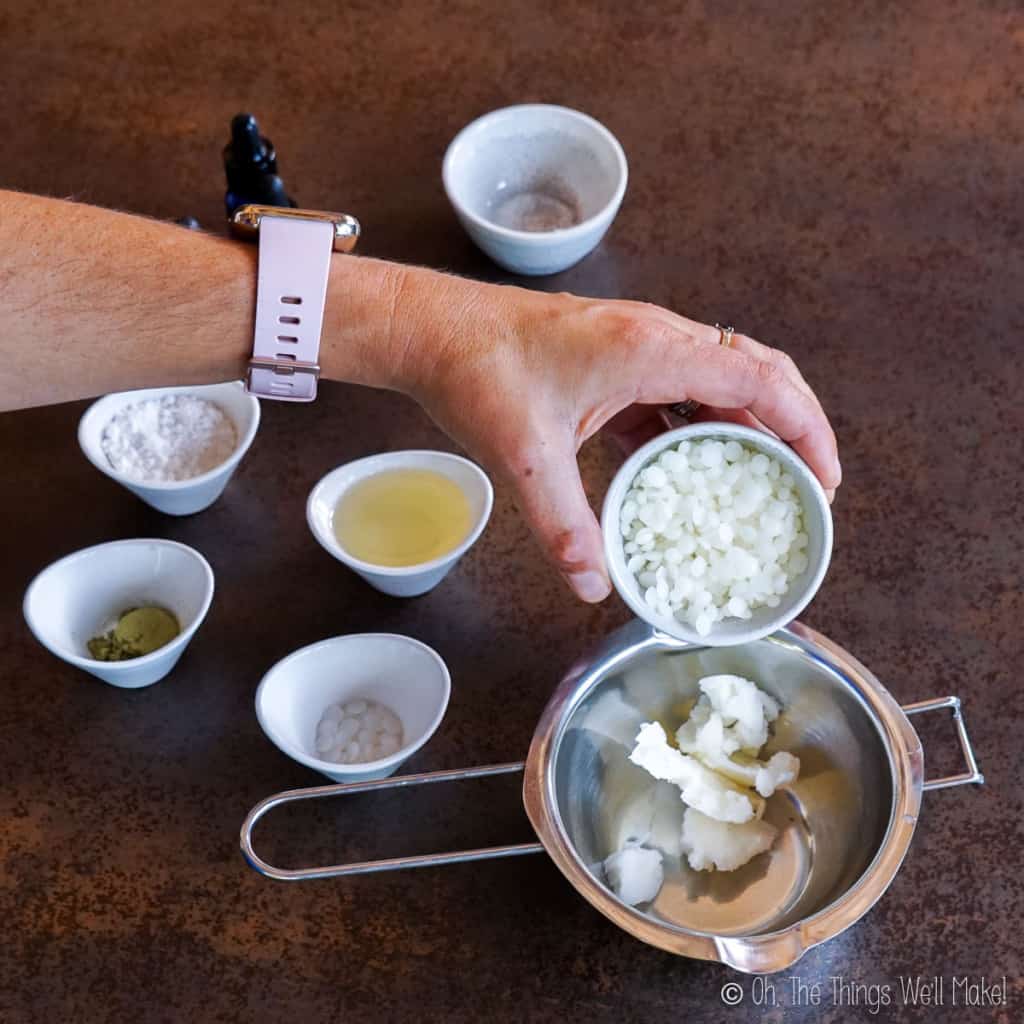
Add the beeswax to the shea butter. 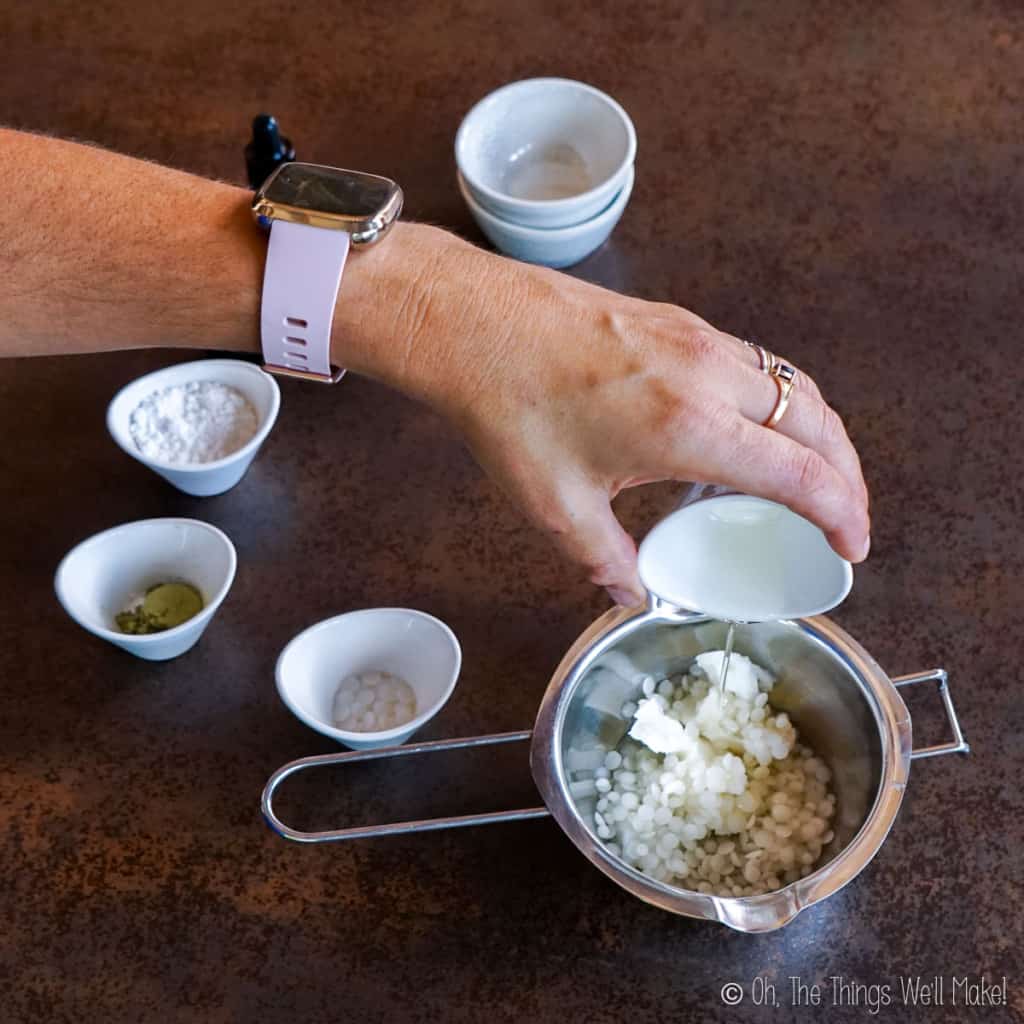
Add the almond oil. 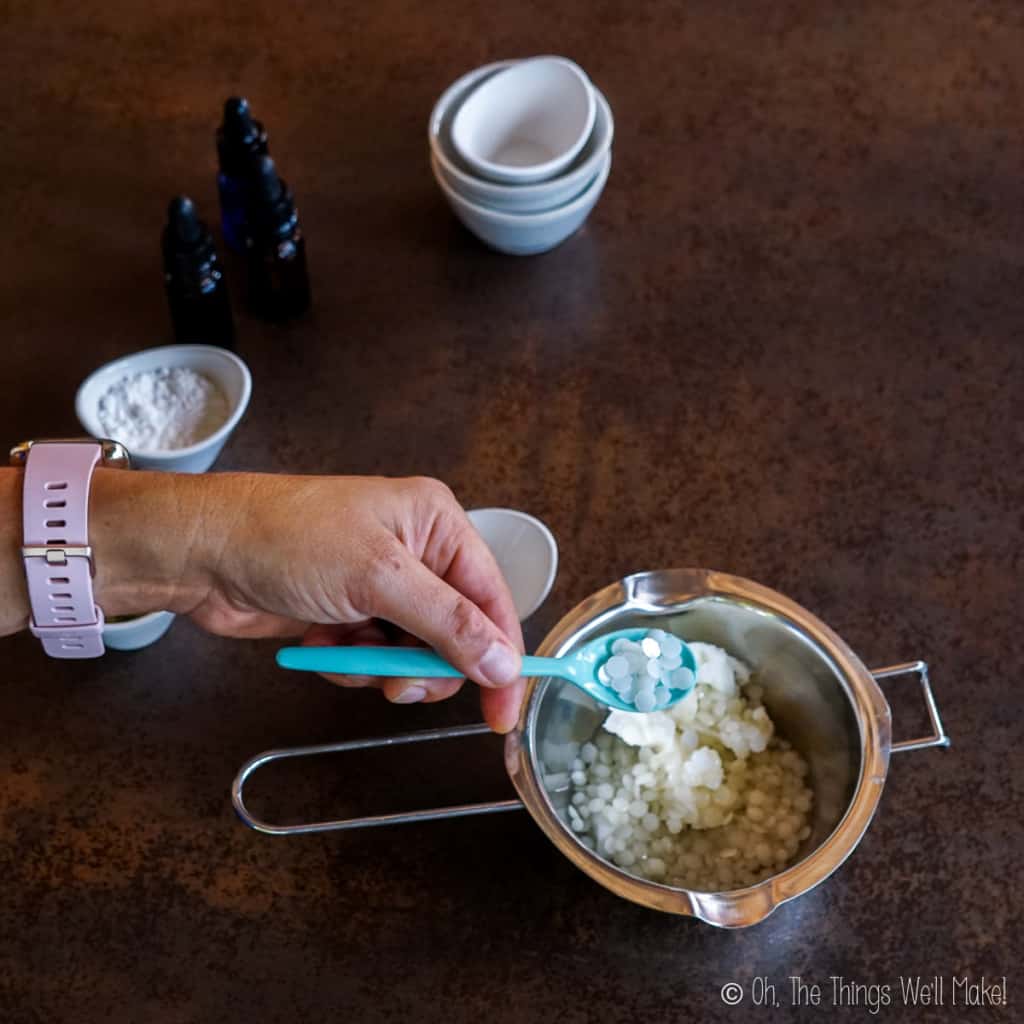
Add the zinc ricinoleate.
Next, add the zinc oxide and matcha powder and whisk them into the oil mixture. To ensure a smooth deodorant, consider sifting the powders by pressing them through a fine sieve. You can also use a small mixer or milk frother to fully incorporate the powders in the oils. (This helps keep the zinc from forming lumps and/or sinking to the bottom of the container.)
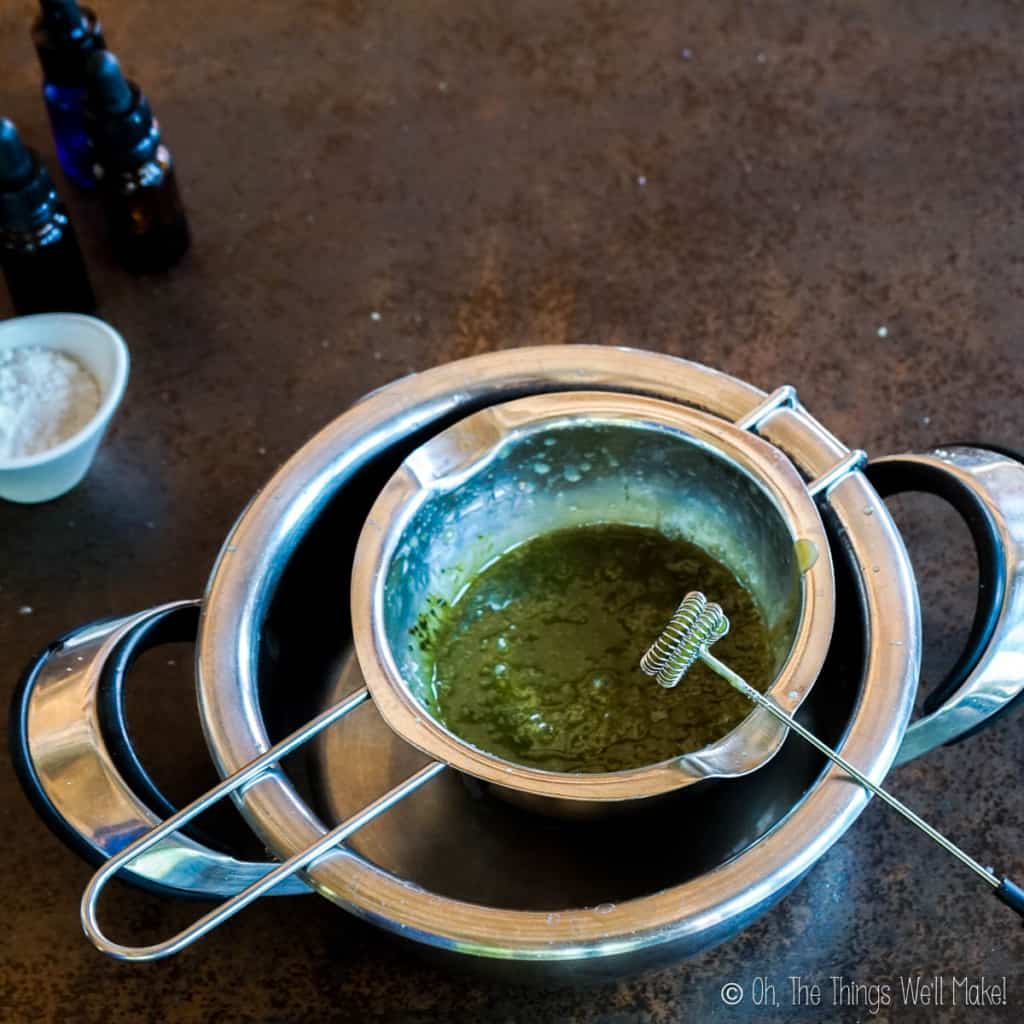
Add the matcha. 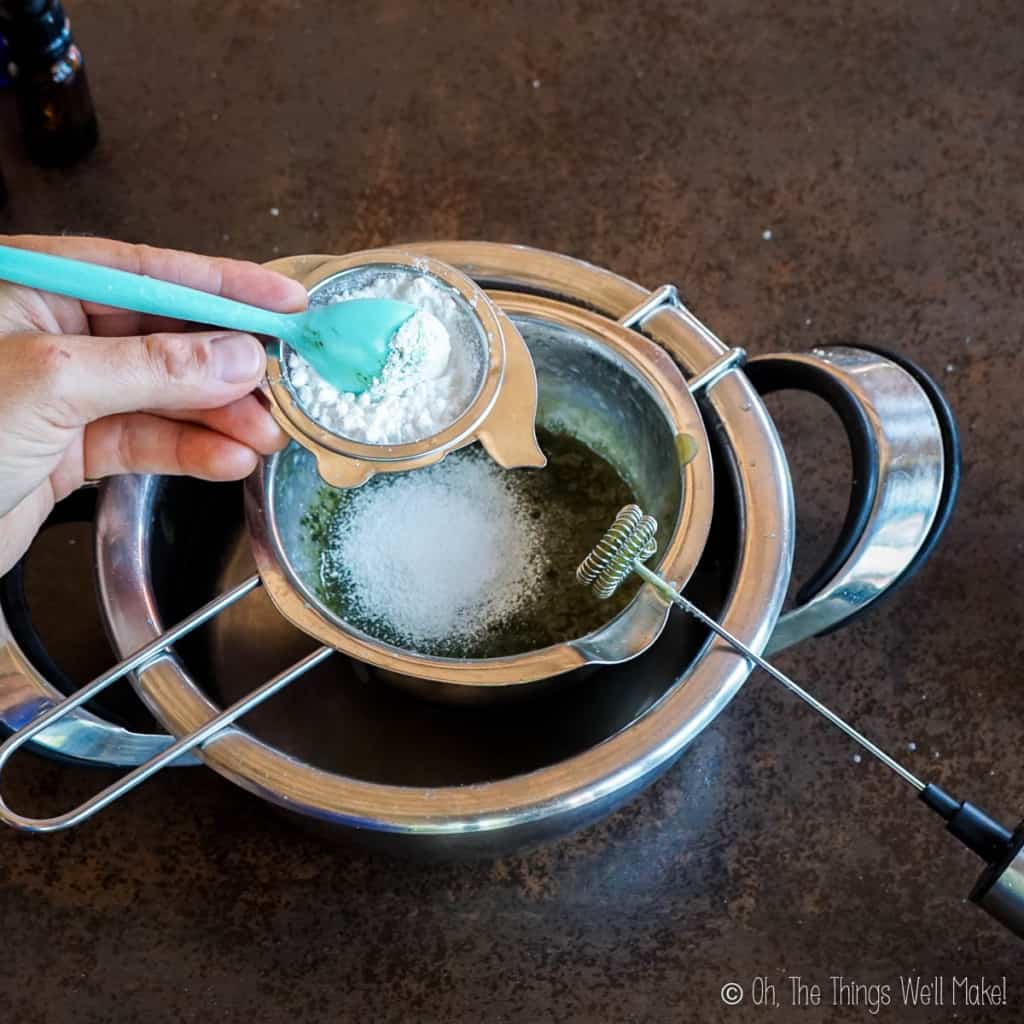
Sift in the zinc oxide. 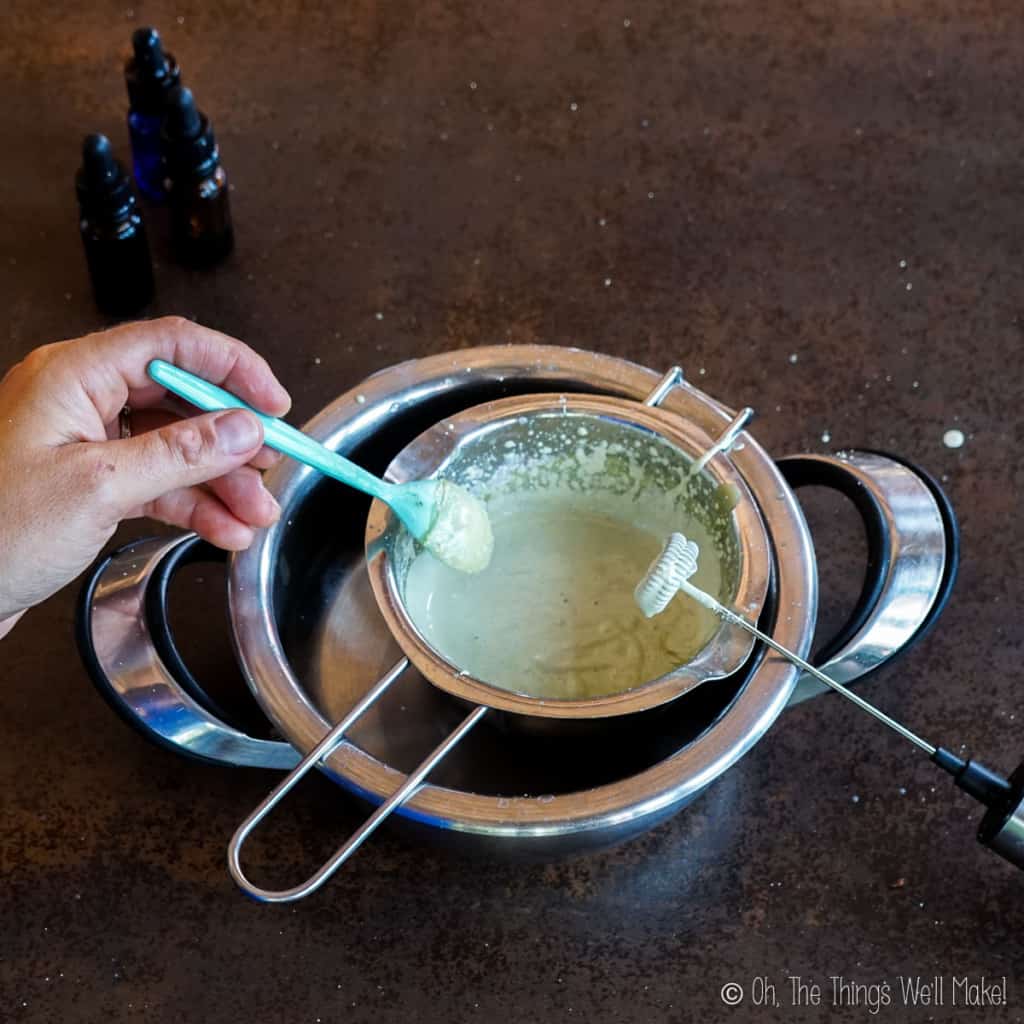
Use a milk frother or mixer for best mix!
Finally, add the vitamin E and the essential oils, whisking everything together until fully blended. (You may need to gently warm the mixture over the hot water if it begins to solidify and you are having a hard time mixing everything together.)
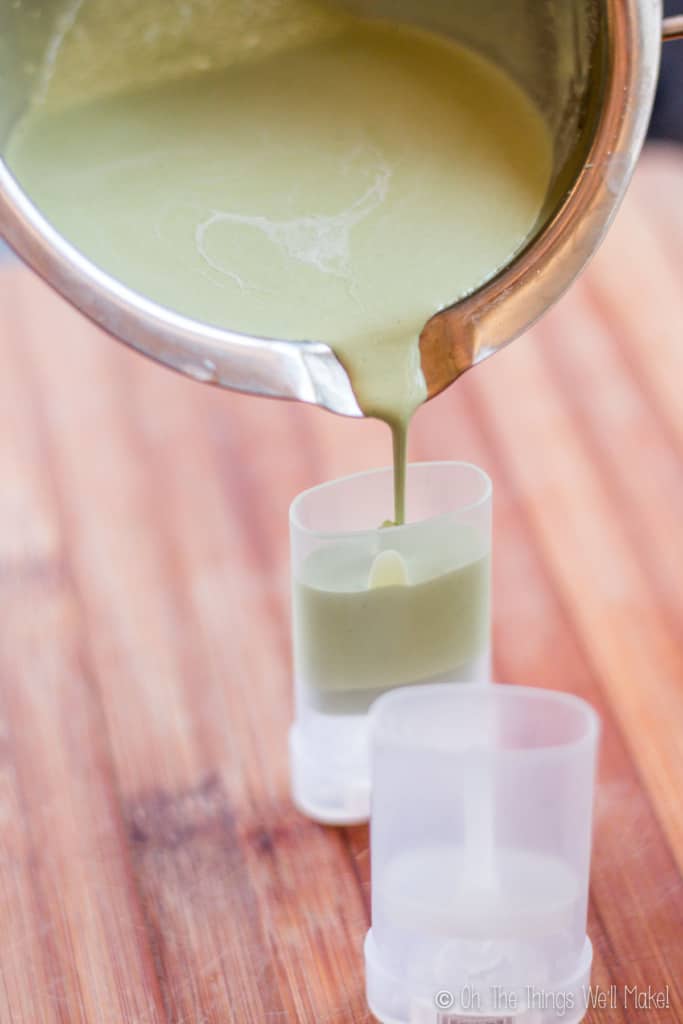
While still warm, pour the mixture into deodorant containers. (You can also pour it into tins for applying the deodorant by hand.)
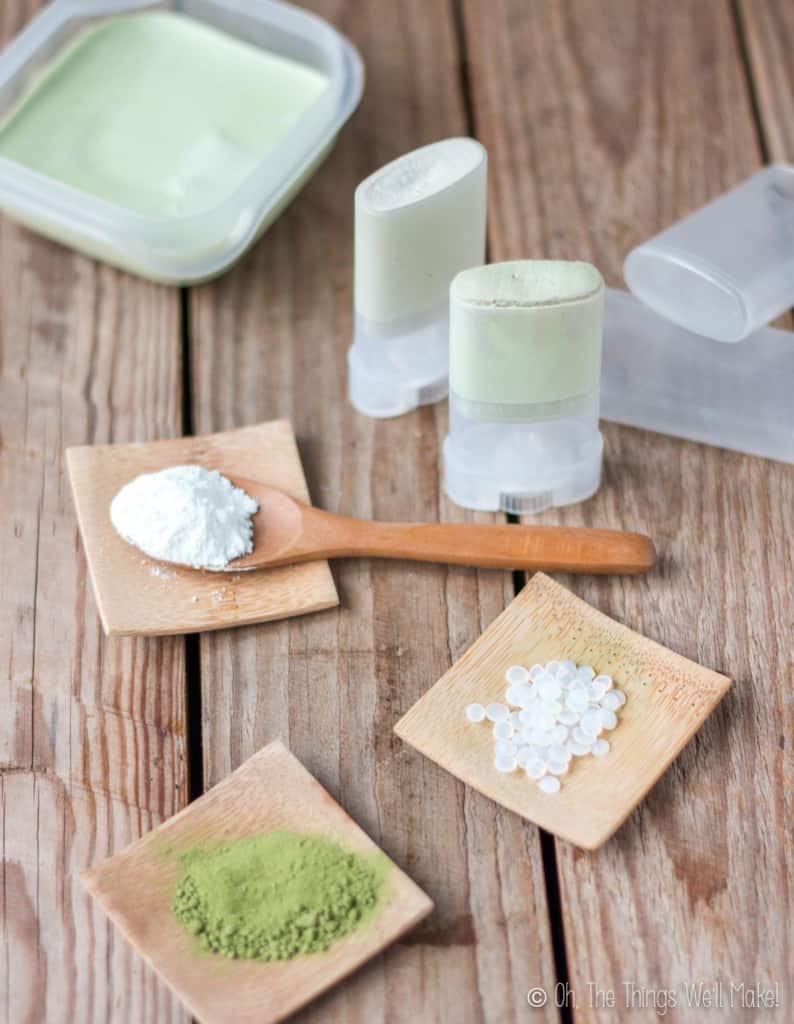
Zinc oxide powder, green matcha powder, and zinc ricinoleate beads.
If making one tube of deodorant, you will likely have a little leftover. You can pour it into a small tin for having on hand or for using in subsequent batches.
Allow the mixture to cool off and set without disturbing it. Once it has cooled and solidified, you can use it immediately!
Materials


FAQs
If applied in a thin coat, I haven’t had issues with staining. To prevent staining, apply a very thin coat and allow it to fully absorb (or rub it in) before putting on your clothes. It’s easiest to apply a thin coat when the deodorant is on the harder (more solid) side. If it’s too creamy or soft, you’ll likely end up applying too much and it may stain. (To get a harder bar, reduce the liquid oil and/or increase the amount of wax.)
I haven’t tried it yet in this particular recipe, but candelilla wax is a vegetable (vegan-friendly) wax that makes a great substitute for beeswax in recipes. It should work here without issues, but you may have to adjust the amount used if you find that the bar is too soft or too hard.
Yes, you can use pretty much any liquid carrier oil instead.
As much as I love coconut oil, I generally avoid using it in homemade cosmetics because it solidifies at around 76ºF. That means that the consistency of the product can vary depending on the ambient temperature. I’ve only tried this with a liquid oil, so I’m not sure if the texture will change in winter if using coconut oil.
While I doubt it will be a problem in this recipe, if you do want to use coconut oil and find it too hard in the winter, try using fractionated coconut oil, which doesn’t solidify, or use a little less beeswax when you make your winter batches with “regular” coconut oil.
Matcha is optional, but I think it’s a great addition to this homemade deodorant.
Green tea, in the form of matcha powder, has lots of antioxidants, it’s anti-inflammatory, and it makes the deodorant a beautiful shade of green! Powders in anhydrous products like this one (something that only uses oils and waxes, and no water) also seem to help with the glide factor and reduce greasiness. All of that said, you most certainly can leave it out of the recipe!
You can switch out the essential oils used if you like, but keep the amount around 1% of the recipe (by weight) or less to avoid issues with sensitivity. Also, keep in mind that some oils may cause more sensitivity than others.
Another issue, which probably isn’t problematic in a product like deodorant because your armpits aren’t generally exposed to the sun, but some essential oils (like bergamot and some of the pressed citrus oils) can cause photosensitivity.
Zinc ricinoleate is one of the active ingredients in this deodorant that help make it effective. If you are desperate to try and really can’t find it, you can try leaving it out, but know that the deodorant will be less effective.
Because zinc ricinoleate is normally a waxy ingredient, you should replace it with an extra gram or two of beeswax to help keep the deodorant solid. If you just leave it out, you’ll end up with more of a cream than a solid deodorant.
I personally have always used zinc ricinoleate because I need the extra effectiveness.
Over the years, I’ve heard from several people who have made the deodorant without it. It has been effective for some, and not so much for others. Using them together, though, I have yet to hear from someone who says it doesn’t work for them. So, if you can find it, add it!
Because there are no water-based ingredients, this recipe doesn’t need a preservative. It will also keep for quite some time, depending on the freshness of the ingredients you are using.
To get an idea, check the expiration date of your ingredients. The deodorant should keep for as long as the ingredient with the shortest shelf life. (With time, it may start to smell rancid as the oils change. It won’t be unsafe to use, but definitely isn’t pleasant.)
Although this is an oil-based recipe, the outside can be contaminated with the bacteria and wetness from your skin. To prevent mold and other microbial growth on the outside, apply it to clean, dry armpits and only cap it if it’s fully dry. (If you’re really concerned, you can always add a preservative.)
This is a difficult question because different liquids have different ingredients. If it’s an anhydrous (without water) liquid, you can probably use it, but you’ll have to adjust the recipe to achieve a solid deodorant consistency. (Reduce the liquid oils and/or increase the wax.)
If it is a liquid that has water, you’d have to use an emulsifier of some sort to add it. You’ll also need a preservative. There is also the issue of adjusting the recipe to get the right consistency.
In either case, you’ll need to use the recommended dosage for the product you’re using. (Your supplier should have that information.)
Yes! I’ve been happily using this homemade deodorant for years now.
Not only has it worked through many-a-workout and walking outside on hot summer days, but it hasn’t caused any irritation at all. In fact, I think it has helped soothe my armpits and has kept me from getting chaffing when I walk or run without any sleeves.
Video
Natural Homemade Deodorant for Sensitive Skin
Materials
- 25 g shea butter
- 25 g sweet almond oil
- 25 g beeswax pellets
- 20 g zinc oxide
- 2 g zinc ricinoleate
- 1/2 tsp. matcha
- .5 g vitamin E
- .5 g tea tree essential oil
- .5 g lavender essential oil
Instructions
- Melt together the shea butter, almond oil, beeswax, and zinc ricinoleate in a double boiler until the wax and zinc ricinoleate melt. Remove from the heat.
- Add the zinc oxide, matcha powder, vitamin E drops, and essential oils, and whisk together well until the zinc oxide is well incorporated into the oils and wax. You can use a milk frother or beater to fully incorporate the powders into the mixture. (Also, consider sifting the powders to avoid lumps.) You may need to mix them together over the warm water if the mixture solidifies too quickly.
- While still warm, pour the mixture into deodorant containers. You can also pour it into tins, or pour any excess into storage containers, for applying the deodorant by hand.
- Allow the mixture to cool off and set without disturbing it. Once it has set, you can use it immediately!
Notes
- Makes around 75 ml (5 small 15ml tubes, or one larger 75ml tube)
- Matcha is optional for antioxidant/anti-inflammatory properties and a bit of color.
- Use the essential oils of your choice for scent. (Or leave them out completely for unscented.)
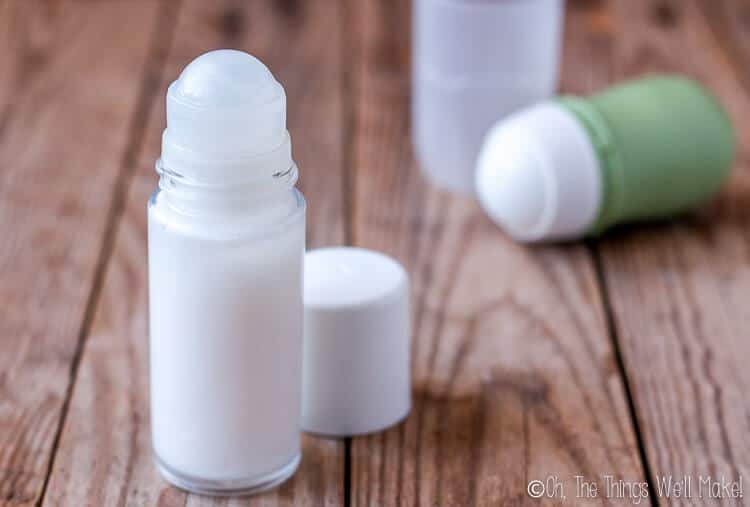
- For those who prefer a roll-on deodorant, I have recipe for a natural roll-on deodorant that also uses zinc.
- For a more solid bar either reduce the amount of oil or increase the amount of wax (or both). For a softer bar, do the opposite.
Changes to this recipe
- This recipe was originally written with the EO’s and Vitamin E in drops rather than grams. As it is impossible to get an accurate estimation of how much you are really using when using drops, I have switched it to grams.
- Some people found the deodorant too soft. It originally called for 40g almond oil and 15g beeswax. I have since reduced the liquid oil and increased the beeswax to get a harder bar.
My old baking soda deodorant recipe
Use this one at your own risk!
As many people have shown interest, I have kept my old baking soda deodorant recipe here. It worked well for me for months, but I did occasionally get irritation when using it.
This deodorant is lacking several things… It combines oils and water and doesn’t use an emulsifier nor a preservative. That’s obviously not ideal.
Lotions and creams are made by emulsifying together a water solution and an oil solution, using an emulsifier to keep them together. Adding water and other liquids to your lotions and creams makes them lighter and hydrating, but it has the disadvantage of being a breeding ground for bacteria. (Just think how quickly a fresh fruit or vegetable goes bad in comparison with a dried one whose moisture has been removed.) So, generally, any time you combine water and oils in a recipe, you’ll need both an emulsifier and a preservative.
I was mainly relying on the high pH from the baking soda to help make my homemade deodorant last longer without needing to add preservatives.
I surprisingly never found any separation when using the mix. Perhaps because the water level was so low? Beeswax isn’t really an emulsifier, but perhaps it in combination with the alkaline baking soda was enough to incorporate the small amount of water in this recipe. (Beeswax combined with borax, for example, can show some emulsifying properties.)
This is a small batch, and it’s probably a good idea to keep it that way because it incorporates water without any real preservatives. (Baking soda will raise the pH which does serve to inhibit microbes from forming. The essential oils, matcha, and vitamin E don’t really preserve at all, but may help it last a bit longer. I can’t be sure that the pH is high enough to prevent bacterial contamination here because I’ve never tried testing it and I haven’t made this in years!) I had mine last a couple of months without any issues, but if you decide to try this recipe, and it starts smelling funky, don’t risk it and throw it out!
It was also measured in teaspoons and drops, something that I no longer do. Ensure that the amount of essential oils doesn’t go over 1% of the recipe by weight so that it is less likely to cause skin sensitivity.
Baking Soda Deodorant for slightly sensitive skin
4 tsp. baking soda
1/2 tsp. matcha
2 tsp. water
2 Tbsp. shea butter
1 Tbsp. almond oil
1.5 Tbsp. Beeswax
0.5% vitamin E (by weight)
10 drops tea tree essential oil
15 drops lavender essential oil
- Dissolve the baking soda in water over a double boiler.
- Add in the shea butter, almond oil, and beeswax and whisk over the double boiler until the wax and shea butter have melted, and all of the ingredients are well combined.
- Remove from the heat and whisk in the matcha, vitamin E, and essential oils.
- Pour into deodorant containers and allow to set.
This post was originally published on July 25, 2016. It was rewritten, adding new notes and photos in June of 2021.
I’ve been unable to find zinc pcs anywhere. Please advise where one can find it
Hello,
I didn’t realize that it was going to be difficult to find when I posted the recipe. I order it from a place called cremascaseras here in Spain. They sell it through the Spanish Amazon.es, but I’m not sure if they send internationally (or if it will take you away from the link to bring you to the Amazon of whatever country you are in.)
In any case, I’ll try… this is the link to the product on the Spanish Amazon.
Hi,
I have been looking for DIY recipes with zinc and magnesium in them and without baking soda. I’ve read about magnesium hydroxide being helpful for natural deodorant use.
For your sensitive skin recipe, how much magnesium hydroxide would you recommend adding? The pure product comes in a powder form.
Also, I have jojoba oil. Could I use that instead of the sweet almond oil?
Thank you!
Hi Jane,
I’m not sure about magnesium hydroxide as I haven’t used it.
I will say that I tried using magnesium oil as a deodorant and didn’t find it effective for me. I also found it irritating to my skin. I’m not sure if magnesium hydroxide would behave similarly. If you do decide to try it, though, I guess I’d probably try switching it out at the same amount.
As for the jojoba oil- that is definitely a switch that you can do without any problems!
Hi Tracy,
Thank you for the reply.
Switching it out for what? I didn’t want to take out any ingredients (other than the matcha) I just wanted to add the magnesium hydroxide powder to the recipe.
It’s basically the same thing as milk of magnesia but without any additives. Some people use MoM alone as their deodorant! Apparently it works great on it’s own, is soothing and drying and controls odor. (Like you, I also can’t handle magnesium oil but apparently magnesium hydroxide is fine for the pH balance.)
I did read that (Philips brand) MoM isn’t a good choice because it adds bleach to the formula. But some cheap drug store brands do not have the bleach. However I don’t want to use a liquid milk of magnesia alone. Personal preference.
The last few days I’ve been using Desitin cream as a deodorant since it has the zinc oxide and it’s working pretty well. However it’s messy and has other ingredients I don’t want to continue using.
Anyhow, I really like the idea of both zinc and magnesium since I know both are good for me and both seem to work well in deodorants for many people. I was hoping to figure out an amount of the magnesium powder to add to your recipe.
Any suggestion?
Thanks!
Hi Jane,
Ah, so I totally misunderstood. I thought you wanted to switch out the zinc oxide for the magnesium because you were worried that the zinc oxide would stain. (I had just gotten a comment from somebody else who was worried about the zinc oxide staining so I guess I jumbled both of the comments together in my head. It must have been either by email or on my Spanish blog, now that I’m looking and don’t see it here.)
If it’s a powder, I’d just add in a small amount to test it out- maybe 1/2 to 1 tsp. I’d probably err on the side of using less the first time to see what the resulting texture is. If you find that it gets too thick or solid, you can add a little more oil the next time to compensate for the extra powder. That would also allow you to test out the difference between the batches to see if you think it makes it more effective, more or less irritating to your skin, etc.
I tend to experiment with lots of batches before posting here to get things just right. I think I had been making both of my deodorant recipes for months before they finally made their way to the blog. 😉
I’d be interested in hearing how you think it works- if you think it increases the effectiveness, etc. While I’m quite happy with what I’ve been using, it may be helpful for others who have issues with the zinc oxide.
Hi again,
Thank you for the suggestions. Since I plan to try it with both magnesium and the two zincs on my first attempt, I won’t be able to make a comparison with your original sensitive recipe. If I have problems with it such as skin irritation then I would leave out the magnesium and just make the recipe the way you have it written up.
I really appreciate your help. I had read a lot, tried a few natural deodorants off the internet and then fine tuned the ingredients I want to use but I really needed the amounts in a recipe.
Thanks!
Hi Jane,
I get that. 🙂
I meant if you make it once with less magnesium, and then the next time with a bit more- I’d love to hear if you notice a difference between batches either way. (It’s very possible that you don’t notice the difference). It’s just my curiosity. 😉
I’m always happy to help and really appreciate your comments too. I can always learn more myself. 😉
Thank you! 🙂
So I haven’t made a deodorant yet but I used the Milk of Magnesia for several days. It did not sting or cause any reaction even right after shaving. It did take awhile to dry since there is so much water in it but once it was dry I stayed DRY! Just amazing. Since I also had good results with Desitin (with the zinc oxide) I feel very confident that combining the two zincs and the magnesium hydroxide will produce the product I’ve been searching for. 🙂
you and your recipe are terrific—–thanx for sharing! a few comments to help you and your readers. one, every body is different——-even in my family i come from parents that have similar dna yet they can use any thing and have no irritations or problems! two, zinc in any form is antibacterial or antimicrobial
and so is coconut oil! three, if you are allergic to pollen or honey, like me, avoid beeswax—period! four, baking soda is an excellent
deodorizer, yet if i use it in homemade toothpaste—no problem with irritation, yet again in deodorants i swell, redden, and itch profusely—–i believe it’s my type o blood since type o’s are naturally the king or queen of body odor! five, because of this b o that seems to be typical to type o bloods——i’ve tried every recipe for deodorant known to man—–ranging from zinc formulas to magnesium and beyond! my greatest success has been with zinc oxide of all the formulas ranging from petro-based to water-based to wax-based to oil-based! zinc oxide beats out all the zincs—–zinc ricinoleate, zinc chloride, and on! six, be care of pouring any powdered zinc out of the containers they come in—–the dust should not get into any mucus membranes such as eyes, nose, mouth, lungs——-it can cause some toxic effects! finally,
we are all supposed to sweat and expel toxins through our pores—-period—–so it is natural! i’ve used a recipe on another site with the best success and i modified it to my liking! it’s similar to my own—–but it has a better feel to me since i apply it with my finger!
i don’t like the applicators like tubes, etc… since most irritate my skin when i apply! if anyone would like the link or more info—-i’ll post with your and the other person’s permission!
Hi John,
Interestingly enough, I have type A blood and my husband has type O, and I’m much more prone to BO than him, even though my diet is cleaner more of the time. (He eats well at home, but at work has to eat what is served.)
Candelilla wax is a good, vegan substitute for beeswax that works well for those with allergies or who otherwise wish to avoid any animal products.
I agree with the zinc oxide working wonderfully. I made a roll-on deodorant that my husband prefers. It uses zinc PCA and zinc ricinoleate. While it works well for me most of the time, this recipe is more effective for me personally too. 🙂
tracy,
i found that my favorite recipe that i mentioned earlier in my first response contained water and has to have additional anti-microbials such as your leucidal because water breeds microbes. these anti-microbials may very well be the extra ingredients to allow my deodorant to last for 2 or more days before b o sets in again. in any case, to prove how sensitive i am, i can’t use candelilla wax, tea tree oil, chamomile, almond oil, matcha, bee’s wax, and the list goes on! ever since i was diagnosed with cancer 2 years ago, i have tried to further reduce my intake of toxins. through the years, i’ve cut toxins dramatically, but it is harder here in the usa than many people realize. even though i have not tried any of your recipes, i have tried enough in my 63 years of human errors to realize that your ingredients alone will work to dispel b o quite well! thanx again for all of your info, recipes, advice because i am ever learning since knowledge is power and until i experience something whether recipe, food, etc… i don’t know my body’s response to it!
Sometimes you can get away without the use of a preservative if the product is in an extreme pH range (above 9 or below 4). The main natural preservatives don’t work very well in those pH ranges anyway. I’m guessing that you would be sensitive to a product in those ranges, though.
My roll-on deodorant doesn’t use zinc oxide and instead uses zinc PCA, but that could be potentially switched out. My husband is sensitive to zinc PCA, but doesn’t need a lot of it so he still favors that recipe. Of course, the zinc oxide is more likely to stain, but if you are sensitive to the other ingredients, it makes sense to use it.
Are there any waxes you can tolerate? There are some lovely floral waxes on the market that you could use to solidify the product more- though if you say that dispensers bother you, then you probably don’t need to solidify the product.
Thank you for your comment. Cancer seems to run rampant in my family, which is one of my main motivations for living a healthier, more natural lifestyle. My husband’s father was also recently diagnosed which has made him more serious about avoiding toxins too. I really hope that you recover/have recovered from your cancer. It’s absolutely horrible to live with (luckily not speaking from personal experience yet- just watching family members suffer.)
tracy,
when you say stain, are you referring to a white stain from zinc oxide as you wear your top or outfit then i understand you, if not, then i’m confused. when i’m finished wearing my tops or shirts the laundry detergent removes the zinc oxide perfectly. my recipe is Coconut oil, Water,
Preservatives (radish and coconut), Olive M Emulsifier, Zinc Oxide, Fragrance(Essential oils).
i tried bay essential oil in the deodorant, but, i developed a headache from it as well as a slight irritation. my deodorant keeps me fresh for 2 or more whole days and i really stink like nothing you’ve smelt before! i produce a very high acid chemistry which causes the strong smell both from the excretions through my pores and the bacteria that comes from the breakdown of the excretions(growth of bacteria)—–normal for most people with type o blood! my cancer was removed. however, i live in fear since it runs on both sides of my families and many have died from it! my psa was normal last time i checked.
so, considering the prostate was removed, i’m a little more at ease. the big issue here is will i develop another cancer. i have made my own products such as soap, toothpaste, deodorant, body wash—shampoo and more for years. my best first bar soaps were from light oils such as apricot kernel oil, grape seed oil, avocado oil. the drawback was they were drying soaps yet my body skin liked them and my hand skin hated them! i like detergent based body wash—shampoo because all soaps now irritate my body horribly especially superfatted or oily soaps! i use Decyl Glucoside with water and the preservatives i mentioned above and my body skin no longer itches to high heaven like it did with bar soaps and commercial products! thanx alot for your concerns and i wish your whole family freedom from cancer! i found out recently from my sister’s dna search that my ancestors came through turkey 1000’s of years ago with ancestors from many regions of the world including spain. but, the test called my relatives iberian as opposed to spanish or any other term! thanx again!!!!!!!!!
Hello again,
Yes, I referred to staining clothes from the zinc oxide. I didn’t really have too many problems with it with this deodorant, but it did concern some people. I was concerned that a water-based product with zinc oxide would be more likely to stain, though, but that may not be true.
I also like decyl glucoside. I just started to experiment more and more with surfactants, and want to start introducing more surfactant based products to the blog.
Some people think that only soap based cleaners are natural, but the gentle surfactants are really great for people who don’t react well to the high pH of soap, and they also come from natural sources. I quite like them myself.
And thank you for the well wishes. I wish you the same. I’m happy to hear that things are going well for you, apart from the sensitivities.
Be aware that zinc oxid is a nanoparticle !
Hi Krys,
It’s quite easy to find non-nano- zinc oxide to use.
You’ll notice that I linked to a non-nano- zinc oxide.
This is a wonderful recipe for sensitive skin. Does not burn like the magnesium deodorant recipies. Thanks for sharing.
Thanks Barbara!
I tried to use magnesium at one time, too, but while it didn’t burn my skin, it wasn’t effective for me. I’m really happy to have found something that really works for a lot of people who were otherwise frustrated!
Where do you get your deodorant tubes from? I’ve tried eBay, Amazon & Etsy & they’re all super expensive! Cheapest I could find was around $15 for 1 tube!
Hi Tania,
I have to admit that the tubes that I used were rather small, like these tubes, and I bought them for using for multiple projects- stick blushes, deodorant, etc. They are a bit small, but are practical for traveling and bringing it with you. I wanted to make the smaller tubes because I wasn’t sure if I was going to have to apply throughout the day when I first made the deodorant. Luckily, that isn’t necessary, so I don’t really bring the deodorant with me anywhere unless I’m traveling.
I’ve found other listings for cheaper alternatives, but the usually come with several tubes. Here’s one with 10 tubes for just under $12 or another for 5 tubes for just under $9. Perhaps you could make some for yourself and some for friends and family. 🙂
There is another alternative that I’m hesitant to give you because I don’t like to advocate waste, but you could buy a cheap solid deodorant and remove it and use the tube for your own homemade deodorant. If you go this route, clean it thoroughly with soap and warm water, and then do a final rinse with something like rubbing alcohol.
I agree that it’s frustrating that the empty tubes are often more expensive than a tube with product already in it!
I just ordered 8 – 2.5oz tubes for about $12 on Amazon. Comes to $1.48 per tube. Keep checking Amazon, their prices bounce around alot!
Did you find that the zinc deodorant continued to harden until it was practically impossible to apply? If not, I wonder what I did wrong. I did notice that the zinc seemed to sink to the bottom. Any tips would be appreciated. I have tried loads of homemade deodorant and this one has the best odor protection of them all. I would love to be able to make it work.
Hi April,
No, I didn’t have that problem at all. Which zinc sunk to the bottom? The zinc ricinoleate should fully melt and easily incorporate itself into the oils. The zinc oxide, on the other had, may sink to the bottom to a certain extent. Ideally, you can wait until it’s starting to cool to pour the mixture, but not too much so that it’s too hard to pour. If that’s too difficult, you can also use a type of electrical whisk to really get the zinc oxide to stay more suspended in the rest of the ingredients.
In any case, I’m just about to post another deodorant recipe that works well for us and doesn’t use zinc oxide if you aren’t loving that. 😉 (Hopefully, I’ll be finishing it up today.)
I just wanted to let you know how much I appreciate you posting this diy deodorant recipe. OMG! I had been having the exact same issues you were with the baking soda and had been looking for a recipe without it for a long time with no success. Then I finally came across yours and when I read what you had been going through I thought you were talking about me. I was so excited to try your recipe out and I’m so glad I did I love it! I can’t thank you enough for posting that recipe it has helped me more than you know.
Yay!
I’m so happy to have been able to help!
It’s definitely one of my favorite recipes on the blog because it was life changing for me. 🙂
(Which, of course, sounds ridiculous to those who haven’t gone through what we’ve gone through, but, ha!, it’s true!)
Thank you so much for letting me know! 🙂
Tracy, thought you might want to read this regarding the zinc PCA https://www.ewg.org/skindeep/ingredient/707071/ZINC_PCA/
I use a DIY spray deodorant of which the base is zinc oxide, magnesium hydroxide and vodka. It works very well but goes on wet so have to let it absorb and dry before dressing. I will try making yours with the zinc ricinoleate and see how it compares to what I’m currently using.
Love your site–and have particularly liked your info on making liquid soap which I will also be trying shortly.
Hi Kathy,
Thank you!
Yes, I saw that.
I noticed that it’s mostly environmental concerns, with a slight concern that it could cause respiratory concerns if used in a spray. I don’t use it in a spray and use it in a very, very small dose in our liquid deodorant. I had a mishap once where my scale was off, and one of the batches used more and it also irritated my husband’s skin.
I tried making it without once, and it worked for my husband, but wasn’t enough for me with just the ricinoleate.
I think with these sorts of things, it’s good to experiment and find what works for you. I need something stronger than my husband does.
I’m constantly experimenting, which is why I haven’t posted my liquid deodorant yet. 😉
We’re probably on our 5th batch now. I wanted to make one final batch before posting.
With the zinc PCA, it works out to being like a pinch used in a batch that lasts several months. I think as long as you use it responsibly, and are careful where you throw it away, that it’s probably not too bad (especially when you compare to what else is out there).
I think the ideal would be a liquid deodorant with just the zinc ricinoleate because occasionally the solid one can build up on clothes after time, but for me it just isn’t enough.
I’ll definitely be addressing the problem when I post that recipe, though! Thank you. 🙂
Hi, I’m really excited to try this recipe! I was just wondering if you have noticed that the shea butter or zinc oxide stains clothes? I noticed this with another recipe I tried using shea butter beacuse it’s yellow. The beeswax was yellow also. I just want to make sure it’s not going to stain my shirts- espeically when I wear a tank top- before making it.If i need to bite the bullet and find beeswax and shea that isn’t yellow I can buy new. I just have quite a bit of the other on hand. Sounds like a great recipe though. I’ve tried everything for both myself and my husband, so hoping it works for us!
Hi Jenna,
I was wearing this for months and months without it staining anything, but I have to admit that it did start to build up a bit on some clothes after using it a lot. I was able to get it out, but the zinc oxide can be a bit of a pain if you let enough of it build up.
You don’t need to use a lot of this deodorant, so I think the secret is to use a very thin layer. In the summer, that can be a bit trickier because the bar is less solid from the heat. (I find in the winter that the deodorant is solid enough to go on smoothly in a very thin layer.) You could try rubbing it in well before putting on clothes to help prevent the buildup.
Lately we’ve been using a liquid formula using zinc ricinoleate and zinc PCA that doesn’t use zinc oxide. It works well. I find that on very sweaty days that this solid bar works better for me, but the fact that it normally works well for me says a lot. I didn’t even really find any commercial liquid deodorants that worked 100% well for me normally, so…
I’m just about to make a new batch of it, and if it goes well, I’ll be posting it soon. I’ve made around 3-4 batches already, but haven’t posted because I was looking to make it with an emulsifier that was easy to find in the US. (My first successful batches used an emulsifier that I couldn’t source well for readers, and I had a few failed batches along the way when trying new emulsifiers.)
I’ve never had any staining issues with that recipe. (Yet. 😉 )