

Homemade laundry detergent (powder & liquid): what works and what doesn’t
Learn how to make homemade laundry detergent using classic soap-based recipes in both powder and liquid form. Plus, what I’ve learned over time about their limitations and better alternatives that work more effectively in all water types.
Over time, though, I started to understand how soap behaves differently in laundry, especially in hard water. Soap can react with minerals like calcium and magnesium, leaving behind residue on fabrics. That buildup can trap dirt, dull colors, and make clothes feel less clean over time.
Because of that, I no longer recommend soap-based laundry detergents for most people.
Instead, I now prefer using surfactant-based detergents, which clean more effectively and work well in all water types.
That said, I know many of you are still curious about these recipes or have seen them shared elsewhere. So I’ve kept them here for reference, along with updated notes to help you understand when they might work and when they don’t.
If you’re looking for a more reliable option, you can check out my surfactant-based liquid laundry detergent here.
Soap-based homemade laundry detergent (what to know first)
Most homemade laundry detergent recipes you’ll find online are based on soap. They usually combine grated bar soap with ingredients like washing soda, baking soda, or borax. The idea is to boost cleaning and help with odors, but the main cleaning still comes from the soap.
This type of detergent can seem to work well at first, especially in soft water. Clothes may smell clean and look fine right after washing.
The issue is that soap doesn’t stay fully dissolved in all conditions. In hard water, it can react with minerals like calcium and magnesium and leave behind a residue on fabrics over time. That buildup can trap dirt and make clothes look dull or feel less clean.
When this type of detergent might work
These can work if you have soft water and are washing lightly soiled clothes. Some people use them occasionally without noticing problems, especially if they’re not dealing with buildup.
I just don’t find them as reliable for regular use.
When it doesn’t work well
This is where these recipes can be hit or miss, especially with hard water or dirtier laundry.
At first everything seems fine, but over time clothes can start to look dull or feel a bit stiff, like they’re not getting fully clean anymore.
What I use now
These days, I use a surfactant-based detergent instead of soap. It’s just been more consistent for me, especially with our water.
I’ve also shared some other laundry options here, like a homemade fabric softener and wool dryer balls, if you’re interested.
If you still want to try a soap-based version, I’ve kept the original recipes below.
Powdered soap-based laundry detergent
Materials
- 4 cups borax
- 4 cups washing soda
- 2 cups baking soda
- 4 cups grated castile soap (or other bar soap; you can also make your own laundry soap)
- Essential oils optional
Instructions
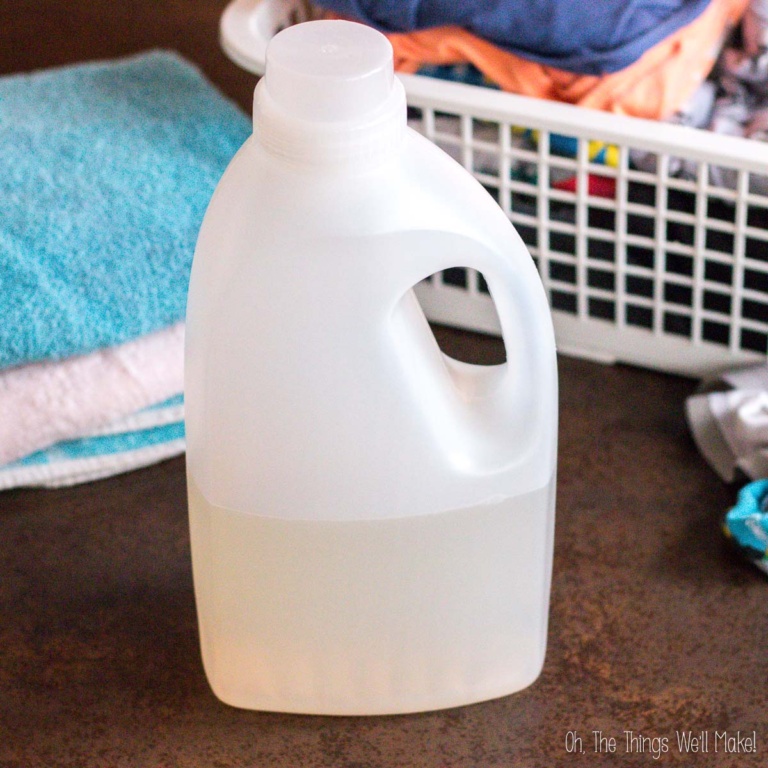
- Mix all ingredients together and store in a jar or container.
Notes
Liquid soap-based laundry detergent
Materials
- 1 cup borax
- 1 cup washing soda
- ½ cup baking soda
- 1 cup grated bar soap (or homemade)
- Essential oils optional
Instructions
- Grate the soap and add it to a pot with water. Heat and stir until the soap has dissolved.
- Add the soap mixture to a large bucket along with the washing soda, baking soda, borax, and optional essential oils. Stir to combine.
- Add more hot water, stirring until everything is fully dissolved.
- Cover and let the mixture cool and thicken overnight.
- Transfer to a container with a lid for storage.
Notes
This post was originally published on February 5, 2016. I updated it in April 2026 based on what I’ve learned since.
Thank you
Thanks!
Thanks for sharing this informative article with us. I don’t think before that we can also make detergent powder at home but after reading this post, I will be going to try once with the given steps :). Thanks again.
Hello Tracy.
Love from India.
Just to wanted to hear how relevant this reciepe stands today?
I have gone through your lovely surfactant version of it.
I was thinking about a waterless product so that I do not worry about preservation & shelf life.
Would equal parts of Borax, Washing Soda, Baking Soda & SLS Powder (in place of SOAP) do the job.
Hi Amy,
I haven’t tried that, but I imagine that, yes, that would work!
I’ve had people ask about the SLS powder, but I imagine that you would need very little of it.
The other powdered ingredients would help reduce the amount of SLS and bulk it up a little.
Honestly, you could probably get away with just the SLS. Washing soda may boost its effectiveness. But, again, I like bulking up the product a bit because we are so used to using a certain amount of a product, and I imagine it would be really easy to use too much SLS at once making things very sudsy. (I’m picturing a sitcom moment with lots of suds all over!)
Ha!
I’ve actually been successfully using a combination of a different (milder) powdered surfactant with some other powders for a dishwashing detergent. (I can’t remember what I finally ended up using, but the surfactant was one of the powders from my shampoo bars along with washing soda and something else. Sigh, my mind isn’t working today. Up until now, though, nothing was working for me in the dishwasher, but this has been perfect for me for months now.
I need to find my recipe to post it soon.
My point, though, is that it would be very similar to this. And, yes, it should work. I don’t think you really need to add all of the different powders to it.
I’ve been meaning to revisit this post again-
Lately, I’ve been rewriting a lot of the posts and republishing with new dates so I can keep track of what’s been overhauled. That’s especially true for posts like that one that were originally guest posts. (While I did try this and used it somewhat successfully for a while, I’ve never been a huge fan of soap based detergents or shampoos.) I think I remember updating this post somewhat at one time, but I’m sure that today I’d have a lot more to say. 😉
Little by little, I guess.
If you do test it, I’d love to hear how it goes. That sort of feedback allows me to better help others (and make more educated revisions to my posts)!
wow, these are so impressive. i wanna say that, really amazing.
Carry on…………..
Would the liquid detergent from the above recipe need a preservative?
Hi Brandy,
Because it has such alkaline ingredients, it’s really self-preserving. I have more information about why pH matters in my guide to natural preservatives.
Please I want the formulation for washing machine detergent powdered soap. Thanks
Recipes like this one have been all over the Internet…and they’re all bad! These are alkali-heavy formulas that were known a century ago to be inferior. When people wore heavy-fabric clothes, didn’t have many of them, and didn’t wash them often, because they didn’t have machines, then it made sense for them to give the clothes a harsh cleaning in alkali (mostly washing soda), often in near-boiling water. But as fabrics got less heavy, and people had more clothes and washed them more often, and especially when they got their own washing machines, extensive tests were done using reflectometry and stretching showing that this washing dulled fabrics and wore them out faster, so alkali-heavy laundry detergents were considered so cheap and inferior, “borax” came to be a slang term for cheap goods in general. The good detergents were those made mostly of soap, with only a pinch of alkali — and a moderately-alkaline sodium silicate (as used in Rinso and Persil) was better than washing soda or borax. (This was before phosphates and non-soap detergent surfactants.) Not only that, but borax + washing soda is rather redundant, no particular reason to use both, and baking soda is just filler.
If you want to make your own soap-based laundry detergent, and you don’t have access to a better “builder” than borax or washing soda, then if you’re going by cups, use NO MORE THAN 1 cup of borax OR washing soda for every 4 cups of grated soap (preferably all-coconut or high-cocnut). That’s assuming you don’t want to wear out your clothes prematurely, and that you’re not using a HE front loader, because you have to use enough to make a good layer of suds when the detergent is based on soap. So then you won’t be wasting money on new clothes, but you won’t be saving a lot on detergent, because soap is the most expensive ingredient and you’ll be using plenty of it.
The makers of laundry detergent are not, in general, ripping you off. It’s a very competitive business that organized crime tried to strong-arm its way into 50 years ago, but were forced out. They do sell a few fancy products that are not worth the extra money for most users, they do try in some cases to get you to use more than you need, but there are bargains out there that are better than buying bar soap (usually from the same company that makes the laundry detergent) to convert to machine use this way. If you make your own soap (usually as a hobby or small business making fancier stuff), then you can save a little money by also making some for your laundry, but otherwise you’re in the same league as the kids on YouTube making bubble bath by mixing commercial shampoo, water, and salt — of which the water and salt are superfluous.
Hi Robert,
Well, this post was guest post by someone with a cleaning business. It isn’t really my area of expertise.
That said, I used the recipe for over a year without noticing any excess wear on my clothes. If anything, I noticed that my clothes lasted a lot longer once I stopped using fabric softener. (I live in an area with very hard water where everybody uses it.) I later learned that it was likely the fabric softener that was eating away at the elastic in my clothing, and once I stopped using it, the elastic bands and swimsuits lasted much longer again. (This was around the same time as I stopped using regular detergent, so I can’t really judge a difference there.)
I do make my own soap. You will find several recipes for soap on my blog, and, yes, I have been considering making a new laundry detergent soap recipe of my own and directing people to it from this one. I do find, as you say, that I don’t need all of the borax/washing soda/baking soda found in this recipe, and I do agree with you that it is a bit redundant to use all of them. I do find that the washing soda does help get my clothes cleaner and whiter, and lately have been mostly using a mix of homemade coconut oil soap and washing soda. (Borax is hard to come by here, and I, like you, didn’t really see the need for baking soda.)
For me, it’s important to make my own detergent, not because I think the detergent companies are ripping anybody off, but because both my husband and son have very sensitive skin. My son has atopic dermatitis and reacts severely to many types of fabrics and the chemical fragrances of detergents and shower gels. I make all of the soaps for cleaning clothes and people in our household. My husband suffered from severe burns on over 30% of his body after an accident on his fishing boat, and they took skin grafts from the non-burned areas to fix the burned ones. After the accident, he was forced to wear a special (polyester) suit that was made to fit him to help reduce scaring and help him regain movement. In the end, he became very highly sensitive to polyester and, like my son, to chemical fragrances, etc., etc.
For me, since I love to make soap, soap is actually the least expensive part of the “detergent” for me.
I do have a front loading machine, and to be honest, I don’t notice much of a difference in how clean the clothes get no matter what I use. I have even successfully used soap nuts for awhile as an experiment.
Thanks, though, for your comment! I’ll keep it in mind when I work on formulating my next “detergent” recipe which will include the directions for making coconut oil soap from scratch. 🙂
How interesting. What recipe would you recommend for front loaders He washing machines?
Mine is front loading. This should work well. Just use a smaller amount- or what’s recommended by your machine.
How much water do you use in the pot with the grated soap?
How much hot water do you add when everything goes into the 5 gallon bucket?
How much liquid laundry soap do you use per load of laundry?
Hi Sue,
With this having been a guest post, I’ll try to answer the questions as best I can in case Patricia isn’t available to answer them.
When I tried her method to making the liquid detergent, I assumed that you were meant to mostly fill the bucket with warm water by the time you were done. The important thing, though, was really just to add enough water to dissolve the other ingredients well. The proportion of water to the other ingredients doesn’t really need to be exact because the only thing that will be affected is how thick or thin your final detergent is which is really a matter of preference. I tried it out in a smaller quantity and just added warm water until I was able to dissolve everything well.
I did try both the liquid and powder soap recipes, but I have stuck with the powder version. At first it sounded easier to me to use a liquid detergent for some reason; I guess because it was what I was used to using. In the end, though, I find the powder so much easier to use (and a lot less messy!).
As with other detergents, the amount you use will depend on a lot of factors: how dirty the clothes are, how hard your water is, what type of washer you use, etc.
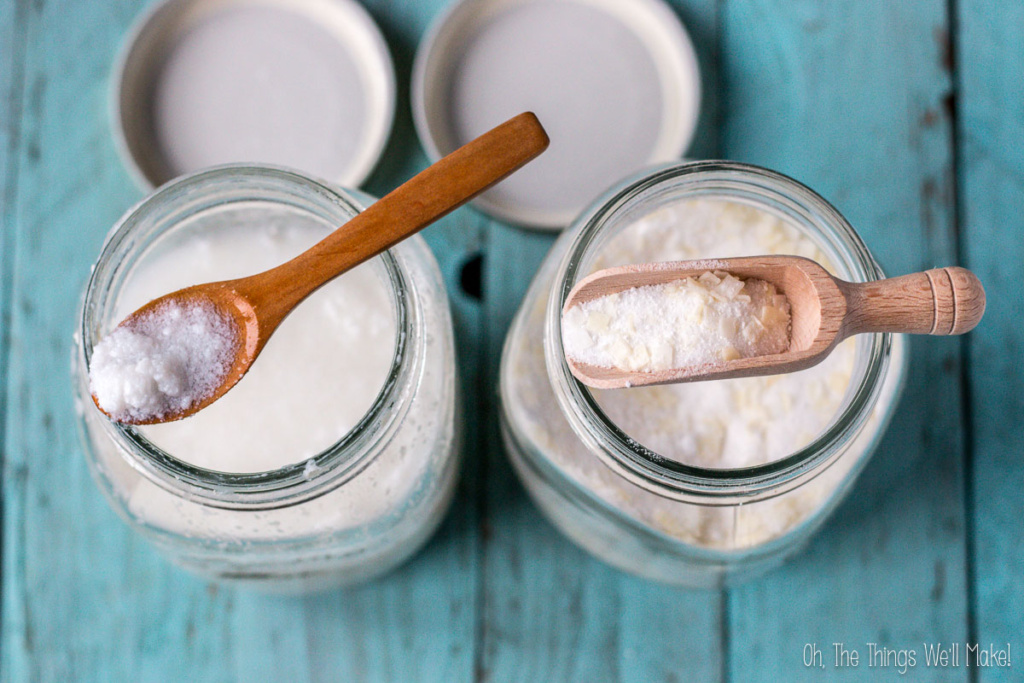
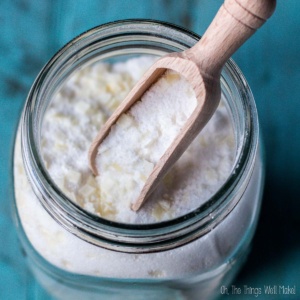
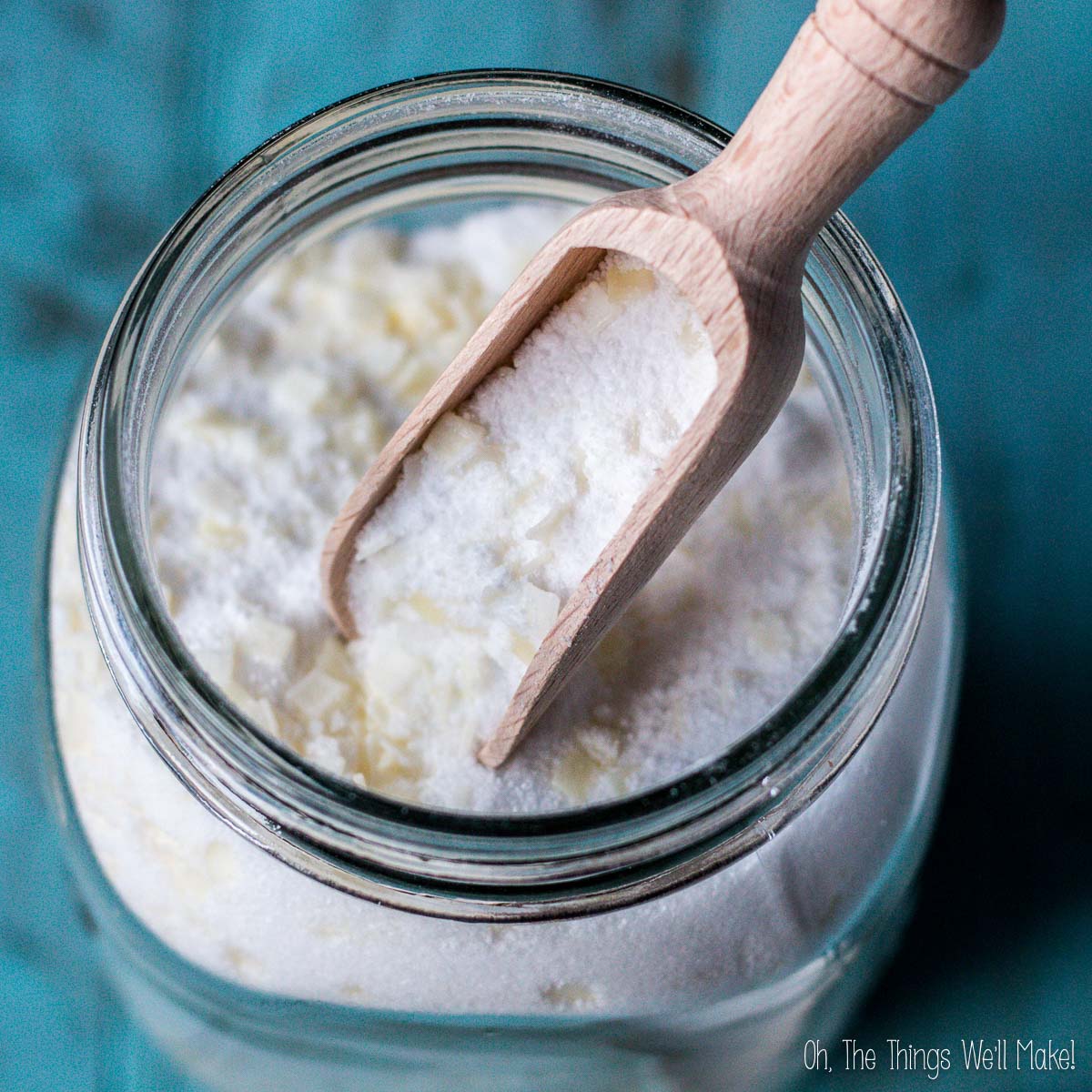
I began with just a spoonful of the powder detergent for most loads, and it is effective for me. (The scoop shown in the picture is what I use, and I use pretty much the amount shown, adding a bit more to more soiled clothes. Don’t think that the scoop is big, though! It’s actually quite small. I’m guessing the jar in the picture is the equivalent of a pint sized jar if that helps you judge the size better.) I have soft water and an efficient front loading washer, though.
I try to use as little as possible not only to save money, but I figure it’s also better for the environment.
You can experiment to find the minimum effective amount for your particular situation.
I hope that helps!
I have been making my own laundry soap for a couple of years and have found that in the summer, I have to add something like Dawn dish soap or sal suds – 2 T. per gallon of liquid soap. This does the trick for the greasy, smelly clothes, although I hate that they contain SLS. I also use grandmother’s lye soap which my husband graciously grinds into large flakes. Those I keep in a plastic bag so they remain soft and melt more easily. It takes 5 minutes to put together. Recipe is 8 c. Boiling water, 1 c. each soap flakes, borax, soda ash, and 1/4 c. citric acid crystals. Melt the soap flakes, add everything but the citric acid and stir until melted. Add citric acid slowly (bubbles) and then the dawn or sal suds and last, whatever eo’s you like. When the shell starts to form on top, I take a stick blender to make into a creamy soap, place that into a gallon jug and add water to make a gallon. Voila! It is so soft that it makes your skin feel slick when you rinse them.
I just wish there was an alternative for SLS!
Hi Laurie,
Thanks for your recipe and tricks!
I’m curious as to why you need the dish soap in the summer? Is it because of heat/sweat in the summer causing an odor in the clothes?
I’ve been using the powder detergent since I posted this, and I haven’t had any issues with it. It’s been working really well for me. I just add in a few drops of citrus essential oils (orange, lemon, or grapefruit- whatever I have around) to the powder when I add it to my washing machine, and have to admit that I was really surprised by how the clothes actually do pick up the scent of the EOs. I thought that the fragrance would disappear with the rinsing, but I find the clothes to hold the essential oil scent added to the detergent even better than the ones I add to my homemade wool balls in the dryer.
If you do find that you need the addition of a dishwasher detergent, perhaps you could try a more natural one without the SLS?
Or maybe using a coconut oil soap for the grated soap part would help better with the grease? I’ve been wanting to share a recipe for making coconut oil soap because they are really good for cleaning and cutting the grease.
I would like to know how much of the detergent are we to use in an High Efficiency (HE) washer? We normally use much less detergent and we buy special HE detergent that dissolves faster and doesn’t suds up as much. According to Technofresh.net you should only use 1 tablespoon of laundry detergent and 1 tablespoon of fabric softener per load. So how much do your recommend using per load?
Thank you in advance!
Hi Lois,
I’m not really sure. I’d have to do a little more research into what high efficiency washers are. Here in Spain most of the washing machines are front loading and are all pretty much the same system. I’ve been using about a Tablespoon of this detergent in my washing machine- maybe even a little less- and it has been working pretty well for me.
I’d probably recommend trying around a tablespoon of this one too, and then adjusting up or down as needed.
This looks AWESOME! I would love to be able to use our own homemade laundry detergent so I know exactly what’s in it. Would you say this could be used on extremely soiled things, like cloth diapers? Or would I have to stick to conventional detergent for that? Thank you so much for sharing! <3
That’s a good question, Savannah.
I haven’t been using it for very long yet, and have been pre-treating stains because I need to with conventional detergent too. My son’s school uniform is a pain to clean!!!
I (luckily) 😉 no longer have any soiled cloth diapers around to give it a try. Maybe I can get Patricia to weigh in on it.
I guess if it were me, I’d give it a try and line dry so as not to set any stains, just in case.
I’ve read that for heavily soiled items, that using more washing soda can help. Washing soda seems to be the biggest stain remover of the ingredients. (if the places I was reading were right at least. Ha!)
In any case, I’d love to hear how it goes if you do give it a try.
I’ve tried just about everything, including “soap nuts” for washing my clothes naturally. They were fun, but I couldn’t really be sure how much they were ever really doing. I think my washing machine gives the clothes a good workout, and I don’t notice a huge difference no matter what I use, so it’s really hard to know what works best, I think. 🙂
For diapers, start with the above recipe, leave out the borax, washing soda, baking soda, and essential oil, just use the soap and plenty of it. My diapers were done in soap powder (Ivory Snow); it had a little bit of fluorescent brightener and some perfume, plus probably a tiny bit of sodium silicate as a corrosion inhibitor for the washing machine — but do you really care if your baby’s diapers are bright? The soap you’re using is probably already perfumed, and washing machine parts today don’t need the protection provided by silicates. But you have to use enough soap to make lots of suds on the wash water.
I don’t need to wash diapers anymore. 🙂
I do use the essential oils, though, to scent the clothes very slightly. I didn’t think it would work because of all of the water, but surprisingly a few drops actually do help add a light fragrance to the clothes. I make my own soap, and rarely do they have much of a scent. (Sometimes they have a few essential oils too.)
i have gotten into making my own cleaners but never tried detergent. thank you for sharing 🙂