
Homemade Glycerin Soap Recipe (From Scratch)
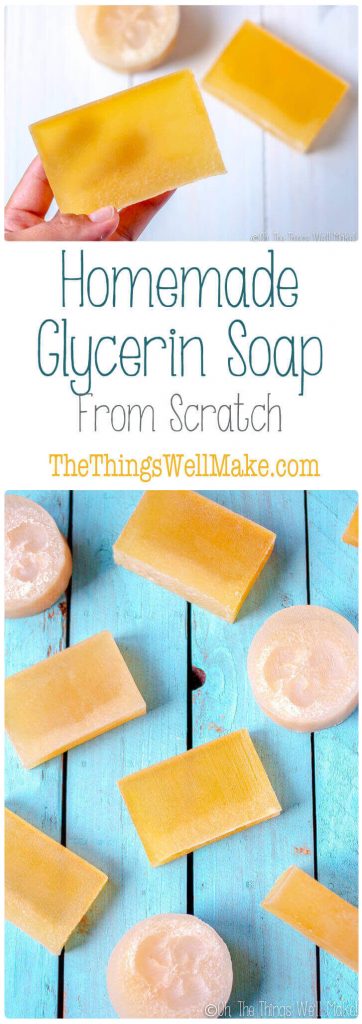
Perfect for those with sensitive skin, this homemade glycerin soap recipe makes a hard bar of soap that lathers nicely while gently cleansing and moisturizing your skin.
What is glycerin soap?
It sounds like an easy question, but there is really a bit of confusion about what should be called glycerin soap.
When most people think of glycerin soap, they think of translucent soaps. Many think of the translucent melt and pour soaps that can be melted down to make easy, customizable soaps. (Although not all melt and pour soaps are translucent, of course).
What most people don’t know is that there is glycerin in all soap because it is a byproduct of the soap making process.
The difference between translucent “glycerin” soaps and other more opaque soaps with glycerin in them, is that the glycerin soaps have been cooked with certain solvents like sugar, alcohol, and, well, more glycerin, to help make the soap crystals small so that light can pass through. (It’s the soap crystals that reflect light back at our eyes, making soap opaque).
Glycerin soap benefits
Glycerin is a humectant, meaning that it helps retain, or reduce the loss of, moisture.
What’s special about glycerin, though, compared to some other humectants, is that it is an endogenous humectant, meaning we have it naturally in our skin. Glycerin has been shown to help restore moisture and elasticity in the stratum corneum layer of our skin, helping to restore the barrier that protects us.
Interestingly enough, even after you stop using glycerin topically, it can continue to help form a barrier to help prevent moisture loss for up to 2 weeks.
Glycerin soaps are thought to be milder and gentler on the skin. While that probably depends on each particular recipe or soap, I’ve found that this soap has worked well on my son who has sensitive skin with atopic dermatitis. (That said, I still use soaps, or other washing products like gels, sparingly on his skin, and most days only rinse the majority of his skin with water.)
I find this to be a great overall soap for face and body, and I like how it helps reduce acne on my skin.
Watch how I make glycerin soap
The Glycerin Soap Making Process
Making a translucent glycerin soap is really a two part process.
First, you have to make the soap, using a hot process method. (I use my slow cooker which works perfectly for both parts of the process.)
After you have made your soap, you need to dissolve the soap crystals to help allow the light to pass through the soap, making it translucent. To do that, you will use a combination of several different “solvents.”
On my first two attempts, I didn’t spend a lot of time trying to dissolve the crystals. I wasn’t careful to keep the slow cooker well sealed, and I didn’t leave the solvents to work longer, or add more of them, to try to get a more translucent soap.
If getting a more translucent soap is important to you, I’ve given you a range of different solvent values for you to experiment with. I chose to add an amount somewhere in the middle of the given range of each particular solvent. You may want to try adding a smaller amount, and increase, as needed, until your soap gets more translucent. Using a stronger alcohol will also probably help you get a clearer soap.
If you’re really picky about getting translucent soap, I’d suggest reading the book, Making Transparent Soap: The Art Of Crafting, Molding, Scenting & Coloring by Catherine Failor. Her techniques are the ones that most people follow when making both translucent solid soaps and translucent liquid soaps. She has another book about Making Natural Liquid Soaps. If you’re interested in making liquid soaps, I have a couple of liquid soap recipes up on the blog. (You can choose to make a liquid castile soap, or a liquid coconut oil soap, or make both and combine them to get the best of both worlds.)
Choosing oils for a glycerin soap recipe
Because we are going to be using solvents to dissolve some of the soap crystals, it’s best to use oils that make a harder bar of soap. This will help ensure you’ll still end up with a hard, long lasting bar of soap despite the solvent process.
In general, oils that are solid at room temperature tend to make harder bars of soap. (Olive oil can also make a hard bar of soap, but it usually requires a long curing process to get it to harden.) Tallow and coconut oil are great oils for this type of recipe; not only because they make a nice hard bar of soap, but they are also said to be good for making a translucent, rather than cloudy, glycerin soap.
Castor oil is another common oil used in translucent soap making, not because it’s a solid oil that makes a hard bar of soap (because it isn’t, of course), but because castor oil is said to be somewhat of a solvent on its own.
Even after using the solvents, this recipe made very hard bars of soap, and I really love the way it lathers. The coconut oil adds to the cleaning factor of the soap and helps make a bubbly lather. The castor oil helps stabilize that lather. This was the first time I used tallow for making soap because it’s not very easy to find here. (I wanted to make my own, but couldn’t get any butchers to save beef fat for me for rendering tallow.) I have to say that I really love it, and plan on using it more often.
Choosing an alcohol as a solvent
I would have loved to use a consumable alcohol without any added scents or ingredients like Everclear, but I wasn’t able to find anything like that here.
Funny story…
I actually went to the supermarket with my mother-in-law and bought some 70% absinthe because it was the only drinkable alcohol I could find over 50% here in Spain. I was slightly embarrassed buying it, and felt the need to say that it was for making soap. In the end, I felt bad about using an expensive alcohol in my experiments with making a translucent soap, and wasn’t sure how the green coloring would affect the color of my final soap. (I wanted to see what I’d end up with without adding anything at all to it.)
I decided to use some 70% denatured alcohol instead. I was worried about it leaving an unusual scent to my soap, but honestly I don’t notice any off putting fragrances from the alcohol, despite my having forgotten to add any essential oils in the end for fragrance.
I think next time I’d try with a stronger alcohol to see if my soap turns out more translucent. If anybody gives a 96% alcohol, or something similar, a try, I’d love to hear how it goes!
I now have been left with a completely full bottle of absinthe at my house, if anybody wants to come for a party. (Just kidding about the second part.)
Superfatting glycerin soaps
Because excess oils can make for a cloudy soap, I chose not to superfat this soap. (Superfatting is when you add more oils to the soap than what are needed to react with the amount of lye used. Some unreacted oils remain in the soap, and can leave a hydrating film on your skin when you use the soap.)
The excess glycerin in this soap helps compensate and acts as the leftover emollient that helps make a moisturizing soap. I used the same thought process when making my liquid castile soap and liquid coconut oil soap, and find that both are very mild for use on face and body.
Now that I’ve been using this glycerin soap for awhile, I definitely don’t think it’s missing anything, and love it just the way it is. That said, you could always try adding slightly more oil if you prefer to superfat the soap.
Glycerin soap recipe
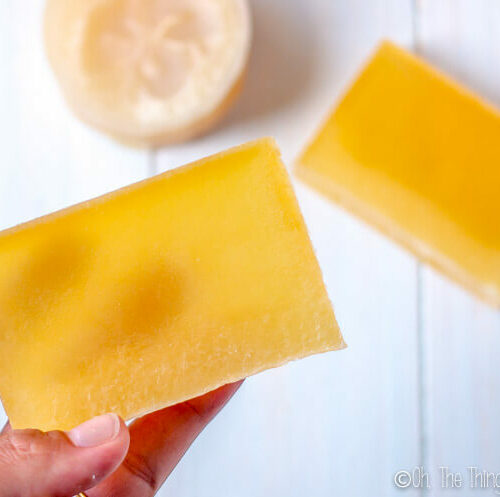
Homemade Glycerin Soap Recipe (From Scratch)
Makes around 8 bars of soap.
Materials
For the soap
- 304 g distilled water
- 117.7 g lye NaOH
- 440 g tallow
- 200 g castor oil
- 160 g coconut oil
Solvents
- 120 g glycerin Between 98g and 147g
- 300 g 70º alcohol Between 275g and 321g
- 90 g sugar Between 73g and 110g
- 180 g distilled water Between 147g and 244g
Instructions
Make the soap.
- Weigh out the lye in a small, non-metal bowl.
- Weigh out the distilled water in another, larger, non metal bowl.
- In a well ventilated area, carefully pout the lye into the container with the distilled water. You should wear gloves and goggles to protect your eyes and hands. Stir the lye into the water until it is dissolved. The mixture will heat up and get cloudy at first, but will clear up and cool down with time.
- Leave the lye mixture to cool while you weigh out the oils. I find that the easiest way is to place the bowl on a digital scale, tare it, add an oil to the bowl until you reach the right weight. You then tare again before carefully adding the next oil, and between each addition.
- Add the oils to a slow cooker on low heat, and stir them together well. Allow any solid oils like the tallow to melt.
- Carefully add the lye mixture to the melted oils, and gently stir them together. Once the lye solution is fully incorporated into the oils, you can begin to blend them together with an immersion blender.
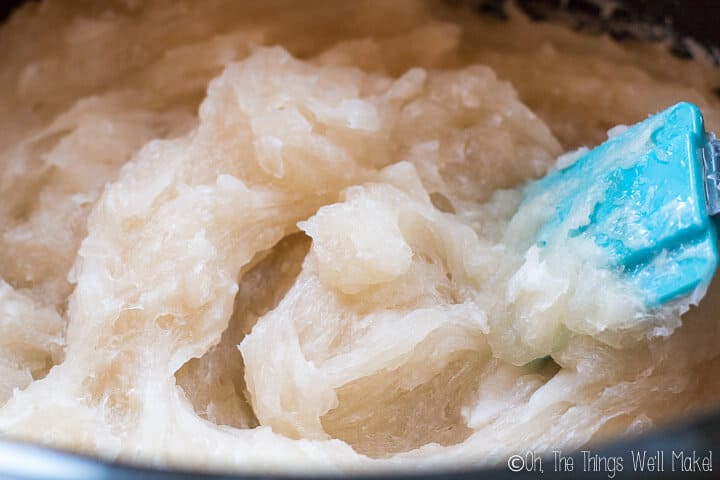
- Blend with the immersion blender until the mixture thickens to trace. Once the mixture has reached trace, place the lid on the slow cooker and allow the soap mixture to cook for several hours (around 3) until it starts to get transparent.
- You have now made a hot process soap.
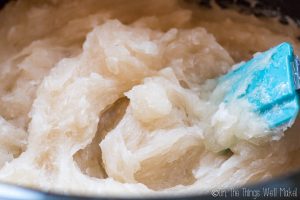
Use the solvents to make it translucent.
- Weigh out the alcohol and the glycerin. You will be mixing them together and adding them to your soap. I would have liked to use a high proof alcohol like Everclear, but couldn’t find anything like that here in Spain. I ended up using a 70º denatured alcohol. they say that if you use a higher concentration of alcohol, that it will do a better job of making the soap more transparent. (Perhaps next time I’ll try with a 90+% denatured alcohol. Rubbing alcohol is said to leave an unpleasant scent behind, but I haven’t tried it to verify the difference.)
- Pour the alcohol and glycerin mixture into the soap. You’ll probably end up with chunks of soap floating in the liquid. Try to break them up as best as you can. (I used my immersion blender to break up the chunks and fully incorporate the alcohol and glycerin into the soap. Work in a well-ventilated area for this step and be careful not to have any open flames in the area. (You should always be careful when heating high percentages of alcohol.)
- Cover the crock pot, sealing it as best you can so that the alcohol doesn’t evaporate. (If it evaporates too quickly, it won’t be able to work its magic on the soap.)
If you really have your heart set on making a translucent soap, you should seal your crock pot with some sort of plastic wrap before placing the lid on top. I didn’t have any on hand, and wasn’t really too concerned about making a fully transparent soap, so I just used the regular lid of my crock pot. - Allow the soap to cook, covered and sealed, for around 30 minutes.
- Meanwhile, make your sugar syrup. Weigh out the sugar and water and mix them together in a saucepan over low to medium heat until the sugar has completely dissolved. Remove it from the heat.
- Once the 30 minutes has passed, you can begin to add the sugar solution to the soap. Gently mix it in, trying not to move the soap too much so as not to form a lot of foam or bubbles.
- At this point, you can begin to test the soap for translucence. It will look translucent to the eye, but as it cools, it will become more opaque. The way most people check is by freezing a glass, and adding a small amount of soap to the bottom of the glass to cool it. Keep in mind that you are using a very thin layer of soap, and that when you have a thicker layer it won’t be as translucent.
- To try to get a more translucent soap, you can continue to cook the soap, adding in small amounts of the various solvents and checking the translucence with the frozen glass. (To be honest, I didn’t bother, and just added the sugar, and went right to pouring the soap into the mold. Perhaps next time I’ll try for a more translucent soap, and will give you my tips for what works best.)
- At this point, you can add in any fragrances or colorings. The nice thing about this soap is that because it has been cooking for so long, and has completed the saponification (soap making) phase, you can even use food coloring to color your soaps. You won’t have to worry about the lye reacting with the colorants and changing them as often happens when adding things to cold process soaps.
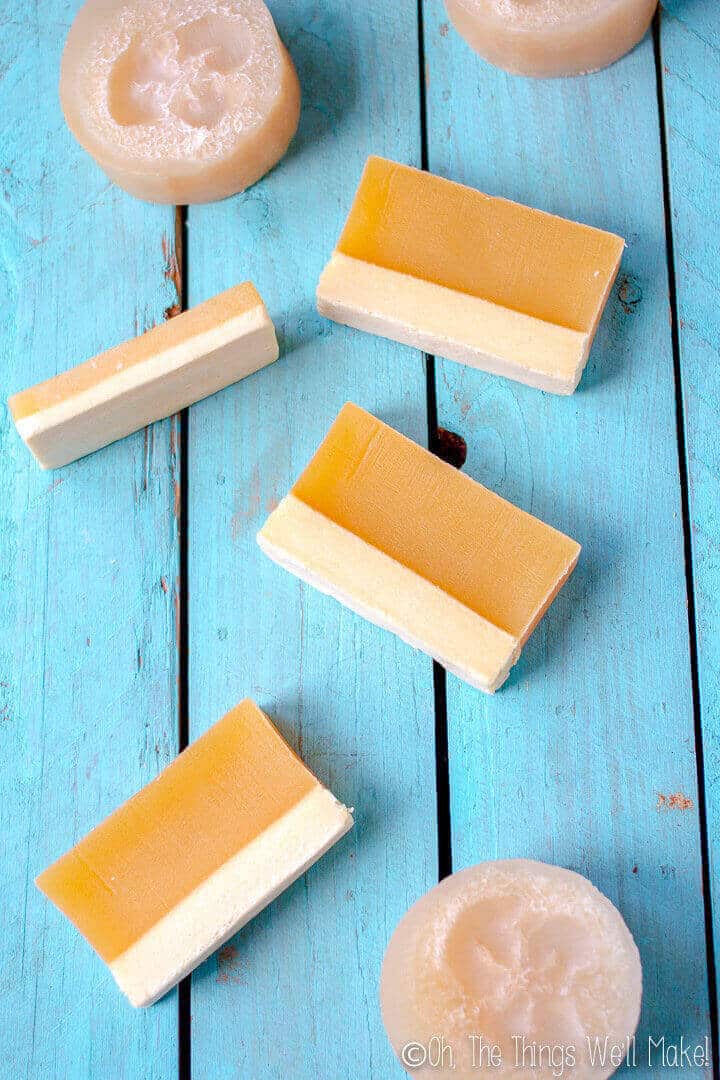
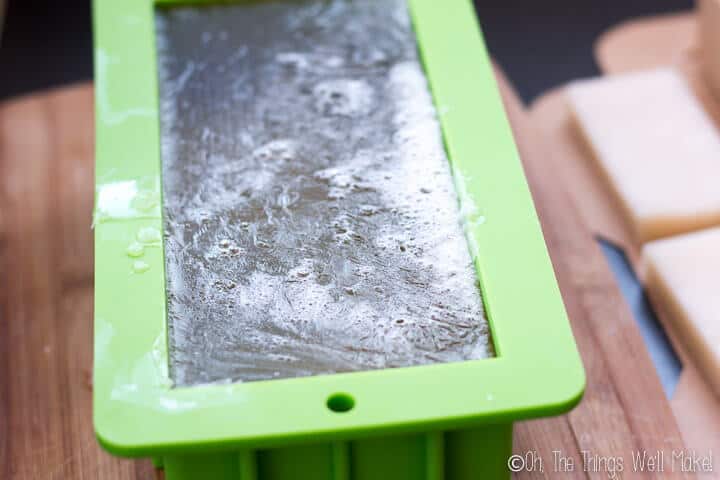
- Clear the foam off the soap, and carefully pour the soap into your soap molds. Try to be gentle at this stage as any movement can cause foaming of the soap, which will lead to a more opaque soap. (I wasn’t very careful, and my soaps have a more transparent layer on the bottom, with a thin layer that is more opaque at the top, where the bubbly soap settled before hardening.)
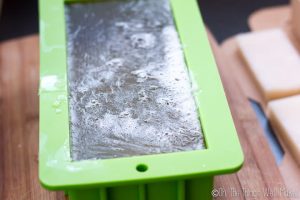
- You can skim the foam off and pour it into small soap molds. They will make a more opaque soap that will work just as well as the rest of the soap.
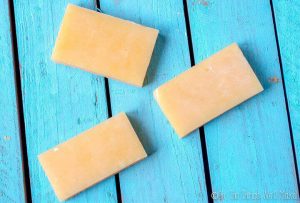
- Allow the soap to set undisturbed overnight.
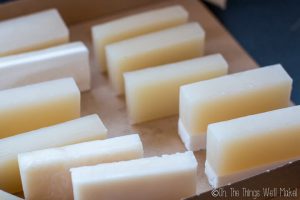
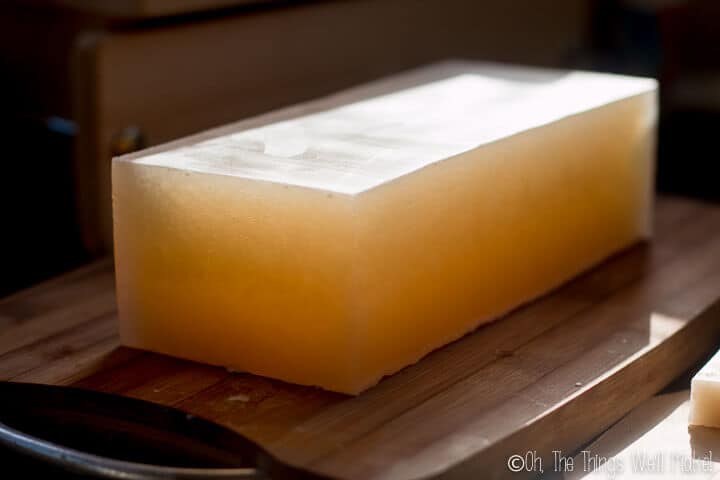
- The next morning, check the soap for hardness. If it is hard enough, unmold the soap and cut it into bars as needed.
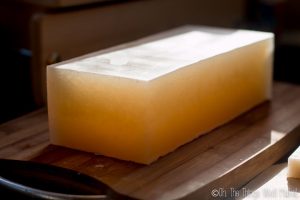
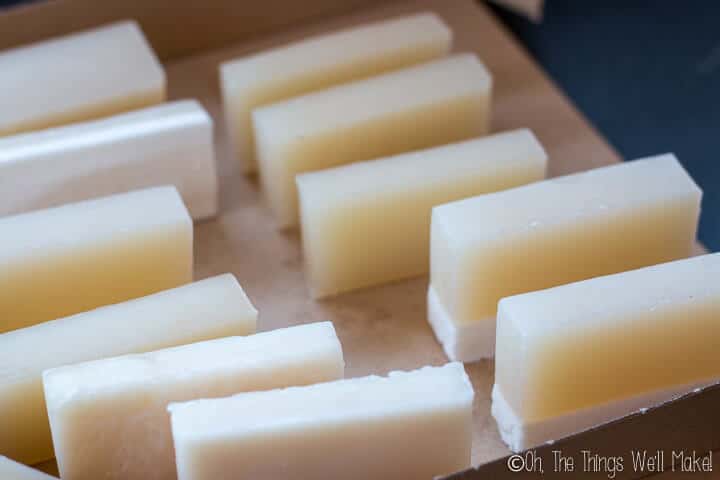
- Allow your soap to cure and dry for several weeks. This is best done by separating the soaps to allow for air flow over them. It’s a good idea to rotate the soaps occasionally so that all sides dry at the same rate. The curing process will allow it to harden and finish any remaining chemical processes to make for a better soap.
My first experience making glycerin soap
The first time I tried to make a glycerin soap, I decided to try using a new wooden soap mold for my newly made soap. I should have experimented with a soap that was easier and quicker to make like my easy, beginner soap.
What happened?
The mold began to leak, and I ended up with my soap solution all over the counter. I scraped up some of it, and tried pouring it into another mold, but by that point I had a lot of parts that were hardening up and floating in the melted soap mixture. I decided that I was going to use my immersion blender to smooth out the mixture before pouring it back into the other mold.
The result?
Because I didn’t let the mixture settle again, I ended up with a more cloudy soap. The soap started to settle on its own leaving a clearer, harder bar of soap on the bottom, and a foamier, opaque soap on top.
What did I learn?
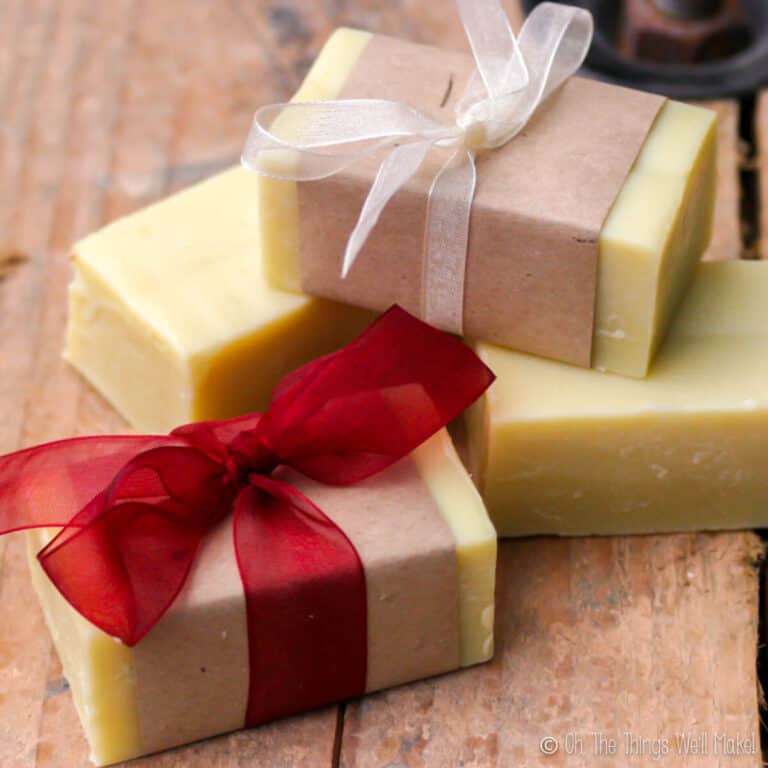
It’s just as important to be careful how you handle the soap when pouring into the molds. You want to be gentle and not incorporate a lot of air into the mixture. That is, unless you are going for this lemon merengue pie look to your soap! (I have to admit that it is kind of cool. The foamy layer is very soft, and almost like a marshmallow.)
Making a loofah soap
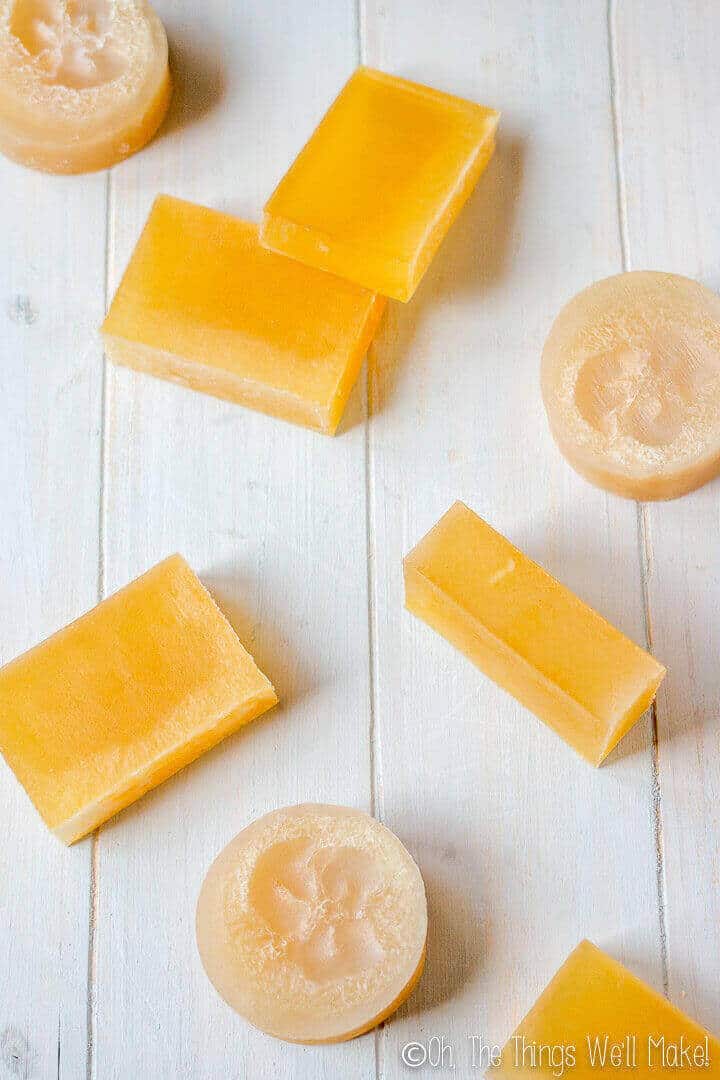
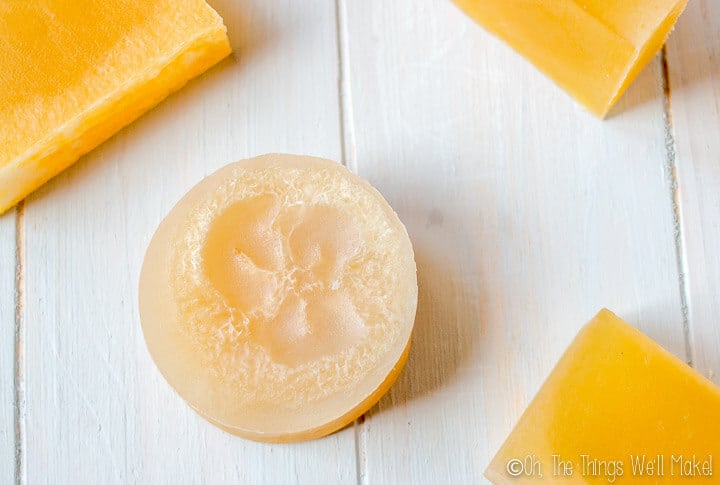
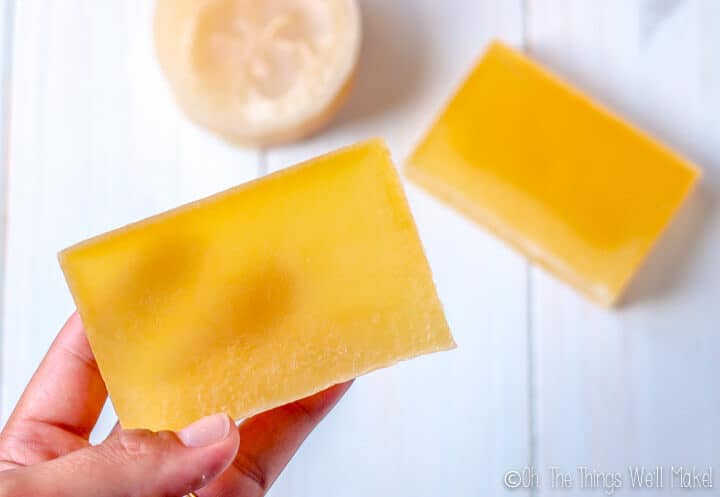
I decided to use the translucency of this soap to my advantage, and made loofah soaps. The loofah serves as a gentle, natural exfoliant for bathing.
To make a loofah soap, you can use PVC piping as your soap mold. If you have a PVC pipe cap, you can seal off one end with one of those. If not, you can seal off the end with some heavy plastic and rubber bands.
Add the loofah to the pvc pipe and weigh it down with something. (I used a spoon.)
Once in place, gently pour the soap into the pipe over the loofah.
When the soap has hardened, the easiest way to pull the soap from the mold is to put the pipe into the freezer for at least half an hour. Not only will this help solidify the soap, but it will slightly reduce its size long enough to help you push the soap out of the mold.
Carefully cut the soap into round bars and allow them to cure like you would any other bar of soap.
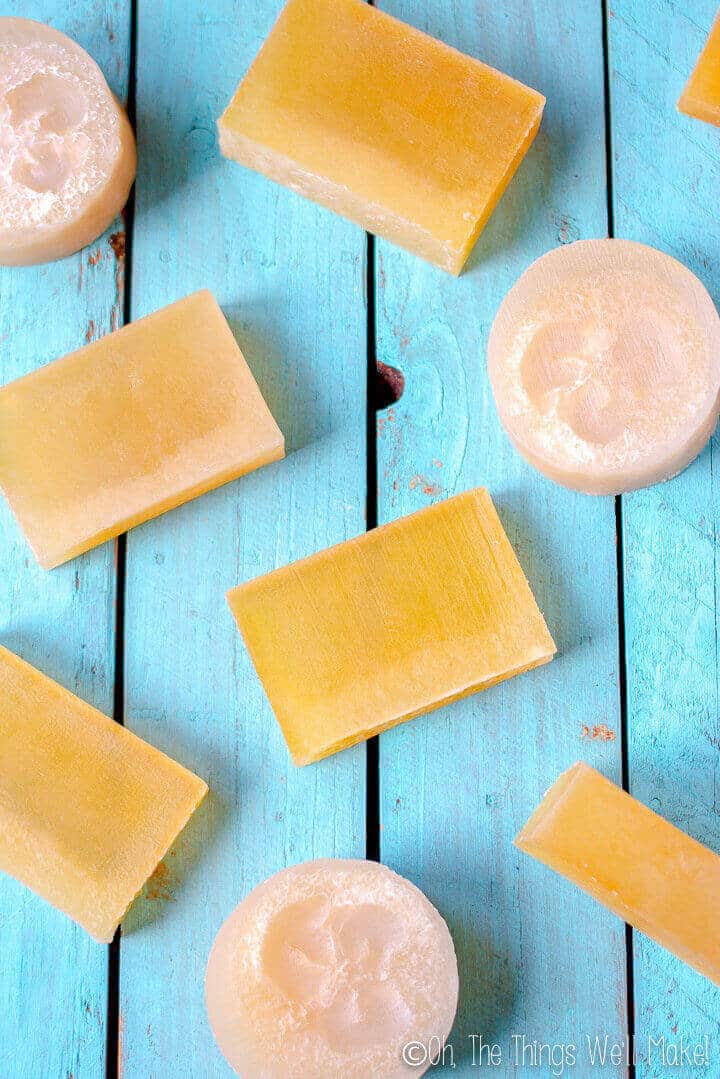
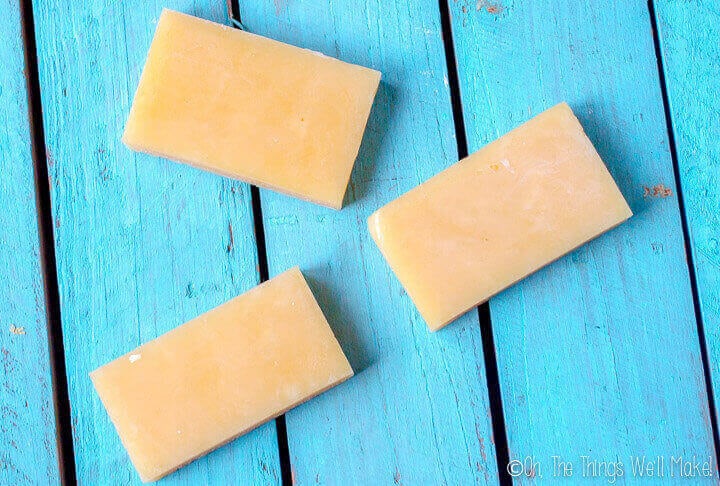
I’m sure somebody will ask me why the loofah soaps stayed white, while the other soaps turned yellow after during the curing process…
I wish I had an answer. I will say that they were from the same batch, and I didn’t add any colorants or any different ingredients to one versus the other. I poured the bar soaps first, and then filled up the pvc mold for the loofah soaps. If anybody has any ideas about why they aren’t the same color, I’d love to hear them!
can I Use lard instead of tallow
Hi Lenora,
Great question! You can use lard instead of tallow in this recipe, but it’s really important to run the recipe through a lye calculator anytime you swap oils. Even though tallow and lard are similar, their saponification values are slightly different, which means the amount of lye needed will change.
I actually have a couple of posts that walk you through this in more detail:
Why and How to Use a Lye Calculator (and Which Ones Are Best)
Best Oils for Soap Making
That said, I’ve made glycerin soap with both tallow and lard, and they both worked well. Tallow tends to make a slightly harder bar, but lard is usually easier to find—and it still gives a lovely result. Just one note: in my experience, both versions eventually turned amber over time, so the oil swap didn’t make a big difference in color.
Hello, Tracy – I loved making the transparent soap with Everclear in the US. We now live in Spain and I am wondering whether Aguardiente would be an equivalent to buy. Thanks!
Hi Angela,
Aguardiente can work if it’s a high-proof, plain alcohol (no sugar, no cream, no added flavors). The key is the alcohol percentage, because higher proof generally helps with translucency.
Look for something around 70% (or higher if you can find it). If it’s lower proof, it can still work, but it’s usually harder to get the soap as clear.
Thanks for sharing, I would love to make it. I use mainly tallow in RSA, easy to come by and render it myself. Absolute perfect for washing white clothes whiter and even perfect on skin to bath with. Makes a very hard soap bar that lasts long. I’ve learned to make soap via the internet a year ago after I went on pension and love every moment of it.
hi i have just got into soap making and come cross this lovely recipe and was waundering if i could change the sugar to honey or would it affect the clearness of the soap. thanks
Hi Charlie
Honey might work, but it may make the soap darker, and it can make it harder to get that translucent look.
If you want the clearest soap, stick with sugar. If you don’t mind it being more amber (and possibly a bit less clear), you can experiment with replacing part of the sugar with honey, but I’d start small.
Hi
Can you add honey vs the sugar or add half honey to incorporate this into the soap?
Hi Avril,
Honey might work, but it may make the soap darker, and it can make it harder to get that translucent look.
If you want the clearest soap, stick with sugar. If you don’t mind it being more amber (and possibly a bit less clear), you can experiment with replacing part of the sugar with honey, but I’d start small.
Hello,
I made soap using this recipe (had to sub some of the tallow with coconut oil as I didn’t have enough of the tallow) BUT used Everclear.
It turned out translucent and just the way I wanted.
Hi Sneha,
That’s great to hear. Everclear works really well for this because of the high alcohol content, so it usually helps produce a clearer soap. I’m glad it turned out the way you wanted!
Hello Tracy,
I had an epic fail with this recipe yesterday and am hoping you can help troubleshoot. I am experienced with cold process soap.
I used pig tallow (lard, from the grocery store that I use in other soap recipes) and all went fine through getting the full gel phase. The wheels came off when I added the mixture of vodka (80 proof) and vegetable glycerin (99.7% food grade): it seized. I was able to massage in those solvents by hand, but the mass remained very stiff and would not melt.
To get to the gel phase of the hot process part of the recipe, I used a stainless steel pot in a water bath set to 160F. That mixture looked like your video: translucent and soft (stirred easily). I took the pot out of the water bath to add the solvents; could that have been the issue? Or did I need to use beef tallow instead of pig? I did check the lye calculator for your recipe with lard and it seemed fine.
Like you have mentioned was your original goal, I am after a bar of soap with good lather and don’t need it to be super clear. Your final product pictures are perfect for me, if I could only get there 😉
Hi Heather,
My guess is that the vodka is the main issue. At 80 proof it’s only about 40% alcohol, and this process usually needs a much stronger alcohol to help dissolve the soap crystals. With lower-proof alcohol the mixture can seize or stay stiff instead of dissolving smoothly.
Substituting lard for beef tallow shouldn’t cause that kind of problem. They behave very similarly in soap. It’s always best to run substitutions through a lye calculator, but that change alone wouldn’t normally cause the soap to seize like that.
Temperature can also play a role. If the soap cools too much before adding the solvents, they won’t incorporate as easily. Keeping the soap hot while mixing them in usually helps.
If you try again, I’d suggest using a much higher-proof alcohol and keeping the soap warm when adding the solvents. That should give you a much smoother result.
My family, customers, and I LOVE THIS SOAP! The compliments just keep coming in from customers and the people they have given the soap to as gifts. It has gotten rid of very dry skin and dry scabs, leaving their skin very soft and smooth.
I’m so happy to hear that, Adrienne!
It’s one of my favorites too!
I’m no genius, but I think that if the foamy part of the rectangular soap was mixed with the harder, darker part of the soap, then the color would balance out to the same color as the loofah soap.
Hi Shaneka,
Yep, that’s very possible. The foamy top has a lot of tiny bubbles, which makes it look lighter. If you mix it into the clearer portion, the color usually looks more even overall.
i make my glycerine soaps I buy different 1kg of soaps
and I started of very small and my patient love the rooibos soap my boss’s wife bought three Shea butter three strawberry and three rooibos soaps today
my sister bought ten black African glycerine soap with shea butter so yes I also do not buy soap in shops now we making it.
just want to learn more on how to use dry lemon and things like that on my soaps thank you I love your article
Bonita South Africa
Hi Bonita,
That’s awesome, and I’m glad your soaps are going over so well. 😊
For dried lemon and other botanicals, the biggest issue is discoloration, scratchiness, and bits going brown over time. A few easy options:
Infuse lemon zest in an oil first, then strain and use the infused oil for scent/“lemon vibe” without gritty pieces.
Use very finely ground powders (and keep the amount low).
Or add the dried pieces mostly on top for decoration instead of mixed throughout the bar.
I have vodka, and alcohol ethanol 70 and 95 degrees, what is better to use in the glycerin soap recipe?
Hi Sami,
Most people say that to get a clearer soap, the higher the percentage, the better. I haven’t experimented that much with it, but I think I have used both and personally didn’t notice a huge difference either way.
Hi. My 10 year old daughter has a small hobby soap making business. She started off with a diy starter kit melt and pour that she was gifted on her 9th birthday. When she discovered what melt and pour is made from she cringed, and asked if we could not make our own that’s more natural and nature friendly. So we embarked on a learning adventure. she now, (with my help for safety reasons), makes her own natural translucent Glycerine soap that she colours and scents with essential oils. So my advice regards the translucency is the higher the grade and percentage of alcohol used the more translucent it will be. Also use on the higher amount range. Tallow almost always gives soap a slight yellowy colour. So add Titanium Dioxide to your oils when starting the initial soap making process. your outcomes will be a whiter soap if your going with an opaque soap. Also use kidney fat for soap making as it’s a whiter fat and when rendering make sure to keep “washing” your fat until it’s white.
Hi Chantell,
I love that you’re doing this together, and that you’re keeping the lye steps as the “grown-up only” part. ❤️
And yes, higher-proof alcohol really does make a difference for translucency. Also, you’re right that different animal fats can change the final color. Thanks for sharing what’s worked for you!
I am trying to make glycerin transparent soaps, as I see up in your recipe, you have tallow, I prefer using vegan ingredients, can I replace tallow to sustainable palm butter, cacao butter, shea butter or simply increase the coconut butter? And please I have a request: how to make shampoo and conditioner soap bars, and face serum base recipe, thanks 🙏🏻
I have a vegan glycerin soap up on the recipe!
hi. trying my hand at the glycerine soap but have ended up with a soft sort of mush. the hot process bit seems fine and then I added the alcohol and glycerine. then about 1/2 hrs later added my sugar water. can I recook it to make some evaporate or is it just a smushy soap now? should I leave the alcohol linger before adding the sugar? help. 🙂 😀
Hello,
Yes, you can try re-cooking it with the lid off for a bit to let some solvent/water evaporate and see if it firms up.
A few things that often cause the “smushy” texture:
Too much total solvent (or measuring by volume instead of weight).
Not keeping it covered well, so alcohol evaporates early (then you’re left with extra water/glycerin without the alcohol doing its job).
Pouring before it has time to fully dissolve/smooth out.
Next time, I’d keep it tightly covered during the alcohol/glycerin step and give it a little more time before adding the sugar syrup, especially if you still have chunks.